




Abstract

Introduction
The High Throughput Biology department at GlaxoSmithKline is developing predictive in vitro models to better predict the efficacy of compounds in the clinic. The task for the automation team was to integrate high throughput methodologies to develop an automation strategy that was robust, flexible and scaleable based on the specific science of the assay and required throughput. We have developed a work-cell approach to automation that combines standard off-the-shelf bench-top automation units and larger integrated automation systems into individual task-targeted work-cells. The work-cells are broken down into three distinct groups consisting of bench-top single-step, bench-top multi-step, and assay workstation automation. During the last six months, we have deployed a variety of work-cells that allow the scientist to automate tasks based on the biology and throughput requirements of the assay. This poster describes the individual work-cells and their applications.
PROBLEM
The Capabilities Development Team (CDT) within High Throughput Biology provides services specializing in the implementation of new and novel technologies aimed at improving efficiency, safety, and throughput of the department.
The initial challenge for the CDT was to create, deploy, and support automation used for cell-based assay development and production within the department. The assays would range in scope from simple ELISA's to more complicated multi-day cell-based assays.
APPROACH
The CDT created a Work-cell based strategy. Work-cell automation combines standard off-the-shelf bench-top automation devices into task-targeted automation systems, i.e. adding a series of reagents to multiple plates. When multiple bench-top devices are integrated into a larger system, scheduling software (static or dynamic) is used to link the individual components.
Properties of Work-cell automation
Robust due to redundancy
Flexible, i.e. new technologies added with low impact
Parallel operation
Scaleable for higher throughput
Low cost per system
Bench-Top Single-Step
PROBLEM
Provide stand alone automation that addresses the most common laboratory operations such as reagent addition, plate washing, and liquid pipetting.
SOLUTION
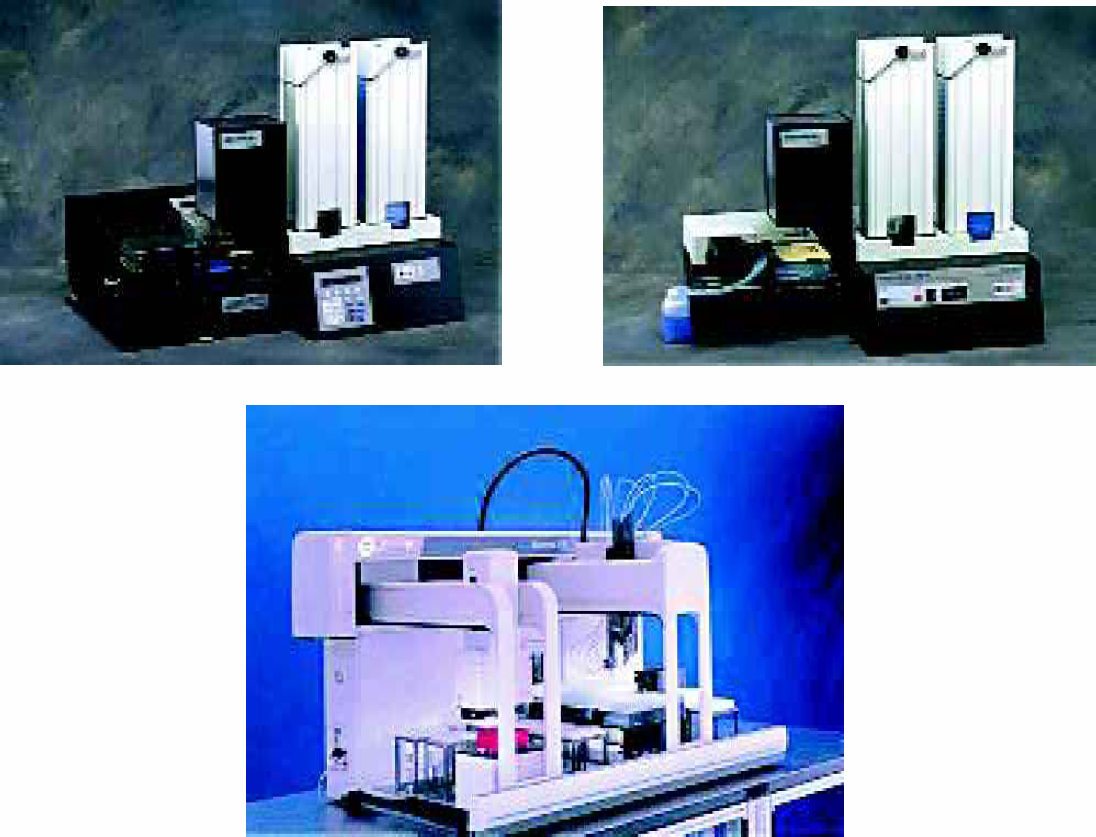
We currently have a variety of instruments, most with stackers and auxiliary arms for increasing throughput (Figure 1).
Biomek® FX (dual arm 96 / Span-8)
Titertek Multidrop with Titertek Stacker
Bio-Tek® EL-405 Washer with Titertek Stacker
Zymark RapidPlate®
Bench-Top Multi-Step
PROBLEM
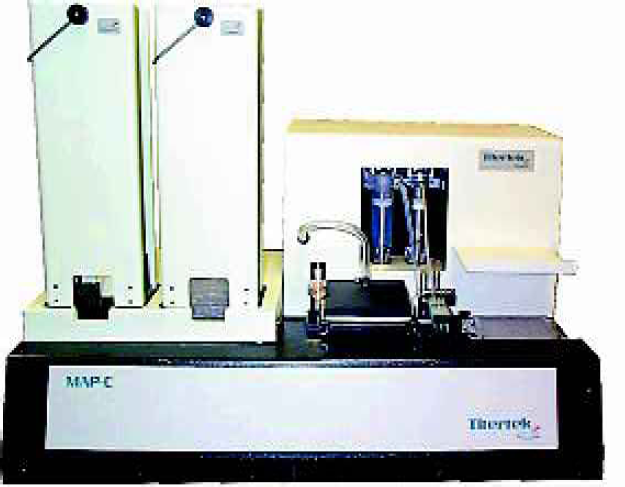
Link the most common steps in a majority of the cell-based assays on a small work-cell that lends itself to duplication and parallel operation. The steps linked are “Wash”, “Add Reagent”, and “Wait/Incubate.”
SOLUTION
Titertek Map-C (Figure 2).
We currently have two systems running in parallel with an additional system to be purchased in 2003. Each system can accommodate up to 20 96-well plates per assay run.
The Map-C's run ELISA and cell-based assays for Cellomics® ArrayScan® detection.
Assay Workstations
PROBLEM
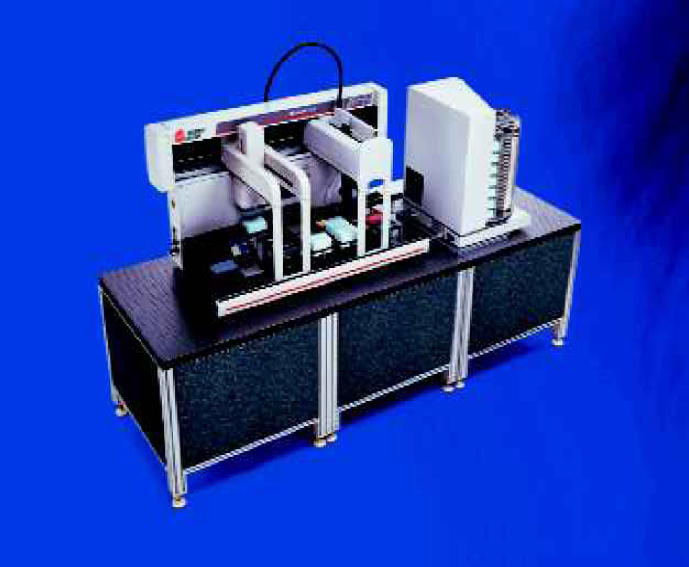
Provide more integrated solution for assays that require higher throughput, 37 degree incubation, and walk away capabilities.
SOLUTION
Beckman Assay Workstation (Figure 3).
We currently have two Assay Workstations. System One consists of a Biomek® FX, Bio-Tek EL-405 plate washer, Kendro Cytomat® MTP hotel, and ABgene® plate sealer. This system is used for assay development, assay production, and compound distribution.
System Two consists of a Biomek® FX, Bio-Tek EL-405 plate washer and Kendro Cytomat® Incubator. This system is used for assay development and assay production.
Detector Technology
PROBLEM
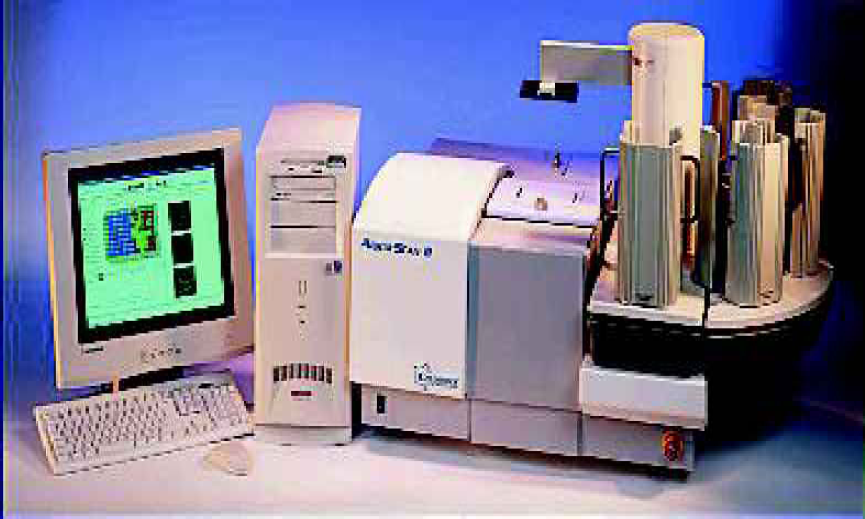
Measure complex cellular responses of numerous whole cells in parallel.
SOLUTION
Cellomics® ArrayScan® HCS system (Figure 4). HTB currently has three Cellomics® ArrayScan® HCS systems worldwide. We are using the following algorithms.
Cytoplasm Nucleus Translocation
Mitotic Index
Acquire only
General screen application
Cell Viability
Receptor Internalization
A Look to the Future
Matrix information will be presented at future conferences in 2003 describing the individual work-cells and their specific applications. Our team will also be addressing automation in terms of assay miniaturization with 384 well cell-based assays and micro-fluidics. We also plan to address the following issues.
PROBLEMS
Increasing efficiency and throughput by providing 24/7 capabilities
Deploying sample tracking capabilities between automated systems
Building automation expertise within the department
Evaluating of Kinetics Reader technology
Acknowledgments
Jay Gill
Renae Crosby
Sue Neill
Deirdre Luttrell
Jennifer Johnson
Mi Xiu
Matt Kostura