




Abstract

Clinical governance — the driving force
Clinical governance as a distinct entity has largely been developed within the UK's National Health Service (NHS), but it is a concept that any organisation providing health care, be it to humans or to cats, must surely aspire to (see left).
Clinical governance
‘A framework through which (NHS) organisations are accountable for continually improving the quality of their services and safeguarding high standards of care by creating an environment in which excellence in clinical care will flourish.’ 1
In essence, clinical governance is a system for improving the standard of clinical practice. It is about looking at one's own practice, considering how it might be improved, and then implementing changes and finding out if those changes work. Ultimately, the aim is to create a ‘whole system’ culture that provides the organisation with the means to deliver sustainable, accountable, patient-focused, quality-assured clinical care.
Component processes
So, what does improving quality and ensuring that professionals are accountable for their practice necessitate? There is some variation in the precise detail, but broadly the processes include:
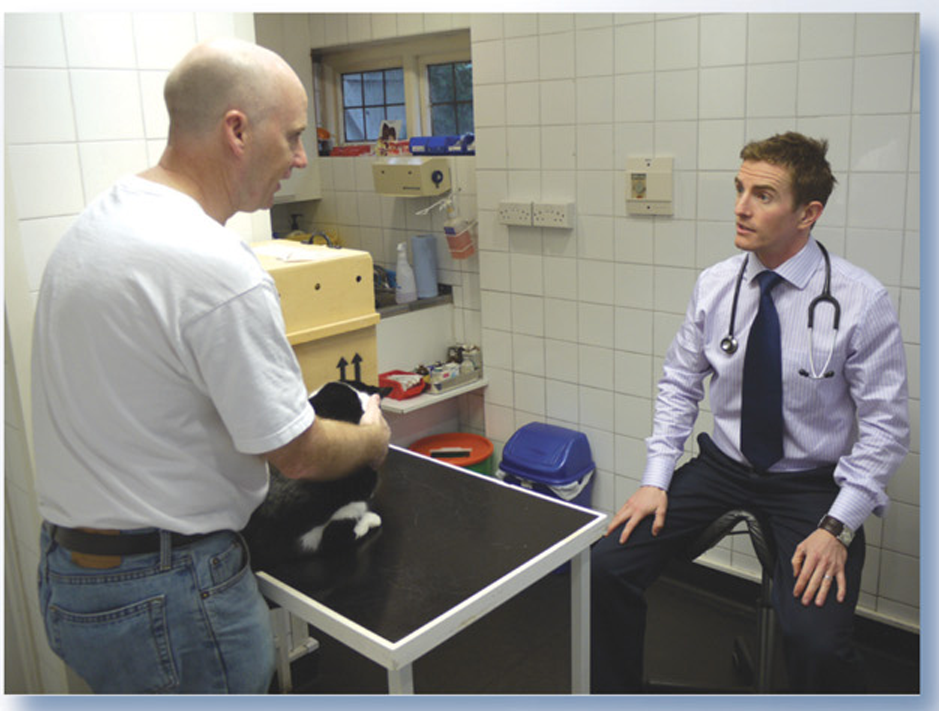
Effective communication of the evidence base helps clients to make informed decisions and avoid unrealistic expectations
Clinical audit cycle
‘The clinical audit cycle is a quality improvement process in clinical practice that seeks to establish guidelines for dealing with particular problems, based on documented evidence when it is available, measuring the effectiveness of these guidelines once they have been put into effect, and modifying them as appropriate. It should be an ongoing upwards spiral of appraisal and improvement.’ 4
A review in 2002 of the application of clinical governance to medical primary care concluded: ‘The experience of implementing clinical governance has been broadly positive to date.’ 3
Clinical effectiveness and clinical audit in context
Clinical effectiveness is a process whereby practices can systematically promote (and be seen to be promoting) good clinical care. Although defined in terms of patient care (see above), obviously in veterinary practice we need to consider the extra dimension of the requirements of the owner as well as the patient itself, and in some instances these may need to be balanced again one another.
Clinical audit is a method of measuring clinical effectiveness and, as such, is an important component. Of more practical relevance, though, is the ‘clinical audit cycle’ (see right), which is a means by which the measurement of clinical outcomes can be used to bring about an ongoing process of clinical improvement.
Clinical effectiveness — a medical definition
‘The application of the best available knowledge, derived from research, clinical experience and patient preferences, to achieve optimum processes and outcomes of care for patients.’ 2
In simple terms, it is possible to think of clinical effectiveness as a major element of clinical governance, and in turn of clinical audit as one of the tools used to enhance clinical effectiveness (Fig 2).

Clinical effectiveness is an important component of clinical governance and, in turn, incorporates clinical audit as a tool
Clinical effectiveness — what tools can the team use?
Improving clinical effectiveness requires a multifaceted approach to encourage excellence, and many different tools have been used including peer review, clinical incident review, surveys, benchmarking, clinical guidelines and the clinical audit cycle.
Peer review
Peer review involves an evaluation of the quality of care provided by a clinical team with a view to improving clinical care. Regular practice meetings to review interesting or unusual cases, and/or carry out morbidity and mortality assessments, are an example of how peer review can be incorporated into practice.
Critical incident review
A critical incident review is formalised peer review used in specific cases that have caused concern or for which there was an unexpected outcome (eg, an anaesthetic death in a patient that was considered to have been at low risk). Discussion and reflection should enable the team to learn from what has happened and to improve in future, but it is important that this can take place in a no-blame environment where all team members feel free to open up about what took place.
Client surveys and focus groups
Surveys and focus groups can be used to obtain users' views about the quality of care they have received and thus inform the manner in which clinical care is provided and the areas where there is most room for improvement.
Benchmarking
Benchmarking may be internal (ie, comparison within a practice or group), or external, involving comparison with similar practices or against an externally set ‘gold standard’. Benchmarks relating to postoperative complications in cats (and dogs) following routine neutering are now available to veterinary practitioners at www.vetaudit.co.uk.
Clinical guidelines — a convenient medium for the busy practitioner
Clinical guidelines can be defined as systematically developed statements to assist practitioner and client decisions about appropriate health care for patients in specific clinical circumstances and, therefore, enhance clinical effectiveness. The term ‘clinical protocol’ is sometimes used synonymously, although it can suggest a more rigid set of rules that the clinician is obliged to follow. In some instances, such as when the circumstances are very clearly defined and the consequences of not following specific instructions are potentially dire, the rigid application of protocols may be more appropriate than the assistance that guidelines can offer.
The use of clinical guidelines is extremely widespread in the medical profession around the world, as they are seen as having a number of benefits:
They can assist the application of evidence-based best practice to individual patients;
They help to provide a uniform standard of care;
They can be used in the education and training of health professionals;
They can help patients (clients) to make informed decisions by improving communications and managing expectations;
They can incorporate a cost/benefit analysis of diagnostic and treatment options.
Despite these advantages, medical clinical guidelines do have their antagonists. There are fears that they may be imposed by health authorities or medical insurance companies as cost-cutting exercises and thus restrict access to potentially useful treatments; that they may interfere with the clinical freedom of doctors; and, potentially, could be used against the medical profession in litigation and therefore increase defensive medicine.
Medical clinical guidelines are only one source of information available to the clinician, and are not suitable for every clinical situation. 5 In practice, they have not undermined the clinical judgement of doctors and, even where guidelines are laid down as a legal standard, courts still require sensible discretion to be used in applying them. 6
Examples of guidelines
A series of 26 protocols, written by the Feline Advisory Bureau's feline expert panel, and covering a wide range of clinical topics, such as anaemia, FLUTD, hyperthyroidism, blood pressure measurement and mycobacterial infections, is available from the International Society of Feline Medicine (www.isfm.net)

The European Advisory Board on Cat Diseases has issued guidelines on feline panleukopenia, feline herpesvirus infection, feline calicivirus infection, feline leukaemia (FeLV infection), feline immunodeficiency (FIV infection), feline infectious peritonitis, rabies, avian influenza, Chlamydophila felis and Bordetella bronchiseptica infections in cats. A synopsis of these was published in a special issue of this journal in July 2009. The main recommendations of the guidelines are also contained in a collection of fact sheets, available online in 18 languages at www.abcd-vets.org/factsheet/index.asp

The American Association of Feline Practitioners publishes guidelines for practice excellence, available at www.catvets.com/professionals/guidelines/publications. Among the subjects covered are feline life stages, senior care, zoonoses, feline behaviour, and retrovirus management and testing

Three key features differentiate guidelines from general clinical advice such as may be given in veterinary texts:
They involve an explicit attempt to systematically review the literature on the subject in question for the best available evidence.
They represent a consensus in the setting in which they are prepared, rather than the opinion of an individual. This may be a panel of experts if they are nationally developed guidelines, or a team of clinical staff if they are guidelines being written or adapted for local use.
The information is presented in summary form, often as a series of bullet points, so as to be readily accessible in a clinical situation.

Currently few nationally developed clinical guidelines exist within the veterinary field, but feline practice is actually relatively well endowed. Those, such as the International Society of Feline Medicine's (ISFM's) clinical protocols, the European Advisory Board on Cat Diseases' guidelines on infectious diseases and the American Association of Feline Practitioners' (AAFP's) guidelines (see box on page 563), as well as veterinary guidelines drawn up by the American Animal Hospital Association (www.aahanet.org/resources/guidelines.aspx), cover various aspects of feline/small animal medicine and practice. And in this very issue of J Feline Med Surg appears a new set of joint guidelines from the ISFM and AAFP on long-term NSAID use.
ISFM and AAFP consensus guidelines on long-term use of NSAIDs in cats
Guidelines to encourage more widespread and appropriate use of NSAIDs in cats that would benefit from treatment are published on pages of 521–538 of this issue of J Feline Med Surg, and at: doi:10.1016/j.jfms.2010.05.004
While not the only way of communicating the findings of evidence-based veterinary medicine (EBVM), guidelines represent a convenient and accessible medium for the busy practitioner and are a useful starting point for practice discussion. It is likely that they will become more widely used in the veterinary profession in the future. Where guidelines are not already available, practitioners wishing to utilise them either independently or as part of the clinical audit process will often need to formulate them locally. In these instances, it falls upon the clinical team to follow the principles of EBVM.
EBVM and best practice
Evidence-based veterinary medicine is a discipline in its own right, and anyone with an interest in the subject is strongly advised to consult a dedicated text on the subject (eg, Cockcroft and Holmes' handbook). 7 The process of grading the evidence has previously been outlined in an editorial in this journal. 8 Within human medicine the best available knowledge has become synonymous with evidence based largely on randomised controlled trials, meta-analyses and systematic reviews. However, in veterinary practice we need to consider a broader range of evidence as these types of evidence are in short supply (see box above).
EBVM involves a five-stage process:
— The patient or problem being addressed;
— The intervention being considered;
— A comparison intervention (or control);
— The clinical outcome.
The aim is to establish what constitutes ‘best practice’ for the management of a particular condition under certain circumstances.
Suitable for audit?
The areas of clinical veterinary practice that are most suited to being audited are:
Amenable to measurement
Commonly encountered
Have room for improvement in performance
Financially significant to the practice and/or animal owner
Best practice is often defined in terms of a local clinical setting where, in addition to any relevant evidence from research, the available skills and resources as well as individual clinician preferences are taken into account in delivering what is considered optimal for the patient in that context. As discussed earlier, best practice may be expressed in terms of a set of clinical guidelines for the condition in question. However, it is important to emphasise that any definition of best practice needs to be interpreted in the light of clinical experience in order to address the primary clinical concern of what is best for the patient at hand.
Clinical audit cycle — what is involved and what are the issues?
Clinical audit is the collecting and recording of clinical information with the aim of monitoring the quality of care. As purely a process of measurement it has limited value, although it can play a role in benchmarking the performance of one practice against another for the purposes of quality assurance. What is of potentially much more value is the clinical audit cycle, as defined earlier, because it can be used as a management tool to improve clinical performance.
A detailed explanation of the process is provided elsewhere. 9 For the purpose of this article, the key components of the clinical audit cycle — which are best visualised as a positive feedback loop (see below) — are:
— Selecting an area to audit;
— Considering your objectives for the audit;
— Making sure that you are able to record and retrieve information;
— Involving the team in the process, which includes developing a culture in which problems and differences of opinion can be freely discussed (Fig 4).
— Compare results with targets;
— Review and discuss how improvements could be made;
— Implement changes;
— Re-audit.
An example of the audit cycle being put into action is given on page 567.
Considerations for the practice
While carrying out clinical audit within the practice does not raise the same ethical dilemmas as practice-based research (Table 1), there are undoubtedly some barriers, as well as manifold benefits, to audit, as highlighted in the box on page 566. There are also a number of more general issues that warrant consideration, as outlined below.
Distinctions between audit and research

Clinical audit cycle

Clinical audit does require an environment in which problems and departures from best practice can be freely discussed. In the past, the veterinary (and human) medical professions have shied away from the discussion of problems and the public may still not be ready to accept that performance in health care can be anything other than optimal. However ‘near miss’ reporting is now accepted practice in air traffic control, where problems are considered as a starting point for improving future performance. Therefore, to improve our clinical effectiveness it is necessary that we as a profession take an honest look at our performance and use problems as an opportunity to learn.

Improving clinical effectiveness in practice requires developing a culture in which problems and differences of opinion can be freely discussed within the team
Interpretation of audit data
Statistical significance is important in a scientific experiment, which has to be designed with this in mind. A control group has to be formed; the numbers involved have to be large enough to be statistically significant; and ideally there will be some form of blinding to minimise bias. Trying to design an audit along these lines will usually result in failure and thus data that is generated by an audit should be viewed rather differently. If treated as scientific data, and the standard tests applied, it is usually very difficult to measure a statistically significant difference between outcomes before and after any changes were implemented. However, if the data are viewed as performance indicators, and investigated qualitatively in more depth where appropriate, they can be used as a logical basis for action. This is similar to using practice financial trends to guide commercial decisions. In other words, audit data cannot be ‘proven’ to be scientifically valid, and thus generalisable, but they can be used sensibly to guide our actions in an informed manner.
Audit — benefits and barriers
Benefits of audit
Audit helps establish, firstly, what the practice is doing and, secondly, that what is being done is acceptable
It is a basis for improving clinical effectiveness
It improves job satisfaction
It helps standardise care throughout the practice
It increases public confidence in the profession as a whole and in individual practice procedures
It may fulfil the requirements of any national or local practice standard schemes
It assists in creating a positive culture within the clinical team
It is a management tool with the potential to increase practice income
If we don't do it, it might be imposed on us externally
Barriers to audit
Time — it takes time and effort to set up an audit
Manpower — staff may be taken away from other activities
Technology — while there is no reason why an audit cannot be done with pen and paper it is more frequently carried out using computerised data
Skills — lack of appropriate training
Fear — feeling of loss of control among clinical staff
Money — although there may also be cost/benefits (see text)
Avoiding pitfalls
Case study

When they reconvene they agree that the audit will be restricted to cats suffering from one of three conditions: chronic nephritis, hyperthyroidism or cardiomyopathy. They also agree that they will use the evidence they have gathered to draw up information sheets for clients, stressing the importance of regular blood pressure monitoring for at-risk cats, and guidelines for the practice team, outlining how such cases should be handled. There is a discussion as to whether the criterion to be measured should be the number of animals that have their blood pressure measured, or simply the number of blood pressure measurements performed, over a period of time. As it is a simple matter to pull out the product ‘blood pressure measurement’ using the practice management software, it is decided simply to measure any increase in the absolute numbers being performed over a 2-month period.
Within the practice, preparation for an audit, including the production of guidelines, should provide the opportunity for discussion of different viewpoints and a review of the evidence. This is within the context that individual clinicians remain responsible for the clinical care of their patients and are required to exercise judgement in their application.
The aim of clinical audit is to improve clinical effectiveness throughout the practice, but the audit data that is gathered may potentially reveal significant differences between individual clinicians. Some thought should be given as to how the issues raised by this will be handled.
And what if results of an audit reveal failure to achieve targets for best practice? While there are few ethical problems with trying to improve performance, there may be ethical implications in continuing to follow procedures that fail to meet expected targets.
There may also be issues about how collected data should be used. The lack of statistical significance of clinical audit data has already been mentioned, and extreme care should be taken in drawing comparisons between practices on the basis of audit. There may be benefits to the profession in organised collation of clinical audit data, to enable practices to benchmark their own performance, but this will raise issues of confidentiality and the possibility of ‘league tables’ being created that compare practices. Great care then needs to be taken to ensure that like is compared with like.
KEY POINTS