




Abstract

To the Editor:
Scorpion envenomation treatment in the Middle East is often controversial due to challenges in identifying responsible species, limited evidence for safety and efficacy of available antivenoms, and lack of practical guidelines for management. It can be especially challenging for military clinicians who must make decisions regarding evacuation after a sting has occurred. Medical personnel treating civilian and military patients may benefit from having a pragmatic approach to scorpionism in the Middle East.
Medically important scorpions in the Middle East include Leiurus quinquestriatus, Androctonus genus, and Hemiscorpius lepturus. L quinquestriatus, also known as the deathstalker, Saudi yellow scorpion, and Palestinian yellow scorpion, belongs to the Buthidae family. Fat tail scorpion is the common name for scorpions of the genus Androctonus, also of the Buthidae family. 1 This scorpion is known for having a distinctive thick tail, although coloration can vary, underscoring the idea that accurately identifying scorpion species by visualization is difficult. 2 H lepturus, on the other hand, belongs to the Hemiscorpidae family and is a very poisonous scorpion found in Iran and nearby countries with a high mortality rate.1,3
Scorpion venoms contain a mixture of peptide toxins that target ion channels and can cause neurotoxic and hemotoxic symptoms in humans. 4 These symptoms can be severe when a sufficient dose of venom is injected relative to the victim’s mass, which explains why the fatality rate is 10 times higher in children than in adults. 5 Many stings lead to local findings only, such as that displayed in Figure 1.
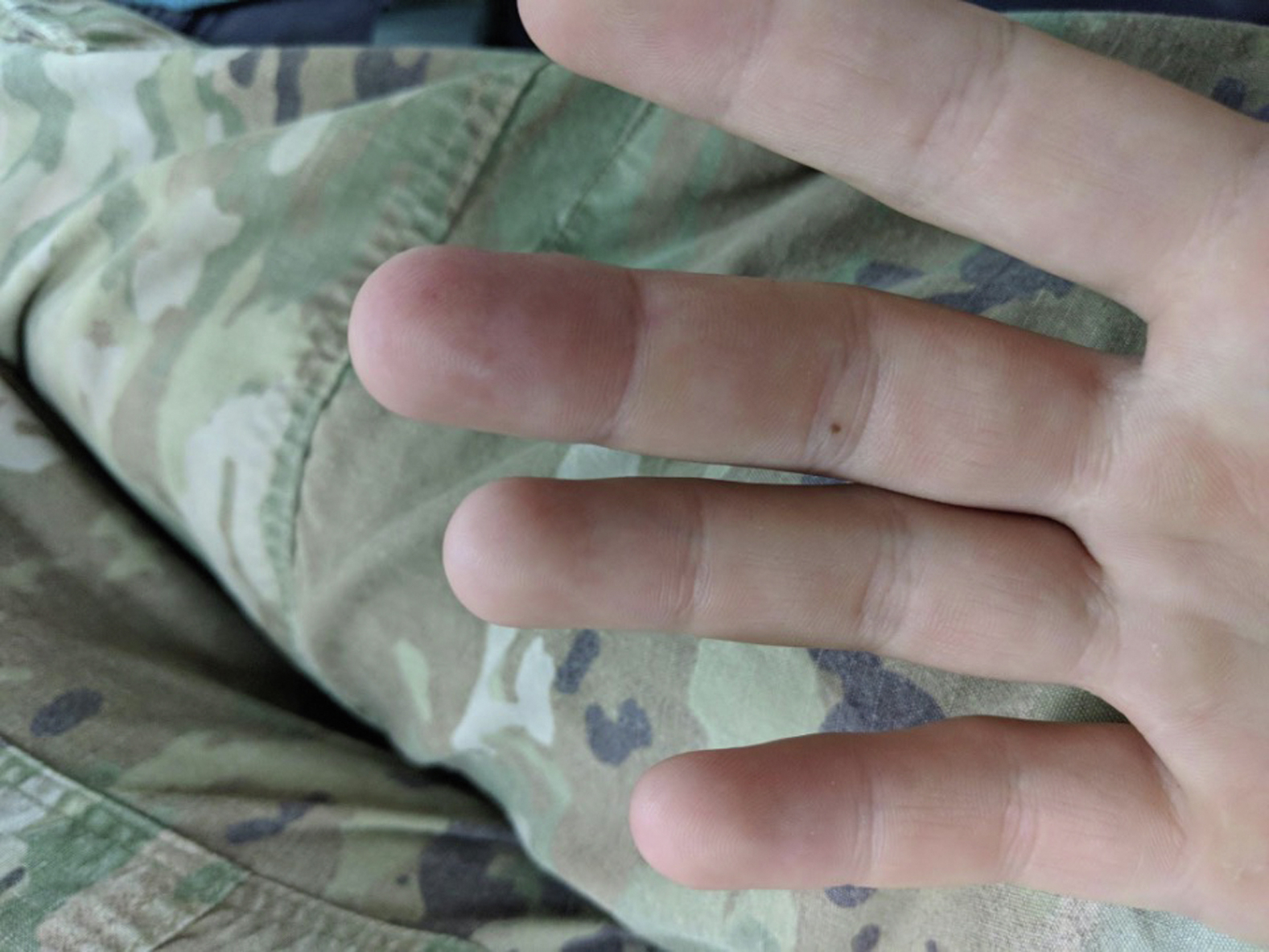
Local erythema and edema of the distal phalanx of the third digit from a Middle Eastern scorpion sting. A 22-y-old male US military service member was on guard duty in the desert in Kuwait. He felt something on his neck and swatted at it, resulting in a sting on his right middle finger. The species of scorpion was not identified by military personnel with entomology qualifications. The patient was observed only and did not receive antivenom. The photo represents the typical appearance of a scorpion sting.
Systemic scorpion envenomation in the Middle East is characterized by overexcitation of the sympathetic, parasympathetic, and skeletal motor nervous systems. 1 Among the clinically important Middle Eastern scorpions, progression from a local to a systemic reaction can occur anywhere from a few minutes to 4 h after envenomation, taking up to 24 h with H lepturus. 6 Effects on the sympathetic nervous system may include tachycardia, hypertension, tachypnea, leukocytosis, and myocardial infarction. 1 Parasympathetic and skeletal motor nervous responses typically include tongue and muscle fasciculations, abdominal pain, gastric and pancreatic hypersecretion, nausea and vomiting, priapism, and occasionally, bradycardia. 1 Both L quinquestriatus (deathstalker) and Androctonus genus (fat tail) scorpions are associated more with cardiotoxicity (typically tachycardia and hypertension) than with neurotoxicity. H lepturus envenomations produce fewer cardiotoxic and neurotoxic effects. They are atypical in that they are not painful and tend to be associated with cytotoxicity, disseminated intravascular coagulation, renal toxicity, and hemolysis.1,3 In fact, although H lepturus is responsible for between 10 and 25% of stings in its region, it is responsible for >70% of fatalities, making it more poisonous than other species in the area.3,6,7
There are multiple grading and treatment guidelines for scorpion envenomations, but they are designed for understanding scorpion envenomations globally.1,8 In reality, host nation protocols for scorpion envenomation treatment can vary by institution. Regardless, the mainstay of treatment for systemic symptoms in the Middle East is medical support, usually with prazosin and sometimes benzodiazepines, with the decision to administer antivenom being a difficult one. 6
Although scorpion identification is suggested for epidemiological surveillance, 9 it is difficult-to-impossible to definitively identify many scorpions in the field. There is no standardized scorpion collection process or centralized data repository to definitively map out the range of each scorpion. H lepturus has been most described in Iran and Iraq, whereas L quinquestriatus and Androctonus genera are most distributed throughout the Middle East and North Africa. Therefore, as a matter of practicality, it is necessary to defer to the local partners for information on what scorpions are present in that specific region. Fortunately, many Middle Eastern antivenoms are polyvalent, neutralizing the venoms of multiple species. 7 Choice of antivenom is usually determined by geographic location and availability. However, many polyvalent antivenoms do not cover H lepturus. When envenomation by this species is a possibility, potentially dependent upon the country in which the patient was stung, Polyvalent Scorpion Antivenom from the Razi Vaccine and Serum Research Institute in Iran is recommended.
According to the United States Joint Trauma System, patients stung by a scorpion should be monitored for up to 4 h for onset of systemic symptoms. 10 In the case of military envenomations, the potential need for medical evacuation should be relayed up the chain of command. Isolated local pain does not require evacuation. However, if systemic toxicity develops, the patient should be transferred to a setting where critical care services are available. While laboratory studies are not routinely recommended, in the case of systemic toxicity, complete blood count, electrolytes, renal studies, creatine phosphokinase, and cardiac enzyme levels should be obtained. Antivenom is recommended for systemic toxicity. Available evidence for safety and efficacy varies with each antivenom, so other supportive measures, such as analgesics, prazosin, and benzodiazepines, should be provided as needed. Patients must be monitored closely for a hypersensitivity reaction to antivenom. When H lepturus envenomation is a possibility, Iranian Polyvalent Scorpion Antivenom should be given at the earliest sign of systemic envenomation. In one study, 90% of deaths following H lepturus stings occurred in patients who received antivenom more than 12 h after the sting. 3
A single protocol for management of scorpionism in the Middle East is not possible due to differing clinical presentations, variety and quality of antivenoms available, and inconsistent local resources. However, we offer these general guidelines for assessment and management, which may be useful to military healthcare professionals in the Middle East.