




Abstract
Vascular cells provide a neural stem/progenitor cell (NSPC) niche that regulates expansion and differentiation of NSPCs within the germinal zones of the embryonic and adult brain under both physiologic and pathologic conditions. Here, we examined the NSPC—endothelial cell (NSPC/EC) interaction under conditions of ischemia, both in vitro and after intracerebral transplantation. In culture, embryonic mouse NSPCs supported capillary morphogenesis and protected ECs from cell death induced by serum starvation or by transient oxygen and glucose deprivation (OGD). Neural stem/progenitor cells constitutively expressed hypoxia-inducible factor 1α (HIF-1α) transcription factor and vascular endothelial growth factor (VEGF), both of which were increased approximately twofold after the exposure of NSPCs to OGD. The protective effects of NSPCs on ECs under conditions of serum starvation and hypoxia were blocked by pharmacological inhibitors of VEGF signaling, SU1498 and Flt-1-Fc. After intracerebral transplantation, NSPCs continued to express HIF-1α and VEGF, and promoted microvascular density after focal ischemia. These studies support a role for NSPCs in stabilization of vasculature during ischemia, mediated via HIF-1α-VEGF signaling pathways, and suggest therapeutic application of NSPCs to promote revascularization and repair after brain injury.
Introduction
The adult mammalian brain harbors two germinal centers that continuously give rise to new neurons throughout adulthood. These include the subgranular zone of the dentate gyrus, which gives rise to new dentate granule neurons, and the subventricular zone (SVZ) surrounding the lateral ventricles, which gives rise to new neurons within the adult olfactory bulb. Neural stem/progenitor cells (NSPCs) that reside within these germinal centers are self-renewing, mitotically active, and multipotent cells with the potential to become neurons, astrocytes, or oligodendrocytes (Gottlieb, 2002; Lim et al, 2007; Temple and Alvarez-Buylla, 1999).
Neural stem/progenitor cells within the adult brain germinal centers reside in a specialized microenvironmental niche, closely associated with blood vessels throughout life (Alvarez-Buylla and Lim, 2004; Doetsch, 2003; Palmer et al, 2000; Wurmser et al, 2004b). Reciprocal signaling between NSPCs and endothelial cells (ECs) within the microenvironmental niche is thought to regulate both neurogenic and angiogenic processes. Louissaint et al (2002) showed a causal interaction between angiogenesis and neurogenesis in the adult songbird brain, involving reciprocal vascular endothelial growth factor (VEGF) and brain-derived neurotrophic factor (BDNF) signaling. Palmer et al (2000) also provided compelling evidence that neurogenesis is associated with active vascular recruitment and remodeling in the adult mammalian brain, and that adult neurogenesis occurs within an angiogenic niche. In vitro studies have shown that brain ECs promote neurogenesis of both embryonic and adult NSPCs (Leventhal et al, 1999; Shen et al, 2004) and that NSPCs promote EC differentiation and vessel formation (Ford et al, 2006; Li et al, 2006). Thus, neurogenic and angiogenic processes appear to be coregulated under normal physiologic conditions.
Much research effort has recently been focused on understanding the neurogenic response to ischemic brain injury, which may play a role in regeneration and repair processes. Focal cerebral ischemia induced by middle cerebral artery occlusion (MCAO) stimulates increased proliferation of SVZ progenitors and massive migration SVZ-derived neuroblasts into the lesioned striatum in rodent. The neurogenic response is delayed and of long duration, such that the migration of neuroblasts does not peak until 1 to 2 weeks after injury and continues for several months (Arvidsson et al, 2002; Kokaia et al, 2006). Interestingly, the onset of the neurogenic response occurs concomitant with the angiogenic response to stroke, and is correlated with the onset of spontaneous improvements in behavioral deficits and cognitive function, even though the percentage of neuroblasts that survive to give rise to postmitotic neurons represents only an estimated 0.2% of lost neurons (Thored et al, 2006). Evidence suggests a functional association between neurogenic and angiogenic responses to stroke (Liu et al, 2007; Ohab et al, 2006; Yamashita et al, 2006). Blood vessels provide a physical substrate for neuroblast migration (Ohab et al, 2006; Yamashita et al, 2006), and both the neurogenic and angiogenic responses to stroke are governed by common growth factors and migratory cues (Ward and Lamanna, 2004). Several lines of evidence have led to the notion that angiogenesis stimulates the migration of neuroblasts after ischemic injury, but the converse may also be true, that is, that the neurogenic response is vasculotrophic, and thereby critical for the stabilization of new vasculature and successful revascularization after stroke.
In this study, we explore the NSPC/EC interactions in the context of ischemia. Neural stem/progenitor cells isolated from the embryonic mouse brain were studied for their ability to provide trophic support for ECs in culture, using a well-characterized in vitro oxygen and glucose deprivation (OGD) model. In addition, NSPCs were tested for their ability to provide vasculotrophic support after intracerebral transplantation into adult mice before the induction of transient focal ischemia by temporary MCAO. This study shows robust vasculotrophic effects of NSPCs in culture and after intracerebral transplantation, mediated via hypoxia-inducible factor (HIF)-regulated VEGF signaling. These findings may have important implications for the therapeutic use of stem cells to support revascularization after stroke injury, and underscore the potential importance of NSPC/EC signaling under conditions of ischemic injury.
Materials and methods
Cell Culture
Neural stem/progenitor cells: Neural stem/progenitor cells were established from the telencephalon of gestational day 14 mouse embryos of the C57BL/6-TgN (ACTβEGFP) strain (The Jackson Laboratory, Bar Harbor, ME, USA), which express enhanced green fluorescent protein (EGFP) under a β-actin transcriptional promoter (Okabe et al, 1997). After the removal of meninges, telencephalons were mechanically dissociated by trituration with a P-1000 pipetman in Hank's balanced salt solution (HBSS). After brief centrifugation (3 mins, 1,300 r.p.m.), the cells were resuspended in culture medium and plated into six-well poly-

Neural stem/progenitor cells support ECs morphogenesis and survival in serum-free conditions. Micrographs show ECs and NSPC/EC cocultures plated on Matrigel matrix. GFP-positive NSPCs are shown using the green channel. (
Brain endothelial cells: The bEnd.3 mouse brain endothelial cell line was obtained from the American Type Culture Collection (ATCC, Manassas, VA, USA) and expanded in DMEM culture medium (Gibco) containing 10% fetal bovine serum, 4 mmol/L
Direct neural stem/progenitor cell—endothelial cell coculture: Confluent brain ECs were trypsinized and plated at the density 2 times 104 cells per 12 mm diameter coverslip precoated with Matrigel matrix (growth factor reduced matrigel matrix without phenol red, BD Biosciences, San Jose, CA, USA). The ECs were cultured for 6 h in the EC culture medium. The medium was then removed and ECs were rinsed before coculturing with NSPCs. A total of 2 times 104 NSPCs were plated directly onto the EC cultures. Neural stem/progenitor cell and EC cocultures were grown in growth factor- and serum-free NSPC media to prevent the astrocytic differentiation of NSPCs. The NSPC/EC cocultures were analyzed after 3, 5, or 10 days using live cell microscopy and immunofluorescence staining.
Indirect neural stem/progenitor cell/endothelial cell coculture using transwells: Neural stem/progenitor cells were harvested by trypsinization, and plated on poly-
This coculture system allowed NSPCs and ECs to share the same growth medium, and allowed substances to freely diffuse through cell culture insert or cell strainer pores without physical contact between the two cell types.
Oxygen and Glucose Deprivation
Cell cultures were subjected to OGD injury as described previously (Wetzel et al, 2008). Cultures were placed in an anaerobic chamber (Coy Laboratories, Grass lake, MI, USA) containing a gas mixture of 5% H2, 5% CO2, and 85% N2 to obtain < 0.2% O2. Normal culture medium was replaced with deoxygenated, glucose-free Earle's Balanced Salt Solution (EBSS), and cells were exposed to glucose-free anaerobic conditions for 3 or 5 h at 37°C. Control cell cultures were placed in EBSS containing 25 mmol/L glucose and incubated under normal tissue culture conditions for the same period.
Endothelial Cell Morphogenesis Assay
Endothelial cells were trypsinized, and after centrifugation, resuspended in EC medium, containing 10% fetal bovine serum and plated at the density of 2 times 104 cells per 12 mm diameter glass coverslips precoated with Matrigel matrix. Six hours after plating, the ECs were either cocultured with NSPCs (see direct NSPC/EC cocultures above) or incubated with a growth factor-free NSPC-conditioned medium (NSPC-CM) (medium collected from NSPCs cultured for 3 days). When plated on Matrigel or collagen, ECs form cellular networks (mesh-like structures) and capillary tubes. In addition, for better EC visualization, immunofluorescence staining for endothelial marker CD31 was performed before analyses.
Endothelial cell morphogenesis was assessed under an inverted confocal microscope, and images were taken using LSM-META confocal imaging system. A total of 10 to 15 images per coverslip were taken systematically across the coverslips. The number and diameter of capillary-like structures were counted using LSM Image Browser. Statistical analysis was performed using GraphPad Prism software.
Immunocytochemistry
Cells were fixed with 4% paraformaldehyde solution and quenched with 50 mmol/L ammonium chloride. After permeabilization with 0.1% (v/v) Triton X-100 and blocking with 1% horse serum, cells were incubated with primary antibodies for 1 h followed by fluorophore-conjugated secondary antibodies for 40 to 60 mins at room temperature. The following antibodies were used: mouse monoclonal anti-nestin (1:1,000; BD Pharmingen, San Diego, CA, USA), mouse monoclonal (1:1,000) and rabbit polyclonal (1:500) anti-GFAP (Accurate Chemical & Scientific Corp., Westbury, NY, USA), goat polyclonal anti-doublecortin (1:300; Santa Cruz Biotechnology, Santa Cruz, CA, USA), mouse monoclonal anti-βIII tubulin/Tuj1 (1:300; Promega, Madison, WI, USA), Alexa Fluor-conjugated rat monoclonal anti-mouse CD106/VE-cadherin (1:300; BioLegend, San Diego, CA, USA), rat monoclonal anti-mouse CD31/PECAM-1 (platelet—endothelial cell adhesion molecule-1) (1:300; BD Biosciences), mouse monoclonal anti-VEGF (1:200; Abcam, Cambridge, MA, USA), and rabbit polyclonal anti-HIF-1α (1:300; Chemicon, Temecula, CA, USA). Secondary antibodies were used at a common dilution of 1:200, and included Cy3-conjugated goat anti-rabbit, FITC-conjugated goat anti-mouse, Cy3-conjugated donkey anti-goat, and Cy3-conjugated donkey anti-mouse (Jackson ImmunoResearch Laboratories, West Grove, PA, USA). 4',6-Diamidino-2-phenylindole (DAPI) staining was used for detection of nuclei.
Western Blot Analyses
The cells were scraped from the cell culture dishes and filter inserts either directly with 2 × SDS sample buffer, or in lysis buffer (250 μL per filter) containing 1% (vol/vol) Triton X-100, 150 mmol/L NaCl, 10 mmol/L Tris-HCl, pH 7.4, and a protease inhibitor cocktail. To ensure equal protein loading, the relative protein concentration in the samples (lysed with 1% Triton X-100 lysis buffer) was quantified according to absorbance at 280 nm. Protein loading was additionally confirmed by comparing actin immunoreactivity across lanes. The proteins were separated on 4 to 20% gradient Criterion precast gels (Bio-Rad, Hercules, CA, USA). A broad-range molecular weight calibration marker from 10,000 to 250,000 MW (Bio-Rad) was used as a standard. The proteins were transferred onto nitrocellulose membrane and identified using mouse monoclonal anti-VEGF (1:100; Abcam) and rabbit polyclonal anti-actin (1:1,000, Sigma, St Louis, MO, USA). Horseradish peroxidase-labeled secondary antibodies were obtained from Amersham Biosciences (Piscataway, NJ, USA) and used in dilution of 1:3,000. For HIF-1α detection, we used a biotinylated anti-HIF-1α antibody (200 ng/mL) provided in the Surveyor™ IC Intracellular HIF-1α immunoassay kit (R&D Systems, Minneapolis, MN, USA), followed by horseradish peroxidase-conjugated streptavidin (1:200). Incubation with both primary and secondary antibodies was performed for 1 h at room temperature.
MTT Colorimetric Cell Viability Assay
Cells were incubated with 0.5 mg/mL methyltetrazolium (MTT, Sigma) for 4 h at 37°C, and treated with 1:1 ethanol/DMSO (dimethyl sulfoxide) for 20 mins at room temperature. The ability of cells to convert MTT into purple formazan provides an indication of the mitochondrial integrity and activity, interpreted as a degree of cell viability. The optical density was measured at 570 nm (with background subtraction at 630 nm) using a microplate reader (Dynex Technologies, Chantilly, VA, USA). Absorbance at 570 nm is directly proportional to the number of viable cells. SU1498 was purchased from Calbiochem (San Diego, CA, USA) and used at concentrations of 5 to 20 μmol/L; Flt-1-Fc (Sigma) was used at a concentration of 30 ng/mL.
Vascular Endothelial Growth Factor and Hypoxia-Inducible Factor-1α Immunoassay
For VEGF immunoassay, conditioned medium was collected, filtered to remove cells and debris, and concentrated eightfold using iCON™ concentrator with 9K molecular weight cut-off (Pierce, Rockford, IL, USA) and centrifugation at 3,000g for 30 mins at 4°C. Quantikine™ VEGF Immunoassay (R&D Systems) was performed according to the manufacturer's recommendations. For HIF-1α intracellular immunoassay, cells were harvested and analyzed using the Surveyor IC Intracellular HIF-1α immunoassay (R&D Systems). Each HIF-1α assay sample was prepared from ∼2 times 106 NSPCs, and the assay was performed according to the manufacturer's recommendations. For both VEGF and HIF-1α immunoassay, the optical density of each well was determined using SpectraMax M5 microplate reader and SoftMaxPro Software (Molecular Devices, Sunnyvale, CA, USA). Readings were performed at 450 nm wavelength, with correction at 540 nm. A standard curve was generated, and total VEGF or HIF-1α concentration in the samples was calculated using the GraphPad Prism software. Values were corrected for relative protein content within the media (VEGF) or cell lysates (HIF-1α), which was detected with Bradford protein assay. Additional normalization was performed by electrophoresis of sample aliquots followed by coomassie staining (VEGF) and by western blotting for actin immunoreactivity (HIF-1α) for each sample. The density of the major protein bands was determined using the GS-800 Calibrated Densitometer and Quantity One software (BioRad). Data were subjected to one-way analysis of variance and Tukey's multiple comparison post hoc analysis using GraphPad Prism software.
Cell Transplantation and Middle Cerebral Artery Occlusion
All surgical procedures were approved by the University of New Mexico Animal Care Committee and conformed to the National Institutes of Health (NIH) Guide for the Care and Use of Laboratory Animals. Eight-week-old male C57BL/6 mice 20 to 25 g (The Jackson Laboratory) were used. Mice received buprenorphine (0.05 mg/kg, s.c.) at the onset of all surgery as analgesic. Anesthesia was induced with 1.5% isoflurane and maintained with 1.0% isoflurane in 1 L O2, using a vaporizer (Summit Medical Equipment, Bend, OR, USA). Enhanced green fluorescent protein NSPCs were implanted into the corpus striatum of 8-week-old C57BL/6 mouse recipients. Mice received stereotaxic injections using a Hamilton microsyringe with a 26-gauge blunt needle. Each animal received an injection of 2.5 μL of cell suspension (5 times 104 cells per μL in phosphate-buffered saline; PBS) at the rate of 1 μL per min at the following stereotactic coordinates (from bregma: A + 1.0 mm, L + 2.0 mm, V −2.6 mm). Sham-transplanted mice were injected with the same volume of PBS at the same stereotactic coordinates. At 3 days after transplantation, mice were either killed or subjected to MCAO as described below (n = 5 mice per group).
Mild transient focal ischemia was induced by right MCAO using the intraluminal thread method as previously described (Kokovay et al, 2006). After the induction of anesthesia as described above, the right common carotid artery was exposed and ligated with 6-0 silk suture. A 6-0 round tip nylon suture was introduced into the common carotid artery to occlude the middle cerebral artery. Successful MCAO resulted in 80% decrease of blood flow to the right cerebral hemisphere as assessed by laser Doppler analysis. After 30 mins, the intraluminal thread was withdrawn and the common carotid artery was ligated with a silk suture above the point of thread insertion. Reperfusion occurred via the Circle of Willis for 3 days before mice were killed for histologic analysis.
Histologic Procedures and Image Analysis
Mice were overdosed with sodium pentobarbital administered intraperitoneally (150 mg/kg) and transcardially perfused with PBS containing 0.1% procaine and 2 U/mL heparin, followed by 4% paraformaldehyde containing 0.075 M lysine and 0.01 M sodium periodate. Brains were postfixed overnight, cryoprotected in 30% sucrose, and sectioned at 30 μm thickness in the coronal plane using a sliding knife freezing microtome. Floating sections were subjected to immunofluorescence staining as previously described (Kokovay et al, 2006). Sections were permeabilized with 0.1% (v/v) Triton X-100, blocked with 5% donkey serum, and incubated with primary antibodies overnight at 4°C. Primary antibodies and dilutions were as follows: rabbit anti-HIF-1α (1:150; Chemicon), biotinylated anti-HIF-1α from the Surveyor IC Intracellular HIF-1α immunoassay kit (200 ng/mL; R&D Systems), mouse anti-VEGF (1:200; Abcam), and rabbit anti-GLUT-1 (1:200; Chemicon). Cy3- and FITC-conjugated secondary antibodies, and Cy3-conjugated streptavidin were used at a 1:250 dilution (Jackson ImmunoResearch Laboratories). All samples were imaged on a Zeiss LSM510 or Zeiss LSM510-META confocal imaging system.
Microvascular Density: NIH Image J image analysis software was used to compare GLUT-1 (glucose transporter 1; Chemicon) immunofluorescence microvascular density in histologic brain sections. Images were digitally captured at × 10 magnification using a BX51 Olympus microscope equipped with epifluorescence and an Olympus Microfire digital camera. Eight images of striatum were digitally photographed per histologic section, across three histologic sections per mouse. The images were converted to 8-bit gray and an area selection tool was used to outline the striatal perimeter on each histologic section. The percentage of striatal area covered by GLUT-1 immunostaining was determined using pixel thresholding.
Ki67/Glucose Transporter 1 Colocalization: Five microscopic fields within the perimeter of each striatum were digitally captured using a × 20 objective and a Zeiss LSM510-META confocal imaging system. The percentage of blood vessels that contained Ki67 + nuclei was estimated by visualizing blood vessels within each digital image using the LSM Image Browser software, and scoring each blood vessel as positive or negative depending whether it contained a Ki67+ nucleus. Five microscopic fields were analyzed in each of five histologic sections per mouse (n = 3 mice per group).
Results
Neural Stem/Progenitor Cells Promote Endothelial Cell Morphogenesis and Prevent Endothelial Cell Death after Serum Starvation and Oxygen and Glucose Deprivation
The vasculotrophic effects of NSPCs were initially tested in vitro using direct contact NSPC/EC cocultures, where both cell types were plated together in direct contact on Matrigel matrix. When grown in the presence of serum, EC monocultures appeared healthy and underwent normal morphogenesis within 3 days of plating, characterized by the formation of capillary tube-like structures (Figures 1A and 1B, left panels). In striking contrast, EC monocultures grown in the absence of serum survived poorly and underwent minimal morphogenesis by 3 days (Figures 1A and 1B, middle panel). Importantly, the detrimental effects of serum deprivation on EC survival and morphogenesis were largely eliminated when ECs were grown in the presence of NSPCs in direct coculture (Figures 1A and 1B, right panel). The vasculotrophic effects of NSPCs were confirmed by quantifying the number and size of CD31/PECAM-1+ capillary-like structures in NSPC/EC cocultures (Figure 1C). At 3 days in coculture, the majority of NSPCs remained undifferentiated and expressed the neural stem cell marker nestin, with only sparse cells expressing the marker for neuroblasts, doublecortin (Figures 3A and 3B). This suggests that as early as at 3 days in coculture, the undifferentiated NSPCs were able to provide support for survival and morphogenesis of ECs under conditions of serum deprivation.
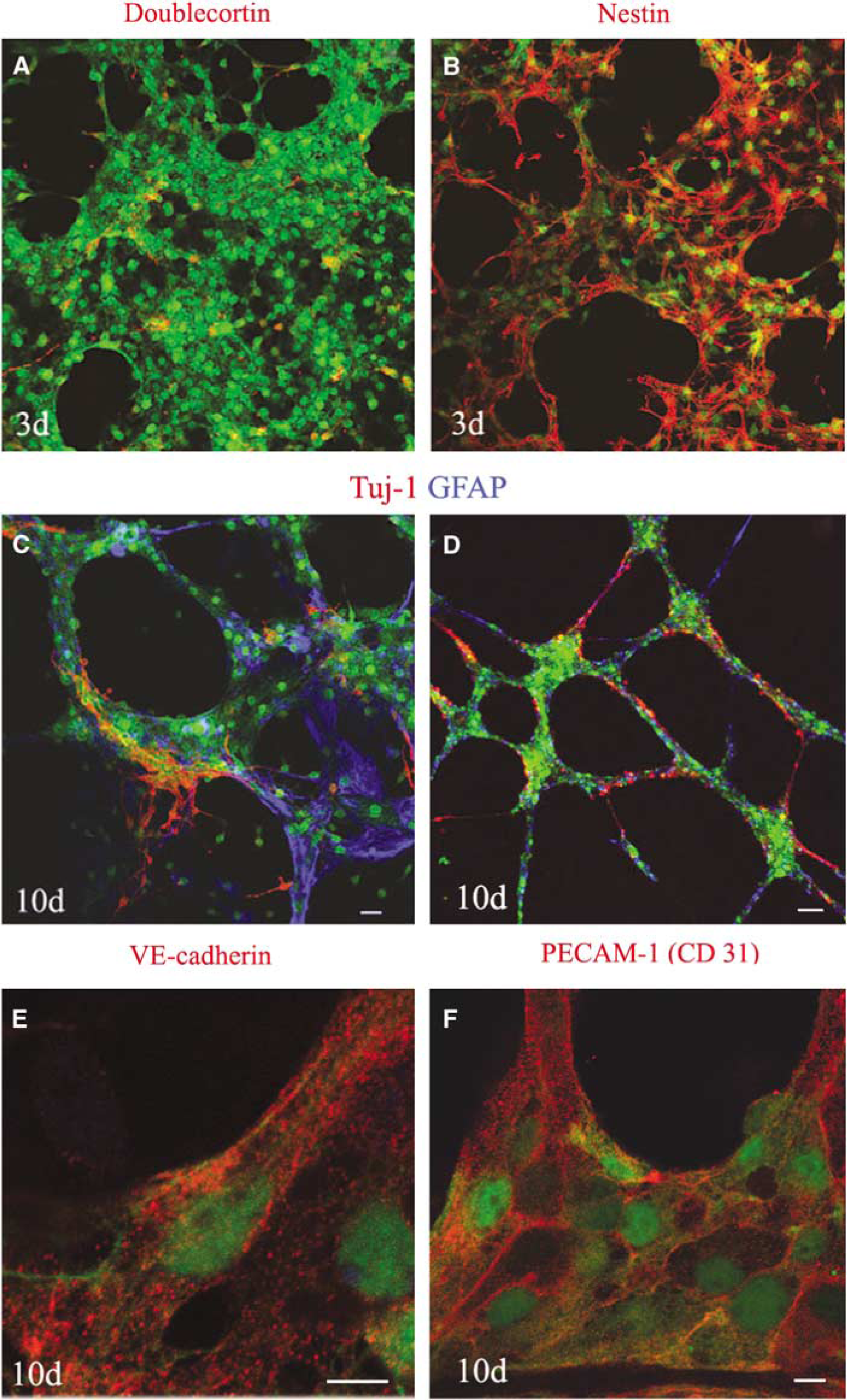
Phenotypic analysis of EGFP/NSPCs in coculture with ECs. Neural (doublecortin for neuroblasts; Tuj-1 for neurons, and GFAP for astrocytes), stem cell (nestin), and endothelial cell (VE-cadherin, CD31) markers were used to characterize the phenotype of NSPCs cocultured with ECs. Enhanced green fluorescent protein-neural stem/progenitor cells (green) were cocultured with ECs for 3 days (
To determine whether NSPCs provide trophic support to ECs under conditions of in vitro ischemia, EC monocultures or NSPC/EC cocultures were exposed to 3 h OGD, followed by growth under normoxic conditions for 7 days in the absence of serum. As shown in Figure 2, EC monocultures grown alone in the absence of serum underwent further cell damage and cell loss in response to 3 h OGD exposure (Figure 2, left panels). The OGD-induced EC degeneration was not observed in the presence of NSPCs (right panels). Both EC cell shape and number appeared robustly preserved in NSPC/EC cocultures exposed to OGD (Figure 2, right panels). Moreover, ECs formed and maintained capillary-like structures in the presence of NSPCs even under OGD conditions (Figure 2, inset). After 10 days of coculture, NSPCs underwent differentiation, expressing both neural and EC markers, formed large capillary-like structures (Figures 3C and 3D), and began to express the EC markers, VE-cadherin, and PECAM-1 (Figures 3E and 3F). These experiments show that NSPCs provide support for both EC cell survival and morphogenesis under conditions of in vitro ischemia, and also indicate potent reciprocal signaling between NSPCs and ECs (i.e., NSPCs promote EC survival and morphogenesis, and ECs promote reciprocal expression of an endothelial-like phenotype by NSPCs in vitro).

Neural stem/progenitor cells support morphology and survival of ECs after oxygen-glucose deprivation (OGD). Direct NSPC/EC cocultures and EC cultures (both grown in serum-free and growth factor-free medium) were subjected to 3-hour OGD and analyzed at 7 days after OGD (middle and bottom panels). Control cultures (top panel), grown in the same experimental conditions, were not subjected to OGD. Endothelial cell morphology was assessed using DIC confocal microscopy imaging and immunostaining with the antibody against CD31/PECAM-1 (bottom panels). Enhanced green fluorescent protein-neural stem/progenitor cells are shown on the green channel. Bars = 50 μm.
Hypoxia-Inducible Factor-1α and Vascular Endothelial Growth Factor are Constitutively Expressed by Cultured Neural Stem/Progenitor Cells and Become Upregulated after Oxygen and Glucose Deprivation
To determine whether NSPCs respond to OGD via increased expression of the transcription factor, HIF-1α, and its downstream target, VEGF, we used western blot analysis, enzyme-linked immunoassay, and immunofluorescence (Figure 4). Neural stem/progenitor cells constitutively expressed of both HIF-1α and VEGF under normoxic conditions, as shown by western blot and immunoassay (Figures 4A and 4B). Furthermore, both HIF-1α expression and VEGF release were increased approximately twofold in response to 3 h exposure to OGD (Figure 4B). Immunostaining of NSPC cultures under normoxic conditions also showed prominent expression of VEGF and HIF-1α (Figures 4C and 4D). The pattern of VEGF immunofluorescence appeared vesicular within the cytoplasm, whereas HIF-1α immunofluorescence was present in both the cytoplasm and nucleus of many cells. The nuclear localization of HIF-1α, confirmed by colocalization with DAPI nuclear staining (Figure 4D, arrow), suggests transcriptional activity. Western blotting showed no detectable HIF-1α or VEGF in EC monocultures (Figure 4A). These results indicate that cultured NSPCs constitutively express both HIF-1α and VEGF, and respond to ischemic conditions in vitro via upregulation of these hypoxia-responsive factors.

Neural stem/progenitor cells constitutively express both HIF-1α and VEGF in culture, and upregulate expression after exposure to OGD. (
These results also indicate that NSPCs show increased resistance to OGD, compared with ECs, as evidenced by their robust morphologic appearance and upregulated expression of HIF1-α and VEGF at 3 days after the 3 h OGD exposure. Unlike ECs, NSPCs grown in monoculture survive 7 days after a 3-h OGD exposure, and maintain their ability to differentiate (Supplementary Figure 1D).
Inhibition of Vascular Endothelial Growth Factor Signaling Impairs Neural Stem/Progenitor Cell-Mediated Survival and Morphogenesis of Endothelial Cells after Serum Deprivation
To determine whether diffusible VEGF mediates the protective effects of NSPCs against serum withdrawal, ECs were incubated for 3 days in serum-free medium conditioned by NSPCs in the presence or absence of the VEGFR2 tyrosine kinase inhibitor SU1498 (5 to 20 μmol/L) or Flt-1-Fc (30 ng/mL). Flt-1-Fc is a fusion protein comprising human IgG-Fc fragment fused to the high-affinity ligand-binding ectodomain of VEGFR1, and acts as a decoy receptor to inhibit VEGF signaling. As shown in Figure 5 (open bars), NSPC conditioned media (NSPC-CM) protected ECs against serum withdrawal, and SU1498 potently inhibited this protection in a dose-dependent manner with 55% inhibition beginning at the lowest dose of 5 μmol/L. Exposure of ECs to 20 μmol/L SU1498 for the same duration had no effect on EC survival, indicating that SU1498 is not directly toxic at the concentrations used in this experiment (data not shown). Similarly, incubation with Flt-1-Fc significantly reduced the protective effect of NSPC-CM by approximately 50%.

Inhibition of VEGF signaling impairs NSPC-mediated survival and morphogenesis of ECs after serum deprivation and OGD. (open bars, left) Viability of ECs after 3 days of culture in the presence or in the absence of serum, NSPC-conditioned medium (NSPC-CM), or the VEGF inhibitors, SU1498 or FIt-1-Fc. (filled bars, right) Viability of ECs exposed to 3 h of OGD, followed by 3 days of incubation with or without serum, NSPC-CM, or VEGF inhibitors. Percent viability in each culture condition was compared with the viability of EC cultures grown under normoxic conditions in the presence of serum, which was set to 100% (far left open bar = control). Neural stem/progenitor cell-CM represents media conditioned for 3 days by monocultures of NSPCs grown in serum-free and growth factor-free media. Data were acquired using the MTT colorimetric viability assay as described under Materials and methods section, **P < 0.01; ***P < 0.0001, One-way ANOVA with Tukey's multiple comparison post hoc analysis, n = 3 cultures per group, assayed in triplicate.
To determine whether VEGF signaling is obligatory for NSPC-mediated protection against OGD, ECs were exposed to 3 h of OGD followed by growth in NSPC-CM with or without SU1498 or Flt-1-Fc for 3 days. Both SU1498 (10 μmol/L) and Flt-1-Fc (30 ng/mL) potently inhibited the protective effects of NSPC-CM under conditions of OGD (Figure 5, filled bars). The vasculotrophic effect of NSPC-CM against OGD was not influenced by incubation with control IgG-Fc. Taken together, these data suggest that VEGF signaling mediates the protective effects of NSPC-CM against both serum starvation and OGD conditions in vitro.
Neural Stem/Progenitor Cells Provide Vasculotrophic Support against Mild Focal Ischemia after Intracerebral Transplantation
To determine whether NSPCs are vasculotrophic in vivo, EGFP-NSPCs were transplanted directly into the dorsal striatum (Supplementary Figure 2) 3 days before the induction of transient focal ischemia induced by 30 mins ipsilateral MCAO. Our goal was to mimic our in vitro results with NSPC/EC cocultures, such that NSPCs were present within the brain during the ischemic event. Mice were killed 3 days after ischemic injury. EGFP+ NSPCs were observed at the site of transplantation at 3 days (Figure 6 and Supplementary Figure 2). Microvascular density within the perimeter of ipsilateral striatum was compared with that of contralateral striatum measuring the density of vessels immunofluorescent for Glut-1, the blood—brain barrier glucose transporter expressed by brain ECs (Pardridge et al, 1990) (Figures 6A and 6B). Neural stem/progenitor cell transplants stimulated a 1.6-fold increase in microvascular density within the ipsilateral versus contralateral striatum, whereas sham injections of PBS had no effect on microvascular density at 3 days after MCAO (Figure 6, graph). Endothelial cells were anatomically juxtaposed to transplanted EGFP-NSPCs (Figure 6C). A survey of blood vessels throughout the entire striatal area of NSPC-MCAO recipients using high-resolution confocal microscopy revealed that approximately 21.31% ± 0.82% of the Glut-1 + structures were also Ki67+ (n = 3 mice, Figures 6D and 6E), whereas Ki67+ nuclei were not observed within the contralateral unlesioned striatum. Both HIF-1α and VEGF continued to be expressed by the EGFP-NSPC grafts at 3 days after transplantation (Supplementary Figure 3).
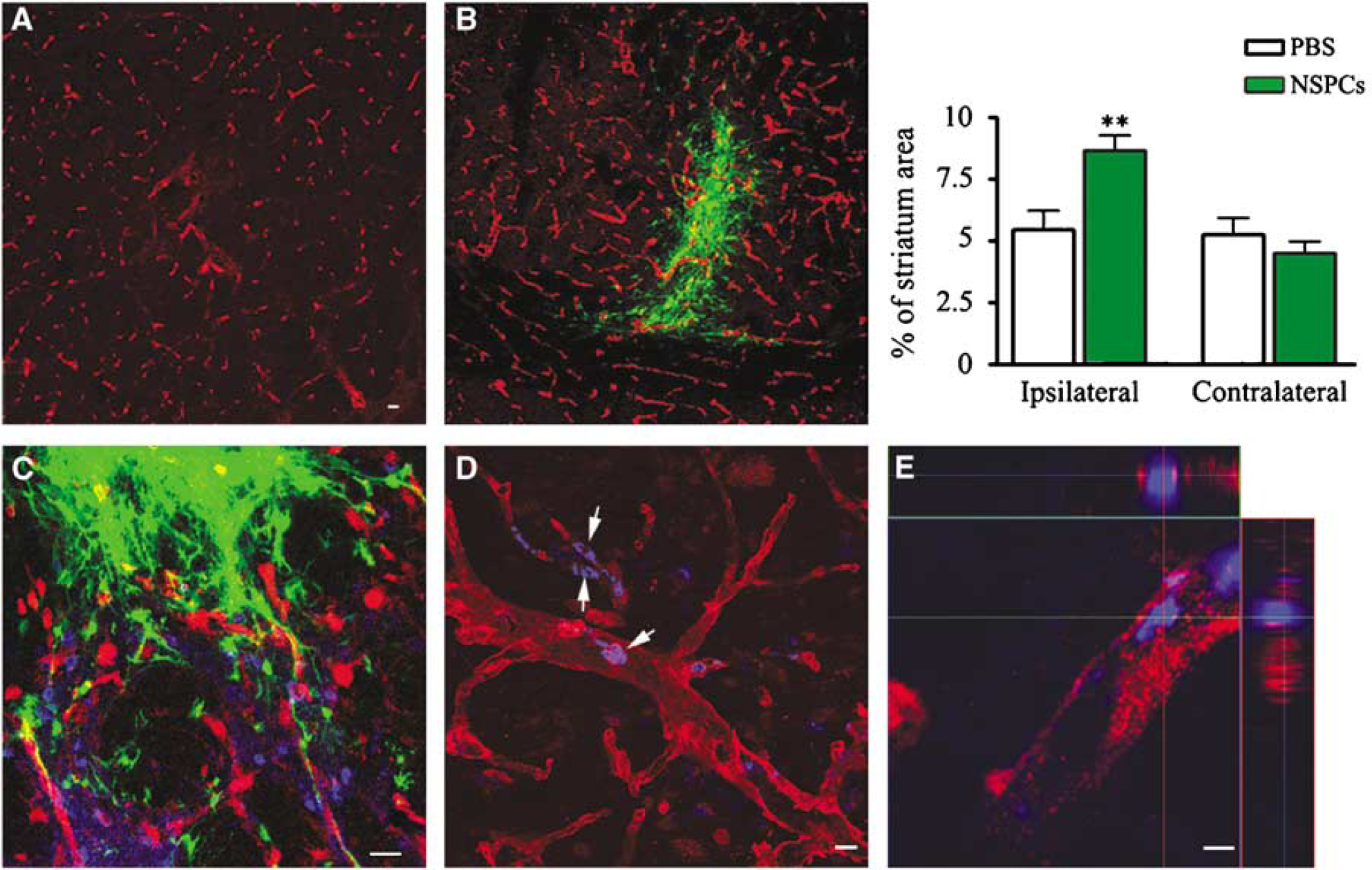
Neural stem/progenitor cells support brain revascularization after ischemia. (
Discussion
In this study, we explored the vasculotrophic effects of embryonic NSPCs under conditions of ischemia in culture and after intracerebral transplantation in a mouse model of focal cerebral ischemia. We found that NSPCs are vasculotrophic under both in vitro and in vivo ischemic conditions, and that the vasculotrophic properties are mediated by diffusible VEGF released by NSPCs. Furthermore, our studies show that NSPCs constitutively express stabilized HIF-1α and its downstream target, VEGF, under normoxic conditions in vitro and in vivo and that NSPCs directly respond to brief OGD with increased stabilization of HIF-1α and increased production of VEGF. Taken together, these observations provide strong evidence that NSPCs provide trophic support to ECs under conditions of ischemia, and suggest that NSPCs may play a proangiogenic role in stroke.
Although several in vitro studies have shown functional reciprocal signaling between ECs and NSPCs to bidirectionally influence cell behavior and phenotypic fate, few studies have explored signaling interactions under conditions of in vitro ischemia. Leventhal et al (1999) initially showed endothelial trophic support of neurogenesis, mediated, in part, by endothelial BDNF release. Using a transwell coculture model, Shen et al (2004) showed that ECs release diffusible factors that support the proliferation of NSPCs and shift their differentiation toward neurogenesis. Neural stem/progenitor cells have been shown to promote EC differentiation (Li et al, 2006), and vessel formation when cocultured in three-dimensional hydrogels that also form functional microvasculature after subcutaneous implantation in vivo (Ford et al, 2006; Li et al, 2006). Our findings extend these studies, by showing that embryonic NSPC protect ECs against death induced by serum starvation and ischemia, and that this protection is mediated by NSPC release of VEGF. Recently, Teng et al (2008) have shown that adult NSPCs isolated from the stroke brain also support EC morphogenesis in culture, suggesting that the vasculotrophic effects of NSPCs are not unique to those isolated from embryonic brain.
Our initial observations that NSPCs release a diffusible substance that promotes capillary tube formation and provides robust protection of ECs against OGD naturally led us to investigate the expression and function of VEGF in our in vitro system. Vascular endothelial growth factor is known to play a pivotal role in angiogenesis and promotion of EC survival during development and after ischemic injury. Direct effects of VEGF on ECs in culture include the induction of capillary-like structures and prevention of endothelial apoptosis induced by serum starvation, mediated by VEGR2 signaling and downstream activation of the phosphatidylinositol 3-kinase (PI3 kinase)/Akt pathway (Gerber et al, 1998). Our studies show that embryonic NSPCs constitutively release picogram amounts of VEGF in culture, even under normoxic conditions. Furthermore, we show that incubation with either the selective VEGFR2 kinase inhibitor, SU1498, or the decoy binding protein, Flt-1-Fc, potently blocks the vasculotrophic effects of NSPC-CM in vitro. That VEGF is highly expressed by embryonic NSPCs in culture is not surprising, as expression of VEGF by NSPCs of the embryonic ventricular zone is thought to contribute to developmental processes, including vascularization and neurogenesis (Kim et al, 2007). Interestingly, in the adult animal, VEGF is not expressed except under conditions of vascular remodeling and pathogenic conditions; however, VEGF expression continues within the adult neurogenic zone (Palmer et al, 2000), underscoring its potential role in maintaining the stem cell-vascular interactions in the stem cell niche. Under conditions of cerebral ischemia, VEGF expression is upregulated in both neurons and glia (Hayashi et al, 1997; Kovacs et al, 1996; Lennmyr et al, 1998), where it stimulates both angiogenic and neurogenic responses (Greenberg and Jin, 2004), and VEGF has recently been shown to be released by adult NSPCs isolated from the adult SVZ after focal cerebral ischemia.
Our observation that NSPCs appear relatively resistant to OGD in vitro led us to ask whether HIF proteins might be constitutively active in these cells. We found that stabilized HIF-1α is highly expressed in cultured NSPCs under normoxic conditions. Hypoxia-inducible factor signaling has been purported to maintain the undifferentiated cell state through the regulation of Notch signaling (Gustafsson et al, 2005), and the regulation of Oct-4 gene expression (Covello et al, 2006). Hypoxia-inducible factor signaling is required for the survival of pluripotent embryonic stem cells exposed to hypoxic conditions in vitro (Brusselmans et al, 2005). Thus, constitutive stabilization of HIF-1α within NSPCs may play multiple roles, including maintenance of the undifferentiated cell state, prevention of cell death in response to hypoxia, and ensuring close association of NSPCs with the vasculature through transcriptional regulation of proangiogenic factors such as VEGF. The proangiogenic role of NSPCs is reminiscent of nestin + brain cancer stem cells, which coopt aberrant perivascular niches through constitutive release of angiogenic factors, including VEGF (Bao et al, 2006; Calabrese et al, 2007).
Much evidence suggests a functional link between neurogenesis and angiogenesis in rodent models of stroke. In rodent models of focal and global ischemia, reactive astrocytes and blood vessels appear to provide the physical substrate for neuroblast migration (Ohab et al, 2006; Thored et al, 2007; Yamashita et al, 2006), and microarray analysis has shown concomitant upregulation of neurogenic and angiogenic genes within adult SVZ after focal ischemia in mice (Liu et al, 2007). These studies and others have lead to the notion that angiogenesis provides the necessary cues for the neurogenic response to stroke. Our studies suggest that activated NSPCs may provide a source of angiogenic factors that enhance the growth and/or stabilization of newly formed vasculature after stroke. Our studies showing increased vascularization after intracerebral transplantation of NSPCs into the adult mouse brain support this. Other studies have also shown increased vascularization after intracerebral transplantation of adult rat NSPCs after embolic stroke (Jiang et al, 2005) and increased vascularization after transplantation of human NSPCs genetically modified to overexpress VEGF in a mouse model of hemorrhagic stroke (Lee et al, 2007). Interestingly, our studies also suggest that NSPCs can adopt an endothelial lineage after exposure to ECs in coculture. That direct contact with ECs can convert NSPCs into the endothelial lineage through cell fusion-independent differentiation was previously indicated by Wurmser et al (2004a), raising the possibility that NSPCs may also contribute to angiogenesis after stroke by adopting an EC fate and direct incorporation into nascent vasculature. Because neurogenic and angiogenic processes are governed by common growth factors, including VEGF, fibroblast growth factor-2 (FGF-2), stromal derived growth factor 1 (SDF1), and angiopoietin 1 (Ang1) (for review, see Ward and Lamanna, 2004), deciphering the selective role of NSPC-derived factors in promoting angiogenesis after stroke using pharmacological inhibitors in vivo has been difficult. Our studies support a proangiogenic role of NSPCs under conditions of cerebral ischemia through HIF—VEGF signaling pathways; however, further studies using transgenic mice that allow inducible gene ablation in adult neural stem cells will be required to fully elucidate the selective role of NSPC-derived factors and the role of the endogenous neurogenic response in revascularization and repair after stroke.
Footnotes

References
Supplementary Material
Please find the following supplemental material available below.
For Open Access articles published under a Creative Commons License, all supplemental material carries the same license as the article it is associated with.
For non-Open Access articles published, all supplemental material carries a non-exclusive license, and permission requests for re-use of supplemental material or any part of supplemental material shall be sent directly to the copyright owner as specified in the copyright notice associated with the article.


