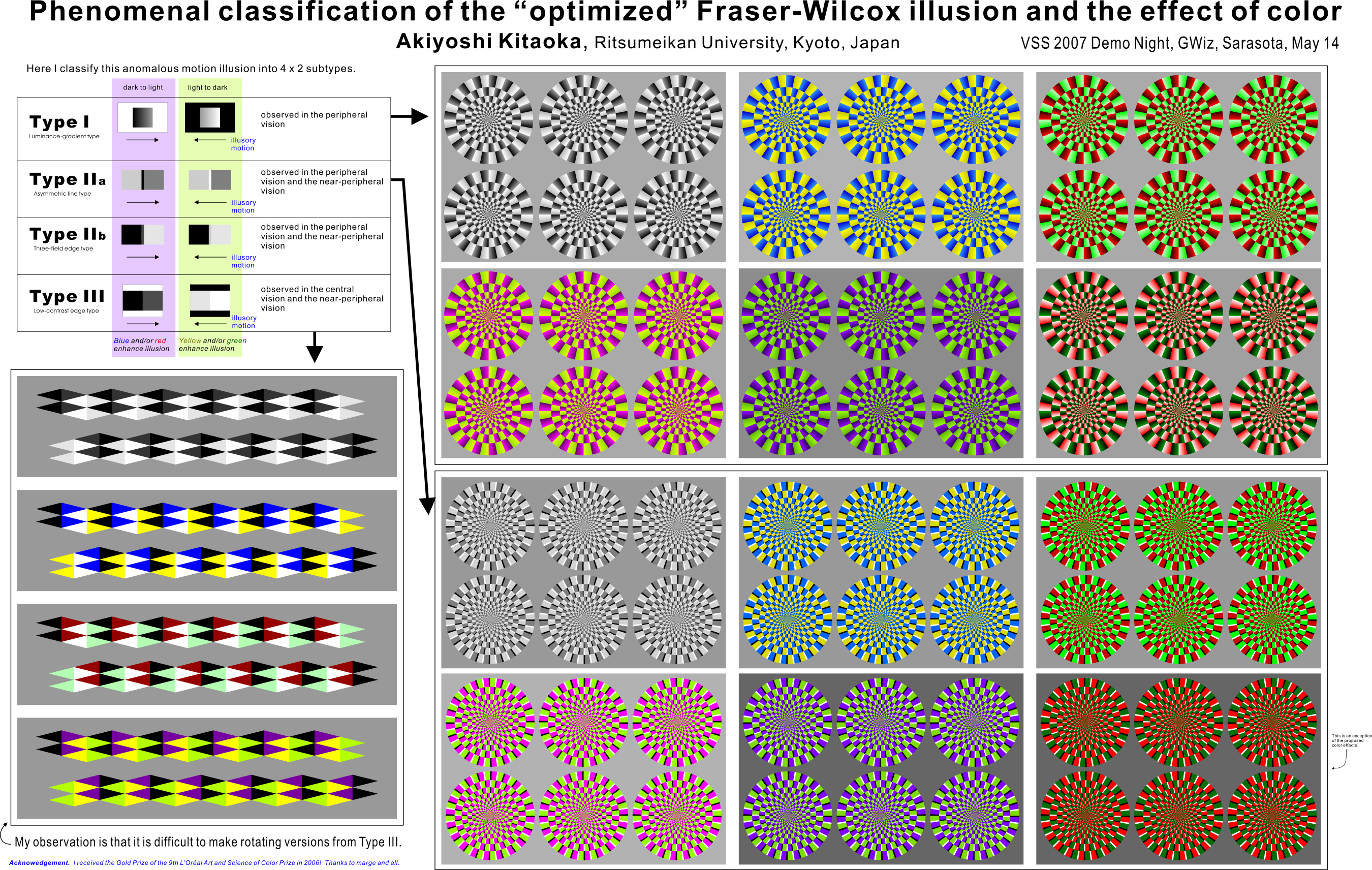
The color-dependent motion illusion in stationary images—a special type of the Fraser–Wilcox illusion—is introduced and discussed. The direction of illusory motion changes depending on whether the image is of high or low luminance and whether the room is bright or dark. This dimorphism of illusion was confirmed by surveys. It is suggested that two different spatial arrangements of color can produce the motion illusion. One is a spatial arrangement where long- and short-wavelength color regions sandwich a darker strip; the other is where the same color regions sandwich a brighter strip.
AnstisS. (2002). The Purkinje rod-cone shift as a function of luminance and retinal eccentricity. Vision Research, 42, 2485–2491.
2.
AshidaH.KurikiI.MurakamiI.HisakataR.KitaokaA. (2012). Direction-specific fMRI adaptation reveals the visual cortical network underlying the “Rotating Snakes” illusion. Neuroimage, 61, 1143–1152.
3.
BackusB. T.OruçI. (2005). Illusory motion from change over time in the response to contrast and luminance. Journal of Vision, 5(11):10, 1055–1069.
4.
BeerA. L.HeckelA. H.GreenleeM. W. (2008). A motion illusion reveals mechanisms of perceptual stabilization. PLoS ONE, 3(7): e2741. doi:10.1371/journal.pone.0002741.
5.
BillinoJ.HamburgerK.GegenfurtnerK. R. (2009). Age effects on the perception of motion illusions. Perception, 38, 508–521.
6.
ConwayR. B.KitaokaA.YazdanbakhshA.PackC. C.LivingstoneM. S. (2005). Neural basis for a powerful static motion illusion. Journal of Neuroscience, 25, 5651–5656.
7.
CropperS. J.WuergerS. M. (2005). The perception of motion in chromatic stimuli. Behavioral and Cognitive Neuroscience Reviews, 4, 192–217.
8.
FaubertJ.HerbertA. M. (1999). The peripheral drift illusion: A motion illusion in the visual periphery. Perception, 28, 617–621.
9.
FermüllerC.JiH.KitaokaA. (2010). Illusory motion due to causal time filtering. Vision Research, 50, 315–329.
FraserA.WilcoxK. J. (1979). Perception of illusory movement. Nature, 281, 565–566.
12.
HartridgeH. (1918). Chromatic aberration and resolving power of the eye. Journal of Physiology, 52, 175–246.
13.
HisakataR.MurakamiI. (2008). The effects of eccentricity and retinal illuminance on the illusory motion seen in a stationary luminance gradient. Vision Research, 49, 1940–1948.
14.
IdesawaM. (2010). A model of illusory motion perception in still figures. Optical Review, 17, 557–561.
15.
KanazawaS.KitaokaA.YamaguchiM. K. (2013). Infants see illusory motion in static figures. Perception, 42, 828–834.
KitaokaA. (2007). Phenomenal classification of the “optimized” Fraser-Wilcox illusion and the effect of color. Poster presentation in DemoNight, VSS2007, GWiz, Sarasota, FL (14 May 2007). Retrieved from http://www.psy.ritsumei.ac.jp/∼akitaoka/VSSDemoNight2007s2.jpg.
18.
KitaokaA. (2008). Optimized Fraser-Wilcox illusions: A pictorial classification by Akiyoshi Kitaoka. Talk in a workshop (WS005) at 72nd Annual Convention of the Japanese Psychological Association, Hokkaido University, Sapporo (19 September 2008). Retrieved from http://www.psy.ritsumei.ac.jp/∼akitaoka/nisshin2008ws.html.
19.
KitaokaA. (2010). Motion perception and illusion. Japanese Journal of Optics, 39, 75–81 (in Japanese with English abstract).
20.
KitaokaA. (2012). The Fraser-Wilcox illusion group: Its phenomena and models. IEICE Technical Report, 112(168), NC2012–24, 57–60 (in Japanese with English abstract).
21.
KitaokaA. (2013a). Color-dependent anomalous motion illusion and its reversal. Talk at 2013 Winter Meeting of the Vision Society of Japan, Kogakuin University, Tokyo (23 January 2013).
22.
KitaokaA. (2013b). The color-dependent Fraser-Wilcox illusion: Motion direction is reversed depending on luminance. “Illusions and delusions” talk at the Barn, Leinroden, Germany (23 August 2013).
23.
KitaokaA. (2013c). A variety of color illusions: (9) Color-dependent motion illusion in a stationary image and rods. Journal of the Color Science Association of Japan, 37, 400–401 (in Japanese).
24.
KitaokaA. (forthcoming). The Fraser-Wilcox illusion and its extension. In ShapiroA.TodorovićD. (Eds.), Oxford compendium of visual illusions. Oxford: Oxford University Press.
25.
KitaokaA.AshidaH. (2003). Phenomenal characteristics of the peripheral drift illusion. VISION: The Journal of the Vision Society of Japan, 15, 261–262.
26.
KitaokaA., & Newton Press, (Eds.) (2007). Newton Graphic Science Magazine: How is the brain deceived? Perfect demonstration of visual illusions. Tokyo: Newton Press (in Japanese).
KurikiI.AshidaH.MurakamiI.KitaokaA. (2008). Functional brain imaging of the rotating snakes illusion by fMRI. Journal of Vision, 8(10):16, 1–10.
29.
MurakamiI.KitaokaA.AshidaH. (2006). A positive correlation between fixation instability and the strength of illusory motion in a static display. Vision Research, 46, 2421–2431.
30.
Naor-RazG.SekulerR. (2000). Perceptual dimorphism in visual motion from stationary patterns. Perception, 29, 325–335.
31.
Otero-MillanJ.MacknikS. L.Martinez-CondeS. (2012). Microsaccades and blinks trigger illusory rotation in the “Rotating Snakes” illusion. Journal of Neuroscience, 32, 6043–6051.
32.
SenoT.KitaokaA.PalmisanoS. (2013). Vection induced by illusory motion in a stationary image. Perception, 42, 1001–1005.
33.
StevanovJ.MarkovićS.KitaokaA. (2012). Aesthetic valence of visual illusions. i-Perception, 3, 112–140.
34.
StevanovJ.SpeharB.AshidaH.KitaokaA. (2012). Anomalous motion illusion contributes to visual preference. Frontiers in Perception Science, 3, Article 528, 1–11.
35.
TomimatsuE.ItoH.SenoT.SunagaS. (2010). The ‘rotating snakes’ in smooth motion do not appear to rotate. Perception, 39, 721–724.
36.
TomimatsuE.ItoH.SunagaS.RemijnG. B. (2011). Halt and recovery of illusory motion perception from peripherally viewed static images. Attention, Perception, & Psychophysics, 73, 1823–1832.
37.
WhittenD. N.BrownK. T. (1973). The time courses of late receptor potentials from monkey cones and rods. Vision Research, 13, 107–135.
38.
YanakaK.HilanoT. (2011). Mechanical shaking system to enhance “Optimized Fraser-Wilcox Illusion Type V”. Perception, 40 (ECVP Supplement), 171 (Abstract).