




Abstract
Abstract
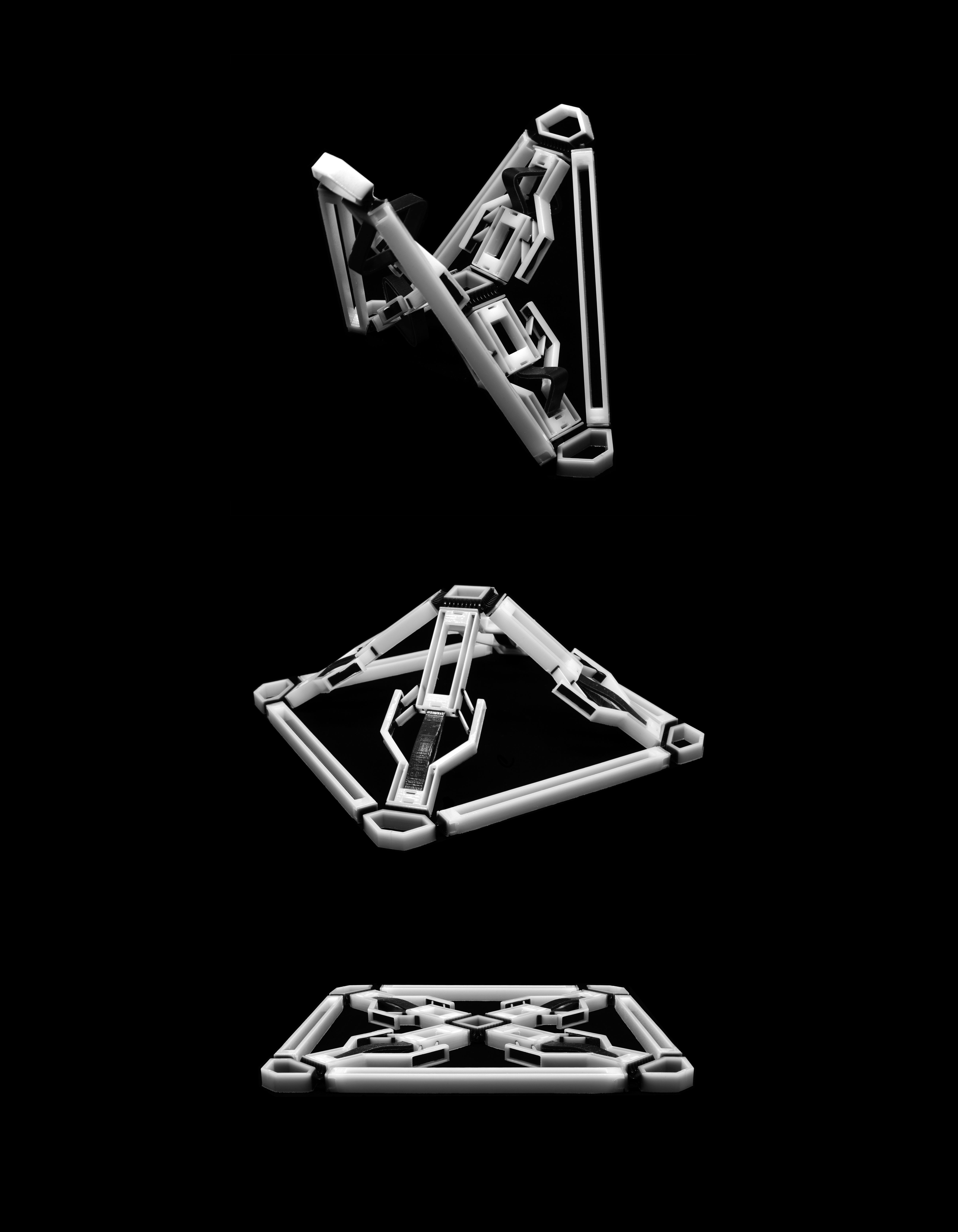
Autonomous deployment and shape reconfiguration of structures are a crucial field of research in space exploration with emerging applications in the automotive, building, and biomedical industries. Challenges in achieving autonomy include the following: bulky energy sources, imprecise deployment, jamming of components, and lack of structural integrity. Leveraging advances in the fields of shape memory polymers, bistability, and three-dimensional (3D) multimaterial printing, we present a 3D-printed programmable actuator that enables the autonomous deployment and shape reconfiguration of structures activated through surrounding temperature change. Using a shape memory polymer as the temperature controllable energy source and a bistable mechanism as the linear actuator and force amplifier, the structures achieve precise geometric activation and quantifiable load-bearing capacity. The proposed unit actuator integrates these two components and is designed to be assembled into larger deployable and shape reconfigurable structures. First, we demonstrate that the activation of the unit actuator can be sequenced by tailoring each shape memory polymer to a different activation time. Next, by changing the configuration of the actuator, we demonstrate an initially flat surface that transforms into a pyramid or a hyperbolic paraboloid, thus demonstrating a multistate structure. Load-bearing capability is demonstrated for both during activation and in the operating state.
Introduction
D
In the field of space exploration, deployment is a critical phase in the life cycle of a space structure. 10 With respect to kinematics, entanglement and jamming may occur if part movements cannot be precisely controlled. 11 Mechanically, the driving force must be tuned to overcome resistance at all stages of deployment. 12 Traditionally, designs often involve complex packing strategies, such as origami folding, 13 tensegrity, 14 as well as bulky powered driving mechanisms such as air pressure 15 and electrical drives. 16 With multimaterial three-dimensional (3D) printing technologies, there is potential to fabricate monolithic designs that can be autonomously activated by environmental triggers, for example, temperature.
An increasing number of active structures are designed and fabricated in a newly coined field of four-dimensional (4D) printing. 8 4D printing uses properties of 3D printing materials to achieve design shape change under environmental forces. The development has been focused in the areas of material synthesis and geometric reconfiguration. In Raviv et al., 17 a hydrogel that swells under water is used as an actuator that changes the shape of a compliant string or surface. Sydney Gladman et al. 18 continued this method of actuation by designing anisotropic properties of a swelling meta-material. Ge et al. 19 first utilized the shape memory properties of the photopolymeric inks used in the Polyjet 3D printing technology to achieve shape change.
Each of these actuation methods has areas for improvement. Swelling in a hydrogel has a long activation time, imprecise geometric configuration change, and lack of load-bearing capacity. In addition, it is often impractical to submerge a structure under water. Shape memory polymers, as implemented by Ge et al., 19 require the design to be fabricated in the activated state, while offering no real precision in the programmed state.
The SME of polymers is adopted in this research as the activation material since it is able to produce a large actuation strain 20 and has a moderate recovery stress. While the SME is observed with most thermosets, it is not feasible for traditional fabrication methods to produce complex parts with multiple materials. In this work, we exploit the multimaterial inkjet technology to fabricate complex designs by selectively depositing photoreactive liquid resins of different stiffness and glass transition temperatures. Currently, there is no other means of fabrication to do this.
By combining this polymer with a bistable mechanism, called a von Mises truss, we are able to define two distinct equilibrium states that can be precisely achieved. Von Mises type bistable mechanisms have previously been used in active masts, 21 for energy absorption, 22 and more recently to create 3D-printed reconfigurable structures. 23
In the activation phase, the bistable mechanism acts as a force amplifier and renders the deployable structure load bearing. By combining the mechanics of bistability and shape memory polymers, we present a unit actuator that delivers the above characteristics and addresses the shortcomings. We propose to integrate this actuator in deployable structures as the source of activation for shape reconfiguration. The structures can be deployed from two-dimensional (2D) to 3D states when the temperature reaches a threshold. By demonstrating a synclastic and an anticlastic structure reconfigured from the same base design, we demonstrate both autonomous deployment and shape reconfiguration.
While it is possible to control individual shape memory elements through Joule heating, one of the aims of this work is to eliminate onboard electrical components in the proposed structures. Instead, activation is controlled through the surrounding environment. In particular, we activate the structures using heated water to simulate a reduced gravity environment. This is typically used to test space deploying structures and machineries 24 and provides more uniform heating compared to say a heat lamp. A similar application on a microscopic level would be the activation of microstructures in blood vessels through body heat.
Design and Results
Design of a programmable unit actuator using bistability and shape memory polymers
First, we introduce the geometry of the actuator design, second, we discuss the kinematics and activation sequence, and finally, we investigate its mechanical behavior. For actuation, we propose a unit actuator consisting of a bistable mechanism that dictates the equilibrium states and shape change and the shape memory strip (SMS) that provides the activation force. This unit actuator is capable of activating independently of the rest of the structure. The principle behind this proposed actuator is shown in Figure 1a, where the SME is used to trigger bistability from the contracted to the expanded configuration or vice versa.

The design of a heat-activated bistable unit actuator.
The bistable mechanism is a realization of the von Mises truss 25 and is adapted from designs proposed by Chen et al. 23 It is fabricated using the rigid truss members, the compliant joint and beam. It has been shown that the bistable force can be increased by increasing the joint material stiffness or decreasing the joint length. The flexible beam is added to better simulate the ideal boundary condition (Fig. 1b). The design is fabricated in either the contracted or the expanded configuration and is triggered by the SMS installed beneath the pin.
The SMS (Fig. 1d) consists of two thin, symmetrical strips with a rectangular cross section. The profile of the SMS is defined by a curve as we use bending as opposed to axial transformation to maximize length change in the SMS without inducing excessive strain. The mechanical behavior of the SMS is parameterized by a cosine curve with amplitude A and thickness t. A cosine curve is used to reduce the stress concentration at the ends, as specimens typically fail at the interface between different materials. Figure 1c shows an example of the unit actuator with the bistable mechanism. The stroke length of the bistable mechanism dictates the change in length of the SMS between the fabricated and the activated states. In this design, the stroke length is
To achieve temperature-controlled deployment, the glass transition temperatures
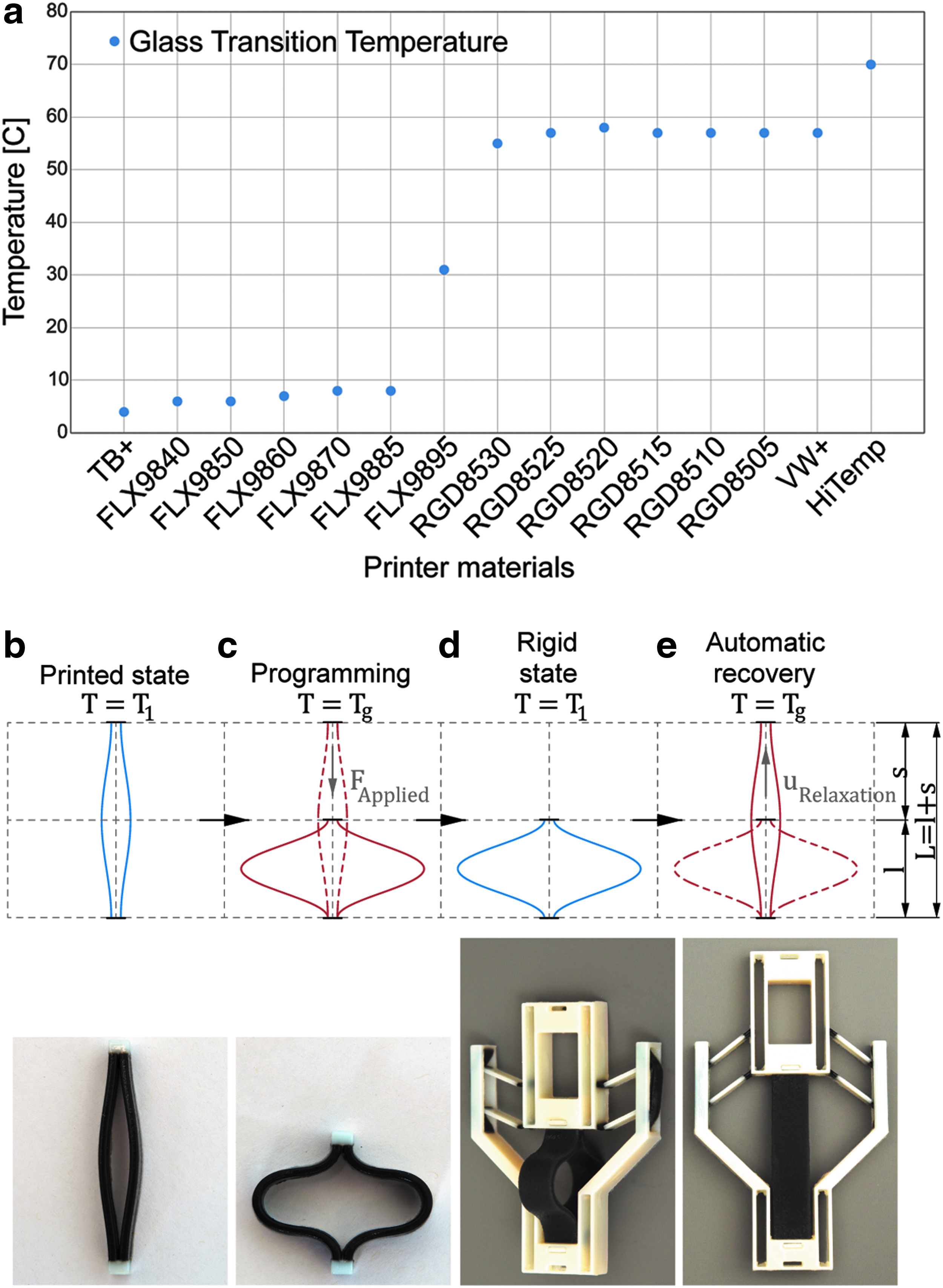
Glass transition temperature of the different printed materials and the activation sequence of an expanded unit actuator.
A dynamic mechanical analysis (DMA) is used to obtain the storage modulus of the SMS material. The transformation of the storage modulus to relaxation modulus and modeling of this using the Prony series is detailed in Wagner et al. 26 The Prony series of the active material is reported in Appendix II.
The deployment of the unit actuator procedure consists of two phases; the first phase is the programming and assembly of the SMS with the bistable mechanism. The second is the constrained recovery of the SMS and consequently the activation of the unit actuator. In the programming phase, the SMS is heated past
To ensure deployment, the SMS must overcome the activation force of the bistable mechanism at all stages of the deployment process. Mechanical testing is done using a dynamic testing machine with an embedded heat chamber. To simulate the test condition, a finite element simulation is performed to obtain the behavior of the SMS using a linear viscoelastic constitutive model constructed for the shape memory material. Static stress and strain behavior of the different materials is obtained from Chen et al. 23 Simulation of the bistable mechanism follows a static nonlinear FEA with prescribed displacement using beam elements.
Simulation and experimental results are shown in Figure 3. Panels a and b show the force exerted by the SMS during relaxation when
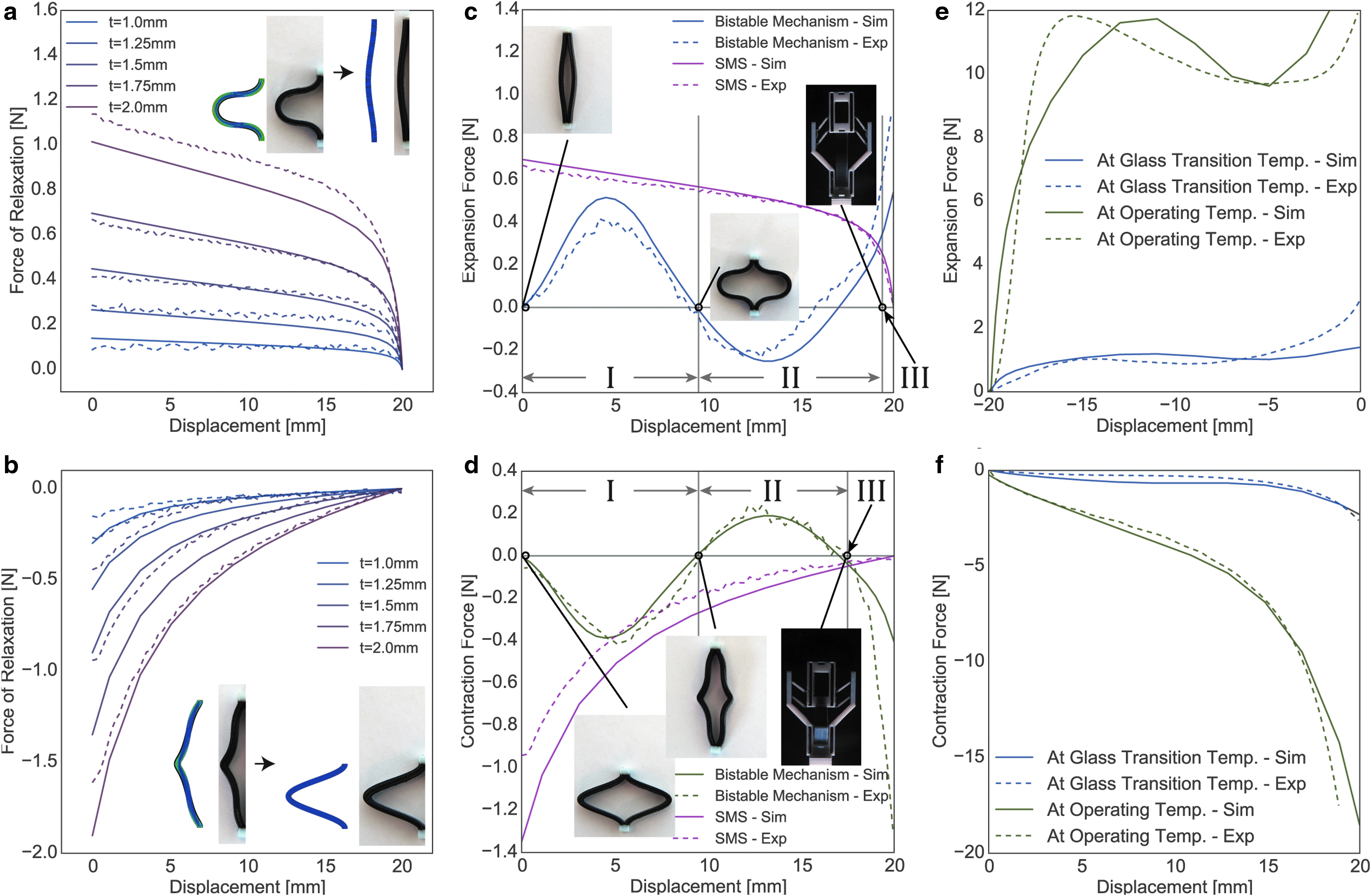
Mechanical characterization of the unit actuator, both in expansion
Panels e and f show the overall mechanical behavior of a unit actuator under either activation temperature (i.e.,
We demonstrate that the actuator can be integrated into a larger structure by showing the controlled activation of three serially connected actuators. By varying the thickness of the SMS, we can control the sequence of activation due to heat conduction of the shape memory polymer. SMS with thicknesses of 1.50, 1.75,
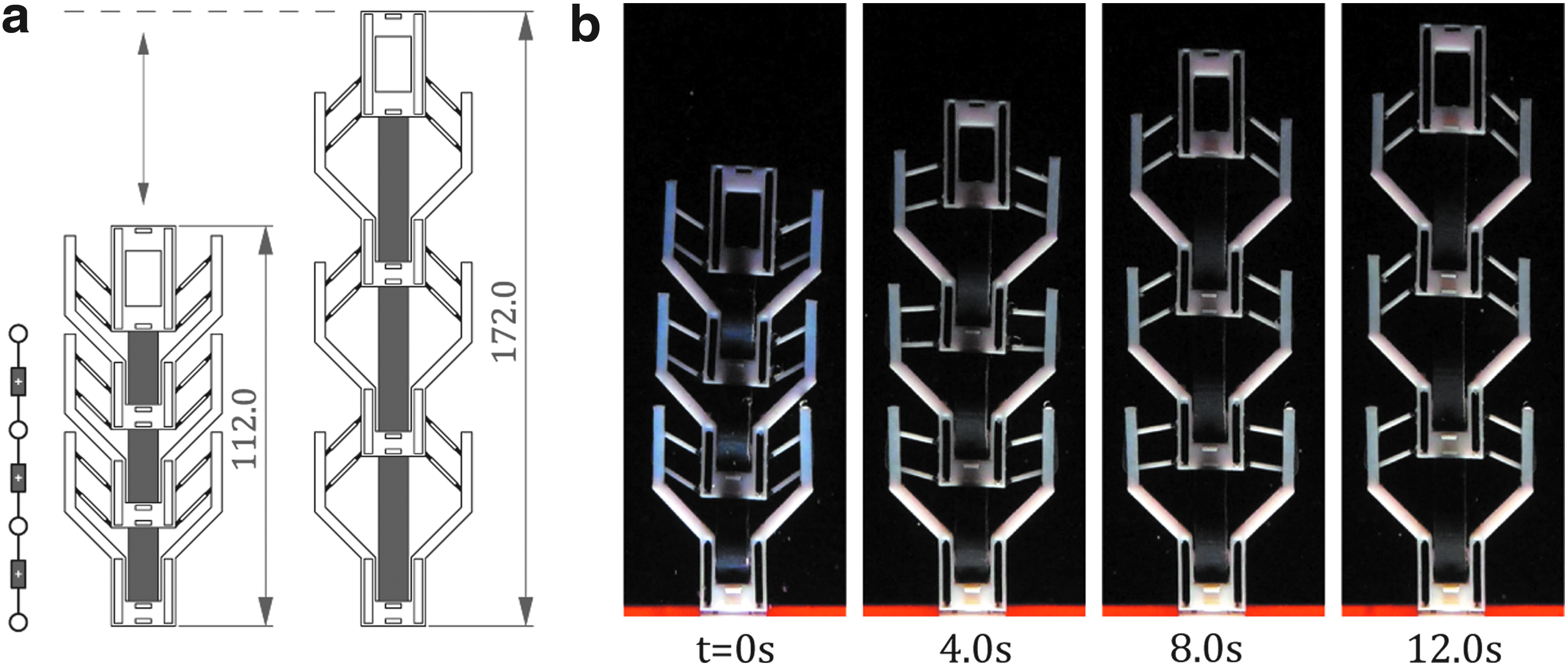
Sequenced activation of multiple actuators.
Design of autonomous, multistate shape reconfigurable structures
We now integrate the described actuators in 2D designs that deploy into load carrying 3D structures. An edge node schematic of the structure is shown in Figure 5a. The design can be simulated as a truss network, that is, the edges can only sustain axial load and the nodes are pin jointed. The design consists of a rectangular frame with four cross edges. Each edge can assume three behaviors: expansion, contraction, or remain static. In this work, two physical realizations of the design are demonstrated by switching the initial configuration of the cross edges between expansion and contraction actuators (Fig. 5b). Compliant joints are placed at the nodes where rotational degrees of freedom (DOF) are required. The stiffness of the joints is reduced by fabricating them with a soft elastomer and internal microstructure. The different parts are assembled with a common joint (Fig. 5c).

Shape reconfigurable structures showing activation and load-bearing capability.
Each SMS is programmed separately and assembled into the structure. The initial state is planar. For deployment, the structure is submerged under
In addition to activation, two load cases are tested by placing a specified mass at the apex of each structure. The first is under the deployment condition where the temperature remains at
Materials and Methods
Fabrication
All presented designs are fabricated with a Stratasys Objet3 Connex500 multimaterial printer. The three materials used to fabricate the presented designs are FLX9895, the shape memory polymer, RGD525, a temperature-resistant rigid plastic, and Agilus30, an elastomer-like material. 27 FLX9895 is one of the digital materials created at the time of printing by mixing VeroWhitePlus and Agilus30. SUP760 is used as a chemically dissolvable support material. During postprocessing, most of the support material is removed with manual tools. The remainder is dissolved in a 2% sodium hydroxide, 1% sodium silicate solution for 2 h. The specimens are then dipped in an acidic solution and air-dried before testing.
Experimental
Mechanical characterization of the SMS is performed in an Instron E3000 dynamic testing machine with an installed thermal chamber. The specimen is clamped with grippers. The interior volume of the heat chamber is heated to
Testing of the deployable structures is done under water that is heated with a heating element. For deployment, water is heated past
Simulation
Numerical simulation of the unit actuator is done using the finite element analysis software ABAQUS 6.14.1. The bistable mechanism is meshed with a nonlinear beam element B32 to reduce computational effort compared with brick elements while retaining accuracy. The flexible beam is assumed to be clamped on the ends. A hyperelastic material model is used for Agilus30 (data shown in Appendix II). A displacement of
Simulation of the SMS consists of a multistep analysis (Fig. 6). The SMS is meshed with viscoelastic brick elements C3D8RH. A displacement of
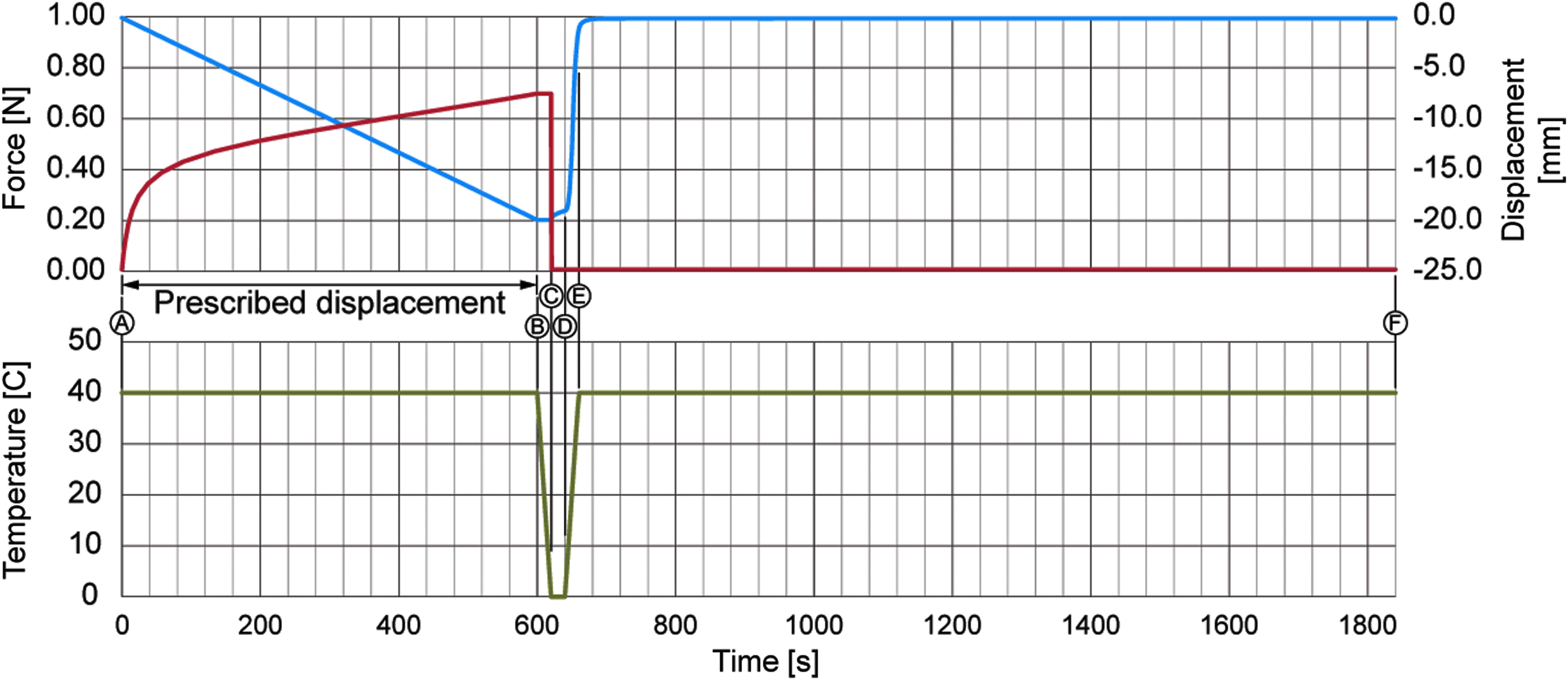
Simulation of the SMS with viscoelastic brick elements during programming and relaxation. From A to B, a displacement is prescribed under T = Tg, the reaction force is the output. From B to C, the prescribed displacement continues to be applied as the temperature decreases to 0°C. From C to D, the displacement is removed, a slight rebound is observed in deformation. From D to E, temperature increases and relaxation occurs. This continues to F.
Discussion and Conclusions
The presented work demonstrates the design of autonomous shape reconfigurable structures. We propose a programmable unit actuator that either expands or contracts under temperature change. Using the viscoelastic behavior of thermosetting polymers, a prestrain is imposed on the SMS at a temperature greater than the polymer's glass transition temperature,
The proposed unit actuator can be integrated in structural applications where the transport volume must be much smaller than the operating volume. With respect to the example of deployable space structures, the proposed design has a number of advantages compared with the state-of-art in all phases of the deployment process.
In the fabrication phase, both the bistable mechanism and the SMS are 3D printed with minimal support material and assembled with a universal connector (Fig. 5c). The activation force of the bistable mechanism is dependent on its joint length and stiffness. 23 The triggering temperature and duration of the SMS can be tuned by varying the chemical composition of the shape memory polymer resin 19 and by changing its thickness, respectively.
In transportation and the deployment phase, the stowed or programmed state of the proposed structure is precisely defined by the first equilibrium point of the bistable mechanism. This stowed state is maintained without a restraining mechanism. 28 Rather than motorized deployment, the proposed structures are activated through environmental change, thereby removing the need for electrical energy input and eliminating the possibility of jamming of parts.
While we demonstrate initially flat structures as an example, one is able to design the stowed state to accommodate given space requirements. By contrast, designs that feature only SMPs are programmed with limited precision using ad-hoc methods such as hand pulling.
29
The proposed structures are load bearing as they are deployed, that is, under high temperature, as the bistable mechanism amplifies the load-bearing capacity of the unit actuator independently of the surrounding temperature. This is in contrast with most 4D-printed designs that focus solely on shape transformation
8
and do not exhibit significant load-bearing capacity during deployment but rather only after the deployed design cools below
In addition to autonomous deployment, the combination of the shape memory effect and mechanical bistability may have broad relevance in other engineering fields. A recent study by the same authors has shown a directional swimming robot propelled by exploiting the instability of a bistable mechanism triggered with a shape memory polymer. 30 As demonstrated, the structures can reconfigure themselves both positively and negatively, with a combination of these two modes and given many actuators, one can form a surface of almost any given curvature. As we have characterized the thermal mechanical behavior of the unit actuator, simulation of the deployment and load capacity can be done using form-finding algorithms, developed in previous work, that can be extended to generate and optimize large-scale reconfigurable structures. 23
Footnotes
Acknowledgments
The authors are grateful to Jung-Chew Tse from the Engineering Design and Computing Laboratory, ETHZ, for fabrication support, Marius Wagner from the Laboratory for Nanometallurgy, ETHZ, for performing the DMA and data analysis, and Dr. Joanna Wong from the Laboratory of Composite Material and Adaptive Structures, ETHZ, for performing DSC experiments.
Author Disclosure Statement
No competing financial interests exist.
Appendix
References
Supplementary Material
Please find the following supplemental material available below.
For Open Access articles published under a Creative Commons License, all supplemental material carries the same license as the article it is associated with.
For non-Open Access articles published, all supplemental material carries a non-exclusive license, and permission requests for re-use of supplemental material or any part of supplemental material shall be sent directly to the copyright owner as specified in the copyright notice associated with the article.
