




Abstract
The high demand on medical devices and personal protective equipment (PPE) during the COVID-19 crisis left millions of health care professionals unprotected in the middle of this situation, as governments around the world were not prepared for such pandemic. The three-dimensional printing (3DP) community, from universities to 3DP enthusiasts with printers at home, was there to support hospitals from day 1 on this demand by providing PPE and other medical supplies (e.g., face shields and valves for respiratory machines). This editorial covers the importance of 3DP in the fight against COVID-19 and how this can be used to tackle potential pandemics and support the supply chain.
Introduction: COVID-19 and Supply Chain
After a series of cases of pneumonia in Wuhan, the capital city of Hubei province (China), the Chinese health authorities announced in January 2020 that a novel coronavirus, officially known as severe acute respiratory syndrome coronavirus (SARS-CoV)-2, was responsible for these cases. 1 SARS-CoV-2, the virus that causes the coronavirus disease (COVID-19), was not detected before the recent pandemic and has been known to be genetically similar to SARS-CoV. 1 The COVID-19 is transmitted mainly through contact with an infected individual, through droplets that are produced when the patient coughs or sneezes or through droplets from the saliva or nasal cavity.1,2 To avoid transmission, it is very important to implement individual hygiene measures and especially the use of personal protective equipment (PPE). However, the lack of PPE and other key resources during the COVID-19 crisis has been a constant problem, leaving many health care professionals across the world unprotected.
Dealing with a pandemic, such as COVID-19, is an unprecedented situation in this modern globalized word, which has created extraordinary emergency that is particularly affecting the supply chain. 3 The supply chain disruptions, in combination with the enormous needs for medical devices and protective health care material, have created the need of new initiatives and the use of emerging technologies such as three-dimensional printing (3DP) to come forward and support the health care professionals and supply chain.
Additive Manufacturing for Health Care Professionals
The “citizen supply chain”
3DP is an additive manufacturing technique, which is able to produce physical models by adding materials layer-by-layer based on a computer-aided design (Fig. 1), and permits the manufacturing of variety of items in a cost-effective and fast approach. 4 There are several 3DP technologies in existence, including fused deposition modeling (FDM), which is a form of material extrusion, and is by far the most common due to its ease of use, low cost, and broad range of material choice. 5
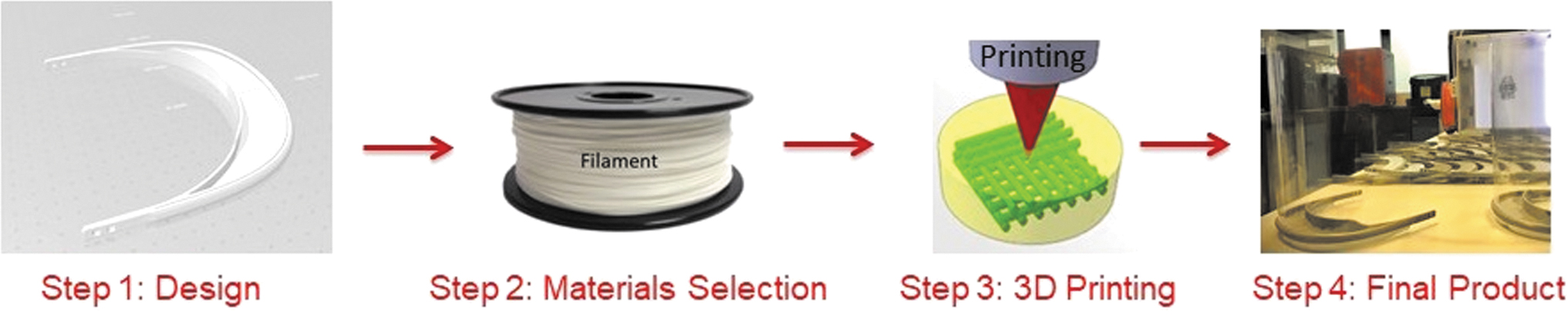
Fused deposition modeling 3DP process of a face shield. 3DP, three-dimensional printing.
Owing to the versatility, 3DP has been used by many researchers to develop new prototypes. Among all the applications, 3DP has been recently used for the manufacture of a range of drug delivery systems and medical devices.4,6,7 Despite these recent developments, 3DP is not a new technique as the first patent describing this technology was filled in the late 80s. 8 However, the field of 3DP experienced a huge increase in popularity during the past 15 years due to the “democratization” of this technology. This process started in 2005 with the project RepRap aiming to develop an open source community to make 3DP technology accessible to everybody. 8 Thanks to this program nowadays 3DP equipment can be found at affordable prices, making it accessible to the general public.
The “democratization” of 3DP combined with the COVID-19 crisis led to an unprecedented situation. Everybody with a 3DP equipment at home could be part of a “citizen supply chain.” A “maker” community led by skilled engineers started working on the demand of PPE and other health care products by mainly using 3D printers and household materials, by providing free support and access to their designs over the Internet. Everyone with a 3D printer at home was able to access these designs and prepare face shields/visors and other important required devices. The “maker” or “citizen supply chain” community across the world, with collaborators from industrial and academic institutions, organized and established enormous networks in a short period, to distribute 3D-printed items to health care professionals. This initiative is the biggest “collaborative project” in the modern history following the spirit of the “RepRap2” initial project.
3D-printed medical devices and PPE
In the last months, 3DP has been constantly in the news, from companies that they know-how to produce with 3DP techniques to volunteers finding solutions in treatment procedures and support local communities. An example of different 3D-printed items that have been reported so far can be found in Table 1. It is very important to emphasize that not all 3DP items that have been reported are appropriate to be used in COVID-19 health centers before getting approval by a regulatory body (e.g., U.S. Food and Drug Administration [FDA]), as they have to provide a certain degree of protection to these health care professionals and/or have to be safe for the patients (e.g., use of valves and ventilators).
3D Printed Examples, Reported in the News, in the Fight Against COVID-19
FDM, fused deposition modelling; SLS, selective laser sintering; SLA, stereolithography.
One of the first examples is the Milan's Issinova technology company that after an intervention of a journalist brought a selective laser sintering (SLS) printer to Brescia hospital (Italy) and immediately designed a new valve for oxygen masks by scanning the original design. The device was tested on patients, and after confirming that the 3DP item was excellent, the company started producing new batches.
Since this first example, the maker community started working actively to develop other pieces of medical devices. The most popular item that has been shared online and 3DP by many groups and individuals worldwide was face shields. Figure 2 shows an example of the 3D-printed face shields prepared using FDM. In order for the face shields to be suitable for use in COVID-19 centers, they must follow specific standards such as be close on the forehead, allow safe air ventilation, and at the same time be comfortable for long wearing hours.

Examples of 3D-printed face shield and door openers prepared by the School of Pharmacy Queen's University Belfast, donated to health care professionals. The face shields were made of a 3D-printed part (gray/orange part), an acetate sheet as visor, an elastic band, and foam to protect the forehead. These designs were approved by the infection control unit of the Belfast Health & Social Care Trust.
Surgical masks and N95 respirators are another example that many companies and individuals are currently focusing on. However, these systems need to receive regulatory approval before use, as many 3DP items and/or materials may not provide the same level of barrier protection, fluid resistance, and infection control, especially when they are getting wet and coming in contact with viruses. 9 Many research groups are investigating the incorporation of drug molecules or copper oxide (CuO) 10 on the manufacture of multipurpose protective items (e.g., masks and goggles) to provide an antimicrobial and antiviral protection, which could be used in hospitals for an additional protection.
Many print farms have also been an initiative in Europe and the United States, with 3DP companies offering their in-house facilities to support with the medical device shortage around the world, using mainly three 3DP types: FDM, SLS, and stereolithography (SLA). Moreover, Volkswagen, Nissan, Ferrari, Airbus, and BMW are some of the big manufacturers that have also used their facilities to manufacture medical products using 3DP.
All these examples have shown that 3DP is nowadays an emergent valuable technology to support in a pandemic and boost supply chain. Very soon, every hospital will have a 3DP department that will be responsible for manufacturing bespoke items in-house.
Conclusions
3DP has supported with the shortage of medical supplies and transform manufacturing by enabling individuals and companies to produce items in the fight against COVID-19 using printers with costs as low as $250. The “citizen supply chain” has proven to be a strong initiative/solution to unlock the potential of 3DP in future supply chains and be a game changer in many industrial sectors. However, it is very important that all safety considerations/regulations are to be followed when a 3DP item is proposed to be used in a hospital environment as not all designs or/and materials used can provide an appropriate physical barrier.
Footnotes
Acknowledgments
The authors thank the technical staff at the School of Pharmacy at Queen's University Belfast (QUB) for all their support with 3DP during the pandemic and Belfast Trust for all their advices on PPE safety considerations.
Author Disclosure Statement
No competing financial interests exist.
Funding Information
The authors thank Queen's University Belfast (QUB) in Belfast for covering the costs for all the PPE donations to Belfast Trust.