




Abstract
Additive manufacturing (AM) brings new design potential compared with traditional manufacturing. Nevertheless, traditional manufacturing knowledge remains embedded in the minds of designers and is a real cognitive barrier to design in AM. Design for Additive Manufacturing (DfAM) provides tools, techniques, and guidelines to optimize design with the specifics of AM. These methods are usable at different moments of the design process. Only few DfAMs focus on the early stages of design, the ideation phase, which allows for the most innovation. The literature highlights the effectiveness of methodologies based on tangible tools, such as cards or objects, to generate creativity. The difficulty with such tools is to be inspirational as well as formative. Therefore, this article presents a method to help designers capture the design potential of AM to design creative solutions at the early stages of product design, named the Augmented Design with AM Methodology (ADAM2). This methodology relies on the potential of AM, defined in 14 opportunities and a set of 14 inspirational objects, each representing an opportunity. Dedicated to creativity sessions, this methodology allows forcing the association between knowledge of a company's sector and the design potential of AM. To validate the effectiveness of the ADAM2 methodology, we use it for an industrial application in a jewelry and watchmaking company. The results showed that ADAM2 promote the generation of creative solutions and the exploitation of the design potential of AM during the early design stages.
Introduction
Additive manufacturing (AM) is now a mainstream technology in the industry, particularly in motor vehicles, aerospace, and industrial machines. 1 The current situation shows a very important development of this technology. More and more companies are using this technology for the production of industrial parts, and not exclusively for prototyping. 1
In this article, we focus on the technological axis of AM.
AM allows to exceed some limits of traditional manufacturing. 2 AM, through its design potential, solves complexities inherent to traditional manufacturing. Gibson et al. have defined these complexities: shape complexity, hierarchical complexity, functional complexity, and material complexity. 3 The design potential of AM makes it possible to improve existing products, or even to manufacture objects that could never have been manufactured before. 4
However, very few methodologies are proposed to assimilate this technical potential to improve design by encouraging creativity and innovation.
After presenting the background, this article focuses on the following research question: How to promote the assimilation of the technical potential of AM to encourage creativity in product design? To answer this research question, we will focus on the Augmented Design with AM methodology (ADAM 2 ). We will apply it to an industrial use case to measure its efficiency.
Background
Design support methodologies specific to traditional manufacturing are not effective for design in AM. 4 The ingrained knowledge of traditional manufacturing in the minds of designers is an impediment to AM design. 5 This knowledge is a cognitive barrier because designers have learned and continue to learn the fundamentals of design in these manufacturing processes. 6 To overcome these barriers, several research projects propose methodologies to help design in AM: Design for Additive Manufacturing (DfAM). DfAM refers to the set of methodologies providing designers with concrete tools, techniques, and guidelines to optimize the design with the specificities of AM. 4
Booth et al. characterize DfAM in three groups: AM technologies, DfAM guidelines, and design methods. 7
Methodologies focusing on the technological aspects of AM present the boundaries of the technology to consider during product design. For example, some methodologies will present solutions to the volume constraints of machines. 8 These methodologies are very useful for the creation of Computer Aided Design (CAD) models.
The main objective of the design guidelines is to present the specificities of the different AM processes. 2 These guidelines focus on the design phase between the creation of the CAD model and the manufacture of the prototype. 7
The group “design methods” is divisible into two sets: the computational design tool and the general DfAM process. 9 Computational design tool aims to help designers to integrate the geometric freedoms offered by additive manufacturing technologies during the design phase, as well as the process limitations (process technology and materials). 9 Thus, there are computer tools for topological optimization or for the study of geometries. 10 These computer tools will operate during the creation of CAD models. Methods are available for the entire design process. These methods mainly rely on the integration of the knowledge of AM in the early stages of design and then reuse them during the rest of the process. Laverne et al. offer a methodology that integrates AM knowledge at several distinct moments in the product design process. 11
The different methodologies do not have the same objectives because they operate at different moments in the design process. There are three phases where it is possible to use a methodology that helps designers (Fig. 1): the ideation phase (early-stage design phase), the development phase (between the definition of a concept and the creation of a CAD model), and the elaboration phase (between the CAD model and the prototype). 12

Product design process. CAD, Computer Aided Design.
During the ideation phase, major design decisions take place.9,13 It is important to introduce the specifics of AM during the early design phases for two main reasons: th e first is to generate creativity, 13 and the second is to introduce the knowledge of this technology as early as possible to overcome the specifics of traditional manufacturing.6,14,15
To foster the generation of innovation, it is important to take into account creativity in a design aid methodology to free oneself from the existing forms and functions of the products. 16 Creativity is essential for product design and innovation. 17 There is quite a number of tools to promote creativity in design sessions: purge, brainstorming, mind map, etc. These tools are general and not specific to AM. Some authors rely on more tangible tools that can more easily bring knowledge in AM and try to integrate it in a creative process.
Several authors have explored the use of card-based approaches to enhance creativity in DfAM. The cards represent characteristics of the potential of AM or objects in AM representative of this technology.18–20 The use of representations in the form of cards allows designers to have a starting point for their ideas that does not depend on traditional manufacturing processes. Some authors based their methodology around a set of tangible objects.9,21,22 The manipulation of objects encourages the generation of creative ideas and concepts. 13 The purpose of these objects is to guide designers toward the design potential of AM.
The handling of objects allows one to become familiar with and better understand the technical specificities of AM. The objects present in the literature are conceived either as benchmarks of the possibilities for a type of material, 22 or through an object representing a particularity of AM present on an existing part,19,21 or through heuristic designs based on a set of existing products. 9
The DfAMs based on a set of tangible objects are presented by objects with existing product designs,9,19 are relying on
The difficulty of methodologies based on tangible objects is the alliance between objects that are as neutral as possible, allowing a high level of creative inspiration, and objects that best present the potential of AM by having a formative function on this technology. The challenge of a methodology based on tangible objects is to promote the generation of creative solutions and the exploitation of the potential of
ADAM
2
: Augmented Design with AM Methodology
The ADAM 2 aims to introduce the potential of AM in a design session to stimulate creativity through inspirational objects. The ADAM 2 methodology uses objects representing the opportunities of AM. We introduce these objects in a design process based on the process proposed by Rias et al. 13 It presents a process forcing the association between knowledge specific to the company's field of expertise and knowledge on AM in early-stage design. In our case, the objects presenting AM opportunities will represent the knowledge on AM.
Opportunities in AM
For each of Gibson's complexities, using the literature and a large number of AM products, we classified existing technical solutions that offer design potential compared with traditional manufacturing. From this classification, we have identified 14 characteristics that define the potential of AM, which we have called the opportunities of
Opportunities associated with shape complexity
Freeform shapes:
Objects from 3D scans: By combining 3D scanning techniques and
Opportunities associated with hierarchical complexity
Microstructure variation: In
Texture: It is possible to vary the roughness of the surface and therefore the texture.34–36 The texture can lead to surface mechanical properties of the surface or structural mechanical properties. 37 Moreover, the texture of a product can have a strong influence on the use of a product, so it is important to take texture into account when designing a product. 38
Opportunities associated with functional complexity
Monoblock:
Topology optimization: With the finite elements analysis, it is possible to optimize the material in volumes subject to constraints; it allows a reduction in the mass of the products.
Nonassembled mechanisms: In
Segmentation: It is possible to manufacture the parts of an assembly separately to create a kit. This opportunity responds to the size constraints of printers, which forces designers to decompose a product into several parts.47,48 This design in kit allows the manufacturer to remanufacture only defective parts. 49
Embedded components: In
Internal channels:
Infilling: AM enables us define internal filling patterns.54,55 Thus, the shapes inside the structure can be adjusted as needed. This opportunity influences not only the mechanical, physical, and technical properties of the objects 56 but also the costs. 57
Auxetics structure: The
Opportunities associated with material complexity
Material choices:
Multimaterials: Some
Physical representation of the opportunities
The “opportunity objects”
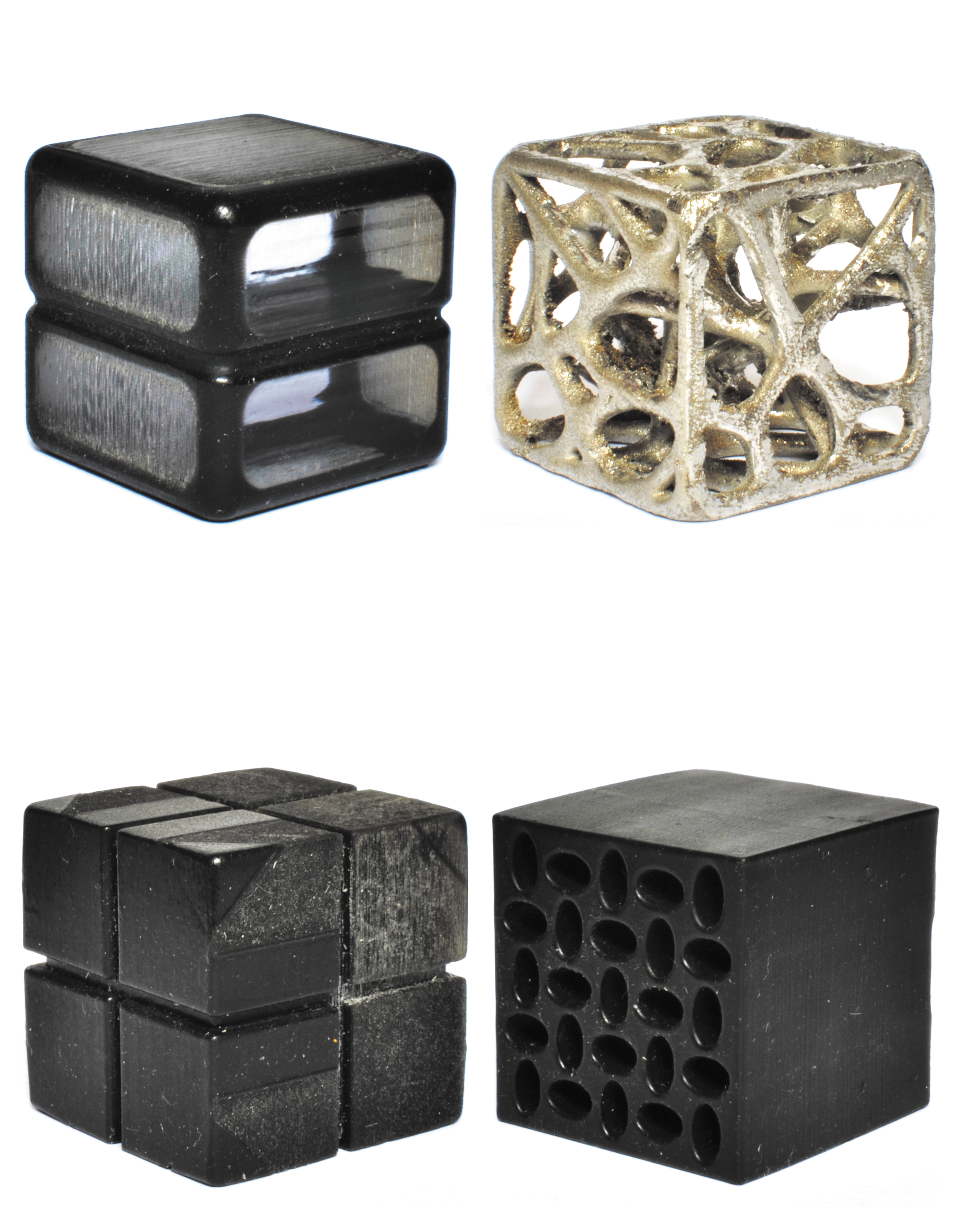
The objects should be as neutral as possible in their general form and at the same time to represent the opportunity as well as possible. Using the literature on inspirational objects in the design process,65,66 we choose cube-shaped objects with a size of 3 cm on each side (Table 1).
The “Opportunity Objects”
Correction added on May 24, 2021 after first online publication of May 6, 2021: The right most figure for the “Internal Channels” row was the incorrect figure. The right most figure has been replaced with the correct figure.
We have chosen to present one opportunity per object to facilitate the understanding of the different opportunities, especially for novice designers in AM.
We use three types of processes: selective laser melting SLM (SLM®125), material jetting polyjet (Stratasys Objet260 Connex), and fused deposition modeling FDM (Stratasys Dimension ELITE and MakerBot Replicator 2).
Evaluation of the “opportunity objects”
The above objects are represented according to their final design. Before using these objects in a creativity session, we wanted to have the cubes evaluated to validate their design in relation to the opportunity associated with each one. It allowed us to adapt and improve the designs to avoid any comprehension bias when using the tool.
Thus, the opportunity objects were evaluated by three samples. The first sample consisted of 18 students of different nationalities in the final year of master's degree in Management Engineering. The second sample involved six engineering professors from three European universities. The third sample consists of five industrialists from five companies based in Europe. These industrialists work in product design and are interested in
The evaluation consisted of carrying out an analysis by verbalization of the objects. Each participant had the object in their hands for 1 to 2 min and had to write down all the words that came to mind.
The objective of this evaluation is to have the opportunity name or a synonym spelled out to validate the design of the objects or improve them. For example, for the “embedded components” opportunity, the synonyms cited were inclusion, encapsulation, and “Russian dolls.”
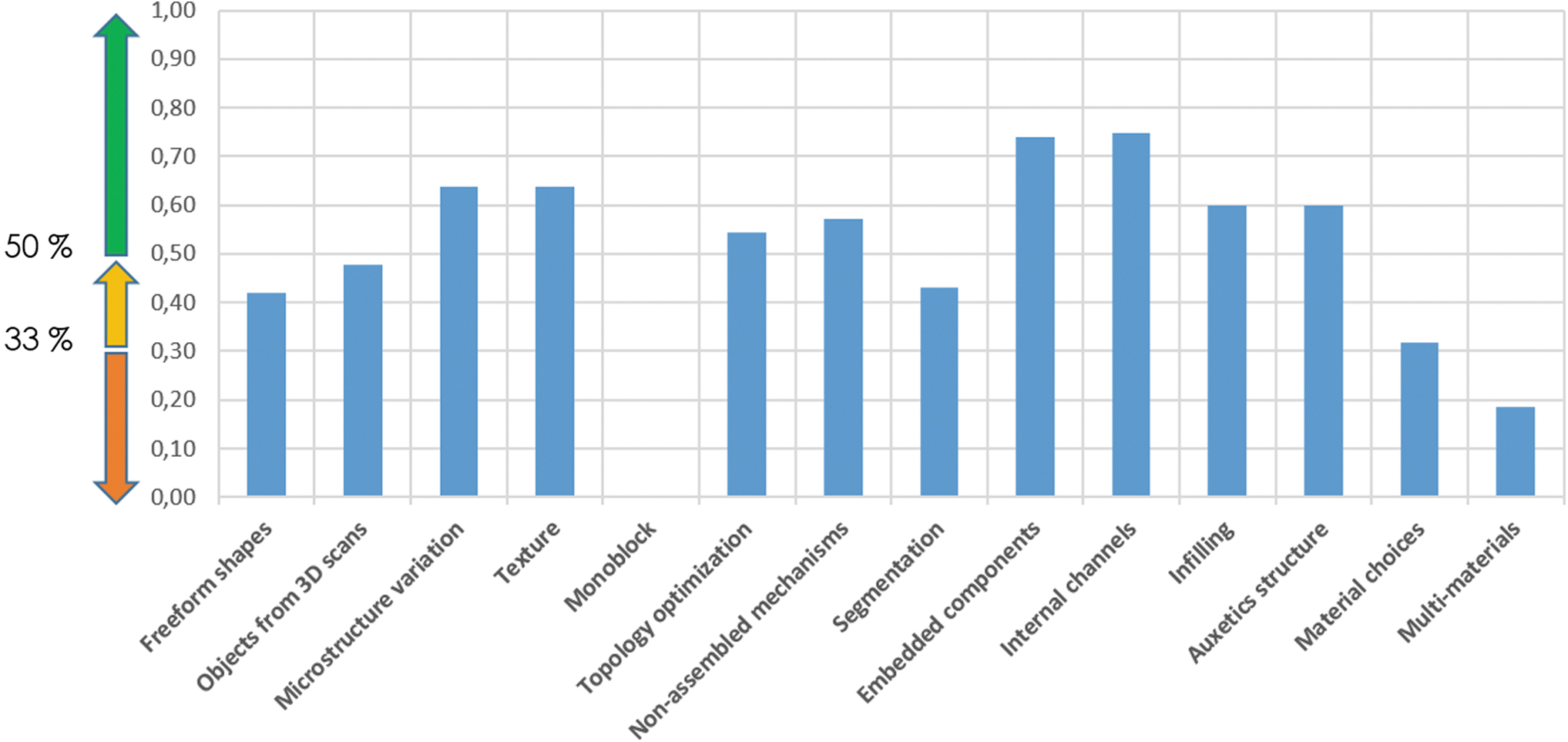
As the creativity sessions are conducted in groups, the design of the objects can be validated if at least one person in two or three gives at least one synonym. 67 For each participant, a score of 1 was given when he or she gave the name of the opportunity or a synonym, and a score of 0 when he or she did not. Each sample has a weight of one third.
Figure 2 shows the results. Above 50%, the object is understood by one person out of two; between 33% and 50%, the object is understood by one person out of three; and below 33% the object is understood by less than one person out of three.
Evaluation of the “opportunity objects.”
For each object, a score between 0 and 1 is obtained. With the words given by the participants, we validated eight objects. We were able to observe words highlighting design biases, which allowed us to improve or adapt the design of certain objects. Moreover, the evaluation pointed out important design similarities between some cubes, forcing them to increase the disparities between them. The first batch of objects was entirely made of plastic material; the panel of industrialists informed us that the presence of metal objects in the batch would make it more attractive to professionals. The evaluation highlighted the difficulty of understanding the object associated with the monoblock opportunity.
Thus, this evaluation made it possible to improve the design of four objects (texture, monoblock, segmentation, multimaterials) and to integrate metal into the design of two objects (topology optimization, material choices).
The new designs of the objects received validation following a new presentation of them to the groups of academics and industrialists. The remarks of the participants highlighted that a short presentation of the “opportunity objects” before their use in the creativity session could improve the understanding of the latter.
Case Study
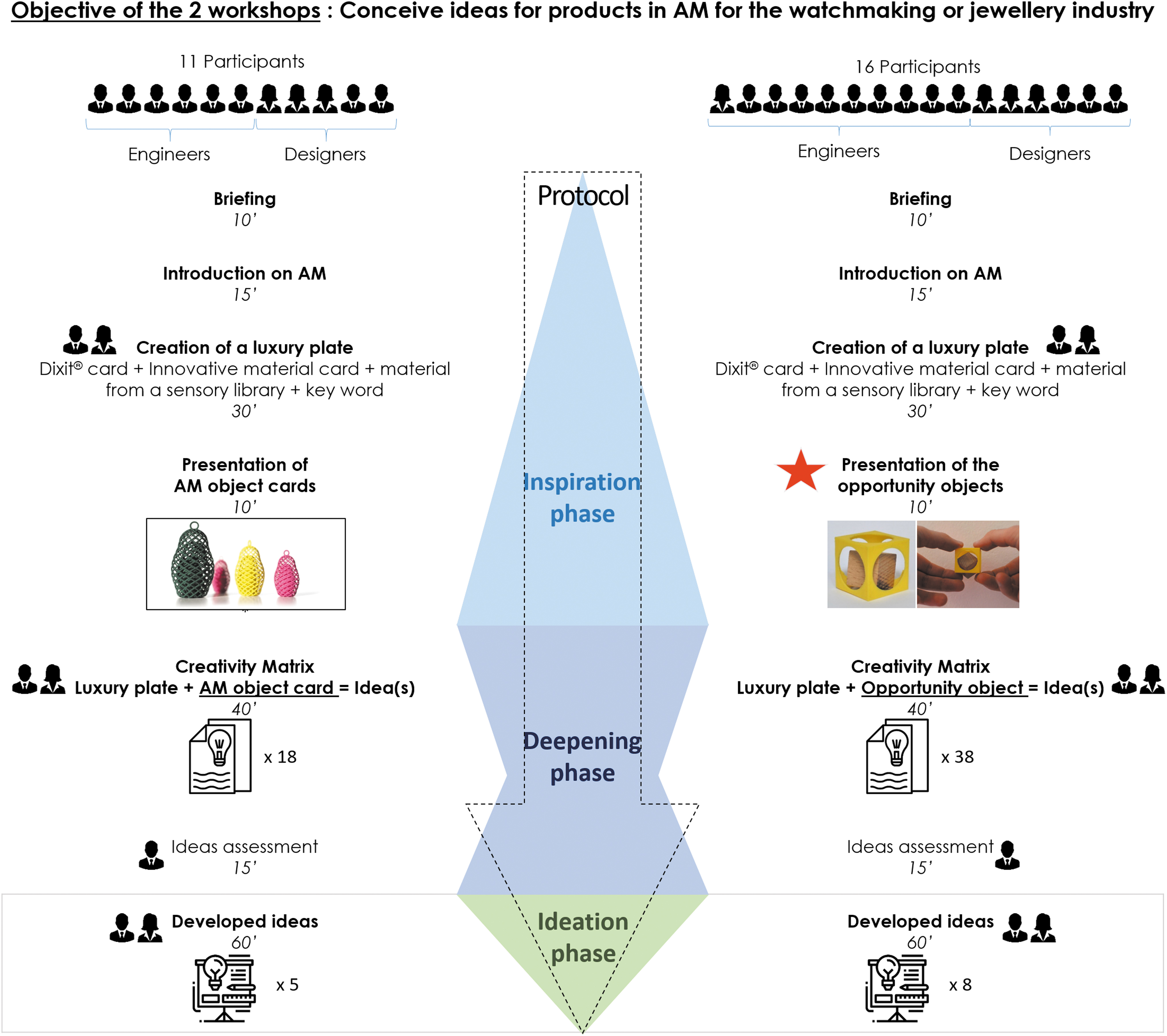
After the validation of the “opportunity objects,” we can use them for a case study with designers in a company. The company is a group specializing in the luxury goods industry, which includes several brands, particularly in the watch and jewelry sectors. The case study includes two workshops with engineers and designers from several brands of the group, all working in product design. The participants were not the same in the two workshops. As the two groups did not have the same number of participants, the designers worked in dyads on the different phases of creativity, problem analysis, and design.
The structure of the two workshops was equivalent. Figure 3 presents the session protocol with the objective, the participant profiles, the plan, the tools used, and the deliverables. The difference between the two workshops appears during the inspiration phase. The first group works with “AM object cards,” while the second group works with the “opportunity object.”
Protocol mapping. AM, additive manufacturing.
Results
Generating creative solutions
To evaluate the level of creativity, we chose five judges who are experts in innovation or product design. For this purpose, all ideas developed were sent to the judges with evaluation criteria.
Evaluation criteria
Four criteria for evaluating creativity were defined, based on the work of the “P's of Creativity” (Process, Product, Person, and Place),68,69 and more specifically on the criteria for product creativity.70,71
The four evaluation criteria are as follows:
Relevance: The concept meets the requirements of the problem from a use and performance point of view (e.g., the concept seems to do what it is supposed to do, the concept seems easy to use, the concept meets the objectives). Improvement (incremental innovation): The concept draws on external knowledge to improve the existing product (e.g., the concept draws attention to gaps in existing products, the concept shows how existing products could be improved, the concept uses existing knowledge to generate novelty). Elegance: The concept is elegant because the solution is at the same time efficient, parsimonious, and intellectually satisfying, hence a certain esthetic feeling (e.g., one can immediately see that the concept makes sense, the concept is well finished and skillfully executed, the concept is surprisingly simple and is “smart”). Vision (breakthrough innovation): The concept proposes new ways of approaching existing problems to innovate (e.g., the concept is designed with new bases, the concept transforms problems into advantages, the concept brings a product that does not yet exist).
Evaluation by judges
Each judge had to evaluate the 13 detailed ideas according to the 4 criteria on a Likert scale with 5 answer choices, from 1 “Strongly Disagree” to 5 “Strongly agree.” Agreement among the judges proved acceptable for reliable analysis (α = 0.78) (Table 2).
Evaluation Table for Creativity Criteria
With the aid of an analysis of variance study, we observe significant differences in the four creativity criteria. We observe a significant difference in the criterion of relevance. The ideas from group 2 put forward concepts with much more detailed technical characteristics. The contribution of knowledge in AM allowed the participants to focus, in more detail, on the use of the product. Thus, while the ideas from the first group look more like futuristic concepts, the ideas from the second group are more concrete and really address an existing need. The difference in average between the two groups is very significant on the criterion of breakthrough innovation (vision).
These results suggest that the ADAM
2
methodology generated more creative solutions than the use of cards presenting
Exploitation of the technical potential of AM
We also chose to conduct an evaluation by five judges, experts in AM or product design.
Evaluation criteria
Four criteria for evaluating the technical potential of AM were defined, based on Gibson's complexities. 3
The four evaluation criteria are as follows:
Shape potential: The concept emphasizes the possibility of achieving any geometry through the use of
Hierarchical potential: The concept highlights the possibility of improving the structural performance of the product through
Functional potential: The concept highlights the contribution of new functions thanks to
Material potential: The concept highlights the use of several materials thanks to
Evaluation by judges
Each judge had to evaluate the 13 detailed ideas according to the 4 criteria on a Likert scale with 5 answer choices (Strongly Disagree, Disagree, Neutral, Agree, and Strongly Agree). Agreement among the judges proved acceptable for reliable analysis (α = 0.79) (Table 3).
Evaluation Table for Criteria for Additive Manufacturing Potential
AM, additive manufacturing.
From the judges' evaluation data on the potential of AM, significant differences are observed between the group that did not use our methodology and the group that did use it on the four criteria.
These results suggest that the ADAM 2 methodology was more conducive to the exploitation of the technical potential of AM with the “opportunity object” than with the cards showing products in AM.
Discussion
While the evaluations show us that the use of objects is more efficient to generate creative solutions and to exploit the potential of AM, these workshops also allowed us to observe a real difference between the use of cards and the use of objects. Some participants from group 2 took a lot of time trying to interpret the “opportunity objects” for their ideas. As the handling of the objects was easy, we observed that the participants tended to take and retake the objects in their hands during the whole time of the conception of the ideas. Conversely, the participants in group 1 looked at the “AM object cards” at the beginning before putting them back on the table during the entire phase of the development of the ideas. The “opportunity objects” lead to much more discussion between the members of a dyad than the “AM object cards.” The time necessary to develop the idea before putting it on paper was longer with the objects; participants from group 2 had more difficulty finalizing the ideas within 10 min, whereas participants from group 1 had on average much more ease. To present the ideas to all participants, group 1 participants tended to use the luxury plates to argue their idea, while group 2 participants relied on the “opportunity objects.” There is a real difference between the ideas of the two groups, because in the first group the descriptions of the ideas are mainly general and form oriented, whereas in the second group the descriptions of the ideas already contain the basics of mechanical and technical properties, while still having descriptions on form. Reading the ideas of the two groups, one immediately observes that those of the second group are more complete and comprehensive. The consequence of this difference is that the drawings and sketches of the second group are more worked out, more detailed, and thus show a better coherence.
Moreover, participants were much more interested in technical issues using “opportunity objects” rather than “AM object cards.” The fact of having an object in their hands intrigues the participants who are interested in understanding how it is possible to manufacture this object; this aspect of curiosity about the manufacturing phase is much more absent with the “AM object cards.” The fact that the objects present opportunities in a “fairly neutral” way makes it easier for designers to interpret the potential of AM for products in their sector. With the AM images in the one group, designers either seem to set aside the “AM object cards” and not really consider the specificities for their idea, or they try to replicate almost the same thing for their idea.
Our results from an industry application case study highlighted the strength of our method during creativity sessions. Nevertheless, several limitations must be highlighted.
One of the limitations of our work is that the current version of the ADAM
2
method is temporal. Indeed, we have taken into account the current state of technology and the designers' level of knowledge in
We have a limit in terms of participants and groups. The industrial context of the experiment led to a different number of participants between the two groups depending on the availability of the employees and the company's own objectives. The workshop panels are not exactly representative of the population of designers in companies in terms of gender, age, or profession. All participants were volunteers for the workshops. Designers in the watch and jewelry industry may be more open to new technologies such as
We have limits at the level of the protocol. Indeed, with our case study, we show a difference between the use of our methodology and the use of images of products in
Our findings open several research axes. This article aims to present a methodology allowing designers to appropriate the potential of
Conclusion
This article presents the method ADAM
2
that answers the research question: How to promote the assimilation of the technical potential of AM to encourage creativity in product design. To answer this question, we have integrated into a design process a set of inspirational objects in
Footnotes
Acknowledgments
Special thanks to Marine Catel who made it possible for us to organize the workshops in an industrial context, and to Pr Paolo Chiabert who enabled us to present and test our research with students from the Politecnico Di Torino.
Author Disclosure statement
No competing financial interests exist.
Funding Information
This research was carried out as part of project CREAM (CREativity in Additive Manufacturing), funded by the National Research Agency (Project ANR-18-CE10-0010) in France.