




Abstract
Over the past decades, endocrine-disrupting compounds have been under active studies due to their potential environmental impact and increased usage. The actual hormones, especially estrogens, have shown to be one of the major contributors to hormonal waste in wastewater. Wastewater treatment facilities have variable capabilities to handle hormonal compounds and, therefore, different quantities of harmful compounds may end up in the environment. We introduce a simple technique to remove estrogens, such as 17β-estradiol (E2) from wastewater by using 3D printed polyamide-12 (PA12) filters. A selective laser sintering 3D printing was used to manufacture porous PA12 filters with accessible functional groups. Adsorption and desorption properties were studied using gas chromatography with flame ionization detector. The results showed that near quantitative removal of E2 was achieved. The 3D printed filters could also be regenerated and reused without losing their efficiency. During regeneration, E2 could be extracted from the filter without destroying the compound. This opens up possibilities to use the hormone scavenger filters also as concentration tools enabling accurate analyses of sources with trace concentrations of E2.
Introduction
The booming use of pharmaceuticals, such as hormones and steroids, pose an increasing risk to ecosystems. Among other chemicals, estrone (E1), 17β-estradiol (E2), estriol (E3), and 17α-ethinylestradiol (EE2) are regarded as major sources of hormonal waste in waterways.1–6 The hormonal impact of free estrogens in natural waters raises environmental concerns as they adversely affect sexual behavior and development of aquatic life.2–4,7 This is especially true for hormones with higher potency, such as 17α-ethinylestradiol and 17β-estradiol, as they are well-known endocrine disruptors even at nanogram per liter concentrations.1,3,4 The European Commission has noted this and has classified estrone, 17β-estradiol, and 17α-ethinylestradiol as priority hazardous substances, which signals their importance and creates even greater need not only for purification systems but also for more accurate analytics. 8
The commonly used wastewater treatment methods, such as sedimentation and biodegradation, via activated sludge can efficiently eliminate hormones from wastewater effluent.2,9–12 However, due to the incomplete purification as well as analytical challenges in sample preparation and analysis, trace levels of endocrine disruptors can pass the water treatment system undetected. 6 Hormones can form soluble glucuronide and sulfate conjugates, which can bypass treatment and readily deconjugate back to free form afterward. 7
The inefficient removal and improper disposal of waste sludge by agricultural recycling or dumping it in a landfill can provide a pathway for estrogens and other harmful substances to eluate back into waterways, which leads to increasing environmental problems.13–15 Additional tertiary elimination methods, such as membrane bioreactor, 3 degradation by TiO2 photocatalyst, 6 bioconversion, 12 microwave hydrolysis, 16 ultrasonic treatment, 17 ozone degradation, 18 or UV and UV/H2O2 degradation, 19 can increase the level of elimination with added costs and complexity.
From available modern manufacturing methods, 3D printing has lately seen use in a range of different fields from the fabrication of catalysts 20 and selective metal scavengers 21 to printing hydrogels 22 and electrodes. 23 From available 3D printing techniques, selective laser sintering (SLS) has been especially promising for the preparation of porous, flow-through scavengers21,24 and catalysts. 25 In SLS, a laser is used to selectively sinter small particles together, thus forming a customizable porous structure. A new layer of printing material is then applied on top of newly sintered layer and process is repeated, until the desired object is formed. 26
The technique allows the adjustment of porosity, shape, and size of the printed object as well as tailoring the printing materials with chemically active additives turning the final product into a chemically active object. Active additives can be added easily by physically mixing desired compounds with the base printing material and thus forming hybrid materials. 27 The printing process partially melts the supporting polymeric material incorporating additives into its structure while enabling added functionality. 21 Especially important parameter in manufacturing of porous objects is input energy density (ED), which has been shown to affect porosity of printed objects.24,28
One of the most commonly used printing materials for manufacturing objects by the SLS technique is polyamide-12 (PA12). Polyamides contain amide linkages, which form the basic structure of the polyamide. Lone pairs on carbonyl oxygen atoms of amide provide electrons to electron-deficient protons of endocrine-disrupting compound (EDC) phenolic hydrogen groups enabling hydrogen bonding. 29 PA12 has been shown to retain its functional properties even after SLS printing process.21,30 Therefore, printed material can be utilized for example in scavenging metal ions from aqueous solutions without any additional additives. 25 It also indicates that the use of functionalized polymers as printing material could provide another route to chemically active printed objects.
In this article, we report a method for the removal of 17β-estradiol from aqueous sources utilizing SLS 3D printed PA12 filters as scavengers. Adsorption and desorption efficiencies of E2 onto printed PA12 filters and nonprinted PA12 powder were compared to gain insight on how accessible the inner parts of the printed filters are. Reusability of the filters was studied by focusing on regeneration and continuous flow experiments. Finally, capacity tests were used to approximate the effectiveness of filters in scavenging E2. The 3D printed filters could be added into already existing wastewater infrastructure providing an additional removal layer for hormonal waste. This could be particularly efficient in hospitals or in other hotspots where heightened amounts of hormones enter wastewater systems.
Materials and Methods
Materials
High performance liquid chromatography (HPLC) grade 17β-estradiol and estriol were purchased from Merck and were used as supplied. The printing polymer Adsint PA12 L was purchased from ADVANC3D Materials and used without any additional additives. Methanol, acetonitrile, and pyridine were purchased from VWR Chemicals and acetone from Sigma-Aldrich. All solvents used in gas chromatography (GC) analyses were HPLC or GC grade. The solvents used in HPLC analyses were ultra-high performance liquid chromatography (UHPLC) grade. Pyridine was dried using 3A molecular sieves. Ultrapure water was purified using ELGA PURELAB Ultra.
Separate stock solutions of E2 and internal standard E3 were prepared in methanol in concentrations of 1 and 0.5 g L−1, respectively. Working solutions of 0.5 or 1 mg L−1 E2 and 0.1 g L−1 E3 were diluted using ultrapure water. The derivatization agent N,O-bis(trimethylsilyl)trifluoroacetamide (BSTFA) + trimethylchlorosilane (TMCS) (99% + 1%) was purchased from TCI Europe. The pH range of solutions used in the experiments was 6–7. This research did not involve human subjects and therefore IRB approval was not required.
Filter printing process
The SLS was conducted using Sharebot SnowWhite SLS 3D printer. The cylindrical, porous filters (height = 5.3 mm, diameter = 16.5 mm, mass = 0.5 g) were printed using the PA12 polymer without any additional pretreatment. Dense, nonporous filters (mass = 1.1 g) were printed for benchmark purposes by increasing input ED. For porous filters, best results were obtained with hatch space (HS) of 0.25 mm, laser power (P) of 5.6 W, and scan speed (v) of 1800 mm s−1. The operation temperature was set to 172°C and a high-intensity laser was then used to selectively sinter desired objects 0.1 mm layer at a time. Nonporous filters were printed by increasing the laser power to 7 W, operation temperature to 173°C, and the scan speed to 800 mm s−1. Whole and split filters are shown in Supplementary Figure S1. ED provides a way to summarize these values in a more comparable unit.
The filters shown in Figure 1a and Supplementary Figure S1b were then thoroughly washed with ultrapure water and methanol to get rid of any unbound material before the experiments. Flow-through experiments were conducted using 10-mL syringes with tightly and firmly fit filters as shown in Figure 1b.

Sample preparation
GC analyses required silylation of samples due to nonvolatile properties of 17β-estradiol and estriol. Internal standard solution with a concentration of 0.1 g L−1 E3 in methanol was prepared and 100 μL of it was added to each sample. The samples were evaporated to dryness in Schlenk line, dissolved into 850 μL of acetone, 50 μL pyridine, and 100 μL of derivatization agent BSTFA+TMCS (99% +1%), and transferred into GC vials. The samples were then silylated at 60°C for 60 min, after which they were measured. Samples that were measured using liquid chromatographic technique were spiked by using 100 μL of internal standard 5.5 mg L−1 E3 in methanol into 1 mL sample and measured without further modifications. The prewashing procedure of filters consisted of 10 mL methanol wash followed by three 10 mL ultrapure water washes repeated three times.
Adsorption and elution experiments
The aim of the adsorption study was to show that the adsorption capability of PA12 is not lost during the printing process. The batch experiments were carried out for both the porous and nonporous printed filters, while only the porous filters could be used in flow-through experiments.
The batch experiments were conducted by using 100 mL of 1 mg L−1 E2 in water. Nonprinted original powder, porous filters, and nonporous, dense filters were tested using four replicates. The adsorbent material was placed in the solution and solutions was stirred during the adsorption experiment. The samples were taken after 15-, 60-, 120-, and 210-min contact times. For porous and dense filters, 1 mL samples were taken for preparation. Due to suspended residue in the powder experiments, powder samples were filtered using 0.42 μm syringe filters before taking 1 mL of sample. Samples were then spiked with internal standard and analyzed using multiple reaction monitoring (MRM) in HPLC coupled with triple mass spectrometer (HPLC-MS/MS).
The flow-through adsorption experiment for 3D printed porous PA12 filters were carried out by using 1 mg L−1 E2 solution. The filter was tightly fit into the syringe and the sample solution was passed through it with flow rate of ca. 4 mL min−1. Samples containing 12 mL of eluent were collected during the experiment, from which 1 mL samples were taken, spiked with internal standards, and analyzed by using HPLC-MS/MS. Experiment was conducted with three replicates.
Elution experiments were conducted using pure acetone, acetonitrile, and methanol. Thoroughly washed porous PA12 filters were loaded using 5 mL of 1 mg L−1 E2 and washed three times using 10 mL of ultrapure water. Elution experiments were then conducted by filtering 10 mL of chosen eluent at a speed of ∼10 mL min−1 through the filter and measuring the amount of extracted E2. Four replicates were measured for each eluent using GC with flame ionization detector (GC-FID).
Reusability experiments
To analyze the reusability of porous PA12, two filters in syringe were loaded using 5 mL of 1 mg L−1 E2 solution. Filters were then washed three times using 10 mL of ultrapure water followed by elution using 10 mL of pure methanol. The amount of eluted E2 was measured from evaporated methanol samples. The filters were washed again using three 10 mL ultrapure water washes before the next cycle. Reusability of PA12 filters was confirmed by measuring extracted E2 from five repeated cycles using four replicates using GC-FID.
Capacity of powder and printed material
The capacity of PA12 powder and dense, nonporous filters was measured using a batch-type process. Around 0.06 g of PA12 powder was measured in 50-mL vials and 50 mL of a solution containing 0.5 mg L−1 E2 was added. The dense filters had masses of 1.12 g, for which sample solutions of 1 mg L−1 E2 in water was used. Higher concentration used with dense filters was due to heavier filter mass compared with porous filters, which had a mass of ∼0.5 g. The size of all printed filters (Fig. 1a) was set to be 5.3 mm thick with a diameter of 16.5 mm. After 2 h of shaking, solutions were filtered through Whatman 41 filter, and a sample of 10 mL was taken and prepared for measurement. The experiment was performed in triplicate for powder and quadruple for dense filters. The measurements were done with GC-FID.
The capacity of porous PA12 filters was measured by continuously running 100 mL of 0.5 mg L−1 E2 solution through a filter in a closed loop at a rate of 5 mL min−1. The porous filters had a mass of ∼0.56 g. Three syringes with separated loops and a single filter in each of them formed three replicates used in the experiments. Samples were collected from each loop after running the systems for 2 h and prepared for measurement without additional filtration. In each case, the amount of hormone in the solution exceeded the capacity of the material so that the capacity could be calculated by taking the amount of extracted E2 against the weight of the filter material in equilibrium.
Gas chromatographic analysis
The qualitative analysis was performed using an Agilent 6890A gas chromatograph with Agilent 5973N selective mass detector in scan mode. The column used was Zebron DB-5MSi (30 m × 0.25 mm i.d. × 0.25 μm film thickness) nonpolar column containing (5%-Phenyl)-95%-dimethylpolysiloxane coating. The electron ionization energy of 70 eV was used. Temperatures of inlet port and ion source were 290°C and 230°C, respectively. Helium was used as a carrier gas and samples were injected in splitless mode. Temperature program started from 150°C with a hold of 1.5 min. The temperature was then raised to 270°C with a rate of 25°C min−1. Finally, the temperature was raised to 300°C with a rate of 2°C min−1 making the overall running time 21.30 min.
The quantitative analysis was conducted using a Shimadzu GC-2010 gas chromatograph with flame ionization detector. Concentrations were calculated using the internal standard. As with GC-MS measurements, Zebron ZB-5MSi (29 m × 0.25 mm i.d. × 0.25 μm film thickness) nonpolar column was used. Temperatures for injection port and detector were 290°C and 300°C, respectively. Splitless injection with 1 μL injection volume was used.
Temperature program of the oven started from 150°C with a hold time of 1.5 min. The temperature was then raised to 270°C with a rate of 25°C min−1. Finally, the temperature was raised to 300°C with a rate of 2°C min−1 making the overall running time 21.30 min. Calibration was linear (R 2 = 0.999) from 0.1 to 0.5 mg L−1. The limit of detection and limit of quantitation calculated for 17β-estradiol using the calibration curve were 10 and 29 μg L−1, respectively.
HPLC analyses
Quantitative analyses were conducted using Agilent 1290 Infinity coupled to Agilent 6460 with Agilent Jet Stream ESI ion source triple quadrupole mass spectrometer. Collision and sheath gas temperatures were 250°C and 350°C, respectively. The compounds were measured in negative ion mode. Capillary voltage was set to 4000 V and electron multiplier voltage to −400 V. Pure water with 1 mM NH4F and 35% acetonitrile in methanol were used as A and B mobile phases with flow speed of 0.300 mL min−1. Binary pump was set to 70% A and 30% B for 0.5 min, after which B solution was ramped to 100% in 6.5 min resulting in a total run time of 7 min. Column was Eclipse Plus C18 RRHD (Agilent, 2.1 × 50 mm, 1.8 μm) and it was kept at 30°C.
Measurements were conducted in MRM mode where precursor for 17β-estradiol was set to 271 m/z and known product ions 183 and 145 m/z were measured. Similarly, precursor for internal standard estriol was set to 287 m/z and ions 171 and 145 m/z as product ions. 31 For both 17β-estradiol and estriol the former product ions were set as quantifier ions and the latter as qualifier ions. Calibration was linear (R 2 = 0.9999) from 0.1 to 1 mg L−1. The limit of detection and limit of quantitation for 17β-estradiol calculated using the calibration curve were 11 and 34 μg L−1, respectively.
Helium ion microscope imaging
Helium ion microscope imaging was performed using Carl Zeiss ORION NanoFab helium ion microscope. GFIS acceleration voltage was around 30 keV and the beam current was set between 0.27 and 0.31 pA. The working distance was between 7.82 and 8.84 mm and scan dwell time was 2 μs. Samples were cut into suitable sizes and cleaned lightly with pressurized air before imaging.
Results and Discussion
It has been reported that polyamide-6 (PA6) can be used as the adsorbent for the removal of estrogens from water. 32 On the other hand, longer chain polyamides, PA11 and PA12, are among the most commonly used polymers used in SLS printing. Therefore, we chose PA12 as the primary printing material to be tested for scavenging estrogens. Physical, chemical, and mechanical properties of the 3D printed objects can be tailored by selecting suitable printing material with desired chemical functionalities and by adjusting the printing conditions.
When the printing conditions are chosen in such a way that the polymer particles are only partially melted, they are firmly fused together but retain their particle-like appearance. This generates voids between the sintered particles and produces a porous object, which makes filtration of solvents possible.23,25,33 The porous filters were therefore made with an input ED of 0.0124 J mm−2, while threefold ED of 0.035 J mm−2 was used for nonporous filters. Supplementary Figure S2a and b clearly shows the difference in porosity, which can be obtained by decreasing the ED needed for building objects. The inherently porous structure allows flow of fluids through the object without printing any specific flow channels in it. The surface structure of the printed object is shown in Figure 2.
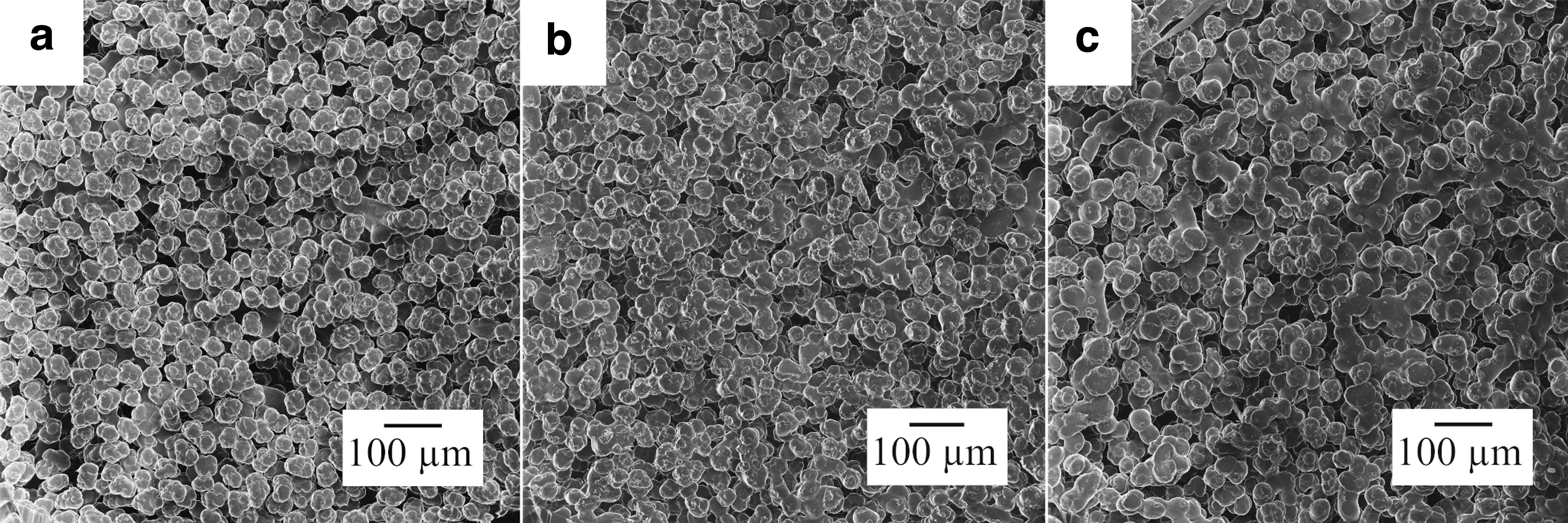
HIM images of SLS-printed PA12 filter surfaces.
In general, the structure of the printed filter, shown in Figures 1 and 2, is mechanically durable and resistant to a wide range of organic solvents. Methanol tends to slightly deform printed PA12 objects after extended exposures, as can be seen in Figure 2b and c, However, notable changes in the detailed structure can be seen only after storing the object ca. two months in methanol. Then, some particles are slightly dissolved, and the fusion of particles becomes more prominent. However, even after this kind of treatment, the printed filters are still able to capture E2 and the overall structure of the filter remains intact.
The methanol exposure lasting for two months can be considered as an extreme case and a more detailed study of how the elongated exposures would affect the properties of PA12 filters is needed. Precise structural comparisons can be somewhat misleading as the printing aspects play a major role in the sintering process and slight variations can lead to nonidentical structures. Properties, such as the temperature of the powder and placement on the printing bed, could cause minuscule fluctuations of fusion rate.
Adsorption and elution tests
The adsorption efficiency of the 3D printed PA12 filter was studied by using both batch and flow-through experiments. The aim was to study the accessibility of inner structure and effectivity of the printed PA12 filters. The batch process was performed by using pure PA12 powder as well as both dense and porous filters and for each sample, one of them was placed into a vial containing sample solution. Additionally, a flow-through setup could also be used for porous filters, and thus one was inserted in a syringe and the sample solution was filtered at a constant flow rate of ∼4 mL min−1.
The pure PA12 powder is expected to have higher active surface area than printed filters and should thus exhibit high adsorption efficiency. The problematic handling of powder samples due to its hydrophobic properties and problems to remove fine powder completely from the analysis solutions increased the uncertainty of the measurements but the overall results seen in Figure 3 support the assumption of higher adsorption capacity. The printed porous and dense filters had quite similar adsorption efficiencies in the batch experiments indicating that only the outer surface of the filters was available for adsorption. This is most likely due to the high surface tension of the water, which prevents penetration of the solution into the porous filter in batch reactions. All samples in contact time study shown in Figure 3 and Supplementary Figures S3 and S4 seemed to reach equilibrium within first 60 min.

Effect of contact time in adsorption efficiency for various PA12 samples.
One of the main benefits of porous filters is that they can be used in flow-through systems. When the solution is pushed through filter, the inner structure of the filter is also available for adsorption. The flow-through experiment showed that higher adsorption efficiencies can be obtained compared with batch-type process. Increasing the dimensions of the filter and therefore the bed volume would have increased adsorption further. Figure 4 shows breakthrough curve for one porous filters when ∼1 mg L−1 E2 sample solution was used. Error bars shown are standard deviations from three separate experiment. An upward trending curve would suggest that the filter was slowly saturated and would eventually reach full saturation.

Adsorption efficiency of porous PA12 filter in flow-through experiment. Flow rate = 4 mL min−1, C0 = 1 mg L−1, Bed volume = 1.1 mL.
Powdery PA12 exhibits the highest efficiency but reduction of adsorption capabilities in printed flow-through filters is moderate. Furthermore, by using the printed filters, the problems with the handling of the powder could be completely avoided. The general principle of the flow-through experiment is summarized in Figure 5.
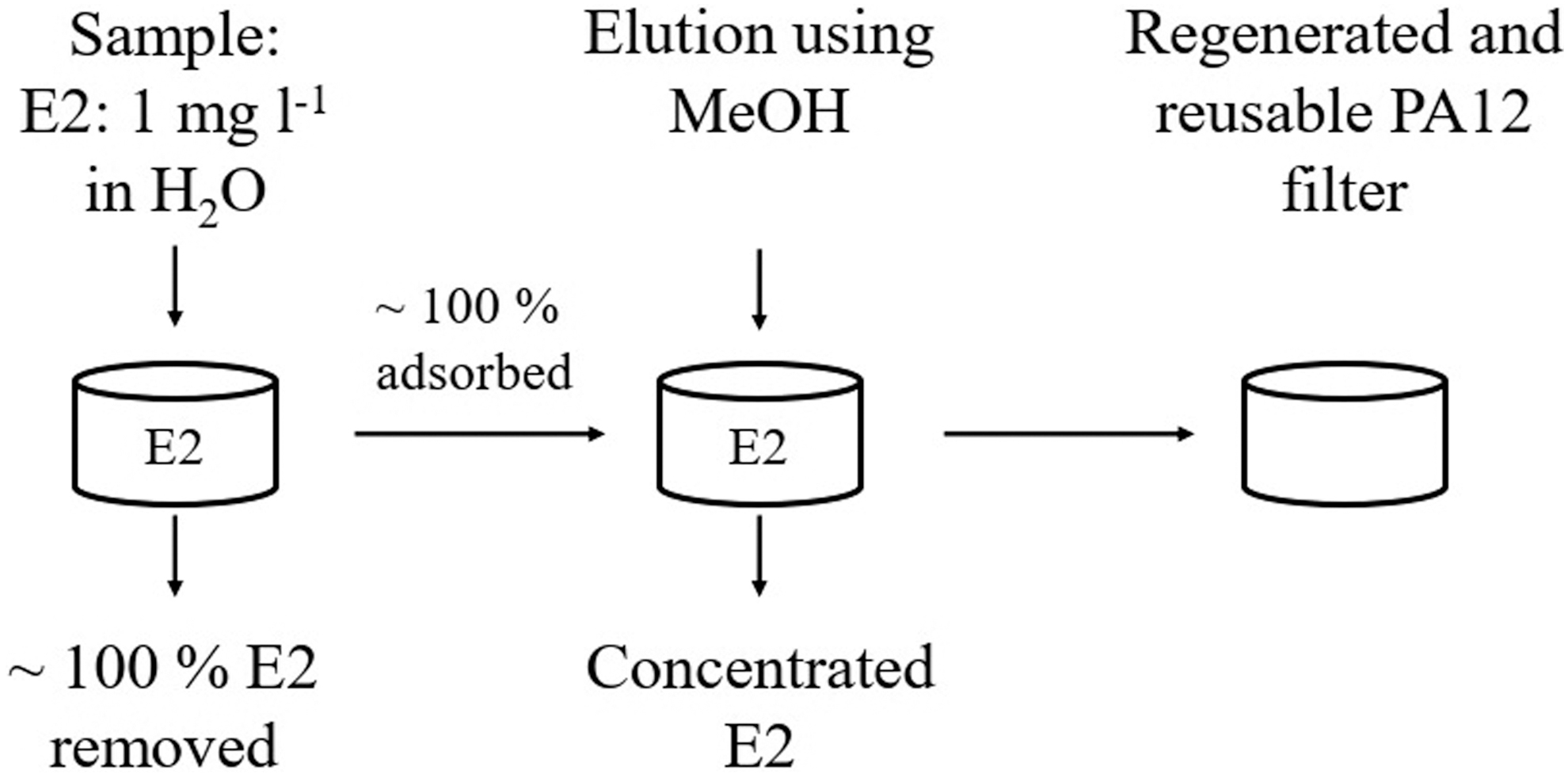
The general principle of the PA12 filter in the flow-through experiment using methanol as removing eluent.
The adsorption capabilities of porous filters were studied by fitting them inside 10-mL syringes. This enabled an easy-to-handle and controllable flow-through setup, where 1 mg L−1 solution could be pushed through the filters for flow rate of ca. 10 mL min−1. The loaded filters were then regenerated by the elution process. The goal of the elution process was to completely remove the adsorbed E2 from the 3D filter. Good candidates for eluent were polar solvents, such as acetone, acetonitrile, and methanol as adsorption mechanism is most likely hydrogen bonding between amide group of polymer and hydroxy group of the EDC.29,32
The most efficient eluent was methanol, which resulted in a nearly complete (94.0% ± 3.4%) recovery of E2. The recovery efficiencies for acetone and acetonitrile were slightly lower (92.0% ± 0.9%) and (82.1% ± 2.5%), respectively. Methanol has also been reported to be the most effective solvent for removing E2 from PA6. 32
Reusability
Reusability of filters was confirmed by repeating adsorption and desorption cycles up to five times, which showed constant adsorption efficiencies and proved reusability of the filters. The efficiency of the removal of E2 by desorption was also consistent. About 93% of adsorbed E2 could be recovered with each desorption cycle using a volume of 10 mL. Additional washing step using 10 mL of methanol was used to desorb remaining E2 and regenerate PA12 to a level where near-perfect recovery of E2 was maintained as shown in Figure 6. The concentration of nonrecovered E2 was below the detection limits of the method. The polar methanol works as an efficient eluent without affecting the reusability of the PA12. Therefore, PA12 can be regenerated and reused easily, enabling usage in high-throughput environments, where the hormonal concentration can be high.

Successive elution experiments of PA12 filters using methanol (mean ± SD).
Adsorption capacity of powder and printed material
The capacities of the PA12 filter and powder were studied in flow-through and in batch systems. As shown in the previous adsorption experiments, the sintering process does not decrease the functionality of PA12 and therefore does not prevent the adsorption of E2. Sample concentrations of initial and equilibrium states were approximately (0.48 ± 0.01) and (0.08 ± 0.02) mg L−1, respectively. The adsorption capacity of printed PA12 filters was (71 ± 6) μg g−1, while unprinted PA6 powder has been reported to have a capacity of ∼10 μg g−1. 32 The dense filters had capacity of (2.6 ± 0.2) μg g−1, which we believe was caused by inaccessible inner structure and higher overall mass. For dense filters, the sample concentrations of initial and equilibrium states were approximately (0.68 ± 0.01) and (0.65 ± 0.01) mg L−1, respectively.
A higher density of functional groups in PA6 compared with PA12 would suggest that PA6 should be more effective and therefore the batch test was conducted for PA12 powder leading to a capacity of (48 ± 3) μg g−1. Sample concentrations of initial and equilibrium states were approximately (0.44 ± 0.02) and (0.38 ± 0.01) mg l−1, respectively. The unprinted and fully suspended powder would theoretically have a higher capacity than the printed filter, as all functional sites are easily accessible. However, the hydrophobic properties of polyamide cause powder particles to agglomerate leading to a situation, where some of the powder's functional sites are blocked. The capacity measurements utilizing the printed filters and flow-through system do not exhibit similar problems and present a simple and applicable way to take advantage of PA12's extraction capabilities.
Conclusions
In this article, we showed that 3D printed polyamide-12 filters were capable of adsorbing 17β-estradiol from synthetic solutions quantitatively. The adsorbed E2 can be efficiently released from the filter using methanol, which also regenerates filters enabling reusability. Extended exposure to methanol can deform printed polyamide filter, but rapid elution cycles have no adverse effects in our experiments. Even longer methanol exposures cause only minor deformations, and the overall structure of the filters stays intact. This shows how partially melted polyamide-12 polymers can form durable structures.
The main benefit of using printed PA12 filters was the possibility of building effective and customizable filters with the desired size, shape, and porous structures. We found that the porous PA12 filters can be used as an inexpensive, efficient, and scalable scavenger of E2, which can be integrated into the already existing wastewater treatment systems. We believe that in the future, printed objects such as PA12 filters with tailored functional groups or specific additives, can be used to extract other pharmaceutical compounds efficiently and selectively from different sources.
Footnotes
Authors' Contributions
J.F. wrote the original draft, conducted measurements, and participated in the development of methodology. A.A. conducted preliminary screening and participated in the development of methodology. E.L. provided conceptualization and participated in writing and review of the draft. M.H. provided supervision and participated in review of the draft. All authors have given approval to the final version of the article.
Acknowledgments
The authors would like to thank Dr. Kimmo Kinnunen for conducting Helium Ion Microscopy imaging and Hannu Salo for helping with Scanning Electron Microscopy imaging.
Author Disclosure Statement
No competing financial interests exist.
Funding information
This work was supported by the Department of Chemistry, University of Jyväskylä, Finland.

References
Supplementary Material
Please find the following supplemental material available below.
For Open Access articles published under a Creative Commons License, all supplemental material carries the same license as the article it is associated with.
For non-Open Access articles published, all supplemental material carries a non-exclusive license, and permission requests for re-use of supplemental material or any part of supplemental material shall be sent directly to the copyright owner as specified in the copyright notice associated with the article.
