




Abstract
Hydrophobic surfaces require finely tuned process chains due to the scale, complexity, and patterning methods. For this purpose, vat photopolymerization (VPP) additive manufacturing is a promising method for surface generation; however, together with the fabrication process, the design phase needs to be optimized to achieve the desired surface property. This work presents the influence of the design features of hydrophobic surfaces through multiple studies on simple pillar structures, intrinsic single-unit geometries, and surface deposition on complex substrates. The results showed that depending on the dimensions of single pillar dimensions, wetting properties can extend between the contact angles (CA) of 83°–115.11°. The hydrophobicity was further increased by applying a re-entrant structure, reaching the CA of 115.24°. The surface deposition on the complex substrates significantly increased water droplet adhesion, preventing it from rolling off, which can be beneficial for manifold device protection from the hazardous influence of the environment. In addition, the influence of the surface on the acoustic properties was examined, which showed that the pattern application in the real-life device does not have a detrimental effect on the intrinsic functionality. This study showed that the design phase should be an essential part of the VPP process chain as it significantly influences the wetting properties of the surfaces.

Introduction
Surface engineering has been rapidly developing and has become an individual research and industrial discipline. Significant growth was influenced by the emerging field of biomimetics, an area of science and engineering, which studies the structure and morphology of systems occurring in nature and adapts them into the design, material synthesis, and manufacturing processes.1–3 The mechanisms developed by nature provide protection and adaptation to the surrounding environment and are preliminary based on the chemistry and architecture of the biological systems. Examples of functionalities involve superhydrophobicity,4,5 adhesion, 6 anti-biofouling, 7 light, and color manipulation.8,9 Many natural surfaces further exhibit multifunctionality, integrating two or more properties, for example, hydrophobicity and adhesion.10,11
Surface–water interaction, also called wetting, is the most investigated property and describes the spreading of a liquid droplet on a flat substrate. It is determined by the interaction between interfacial tensions. The balance between these interfaces is expressed by the static contact angle (CA),
where
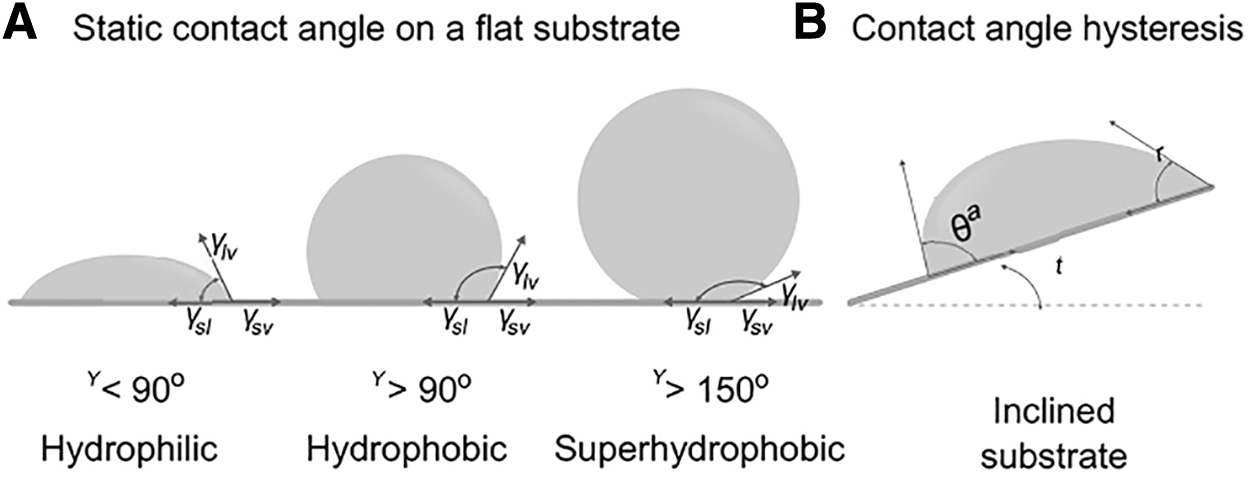
Wetting surfaces.
Another property related to wetting is water droplet adhesion, characterized by contact angle hysteresis (CAH), which is the difference between the advancing (
Thanks to the advancements in manufacturing methods and material synthesis, there has been significant progress in the field of fabrication of wetting surfaces. Hydrophobicity is of the highest interest as it can be extended to self-cleaning, anti-icing, anti-corrosion, water–oil separation, and drag reduction applications. 16 Chemical modification has been the most successful method in achieving desired wetting properties; however, this approach restricts the use of surfaces to applications that disregard the influence of the material composition such as toxicity or intrinsic physical properties. To overcome this issue, the surface–water interaction can be modified, independent of the material, by enhancing the roughness via micro- or nanostructuring. 17 In this approach, the surfaces are built from repeated arrays of microfeatures.18,19 Among numerous processes, photolithography, 20 which can be further altered by etching, 21 replica molding, 22 and electrodeposition, 23 resulted in surfaces with high hydrophobic properties.
The aforementioned methods, however, have their constraints. Conventional manufacturing techniques require multiple fabrication steps within the process chain and lack design freedom. Complex structures can be achieved only via assembly and features such as undercuts; free-form or lattice structures cannot be obtained in a single process cycle. Taking into account these constraints, the deposition of surfaces on devices composed of intricate and organic structures is challenging. These limitations can be overcome by applying vat photopolymerization (VPP) additive manufacturing. VPP employs structured ultraviolet (UV) light to cross-link a liquid polymer and convert it into a solid structure with the shape of the cross section of the produced part with a defined thickness. The components made by VPP are built layer-by-layer, allowing much higher design freedom. 24 Furthermore, the method is characterized by high resolution and versatility of the properties as it applies polymer as a feedstock, which can be modified to achieve the required mechanical, thermal, and physical properties, biocompatibility, stimuli-responsivity, and so on.25,26
Owing to the capabilities of the VPP process, the possibilities for architecture-based hydrophobic surface fabrication have expanded. However, to date, the influence of the geometrical characteristics of the single units as well as the pattern generation by VPP on the wetting properties have not been established. This study explores the design aspects of the structure of the surfaces made by VPP and their influence on hydrophobicity.
Materials and Methods
VPP additive manufacturing
Surface fabrication requires a system that can generate features on a submillimeter scale with high precision. Currently, no cost-effective commercial VPP machines that would meet this criterion exist on the market. Therefore, an open architecture, high-resolution UV mask-projection VPP platform, with a bottom-up configuration, was developed and applied for parts fabrication. The system was entirely designed and built at the Technical University of Denmark (Fig. 2). It uses a Visitech LUXBEAM® LRS-WQ-HY projector with an integrated DLP9000 DMD™ UV light engine with a resolution of 2560 × 1600 pixels and 7.54 μm pixel pitch. The vertical movement of the machine is achieved with a Newmark heavy-duty stage geared with a ClearPath® servo motor, resulting in a Z-resolution of 0.625 μm. The machine has a specially designed vat with an offset geometry for asymmetric membrane peeling, which facilitates part separation for microscale features. 27 The system includes open software, allowing full control over the fabrication process parameters.
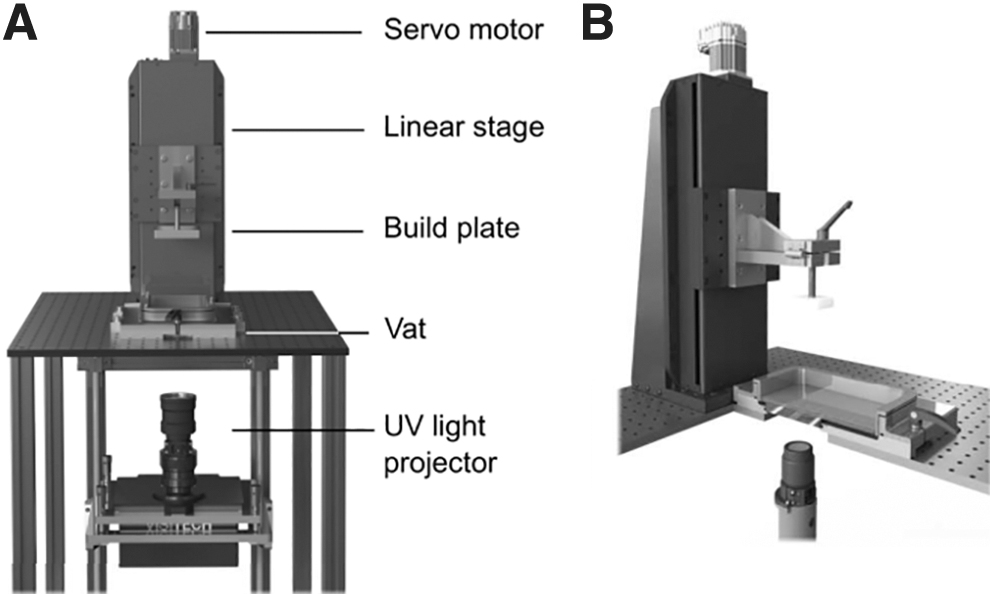
Open architecture, high-resolution mask-projection VPP platform.
35
The material used for the fabrication was a commercial methacrylate-based photopolymer blend (Supplementary Data, Section 1.1). Process parameters were adjusted individually depending on the geometry of the parts (Supplementary Data, Section 1.2). After fabrication, the components were removed from the build plate using a putty knife, rinsed with isopropanol, and subjected to ultrasound cleaning at the frequency of 80 kHz, the temperature of 45°C for 5 min, and subsequently post-cured for 5 min in 45°C in a nonstructured UV light flood bath.
Surface design
The design protocol was divided into two parts. In the first part, the investigation of the influence of various geometries of the single units in the surface structure on the wetting properties was performed. The features were deposited on a flat substrate. The second part examined the deposition of surfaces made of basic patterns on complex structures to investigate water droplet adhesion. For both experiments, pillars have been selected as the entry shape of the single features of the surfaces, as they have been previously explored in various studies.28–30
Single feature and pattern generation on a flat substrate
The surface generation on flat substrates was further divided into subsequent two categories. The first study featured the critical dimensions of the pillar-based surface: width (W, or diameter in the case of the circular pillars), spacing between the pillars in the X-Y plane (S), and height (H), distributed in a periodic arrangement, as shown in Figure 3A. A full factorial, two-level design of experiments (DOE) approach was applied to determine how the dimensions of the critical features influence wetting properties. Table 1 shows the DOE parameters selected for the experiment. The sizes in the X-Y plane were adjusted to the DMD grid, where the dimensions of the width and spacing equaled a multiplication of the pixel pitch of 7.54 μm.

Pillar-based hydrophobic surface.
Design of Experiments Parameters for the Critical Dimensions of the Pillars
DOE, design of experiments.
For simplification, the W, S, and H were abbreviated with a capital letter for high levels, and small letters, w, s and h, for low levels. In the second study, four intricate variations of the pillar geometry were examined (Fig. 3B–E). The first, referred to as diagonal, used patterning at an angle of 60°. In the second type instead of circular pillars, cuboids were applied. In a hierarchical pattern, the pillars were topped with three half spheres. The goal of such an approach was to improve the roughness of the top area of the pillars. The last pattern was based on a re-entrant approach. In this design, each feature had a thin base topped with a wider component to maximize the solid base for the liquid and air between the pillars. In all four geometries, the spacing between the single units was 67.86 μm.
Surface generation on a complex substrate
This study aimed to simulate the applications where water droplet adhesion is used to prevent liquid contaminants that come from the environment. Such a solution can be used in devices, which contain sensitive electronics within their architecture, to prevent the water droplets from migrating along the device and penetrating the inlets. In real applications, where devices on which special wetting surfaces are used, incorporating the arrays of functional features is challenging. The multidirectional facets and inclined arrangement can lead to variations in the pillars' configuration, which can change the functionality of the surface. To mimic such components, four pyramids with different inclination angles were designed with simple pillars with a diameter of 105.56 μm, spacing of 67.86 μm, and height of 108 μm. They are depicted in Figure 4A.

Complex substrates.
The last configuration investigated surface properties applied in the internal walls of a cylindrical substrate. Two pillar-based surfaces with varied patterning and heights were studied according to the DOE approach. Table 2 depicts the dimensions of the patterns, and they are visualized in Figure 4B.
Dimensions of the Microfeatures Applied Inside the Cylindrical Structure
Static CA and CAH
To evaluate the hydrophobic properties of the surfaces, a water drop test was performed with a CA goniometer Model 200 (Ramé-hart). Ten milliliters of distilled water droplets were deposited on samples using a pipette from VWR. The images were further post-processed, and the CAs were measured using an ImageJ Drop Shape Analysis plugin. 31 For reference, a drop test was performed on a flat substrate without any structured surface applied.
Practical use of wetting surface in devices
The application of hydrophobic and adhesive surfaces brings benefits of device protection from hazardous environmental impacts, but it also raises concerns about whether the microfeatures hinder the primary functionality of the part. Acoustic devices, such as speakers or hearing aids, are an example where undesired sound dissipation can take place due to micropillars located in the vicinity of the functional inlets. It is therefore necessary to determine whether such a phenomenon takes place. For this purpose, an experiment to quantify the acoustic absorption of the different cylindrical samples was conducted. The procedure consisted of measuring the normal incidence absorption coefficient of the cylinders placed inside an impedance tube according to the standard ISO 10534-2. 32
The measurement used Brüel & Kjær (B&K) impedance tube (model 4206-T). The inner diameter of the tube was 100 mm, and to fit the cylinders inside the tube, an outer holder was fabricated by fused filament fabrication. The setup used two 1/4-inch B&K pressure-field microphones Type 4187, with preamplifier type 2670. The distance between the microphones, the first microphone, and the surface of the sample was set to 100 mm. With this measurement setup, the frequency range of validity for the measurements spanned between 172 and 1552 Hz. The signal used was a pseudorandom noise containing frequencies between 0 and 800 Hz, with a resolution of 0.5 Hz. From the measured acoustic pressure values, the transfer function between the microphone positions was determined. From this, the reflection coefficient was obtained as follows:32,33
where
For reference, the acoustic performance of the cylinders with applied pillar-based surfaces was compared with a cylinder without any applied structure.
Results
Wetting properties of surfaces—flat substrate
Figure 5A shows CA for various pillar geometries according to the DOE. It can be also seen that the flat substrate is intrinsically hydrophilic, with CA of 65°. The highest average CA was obtained for samples with higher width and height and low spacing, WsH, followed by wsH and WsH. The highest single CA of 118.6° was also obtained by the WsH configuration. The impact of the dimensions is further depicted in the main effects plot, Figure 5B, showing the highest influence of spacing, with the average CA of 110° for s = 67.86 μm and reaching the hydrophobicity threshold of 90° for S = 105.56 μm. Height was the next influencing factor, with a hydrophobicity improvement at H = 108 μm. The width was determined as the least significant factor.
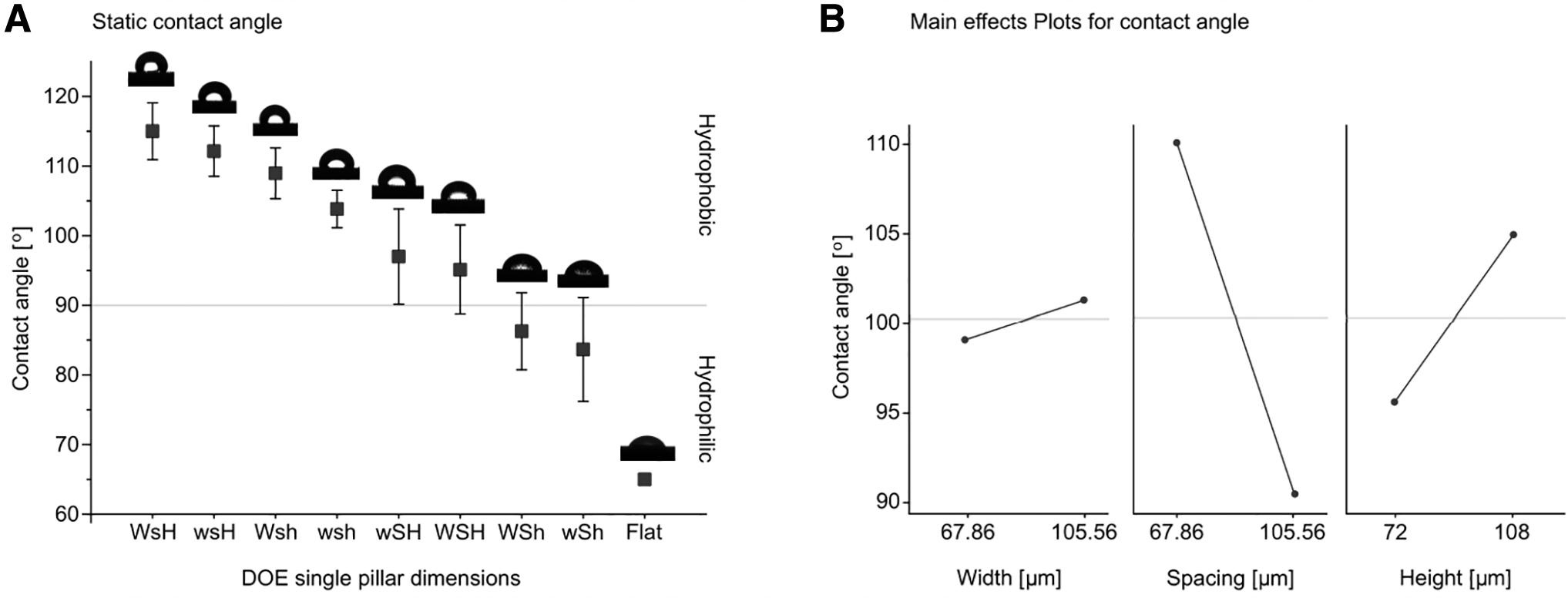
Contact angle for different combinations of width, spacing, and height in the pillar-based surface.
The results of the water drop measurements of the features with higher complexity are shown in Figure 6A. Simple pillar structures with the highest CA, WsH, obtained in the previous study were added to the plot for comparison. The re-entrant geometry contributed to increasing the hydrophobicity, with an average CA of 115.24° and the highest CA of 121.6°. The diagonal arrangement of the pillars and square-base pillars yielded the lowest CA with the diagonal pattern being hydrophilic. The results indicate that the circular pillar with a linear straight arrangement is preferred to achieve hydrophobicity. The application of the half domes did not increase CA; yet compared with all the investigated dimensions and shapes, it resulted in a relatively high CA. Figure 6B shows microscopic pictures of the achieved surfaces. It can be observed that the microstructures were successfully fabricated, and features such as sharp corners and miniature half domes were obtained, indicating that the VPP technique is suitable for the fabrication of surfaces with enhanced complexity.
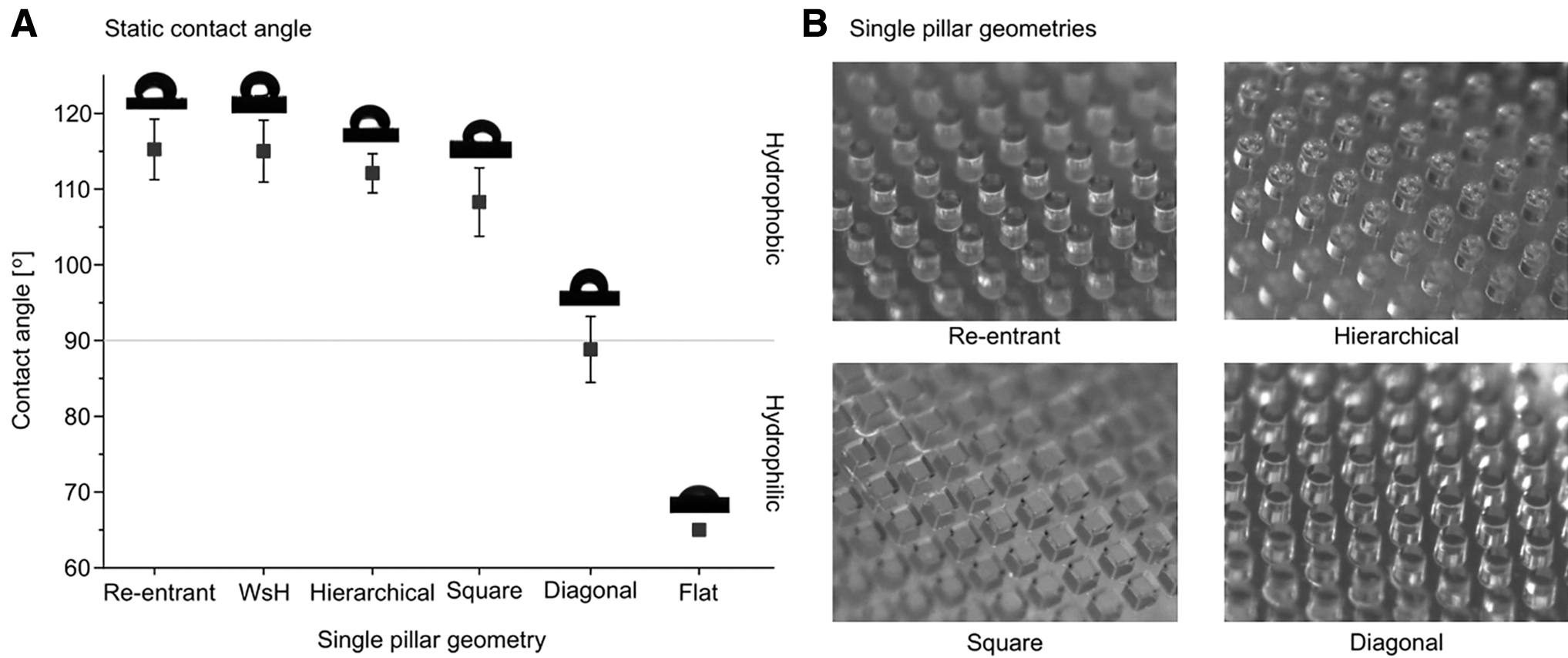
Surfaces fabricated with intrinsic single units.
Wetting properties of surfaces—complex substrates
Figure 7A shows the resulting CAH, compared with a pyramid structure without any applied features, and Figure 7B shows the deposited water droplets. As expected, the inclination resulted in decreased hydrophobicity, but the application of the surface significantly increased the water droplet adhesion. Even at the highest angle of 80°, the liquid remained on the deposition area, whereas for flat walls, it would roll off after several seconds. This is caused by a combination of enhanced roughness of the surface-covered walls and their scale.

Water adhesion properties of inclined structures.
Figure 8A depicts the water droplets in the interior walls of the cylinders. Upon deposition, an adhesive behavior was observed for all the samples, whereas the droplet was moving immediately after application on the straight-walled cylinder. In the case of the surface-covered cylinder, a more elliptical shape of the droplets was observed for shorter pillars, which, as observed in the earlier studies, increased the water spread. This phenomenon is analogous to the flat substrate example, where the shorter pillars were less effective in preventing water droplet spread.

Adhesion and acoustic properties of surfaces applied in cylindrical structures.
Acoustic properties of wetting surfaces
The absorption coefficients (α) for cylinders with applied surfaces were compared with the corresponding cylinders without any features (Fig. 8B). The absorption coefficient (α) for all the specimens was above 90%, indicating high absorption and is associated with viscous losses, which take place along the boundary layer, located close to the walls of the cylinders. This area is characterized by frictional forces between the cylinder and acoustic particles, being restricted from movement the closer they are to the boundary. 34 It is considered to be a material property, rather than the influence of the applied surface.
The zoomed plot depicts a minor shift in absorption for different patterns. The straight arrangement led to an absorption decrease of 0.03 and 0.02 for short and high pillars, respectively. On the contrary, the alternating pattern resulted in an increase in absorption by 0.01, regardless of the height of the microfeatures. A small trend can be observed; however, the change is considered insignificant.
Discussion
The approach employed in this work showcased a strong dependence of the design phase on the final functionality of liquid-repellent surfaces. The application of the simple pillar-based surface significantly increased the hydrophobicity, and the combination of smaller spacing and larger height achieved the most substantial CA increase. On the contrary, high spacing and low height resulted in hydrophilic surface behavior due to the decreased roughness supporting the structure of the droplet. As an effect, these pillars are less efficient in preventing the liquid from spreading across the surface, which results in the flattening of the water droplet.
Re-entrant structures further facilitated liquid repellency as an effect of the air pockets, which appear under the water upon deposition and a pinning mechanism of the droplet that stabilizes its spread. On the contrary, the hydrophilicity of the diagonal pattern can be explained by low water droplet adhesion to the surface due to the discrepancy between the circular shape of the droplet and the arrangement of the features, leading to water spread.
Knowing the properties of the pillar-based features, they were further deposited onto inclined substrates. They revealed high adhesion of the water droplet, the phenomenon best explained by analyzing two surfaces occurring in nature: lotus leaves and rose petals. While both exhibit high hydrophobic properties, lotus leaves are highly anti-adhesive, causing the water droplet to roll off instantly. On the contrary, the liquid deposited on a rose petal remains pinned, even at 180° rotation. This difference occurs due to the scale difference of the single building units in the surface structure. The functional features of the rose petals are larger than those of the lotus leaves. As an effect, the liquid can partially impregnate the space, preventing the water from rolling off, and keeping the hydrophobic properties at the same time. 14 Therefore, for properties where water droplet adhesion is desirable, the scale factor in the tens of several hundreds of microns range can be considered optimal. As the VPP machine presented in this work operates at such scale, while keeping high accuracy, the method proves applicable for devices that require a water-adhesive surface.
The obtained results indicate an evident influence of the dimensional characteristics of single features on the water repellency of surfaces, and it opens their applicability in many devices. Any equipment that is susceptible to damage as an effect of liquid exposure can benefit from the application of such surface, where chemical modification cannot be implemented. The aforementioned speakers and hearing aids can be prime recipients of such solutions, where water, dirt, microorganisms, and earwax can be prevented from penetrating the devices. This property can be further developed and implemented in biomedicine, namely scaffolds. In such applications, typically a liquid hydrogel is cured into net structures. Due to their poor mechanical properties, they often need to be supported by a special structure or chemical suspension, inhibiting their functionalities. If applied in their liquid structure onto a hydrophobic surface, they can be fabricated at a minimum contact with the substrate and directly used. A similar example is membranes and filtering devices, which exhibit similar fabrication barriers.
It is important to notice that the specific dimensions depend on the resolution of the VPP unit, curing characteristics of the resin and surface design features (i.e., microscale and periodic arrangement). Therefore, the exact values should be refined to achieve the structures. Nevertheless, the presented work can serve as a guideline for surface fabrication with VPP and facilitate the procedure for achieving higher hydrophobicity.
The same experimental approach should be further adapted to more functionalities, such as adhesion, anti-biofouling, optical diffraction, acoustic wave manipulation, and many others. Regardless of the application, there still exist shortcomings in the current state of the art, which can be overcome by a systematic analysis of every single step in the entire process chain in which design is an inherent element.
Conclusions
This work provided an extended study on the design aspects for efficient hydrophobic surface fabrication with VPP additive manufacturing. The first study examined the dimensional aspects in the simple pillar-based surfaces and established a high influence of the dimensions of the single unit. It was determined that the height and spacing have the most significant influence on wetting properties, reaching the highest hydrophobicity and CA for small spacing and large height. In the case of intrinsic feature geometries, the re-entrant structures proved to be the most efficient.
The studies on the complex substrates resulted in increasing water droplet adhesion on all the parts with deposited surfaces, which can provide good protection for devices from the impact of the environment. Moreover, it was shown that in the case of acoustic devices, the surfaces can be safely applied, as they do not have detrimental effects on sound absorption properties.
The presented results depicted significant evidence that tuning the geometry of both the surfaces and substrates has a strong effect on the wetting properties and should be an inherent part of the entire process chain when fabrication surfaces with VPP. Moreover, the microscopic observations determined the high accuracy of the obtained geometries, deeming the VPP technique suitable for surface fabrication regardless of the complexity of both the microfeatures of the surfaces and the substrate on which they are deposited.
Footnotes
Acknowledgments
The authors would like to thank Brüel & Kjær for supplying the impedance tube used in the sound absorption coefficient experiment and Sam Cocks (Demant A/S) for his insightful comments regarding data interpretation of the acoustic properties of the surfaces.
Authors' Contributions

Author Disclosure Statement
No competing financial interests exist.
Funding Information
No funding was received for this article.
References
Supplementary Material
Please find the following supplemental material available below.
For Open Access articles published under a Creative Commons License, all supplemental material carries the same license as the article it is associated with.
For non-Open Access articles published, all supplemental material carries a non-exclusive license, and permission requests for re-use of supplemental material or any part of supplemental material shall be sent directly to the copyright owner as specified in the copyright notice associated with the article.
