




Abstract
The use of deformable materials in 3D printing has allowed for the fabrication of intricate soft robotics prototypes. Polyjet technology, with its ability to print multiple materials in a single print, has been popular in creating such designs. Vero and Agilus, the commercial materials provided by Polyjet, possess shape memory properties, making Polyjet ideal for high-precision and transformable applications. Voxel printing, where users assign materials to voxels, has allowed for the further expansion of design possibilities by tuning the properties of the jetted material. This study aims to investigate how different compositions of uniformly distributed Vero and Agilus voxels affect the thermomechanical properties of the voxel-printed part. In addition, high stiffness Vero droplets surrounded by a soft matrix of Agilus resemble polymer composites, thus calling for the examination of percolation, which is an important phenomenon in polymer composites. The study explores the presence of percolation in voxel-printed mixtures of Vero and Agilus and its impact on mechanical properties. Using dynamic thermomechanical analysis and thermomechanical analysis, the study characterizes the glass transition temperature (
Introduction
3
To further enhance the passive deformability of soft materials, there has been growing interest among researchers in printing shape memory polymers (SMPs) due to their ability to transform. Below the glass transition temperature (
Most 3D printing technologies, including fused deposition modeling, direct ink writing, digital light processing, and inkjet printing, are capable of printing with SMPs. However, only Polyjet, an inkjet printing technology, could achieve multimaterial printing in a single print. The combination of Polyjet's high-resolution, multimaterial printing, and the smart properties of SMPs has led to the development of complex morphing systems.17–20
However, the limited availability of SMPs for Polyjet printing is a challenge. Vero is a commercial thermosetting plastic that is widely used14,17,21–34 to integrate functional materials into morphing systems due to its drastic change in viscoelastic properties above room temperature, but the inability to use other types of SMPs limits the design space. An approach to address this issue is known as “voxel printing,” which uses the inkjet mechanism to assign the material of each jetted droplet. This technique allows for the creation of a new, homogeneous material with the properties of both materials by varying the distribution of Vero and other materials on a droplet scale. Voxel printing has the potential to solve the issue of limited SMP availability for Polyjet printing without requiring expertise in material science or expensive equipment.
Multiple studies have investigated the use of voxel printing and digital materials provided by Polyjet to mix Vero with other materials to achieve desired properties. Researchers have also explored how voxel printing could be used to tune the properties of SMPs. For instance, Akbari et al.
14
characterized a series of digital materials that are mixtures of Vero and Agilus, an extensible and flexible elastomer provided by Polyjet. Akbari et al. evaluated the
However, abovementioned studies were more application focused and did not provide an explicit mapping of the effect of varying Vero volume fraction. Therefore, this article aims to unveil the thermomechanical properties of a voxel-printed mixture of Vero and Agilus and provide an explicit mapping between the thermomechanical properties and the Vero volume fraction.
Kaweesa and Meisel 35 and several other works36,37 have reported that the modulus of voxel-printed parts does not increase linearly as the Vero volume fraction increases. This nonlinearity suggests that there may be microscopic mechanisms at work. Due to the major difference in stiffness between Vero and Agilus at room temperature, the voxel-printed part composed of these two base materials can be analyzed as a composite with a soft matrix and rigid fillers. In composites, percolation is a critical phenomenon that occurs when the filler fraction exceeds a critical threshold, resulting in a fundamental change in the magnetic polarity, 38 conductivity, 39 and load-bearing ability 40 of the fillers. Although studies have investigated the conductivity of jetted parts with added conductive fillers, there have been no reports on the percolation phenomenon in Polyjet voxel-printed parts, which is the focus of this study. The goal is to investigate the presence of the percolation phenomenon and its impact on the thermomechanical properties of the voxel-printed mixture of Vero and Agilus.
The article is structured as follows: in Introduction section, we describe the methods used for voxel printing and characterizing the thermomechanical properties of the voxel-printed material. We also investigate the state of Vero droplets using experimental and numerical methods. Materials and Methods section presents the effect of Vero composition on important properties relevant to robotics applications, and we compare the tested modulus data with a microscope image of Vero droplets and a Monte Carlo simulation to address the nonlinear map between the modulus and the composition of Vero. In Results and Discussion section, we analyze the different tendencies of the material properties as the Vero composition varies and compare them to different prediction models. The results are further employed to design a variable stiffness foldable structure. In Conclusions section, we provide the conclusions.
Materials and Methods
To investigate the thermomechanical characteristics of voxel-printed parts that are critical in robotics applications, it is necessary to assess specimens composed of various combinations of Vero and Agilus. This section will begin by outlining the fabrication process of a voxel-printed part before delving into the methodology employed to evaluate the parts' properties. To further understand the percolation phenomenon, we also conducted microscopic, probabilistic, and numerical analyses of the voxel-printed parts' microstructure.
Preparation of bitmaps for voxel printing
Polyjet technology is akin to traditional inkjet printing, wherein the printing equipment comprises multiple printing nozzles. During the printing process, a single material is sprayed from a nozzle onto the lift platform, and then a roller is used to mix each droplet with its neighboring unit to some extent. Subsequently, ultraviolet light is immediately irradiated to solidify the material that has been sprayed out (Fig. 1a). As the lift platform descends, the part is printed layer by layer based on the previous layer. In this study, Stratasys J750 was utilized, which provides a resolution of 14 μm in the z direction and resolutions of 423 and 846 μm in the x and y directions, respectively.
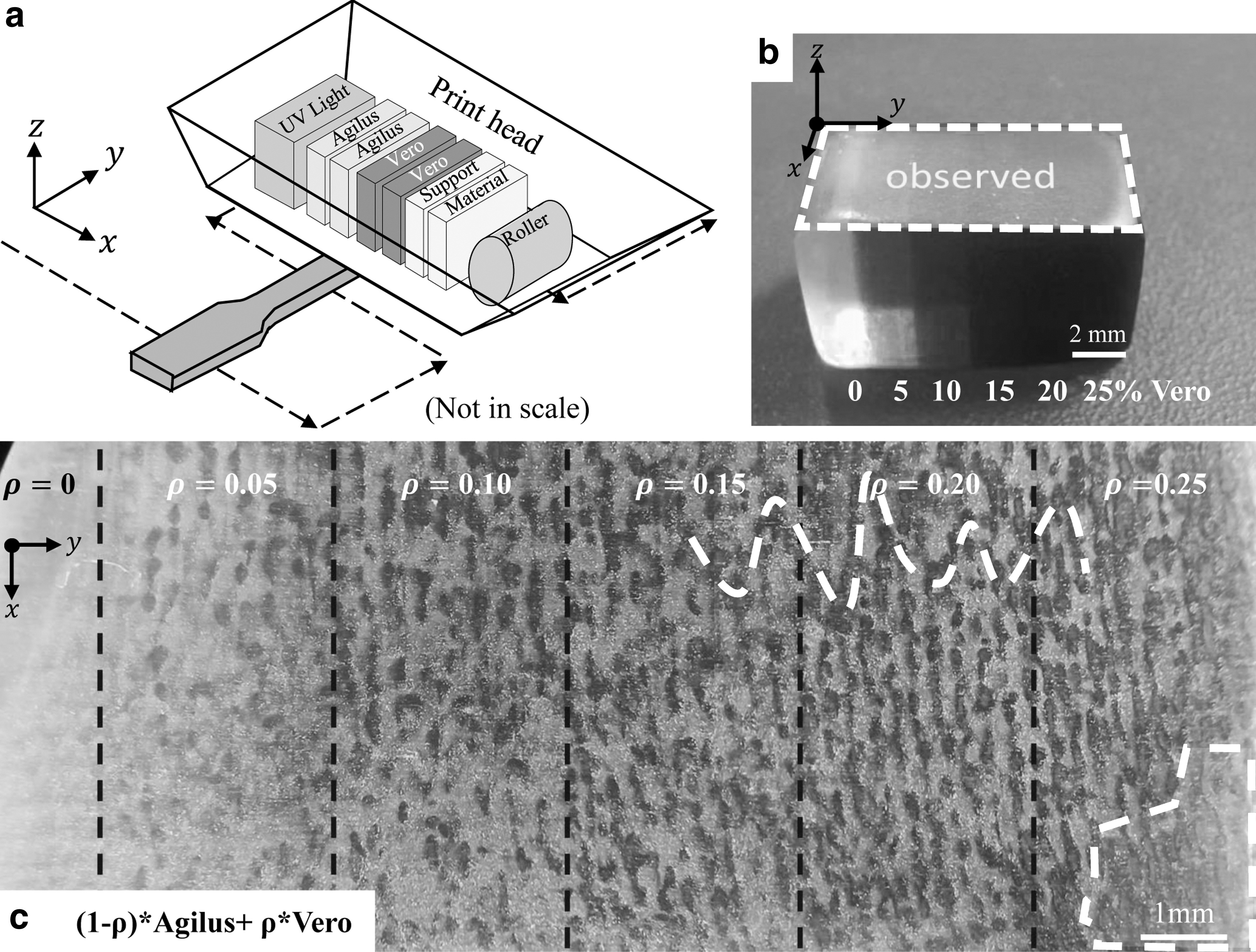
Polyjet voxel printing mechanism and part.
Unlike traditional printing, where users provide an STL file of a part to the printer, voxel printing involves designating the material of each voxel by providing a series of bitmaps that are slices of the model, with materials differentiated by color. To achieve this process, a rasterization and dithering algorithm was developed based on MATLAB 2022a. The rasterization process involves acquiring the contour of the model at every 14 μm in the z direction, which corresponds to the J750's resolution. The planar contour is then discretized according to the resolution of the printer in the x and y directions, respectively. Macroscopically, to obtain arbitrary proportions of Vero with only discretized voxels of Vero and Agilus, we implemented the random dithering algorithm, as opposed to the commonly used Floyd–Steinberg dithering,7,41 because the visual outcome is less important than ensuring a homogeneous part without artifacts that could lead to unexpected mechanical properties.
Characterization of thermomechanical properties
In this study, we conducted both dynamic thermomechanical analysis (DMA) and thermomechanical analysis (TMA) to characterize the important properties of voxel-printed parts with varying Vero volume fraction for robotics applications. We utilized a Waters Q800 to perform DMA on 30 × 2 × 1 mm specimens in tensile deformation mode at a frequency of 1 Hz and an amplitude of 0.1% of the remaining length after being clamped, which is 15 mm in our test (Fig. 2a). The tensile direction aligns with the x direction of the J750 printer. The specimens were equilibrated for 10 min at a temperature of at least 30°C above their estimated

DMA was conducted on a voxel-printed cuboid specimen to investigate the glass transition temperature (
To perform TMA, we employed a ZwickRoell BT2 and followed the ASTM D638-22 standard by using type IV specimens (Fig. 3b). The temperature range for the TMA test was chosen based on the results of the DMA test, which will be explained in Relationship Between Composition and Glass Transition Temperature section. The results of the tensile test are shown in Supplementary File.

TMA was conducted on voxel-printed type IV specimens to investigate the yield strain according to ASTM D638-22 at different compositions.
Microstructure investigation
Metallograph
We used a LEICA DM6M metallographic microscope to investigate the surface of a voxel-printed cuboid parallel to the xy-plane of J750. The cuboid is 16.2 mm high and consists of six layers, including Vero volume fraction ρ = {0, 0.05, 0.1, 0.15, 0.2, 0.25} (Fig. 1b). In this study, we used black Vero with transparent Agilus for easy observation. After printing, the surface was ground with sandpaper of 500, 1000, and 2000 grids on a Phoenix4000 polishing machine and then polished with a suspension of alumina particles. The microscopic image is shown in Figure 1c.
Probabilistic and numerical analysis
To explore the voxel-printed part's internal characteristics and validate the presence of percolation, we conducted both a probabilistic analysis and a Monte Carlo simulation. To establish a probability space for modeling the voxelated and jetted Polyjet part, we envisioned an infinite cubic lattice, where each site corresponds to a Vero voxel with a probability equivalent to the portion of Vero material within the part.
Within this unbounded space, we identified two distinct scenarios: [VO] and [
To assess the probabilities of these events occurring at various Vero volume fractions, our study focused on determining a nontrivial value of
Throughout the simulation, voxel units were considered connected only when their faces touched (utilizing a six-connected neighborhood). By adjusting
Results and Discussion
Relationship between composition and glass transition temperature
Shape memory phenomena do not occur in SMPs if the temperature during deformation is too low, and the fracture/yield strain decreases sharply if the temperature is too high. Therefore, determining the
From a phase evolution perspective, the glass transition can be depicted by most “glassy” areas transitioning into a “rubbery” area. A classic model that depicts this transition is the normal distribution model,
42
where the mean corresponds to the
This section continues by examining the relationship between composition variation and the second type of
Relationship between composition and yield strain
In practical applications, it is crucial to determine the allowable strain of a material before it yields. However, conducting TMA can be expensive, so it is essential to choose the appropriate range of composition and temperature for conducting tensile tests. To exhibit shape memory effects, deformation must occur when the SMP is in its “rubbery” state. Hence, Vero volume fractions lower than 0.5 should be excluded as their
As the yield point for polymers is not as well defined as for metals, we considered the maximum stress point as the yield point unless there was necking. If necking occurred, the maximum stress before necking was considered the yield point. The results are shown in Figure 3a. For every composition, the maximum yield strain occurred when the temperature was 7°C above the second type of
At around
Moreover, if we substitute the
This equation is plotted in Figure 3a as the dashed black line, and it could predict the possible maximum yield strain of each composition especially at high compositions.
Relationship between composition and modulus
In practical applications, understanding the Young's modulus of a material at both its “glassy” and “rubbery” states is crucial as it reflects how the material interacts with its environment. For viscoelastic materials like SMPs, characterizing the Young's modulus without having to tear countless specimens with varying compositions and temperatures can be achieved through approximating it with the storage modulus acquired from DMA testing, provided that the deformation rate is not too high.
Figure 3c displays the variation in storage modulus with temperature for various compositions. The vertical dotted line on the graph represents the location of the second type of
The relationship between the modulus and composition was also analyzed due to the good linear relationship between the previous properties and composition. Figure 3e illustrates the relationship between composition and modulus at room temperature. It can be observed that unlike the previous properties, only the composition does not have a linear relationship with the modulus, which is consistent with previous studies.35–37
Furthermore, a critical composition can be observed at approximately ρ = 0.2, where the change in modulus exhibits a different trend. It is highly likely that during the increase of Vero fractions, a large, connected network is formed from discrete Vero voxel droplets, shifting the load distribution. The addition of various forms of reinforcement materials (such as particles and short fibers) to the matrix material is a common method of changing overall properties in the field of composite materials. 44 If a new form of reinforcement material appears during the increase of filler proportion, such as replacing droplets with a network-like reinforcement material in the matrix, there will be a significant change in the modulus, 23 even if the volume fraction of the filler is the same.
This phenomenon is often exploited in soft sensors, 39 where designers add conductive fillers such as carbon black and carbon nano tubes beyond a critical ratio to make the entire material suddenly conductive, a phenomenon referred to as percolation of the conductive fillers. The next section verifies this hypothesis.
Existence of percolation in a Polyjet voxel-printed part
Figure 1c illustrates a microscopic image featuring black fibrous Vero dispersed within a transparent Agilus matrix, with the short fibers oriented in the x direction. The Polyjet printing mechanism, considering the arrangement of the print head, would typically result in the SMP appearing as short fibers oriented in the y direction, due to the x direction having twice the resolution. However, a closer examination revealed that the fibrous Vero consists of droplets with similar length and width, slightly longer in the x direction. The Vero droplets' length and width were ∼850 μm, suggesting that the voxel droplets, initially rectangular (423 × 846 μm), are extended by the roller effect in the x direction, giving them a squarer appearance.
As the proportion of Vero increases in the printed part, it undergoes a transition from dispersed droplets to a connected network. This shift in the material's arrangement affects the load-bearing mechanism, which explains the observed trend in modulus. However, the critical fraction at which the trend of the modulus changes still requires explanation. To address this issue, we turn to the probability space constructed in Microstructure Investigation section to investigate the part's inner structure.
In an infinite space, the occurrence of both event [Vo] and [
Once the theoretical existence of percolation is established, its exact value can be estimated numerically. Figure 4a displays the result of a Monte Carlo simulation of the volume of the largest connected region at different Vero compositions. Notably, the volume of the largest connected region significantly increases at approximately ρ = 0.3, consistent with 3D site percolation theory. However, this assumption is not applicable to our case, as depicted in Figure 1c, where Vero extends from the designated voxel to the neighboring sites along the x direction due to the roller effect, leading to an additional site being filled with Vero. Consequently, the simulation is adjusted, and the critical value drops to ρ = 0.15 (Fig. 4b), aligning with experimental observations. Visualizing the largest connected region in the voxel-printed part, where the Vero network is marked with blue dots (Fig. 4c–f), demonstrates that dispersed Vero droplets suddenly connect at the critical fraction, forming a network that spans the material. This simulation provides deeper insights into the underlying mechanisms driving the observed changes in modulus with varying Vero composition.
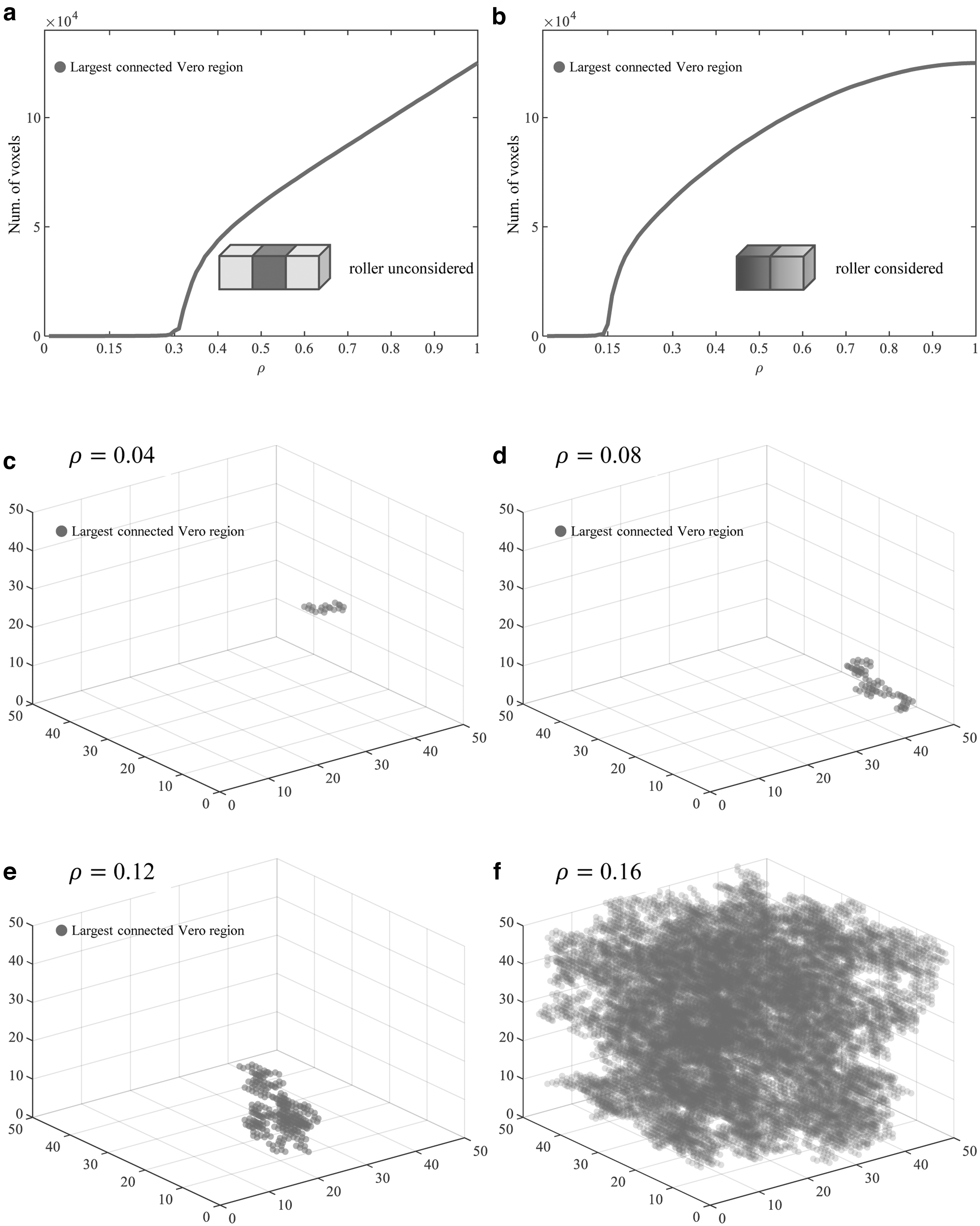
Monte Carlo simulations were carried out on a 50 × 50 × 50 matrix to investigate the percolation phenomenon in Polyjet voxel-printed parts.
Effect of percolation on the thermomechanical properties
In the previous section, we discovered the percolation threshold in jetted parts, which changes the load distribution in voxel-printed parts. In this study, we aim to investigate how it can affect thermomechanical properties.
Both the first and second types of
In this article, the characterization of yield strain is limited to the range of ρ larger than 0.5. Although 0.5 is far away from the percolation threshold of 0.15, it is still difficult to establish a clear relationship between percolation and the maximum yield strain.
The modulus near the percolation threshold can be predicted using de Gennes' scalar model of elastic percolation
45
as follows:
Here,
Design of a variable stiffness foldable structure
By explicitly expressing the properties of voxel-printed parts, both applications using digital mixtures, 14 and voxelated28,33 ones can select materials according to their desired application properties. As a practical example, we demonstrate the design of a simple variable stiffness foldable structure, as depicted in Figure 5.

Variable stiffness structure design using the prediction of modulus in the rubbery phase.
The objective is to create an accordion-like foldable structure with creases made of different materials to achieve specific properties. To realize this, Polyjet is a suitable method where the creases can be printed using various material compositions. For demonstration purpose, the desired properties are as follows: a reactant force lower than 4N at a compressive strain of 0.45 in the rubbery phase, and the highest possible shape fixity in the glassy phase. This foldable structure finds potential applications as the body of a robotic worm, 46 a constituent of a morphing surface, 47 or a robotic gripper. 48
Due to length limitations and scope considerations in this article, we refrain from presenting the modeling and design optimization process in detail. Instead, we regard the structure as rigid facets with torsional springs, employing a simplified yet classic model. Figure 5a illustrates the actual strucutre. Due to its possession of three distinct planes of symmetry, the definition of a single octave suffices. Here we define crease AC as the connection between vertex A and vertex C. Subsequent references to crease AC encompass all analogous creases situated within equivalent positions across the other octaves. Note that crease AC has a Vero fraction of 0.8, while the remaining creases are composed of pure Agilus.
With the model and Equation (4.4), we can predict the reactant force when loading the structure while the temperature on crease AC is 65°C, depicted in blue in Figure 5b, where the force remains just below 4 N. However, experimental data, indicated by the black dashed line, reveals a discrepancy between the model and the experiment. To address this discrepancy, we applied a proportional term to the model, resulting in the red curve. The adjusted model now aligns well with the experimental data, demonstrating its ability to predict the tendencies of the real condition. It is essential to note that viscoelastic materials can be influenced by loading speed, humidity, and aging, thus explaining why this result is considered satisfactory despite using an oversimplified model.
Conclusion
Polyjet 3D printing technology is being utilized by designers to integrate smart materials into soft robotics, which allows for the creation of prototypes with high precision and the ability to transform. This is combined with Polyjet's ability to achieve voxel printing, enabling researchers to fine-tune the thermomechanical properties of the printed part. The purpose of this study is to explore how changes in Vero/Agilus composition impact the thermomechanical properties of voxel-printed parts. Additionally, since percolation is a crucial factor that impacts composite properties, this study investigates whether percolation occurs in jetted parts and its impact on thermomechanical properties. The results of the study can be summarized as follows:
A linear relationship exists between Vero volume fraction and Percolation occurs at a Vero volume fraction of ρ = 0.15, where the Vero droplets form a single network that spreads throughout the material, resulting in a sudden change in modulus due to altered load distribution. This is verified through microscopic images, Monte Carlo simulation, and de Gennes' scalar model of elastic percolation theory. The roller in Polyjet equipment extends the jetted rectangle voxels approximately twice its width for better mixing between neighbor voxels, resulting in a percolation threshold of 0.15, which differs from the 3D site percolation threshold of 0.31.
49
These results can guide future works in selecting the most appropriate Vero and Agilus composition for their voxel-printed parts. However, it is important to note that for viscoelastic materials, the strain rate is a crucial factor in its constitutive relation. Therefore, the results of this study should be used as a guide for the thermomechanical property variation tendency as the composition changes, and it should be adjusted accordingly to the strain rate of specific applications. Moreover, for applications that operate below room temperatures, the yield strain when the Vero fraction is lower than 0.5, which was intentionally avoided in this study, should be examined. Furthermore, exploring how different dithering algorithms can impact thermomechanical properties could be an interesting topic for future research.
Footnotes
Acknowledgments
The authors would like to express their gratitude to Jing Lee for the valuable discussions, as well as to Renjun Dang and Changping Hu for providing helpful suggestions during the revision process.
Authors' Contributions
C.H.: Conceptualization (lead); Methodology; writing—original draft; formal analysis; and writing—review and editing. J.B.: Conceptualization (supporting). J.X.: Supervision.
Author Disclosure Statement
No competing financial interests exist.
Funding Information
No funding was received for this article.

References
Supplementary Material
Please find the following supplemental material available below.
For Open Access articles published under a Creative Commons License, all supplemental material carries the same license as the article it is associated with.
For non-Open Access articles published, all supplemental material carries a non-exclusive license, and permission requests for re-use of supplemental material or any part of supplemental material shall be sent directly to the copyright owner as specified in the copyright notice associated with the article.
