




Abstract
Regenerative design lies on synergistic relationship between sociocultural and ecological systems, which can enable revolutionary boundaries for designing decision-making frameworks. Transitioning to regenerative design as a manifestation of systems thinking necessitates a fundamental shift from sustainable patterns and mechanistic design methodologies. At its core, regenerative design unlocks a holistic paradigm that fosters circular systems reliant on renewable resources, which can strive for equilibrium between creation and utilization. This framework goes beyond mere sustainability by actively engaging in the restoration and regeneration of its sources of energy and materials. It aspires to harness the inherent wisdom of nature, facilitating a comprehensive harmonious coexistence with environment. The integration of data-driven decision-making and regenerative paradigms can provide an insight for developing evidence-based solutions for strategic environmental and natural resource management through design practices. This short research presents a holistic data-driven and self-adaptive design strategy as the integrated problem-solver model under the imperatives of regenerative adaptive design and transfer knowledge system capable of the extensive range of applications from microscale to macroscale. The underlying idea proposes orientation on machine learning feedback loop mechanisms and nested coevolutionary loops embedded in an inclusive feedback loop frame, synergistically interfaced with the typologies of monitoring systems and intuitive datasets to problem-solve at the intersection of design, construction, and built environment. This design model can support designers, planners, and city managers in optimizing their decision-making process by relying on precise data-driven feedback in different scales of complex systems, from living bits to ecological living environments.
Introduction
Problem-solving through data-driven decision support systems in regenerative design
The coevolutionary relationship between sociocultural and environmental systems is a critical concept in regenerative design, requiring explicit engagement with the consequences of future design decisions.1,2 Coevolution is a term used to define natural processes where two or more components interact in a complex way, and the progression of each is interdependent. 3 In addition, biological coevolution has been a foundational research framework in biological and evolutionary sciences for nearly 60 years, inspiring a class of computational definitions known as coevolutionary algorithms. 4 Based on a systemic design approach and developed as a computational model, the coevolutionary design model explores parallel search spaces of the problem and solution spaces. 5 This model aims to demonstrate how a mechanism for design can involve reasoning about the problem concurrently with reasoning about the design solution. In the context of coevolutionary approaches in design systems, a comparative perspective on generative processes in nature and architectural design processes has prominently featured in generative computational design approaches, with a specific emphasis on feedback loops.6,7 Generative processes in the realm of computing have been supported by Wolfram (2002). 8 The foundational basis of Wolfram’s “New Kind of Science” is a simple abstraction rule, a generative code closely resembling the principles of a pattern language. 8 Indeed, Wolfram extended the concept of generative processes in computers by conceptualizing feedback loops in natural processes as a form of computation, thereby elucidating the complexity of modern systems.9,10 This short research article presents cognitive nests as the operational problem-solving model under the imperatives of data-driven decision support systems (DSSs) in regenerative design with the capability to transform and adapt to various types of datasets and unstructured problems that can support a wide range of scales, from material-based living systems or systems biology to ecological living systems. To substantiate this claim, two data-driven decision-making loops are presented as follows: a biocomputational data-driven loop as a programmable material system for the biofabrication of bacteria biofilm and a landscape regenerative design decision support loop for dynamic simulation and 3D reconstruction of urban landscape living systems, based on computational fluid dynamics (CFD) and urban heat islands that experimented in the previous authors’ researches separately.
Data-Driven DSSs
Data-driven DSSs provide critical support in managing complex processes by integrating and analyzing vast amounts of data from varied sources that can integrate data from diverse sources and utilize advanced analytical techniques to provide real-time actionable insights.11,12 These systems are particularly valuable in environments where diverse elements interact, such as mechanical, electronic, human, biological, and chemical systems. 12 In addition, the system can excel in handling the intricate and often unpredictable dynamics of such processes, providing critical support in supervision, control, and optimization tasks. In contexts such as environmental and ecosystem management, specifically Wastewater Treatment Plants (WWTPs), DSSs are vital for maintaining compliance with stringent environmental regulations and minimizing risks. 13 WWTPs operate continuously, and their high energy consumption can be optimized through intelligent DSSs that use artificial intelligence (AI) to monitor and control operations efficiently. 5
By analyzing data on parameters like effluent quality, these systems ensure adherence to environmental standards, thereby protecting both ecosystems and public health. In addition, DSSs enhance the diagnosis and resolution of potential issues, offering a robust framework for improving process reliability and performance. 4 As technology progresses, the capabilities of DSSs continue to expand, incorporating more sophisticated algorithms and real-time data processing to support strategic and operational decision-making across various sectors. 10 Beyond environmental issues, data-driven DSSs are also transformative in the field of biofabrication processes and programmable living material systems. In biofabrication, DSSs enable the precise control and optimization of complex biological processes, ensuring the consistent production of high-quality biological products. 12
By integrating real-time data and predictive analytics, these systems enhance the efficiency and scalability of biomanufacturing operations. 14 Programmable living material systems, which involve the assembly of materials at the biological level, also benefit from data-driven DSSs. 15 These systems provide the necessary computational support to design and control living materials, facilitating innovations in fields such as tissue engineering, synthetic biology, and regenerative medicine.14,15 Through advanced modeling and simulation, data-driven DSSs help in understanding and manipulating the dynamic behaviors of biological systems, thereby driving advancements in creating programmable adaptive materials. 15 This comprehensive approach ensures that DSSs not only support decision-making activities but also contribute to sustainable and efficient process management across various domains.14,15
Biological domain: DSSs for programmable material system
In the biological domain, DSSs for programmable material systems represent a cutting-edge intersection of computational technologies and biological engineering, aimed at innovating the creation and control of living materials output functionalities.5,16,17 These systems use advanced technologies such as AI, machine learning, big data, and scarce data analytics to design, monitor, and optimize complex biochemical processes. 18 A prominent application within this field is biofabrication, where DSSs facilitate the development and manipulation of programmable living matter systems for construction of desired 3D biocomponents.19–21 In synthetic biology, DSSs aid in the design and assembly of genetic circuits within microorganisms to produce specific biochemical outputs. Machine learning algorithms analyze extensive datasets of genetic sequences, metabolic pathways, and cellular responses to predict the most effective genetic configurations for desired outcomes, such as the production of pharmaceuticals, biofuels, or other valuable compounds.17,22 These AI and ML-driven DSSs simulate numerous scenarios to identify optimal genetic modifications, ensuring high efficiency and precision in biofabrication processes. Biofabrication systems within programmable living matter exemplify the integration of DSSs in tissue engineering, regenerative medicine, and living building materials.23–25 These systems utilize data from image processing technologies, informative and deep learning techniques, bioreactors, and biosensors to monitor and optimize the growth and development of engineered tissues and construction materials for buildings. Advanced data analytics enable the adjustment of growth environment conditions, such as nutrient supply, temperature, and mechanical forces, ensuring the proper formation and functionality of the engineered biofilms.20,21,26 In addition, DSSs can analyze data from 3D bioprinting processes to dynamically adjust printing parameters, improving the fidelity and viability of printed tissues. 18
Ecological domain: DSSs for landscape and environmental regeneration
In the ecological domain, DSSs are essential for landscape and environmental regeneration, leveraging advanced technologies like geographic information systems (GIS), remote sensing, laser scanning (LiDAR), machine learning, and big data analytics. 11 These systems collect and analyze vast amounts of spatial and temporal data on land use, vegetation cover, soil health, and hydrology. In landscape regeneration projects, DSSs utilize GIS, remote sensing, and LiDAR to provide high-resolution, 3D data for precise mapping and monitoring. Machine learning algorithms process these data to identify patterns and predict future ecological changes, aiding in the development of targeted regeneration strategies. 27 DSSs also support the monitoring and management of ecosystem health and resilience in environmental regeneration. In forest regeneration projects, DSSs integrate data from drones, sensor networks, climate models, and LiDAR scans to monitor tree growth, species diversity, and pest infestations. 13 Advanced analytics predict the outcomes of different management practices, such as controlled burns or selective logging, on forest recovery and carbon sequestration. These systems facilitate adaptive management by providing real-time feedback and predictive insights, ensuring that regeneration efforts are responsive to changing environmental conditions. 12
Materials and Methods
Cognitive nests
Model architecture and coevolutionary steps
The primary focus of this research is on the theoretical model presented as support for operational scales. To evaluate the scalability and effectiveness of the proposed model, two operational examples at different scale ranges have been examined. These examples, detailed in the authors’ previous studies, explore two cases as follows: decision-making and performance guidance of bacterial cellulose growth within a DSS based on reprogramming growth processes in a regenerative self-adaptive design process and adaptive response at the macroscale in addressing environmental challenges within urban landscape contexts.6,18 Due to the centrality of the support model framework presented in this research and regarding the validations of the Nested data-driven decision support system (NDSS) model, the operational scale is schematically illustrated, drawing inspiration from the authors’ previous projects. The model presented in this research is a multifunctional and scalable mechanism consisting of four submodels designed to address problems systematically, ranging from the microscale to the macroscale (Fig. 1A–D). The first section presents the coevolutionary and data-driven workflow of the model, from the emergence of unstructured problems to the structuring and solution of the problems (Fig. 1A). This interactive process (loop operation) consists of three main components as follows: data mining and monitoring in the problem space, data processing and evolution in an action and reaction part of the loop within the solution space, and finally, decision-making and system adaptation to new conditions based on the type of problem, serving as the solution and output of this process. The evolutionary dimension of the model, comprising nested loops, can demonstrate the scalability of the model hierarchically by solving more minor problems in the inner loops and gradually evolving step by step to address more significant problems in the outer loops (Fig. 1B).
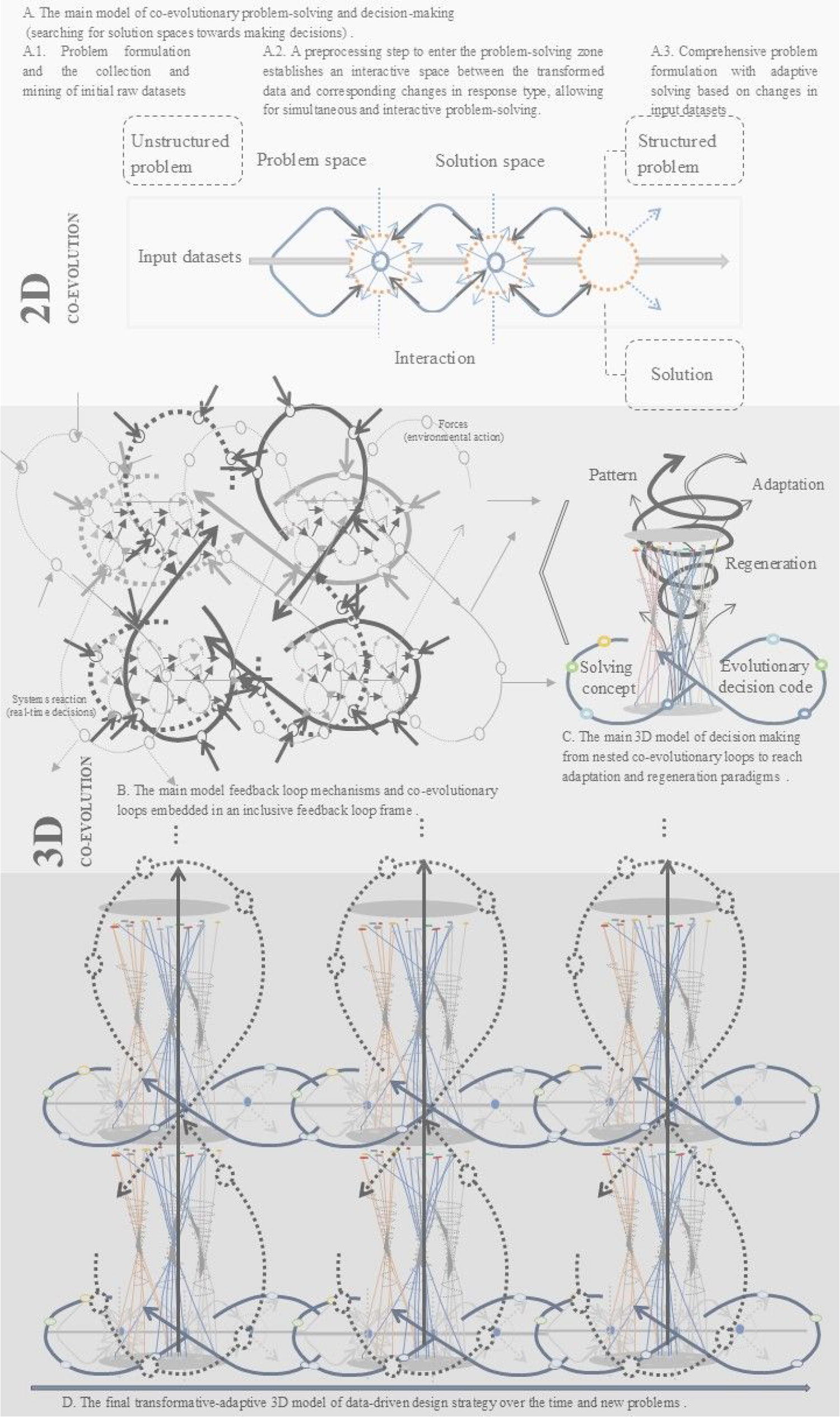
Model structure of presented holistic data-driven regenerative design strategy.
The model can interact with the environment in the solution space; to find the best decision and solve the problem, environmental datasets (actions) should be received simultaneously and proportionately to the changing conditions of the operational loop environment (the problem space and its parameters). After information processing, the response is returned to the environment as the system’s reaction to solve the problem. Simultaneous responsiveness to the parameters of the problem space and the provision of optimal decisions to solve the problem led to the pattern formation of a solution and adaptability in a wide range of problem zones (Fig. 1C). Since the presented model operates based on the flow of the datasets, it synchronizes itself with changes in the type, time, and volume of datasets in different problem zones, providing efficiency in adaptability and responsiveness to transformation (see Fig. 1C). The presented model can perform a wide range of optimized user-designed tasks based on regenerative adaptive design and built environment agendas covering a broad scope of applications, including architecture and planning, bioproduct design and biofabrication, ecosystem regeneration, energy systems, and water management.
Transformative-adaptive scalability
Microscale: Programmable biofabrication systems to programmable living materials
To demonstrate the performance of the model presented in this research on the biological scale and in designing programmable material systems, a materially informed decision support loop has been defined. This loop aims to guide, control, and make decisions regarding a specific bioactive cell growth (the growth and production process of bacterial cellulose from Komagataeibacter xylinus is proposed at this scale, schematically based on previous experiments) toward desired 3D biological structures within programmable biofabrication protocols (see Fig. 2-biological scale). In this process, user-designed cell growth pathways have been defined through supportive structures and growth environment parameterization. This process can perform by culture medium in cubed scaffolds and controlling the material behavior through installed physical controller modules in specified areas for writing decisions based on parameterized growth environment.

Schematic of the transformative-adaptive scalability of the model.
After setting up the culture environment, real-time monitoring and data mining of the living material’s behavior can be conducted (see Fig. 2-biological scale part 3). Based on the presented NDSS model, at the first stage, materials behavior in the growth processes, medium, and environmental conditions is monitored and analyzed. These data are simultaneously collected and mined throughout the growth phase, allowing for real-time utilization in adaptive control and optimization of the programmable biofabrication system. The growth datasets are transferred to a database for future decision-making and to train the machine on the material’s behavior under various conditions. This process can be implemented using one-dimensional or 3D image processing, converting sensor pulses to a valuable domain of feature and video recording real-time feature extraction methods.
After implementation of real-time monitoring and simultaneous data collection from the culture environment as the programmable biofabrication system (using reprogramming growth process function of a specific cell with the capability of application in a biofabrication system), various machine learning and deep learning techniques, including supervised, unsupervised, semi-supervised, and reinforcement learning, can be implemented using neural networks and transfer learning to extract features from images in specified areas of the environment (see Fig. 2—biological scale part 4). Using the techniques provided, material behavior under various conditions is taught to the system based on input image datasets. Through this training and classification, the system can predict material behavior in response to changes in culture medium parameters. Finally, based on the trained datasets, the system can adjust the culture environment parameters to guide cell growth toward the designer’s required predefined biofunctions. Moreover, based on logical conditions for shaping different regions on the predefined pathways and controlling the culture environment through modules, the growth process in specific different areas of medium can be regulated adaptively toward the designer’s desired 3D biological structure in a decision-making loop (see Fig. 2—biological scale part 5). At this scale of the NDSS model, the process represents a regenerative-adaptive, biointegrated design supported by active living cells, leveraging growth performance within a biofabrication system. This approach allows for dynamic responsiveness to environmental inputs, enabling the biocomputational design to evolve in real time with its surroundings. By harnessing the natural growth processes of living cells, the system achieves a unique synergy between biological fabrication adaptability and architectural intent, creating structures that are not only functional but also resilient, supporting adaptive regeneration through interactions with environmental changes.
Macroscale: Simulation and regeneration of ecosystem and environmental dynamics
On the ecological scale and for environmental regeneration, a landscape regenerative decision support loop has been presented to regenerate and transform landscape heritage sites based on real environmental datasets (see Fig. 2-ecological scale). In this process, datasets from specific sites (Persian gardens) are captured by drones using the structure from motion (SFM) technique, all dataset converted into 3D point clouds and dense clouds (see Fig. 2—ecological scale parts 1, 2, and 3). In the next stage, these dense point clouds are transformed into voxel-based 3D mesh models based on spatial points and their relationships in 3D space (see Fig. 2—ecological scale part 4). These types of datasets are ideal for various analyses and simulations, such as CFD and heat island effects. Finally, based on the analyses conducted on the captured sites, the system automatically provides the optimal site form to reduce thermal load in heat islands, eliminate heat islands, and optimize forms relative to wind flow (see Fig. 2—ecological scale parts 5 and 6). These can be considered adaptive and evolved models over time, capable of being implemented in various analytical samples and parameters. The model presented in this research operates on both scales by extracting features from input images and using them as the primary input for decision-making logic.
Discussion and Conclusion
This research presents a comprehensive, transformative-adaptive, data-driven DSS model as a systemic problem-solver within a framework of cognitive nested feedback loops from biology to ecology. In the biological domain, a material-informed decision support loop was developed to guide, control, and optimize the growth processes of a specific bioactive cell within a programmable biofabrication protocol. The process involved parameterization of growth environment, followed by real-time monitoring and data mining of the bioactive material’s behavior. Machine learning and deep learning techniques—including supervised, unsupervised, semi-supervised, and reinforcement learning—were used to extract features and train the system to understand material behavior under various conditions. This approach enabled the precise formation of distinct regions, ultimately guiding the growth process toward the desired 3D biological structures. In the ecological domain, a landscape regenerative decision support loop was designed to regenerate and transform landscape heritage sites, specifically Persian gardens, based on real environmental datasets. Utilizing drone-captured data and SFM technique, the process converted datasets into 3D point clouds and dense clouds. These were then transformed into voxel-based 3D mesh models, ideal for various analyses and simulations, such as CFD and heat island effects. The system provided optimal site forms to reduce thermal load in heat islands, eliminate heat islands, and optimize forms relative to wind flow. These adaptive and evolved models demonstrate the capability of DSSs to be implemented in various analytical samples and parameters, offering a robust framework for sustainable and efficient process management across biological and ecological domains.
The symbiotic relationship between data and feedback loops ensures a continuous evolution of the solution space and problem-solving approaches. The model’s adaptability extends to various scales, from micro-level intricacies to macro-level ecological systems, offering a versatile tool for designers, planners, and city managers. This research establishes a transformative framework that transcends traditional design paradigms by incorporating regenerative adaptive principles and data-driven methodologies. The proposed model’s capacity to handle environmental data variability and its adaptability to different scales position it as a powerful tool for decision-makers in design, construction, and urban planning. The symbiosis of machine learning, data mining, and dynamic data-driven techniques within the model demonstrates a forward-thinking approach to addressing challenges associated with design complexity and data limitations. As designers and decision-makers grapple with the intricacies of sustainability and regeneration, this model offers a comprehensive solution by harnessing the wisdom of nature and integrating it with cutting-edge technological advancements. The presented research paves the way for a new era in design thinking that considers the immediate impact and fosters regenerative processes, shaping a harmonious coexistence between human activities and the environment. In particular, this model can support the design and construction of programmable living materials with a wide range of eco-friendly responsiveness through biofabrication.
Moving forward, the integration of advanced machine learning algorithms will enhance DSSs by improving predictive accuracy and responsiveness to dynamic input data. In addition, exploring interdisciplinary approaches that combine biofabrication with computational design will facilitate the development of more innovative and sustainable solutions. Ultimately, the evolution of DSSs will rely on continuous feedback loops that allow for real-time adjustments and optimizations based on environmental and operational changes that can support design processes at the intersection of materials science, fabrication systems, and the contribution of living systems’ properties to architectural design and construction, fostering a holistic approach that enhances regenerative principles, efficiency, and adaptability in built environments. This integration will not only improve material performance but also promote the development of structures that respond dynamically to their surroundings, ultimately leading to a more resilient and responsive architectural practice. By leveraging the unique capabilities of living systems, we can create innovative solutions that blur the boundaries between biological and built environments, paving the way for a new era in a wide range of applications, including biointegrated designing with living cells and macroscale landscape problem-solving.
Footnotes
Authors’ Contributions
F.H.: Conceptualization, writing—original draft, and formal analysis (lead). P.G.: Conceptualization, writing—original draft, and formal analysis (lead). K.Z.: Review and editing. M.M.: Review and editing.
Author Disclosure Statement
No competing financial interests exist.
Funding Information
No funding was received for this article.