




Abstract
3D printing has emerged as a groundbreaking technology with transformative applications in various health care domains. In drug delivery, it enables the precise fabrication of customized dosage forms, offering controlled release patterns and stimulus-triggered release capabilities. In addition, 3D printing plays a pivotal role in tissue engineering, facilitating the creation of complex structures with biomimetic properties. The impact of 3D printing technology extends to personalized medicine, allowing for the production of patient-specific medications tailored to individual needs. In the realm of regenerative medicine, 3D printing contributes to the fabrication of intricate scaffolds and bioprinted tissues, fostering advancements in the regeneration of damaged or diseased tissues. The versatility and precision of 3D printing make it a powerful tool across these domains, promising innovative solutions and personalized approaches in the field of health care. A comprehensive review of scholarly literature spanning from 1980 to the present was conducted across prominent databases such as PubMed, Wiley Online Library, Multidisciplinary Digital Publishing Institute, Kosmet, Science Direct, and Scopus. The present review offers a comprehensive examination of 3D printing in the biomedical and pharmaceutical sectors, shedding light on its historical progression while envisioning a future where regenerative and customized medicines become commonplace.
Introduction
Today, we are on the cusp of the next industrial revolution, a time when technologies such as cloud computing, contactless payments, and 3D printing (3DP) are rapidly becoming mainstream. 1 Rapid prototyping, often known as 3D printing, additive manufacturing (AM), solid free form technology, or simply 3DP, is a novel idea in the pharmaceutical industry. A growing number of industries, including aerospace, automotive, and health care, have adapted to the effects of this group of technologies, which enables quick prototyping and manufacturing. 2 3D printing, as defined by the American Society for Testing and Materials, is the “creation of things by the deposition of materials using a print head, nozzle, or another printing technique.”
AM techniques include various processes such as fused deposition modeling (FDM), hot-melt extrusion (HME), 3DP using inkjet technology, selective laser sintering (SLS), semi-solid extrusion, and stereolithography (SLA). These techniques involve the deposition, melting, or solidification of materials in a layer-by-layer manner to fabricate objects, catering to diverse applications in industries and research fields.
The basic principle behind 3D printing is to deposit a single layer of feed substrate on platform. 3 Layer-by-layer material deposition enables 3D printing to create nearly endlessly configurable objects. The latter is what the printer nozzle ejects in an x–y plane, giving you the object's bottom. 4 Following the design specifications, the printer head systematically moves along the z-axis, depositing the liquid binder onto the printed base in a layer-by-layer manner until the desired thickness is attained. This iterative process can be repeated multiple times based on the information derived from the computer-aided design (CAD) file, enabling the creation of the intended dosage form. Fabrication commences once the unbound substrate has been removed by post-printing treatment. 5
3D printing offers significant benefits to the pharmaceutical industry, primarily in the production of customized medications in limited quantities that possess precise dosing, forms, and release profiles. 6 This kind of drug production has the potential to make personalized medications a reality. Therefore, 3D printing has found use in a wide variety of fields, from quick prototypes in engineering to customized medical equipment. There might be a dramatic change in the way medications are developed, administered, and produced as a result of the advent of 3D printing in the pharmaceutical industry. 7 Conventional pharmaceutical production procedures have been established for around 200 years, and despite the substantial technical breakthroughs achieved thus far in the 21st century, many of them are still in use today. 8
While these processes are efficient for mass manufacturing, they often come with drawbacks such as lengthy preparation times, a high labor input, and dosage rigidity due to the huge batch sizes required. 9 The production of tablets, and the subsequent shift from a “one size fits all” approach to personalized treatments, might be profoundly affected by the advent of 3D printing. Indeed, 3DP could be used from the very beginning of the drug development process up to the point of treatment in the front lines of medicine. 10 Accordingly, 3DP technology allows to production of highly repeatable dosage forms made from a wide variety of materials and featuring complicated drug release dynamics. 11 Biosensors for measuring blood sugar, lactate, perspiration, and other bodily fluids are also widely produced using 3D printing methods. 12 Some wearable smart bandages also have biosensors that can track the heart rate and oxygen levels thanks to 3D printing technology. 5 The goal of personalized medicine is to tailor diagnostic and therapeutic approaches to each patient or subset of patients, rather than treating everyone the same way. 13
A joint study conducted by the U.S. Department of Health and Human Services and the U.S. Food and Drug Administration (FDA) suggests that personalized or tailored pharmaceuticals represent the future of medicine. 14 In addition, the pharmaceutical dose forms may be printed on demand, saving money and reducing waste using 3D printing technology. Because of this shift in thinking, consumers now see tailored pharmaceuticals in a very different light, which might have far-reaching consequences for the health care system. When used in the pharmaceutical industry, 3D printing involves the painstaking construction of individual dosage forms from digital designs. 5 Traditional manufacturing methods and formulation design are currently preferred in the pharmaceutical industry to ensure product stability. 15 However, as previously stated, there has been a shortage of research in both preclinical and clinical settings.
The classification of 3D printing as a manufacturing process or extemporaneous production (compounding) remains a subject of ongoing debate, with persuasive arguments favoring the latter. Extemporaneous compounding refers to the formulation of a customized, unapproved medication that addresses the specific medical needs of an individual patient. 16 When creating a patient-specific medicine product, pharmacists in hospitals, community pharmacies, and specialty manufacturing units traditionally generate extemporaneous formulations. From one perspective, 3D printing technologies can be conceptualized as “automated compounders” in which a feedstock containing the drug is supplied to the printer, and the dosage is controlled by adjusting the quantity of material deposited on the build plate. One method may be to employ a system similar to that of the coffee maker brand Nespresso, with the 3D printer acting as a coffee maker and the drug-loaded feedstock acting as disposable coffee pods. 10
Biosensors with high spatial sensitivity might be made through biomanufacturing and used in accurate detectors and diagnostic equipment. Another technological barrier for pharmaceuticals is the possibility for 3D printing processes to be scaled up throughout drug research and clinical testing. 10 An alternative approach to facilitate the scalability of phase II and III clinical trials is to utilize multiple 3D printers simultaneously or employ a 3D printer equipped with multiple nozzles to enhance throughput. These options can effectively address the increased demand for dosage form production in these later-stage studies compared with the initial first-in-human trials. 17
However, if the industry recognized and embraced the power of breakthrough technology to support manufacturing processes, it may revolutionize the way medications are developed for specific patients. Drug manufacturing in the future may move away from the bulk manufacture of fixed-dosage tablets and toward customized compositions of tablets at any dose. This trend is facilitated by several variables, including polypharmacy, increased knowledge, and relevance of pharmacological dosage prediction utilizing genomics, and the development of low-dose drugs with limited therapeutic windows (such as hydrochlorothiazide and digoxin). Most significantly, 3D printed medications allow for the individualization of both drug dosage and chemical makeup. The usage of 3D printed platforms is a relatively new method (carriers).
With the launch of the Precision Medicines Initiative in the United States in 2015, there has been a greater push on tailoring medical care to each patient. 1 Now, more than ever, the pharmaceutical sector must not be resistant to change and instead recognize and appreciate the potential of cutting-edge technology to bolster production methods. In this review, the authors provide a novel and contemporary view point on how 3DP might be incorporated into clinical practice by reviewing the historical and future motives, uses, and implementation issues of the technology within the pharmaceutical industry. 1
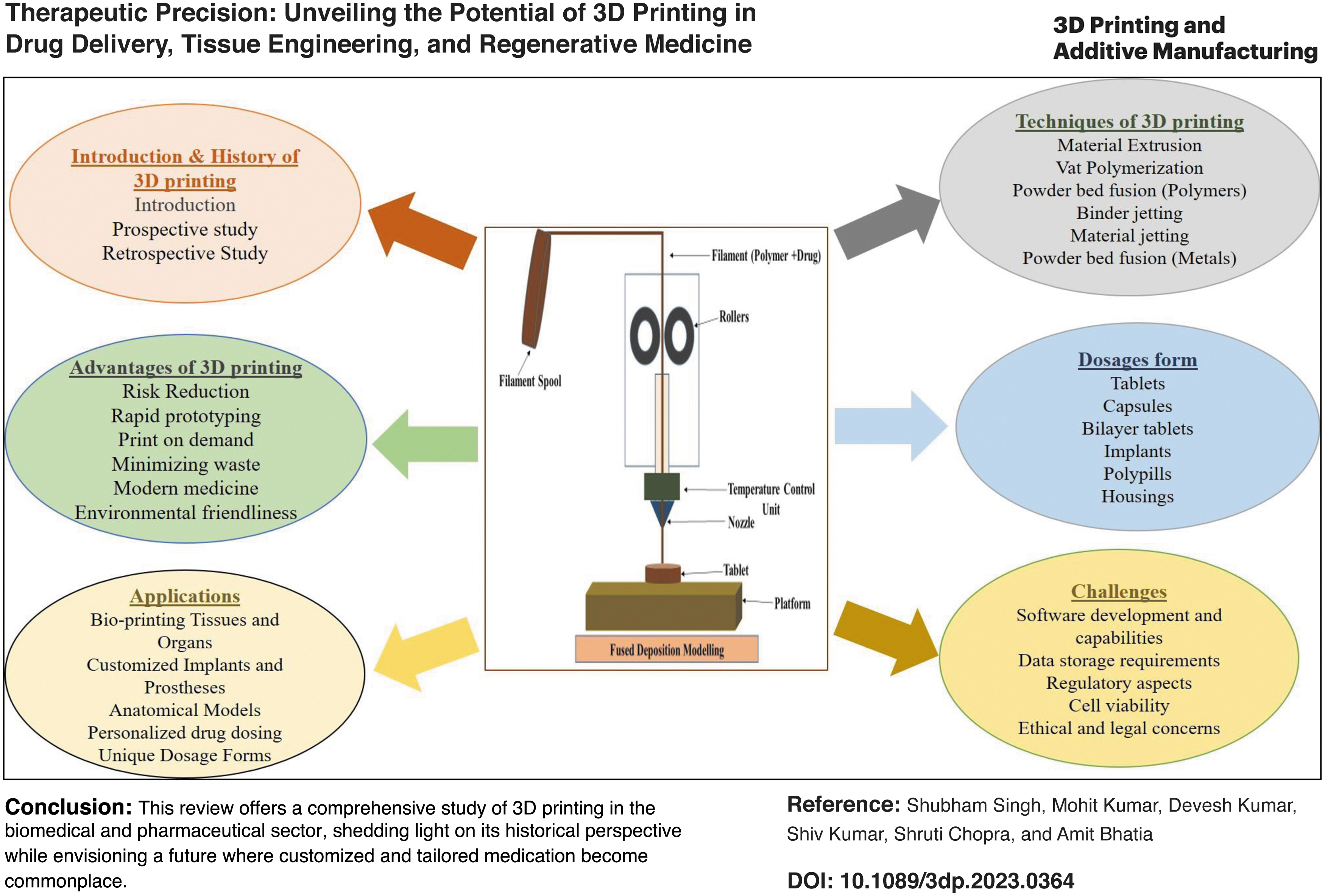
In this scenario, pharmacists would pre-order drug-loaded cartridges from a facility with an existing manufacturing license, and those cartridges would then be delivered to pharmacies on demand. An alternative method to meet the demand for dosage form production during phase II and III clinical trials involves the utilization of extemporaneous preparation or pharmaceutical compounding conducted at hospitals or pharmacies. Under this approach, the pharmacist has the ability to prepare the necessary drug and excipient powders or crush commercially available preparations and blend them with additional excipients. However, it is of utmost importance to ensure the formulation's quality post-printing, which can be influenced by the particular 3D printing technology utilized. Some technologies might require the introduction of external components such as heat or light to achieve the desired quality. Careful consideration and validation of the 3D printing process would be necessary to ensure consistent and reliable dosage forms. The overview of 3D printing is shown in Figure 1.
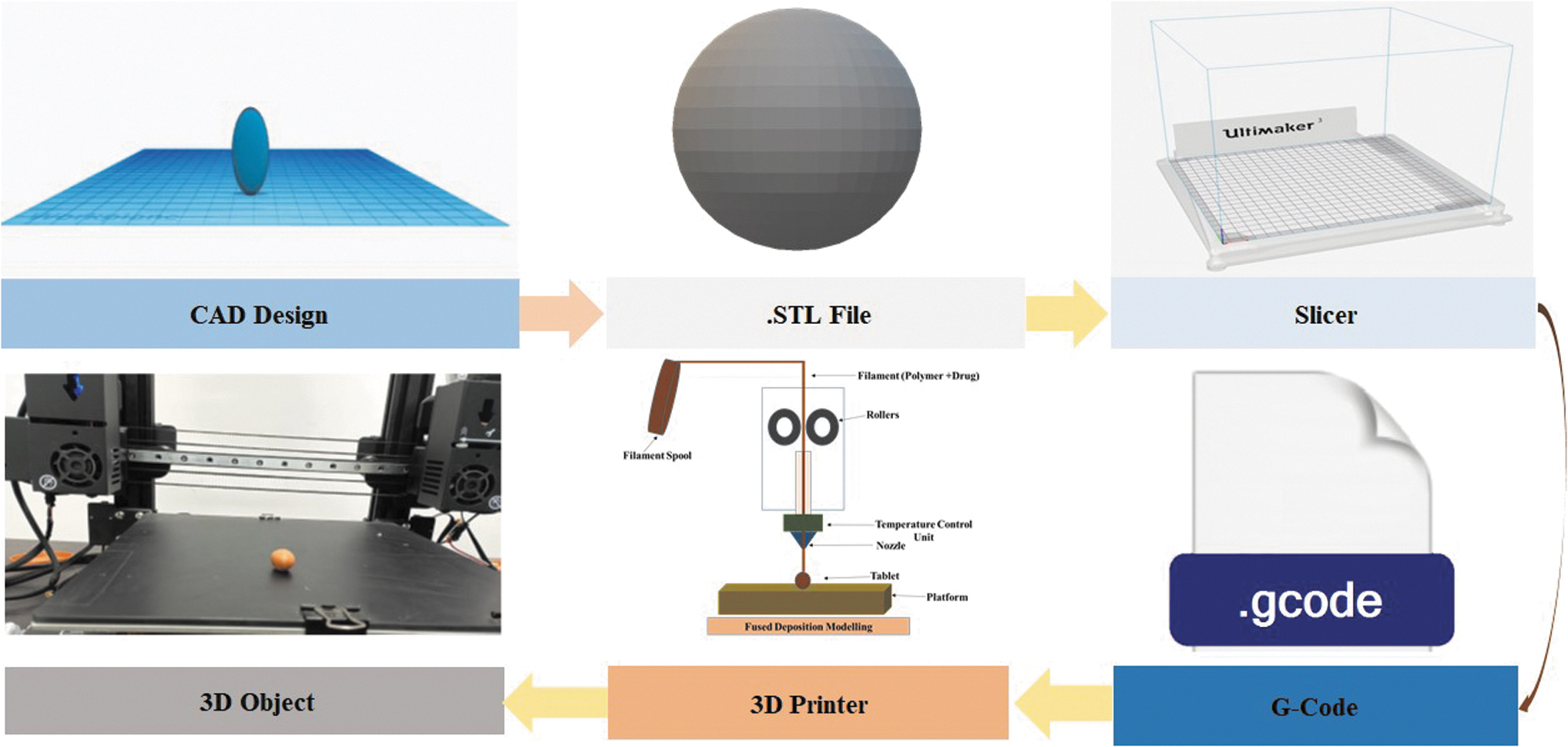
Overview of 3D printing process of FDM. FDM, fused deposition modeling.
The development of regulatory standards and support for the use of 3D printing in customized medications and drug research would greatly benefit stakeholders seeking to innovate and integrate this technology into the pharmaceutical field. Ensuring the quality of dosage forms manufactured through 3D printing is another essential aspect when incorporating this technology into clinical research. Traditional quality control (QC) testing methods used in large-scale manufacturing processes are not suitable for on-demand production at trial sites due to their destructive nature, labor-intensive requirements, and high costs. 10
Other studies have explored track-and-trace technologies, such as quick response (QR) codes and data matrices, to ensure the quality and safety of pharmaceutical items. Such innovative approaches can assure pharmaceutical quality in real time, opening the road for their usage in clinical settings. Commercially available 3D printers have not always been standardized or acceptable for the fabrication of pharmaceutical items (in terms of good manufacturing practice [GMP]). This is in addition to regulatory and QC issues. To be sure, the ideal 3D printer for medicines would be tiny, economical, and user-friendly, capable of producing high-quality medications in a secure environment at a fair output rate.
In pursuit of this objective, companies have been dedicated to developing pharmaceutical 3D printers that adhere to GMP and QC standards. An example of such a printer is the M3DIMAKER 3D printer, which is specifically designed for use in hospital pharmacies, specialty manufacturing units, or clinical trial settings. This printer utilizes interchangeable extrusion-based nozzles to cater to various requirements. It has been developed exclusively for the production of personalized medications and can undergo comprehensive validation according to GMP guidelines. The M3DIMAKER represents a significant advancement in the field of 3D printed pharmaceuticals. 18
The future implementations of 3D printing in pharmaceuticals and biomedicals hold tremendous potential for transforming various aspects of drug development, manufacturing, and personalized medicine. Some of the future applications are personalized medicine, complex drug delivery systems, printed organs on chip, bioprinting of tissues and organs, on-demand drug manufacturing, combination of drug products, distributed pharmaceutical manufacturing, customized medical devices, and smart drug delivery devices. As research in 3D printing technologies continues to advance, these potential future implementations hold the promise of revolutionizing the pharmaceutical and biomedical industries, offering innovative solutions for drug development, manufacturing, and patient care.
Techniques of 3D Printing
3D printing, also known as AM, is a versatile technology that allows the creation of 3D objects layer by layer from a digital file. There are several techniques and methods of 3D printing, each with its advantages and applications. Here, some of the most common 3D printing techniques are:
Material extrusion
Material extrusion is an AM technology that builds 3D items layer by layer by depositing a continuous strand of composite or thermoplastic material. 19 The filament is fed from a spool via a heated extruding nozzle, which warms and places the material on a build platform, 20 for example, FDM21,22 and direct ink writing. 22
Vat polymerization
Vat photopolymerization is an AM technology that produces 3D objects by curing photopolymer liquid resin using light waves, 23 for example, SLA 22 and digital light processing (DLP). 22
Powder bed fusion (polymers)
A heat source (such as a laser or thermal print head) is used in powder bed fusion (PBF), a subset of AM, to consolidate material in powder form to create 3D objects, 24 for example, SLS.
Binder jetting
For the high-volume production of incredibly dense and useful precision products, binder jet 3D printing is widely acknowledged as the most effective AM technique. Sand binder jets have been created for 3D printing, 25 for example, binder jetting.
Material jetting
Similar to how a two-dimensional inkjet printer creates objects, material jetting also builds objects. Material is jetted onto a building platform using a continuous or drop on demand (DOD) process. For the material to harden, it is blasted onto the platform or build surface. The sculpture is then built layer by layer, 26 for example, DOD.
PBF (metals)
PBF methods employ a laser or an electron beam to melt and fuse material powder. Electron beam melting (EBM) methods require a vacuum but may be used to make functional metal and alloy components. 27 for example, selective laser melting (SLM) and laser PBF.
Advantages of 3D Printing
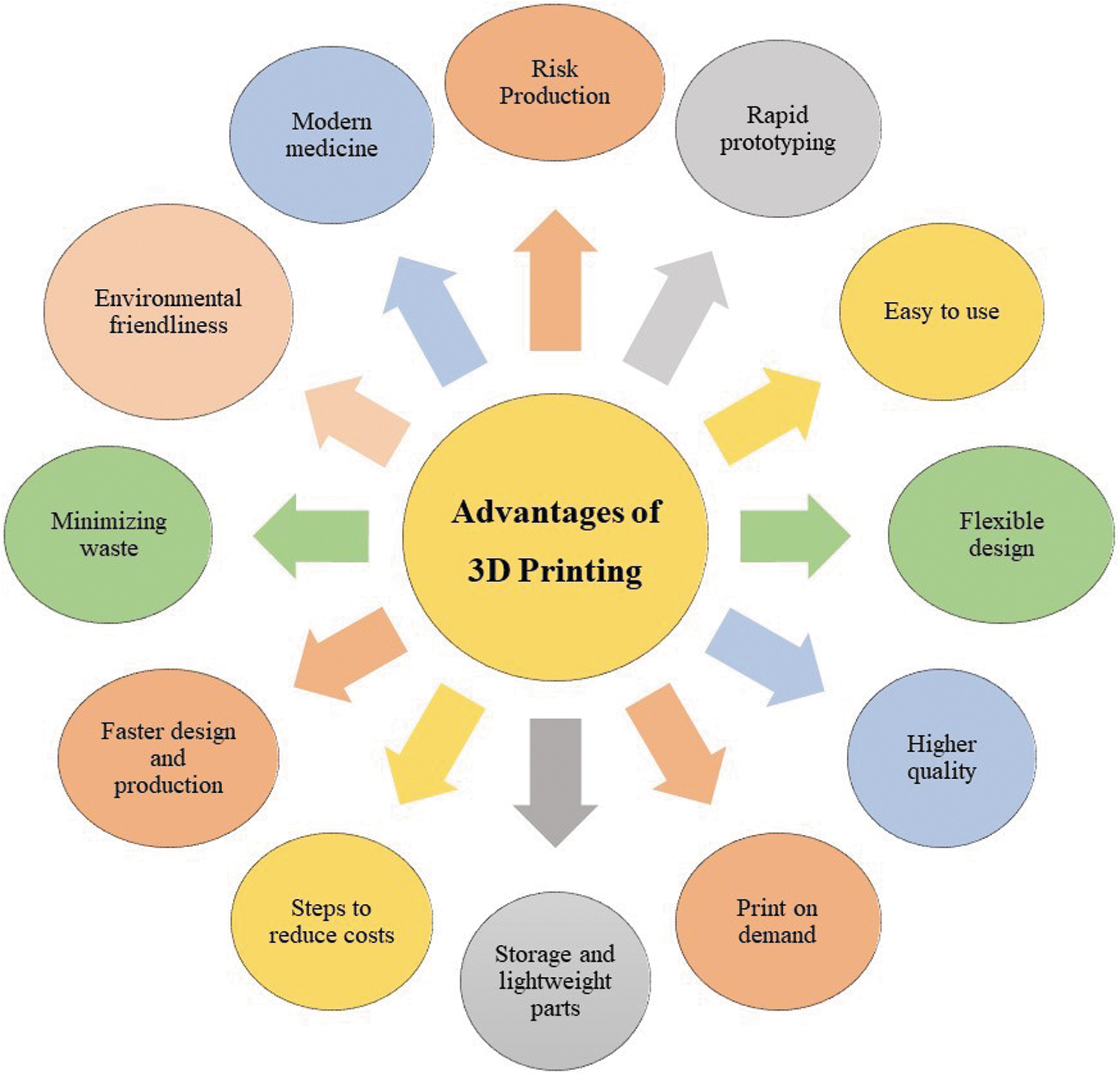
AM, or 3D printing, has several benefits for a variety of businesses since it is a creative and adaptable technology. These are a few of the main benefits of 3D printing, which are shown in Figure 2:
Risk reduction
Reducing risks in 3D printing involves addressing various aspects of the technology and process to ensure safety, reliability, and quality. With the help of this technology, we can minimize steps in the formulation of the tablet dosage form in comparison to conventional tablet formulation. 3D printed formulation reduces the risks of various processes during formulation such as drying and compression. 28
Rapid prototyping
Rapid prototyping is enabled by 3D printing's ability to manufacture components quickly. As a result, the procedure can be completed faster. While prototypes can be machined in a few hours, 3D printed components can be available in as little as an hour, saving both time and money. As a result, each design iteration may be completed in significantly less time. 29
Easy to use
3D printers are becoming more user-friendly as more local service providers provide manufacturing process outsourcing. When compared with more traditional production processes utilized in nations such as China, this saves time and avoids the need for high transportation expenses. 30
Flexible design
3D printing enables the creation of more complicated designs than traditional production procedures. The design limits of traditional production procedures are eliminated by 3D printing. Each CAD or Standard Tessellation Language (STL) file used to produce a 3D design is preserved in a single location so that users can quickly and easily identify and download the relevant file for their printing requirements. Design changes may be done inexpensively and with little wastage of stock or investment in new machinery by simply updating individual files. 31
Higher quality
With the use of 3D printing, product formulations were made with greater reproducibility and consistency for better quality. 32
Print on demand
Print on demand provides an additional benefit over traditional production techniques in that it requires substantially less warehouse space. Not needing to print in bulk until necessary is a win-win for both storage and cost. 33 Each CAD or STL file required to produce a 3D design is saved in a single location so that customers can quickly and easily identify and download the right file for their printing needs. Design changes may be done cheaply and with little wastage of stock or investment in new machinery by simply updating individual files. 34
Storage and lightweight parts
As an extra benefit, print on demand removes the need for a huge warehouse by just printing what is required at any one moment. The time and resources spent on preparing a huge print run are saved until they are necessary, which is a win-win situation. 35
Steps to reduce costs
When compared with the traditional production processes, 3D printing saves both time and money since it is a one-machine-does-it-all manufacturing approach. You can set up 3D printers and leave them alone to complete their work without continually sending someone to supervise them. Aside from the labor reductions noted above, this manner of manufacturing may also save material costs by eliminating unnecessary waste. Although buying your 3D printing equipment may be expensive, outsourcing it to a 3D printing business can eliminate this cost. 36
Faster design and production
Depending on the complexity of the part's design, 3D printing can produce an item in hours rather than days or weeks for molded or machined components. 3D printing may reduce development time by allowing designers to produce print-ready STL or CAD files for the object directly. It will also contribute to increased efficiency, cost savings, and innovation in various industries. 37
Minimizing waste
Waste is minimized since just the resources essential for the part's manufacturing are used, as opposed to the massive volumes of nonrecyclable materials required by other techniques. This strategy not only reduces waste but also helps you save money on the goods you use. 38
Environmental friendliness
As soon as possible and as needed as a consequence, when 3D printing is used in manufacturing, the carbon footprint and overall quantity of wasted energy are both decreased. The environmental effect of assembly, shipping, logistics, maintenance, and storage is negligible. 39 3D printing materials that are recycled, recyclable, or made from organic pigments may be utilized. 40
Modern medicine
By manufacturing human parts such as livers, kidneys, and hearts, 3D printing is employed in the medical field to help save lives. The health care business is constantly improving and discovering new uses for 3D printing, which has the greatest benefit of enabling customized medication and drug manufacturing on demand.41,42
Disadvantages of 3D Printing
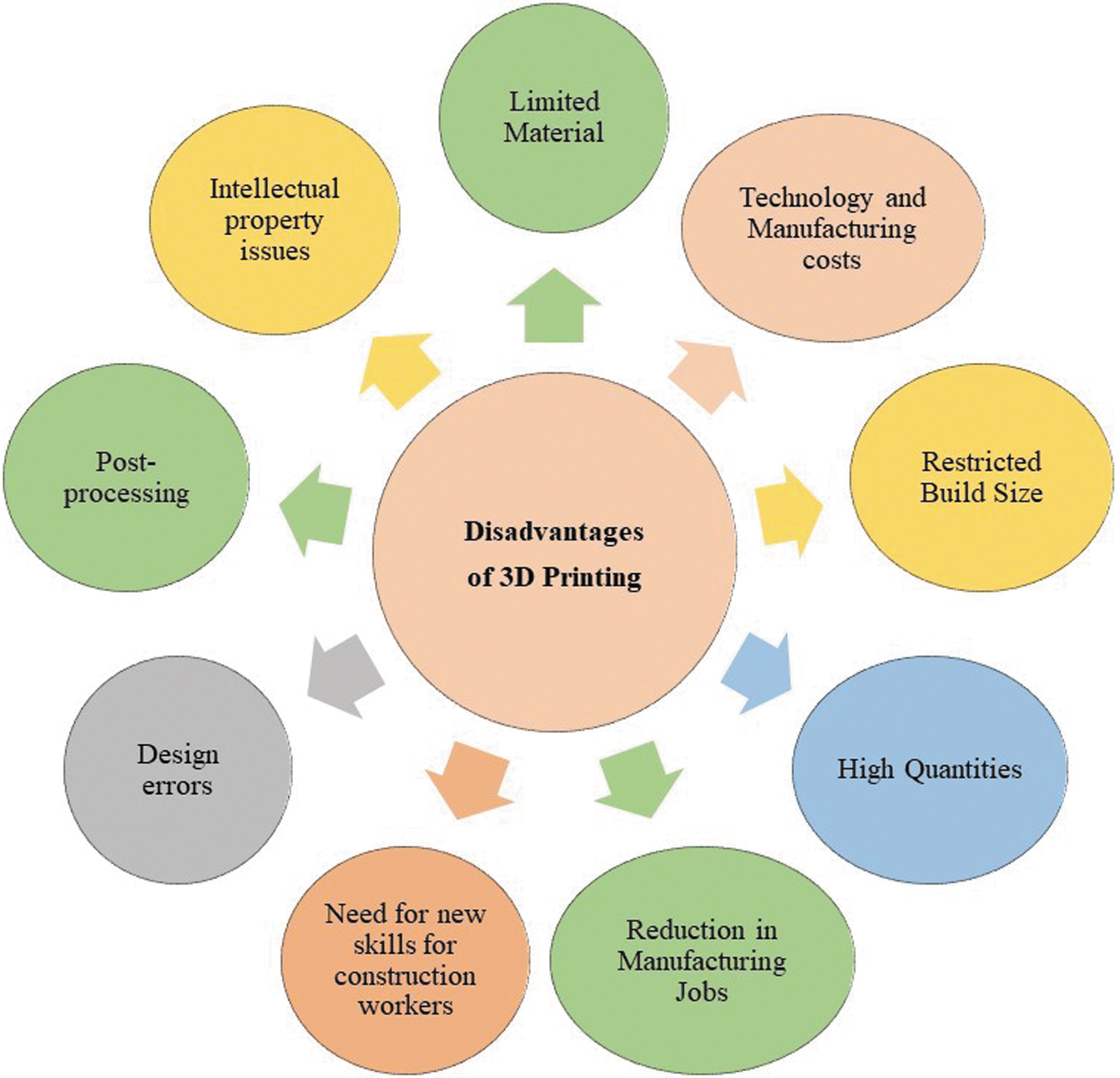
Although 3D printing has many benefits in the pharmaceutical industry, it also has certain drawbacks. 45 Limited materials, technology and manufacturing costs, restricted build size, high quantities, reduction in manufacturing jobs, need for new skills for construction workers, design error, post-processing, and intellectual property issues are shown in Figure 3. 46
Limited materials
Even though 3D printing can produce objects from a variety of metals and polymers, the number of raw materials is not limitless. This is because not all metals or plastics can be heated to an appropriate temperature for 3D printing. PVA, HPMCAS, HPC, HPMC, PEG 6000, and other restricted polymers, for example, can be utilized as excipients in the manufacturing of pharmaceutical and medical products. 47 A serious threat to the development of the 3D printing business is a scarcity of easily available raw materials. While currently, only a few materials are suitable for 3D printing, we expect that to change shortly as our scientists uncover a wide range of novel options. 41 The availability of materials such as polyvinyl alcohol (PVA), eudragit, and high-performance thermoplastic for FDM, and poly(ethylene glycol) diacrylate (PEG-DA) and PEG-dimethacrylate for SLA could also be a problem.
In addition to being drug-compatible, these materials must be biodegradable and acceptable for the creation of 3D-printed formulations. Neither the procedure nor the final product should result in the release of any potentially dangerous compounds. 44 Although advancements in printing technology have made it possible to print in several materials quickly and in different configurations, a shortage of really novel materials with a wide range of physical qualities is holding back the industry from realizing its full potential. Varghese et al. conducted a literature review on novel 3D printing materials, including new photoinitiators for 3D hydrogels, responsive photopolymerizable materials, and ceramics. 5 These new materials, when used in tandem with our present 3D printing technology, may enable the creation of structures and uses that were previously unimaginable.
Technology and manufacturing costs
Due to the market's restricted availability and producibility of materials, the price of equipment and materials is high. 48 The shortcomings of each kind of 3D printer have been discussed at length. Problems with nozzle obstruction are possible in nozzle-based systems, whereas Active Pharmaceutical Ingredient degradation is possible in laser and thermal-based devices. An urgent solution is needed for the issue of drug incompatibility with excipients. 5 In addition, various manufacturing parameters must be optimized to resolve configurational and surface anomalies in the final formulation. Furthermore, the viscosity of the material may be easily varied by changing the pH, temperature, or number of excipients to obtain a printable feedstock, and these changes affect the physical condition of the drug. 49 Manufacturing costs are high because of the high price of materials and the high cost of electricity used in the printing process. 50
Restricted build size
The tiny print chambers used in 3D printers now place a limit on the size of the components that may be printed. Anything bigger requires printing in many portions, which will then be put together after manufacturing. Because the printer must manufacture more components before employing human labor to assemble the parts, the price and manufacturing time for larger objects may increase. 51
High quantities
In contrast to more conventional techniques such as injection molding, where large quantities may be produced for less money, 3D printing has a set cost. Although 3D printing requires a smaller initial investment than other manufacturing processes, if it is scaled up to mass-produce many units, the cost per unit does not drop as much as injection molding. 52
Reduction in manufacturing jobs
Another disadvantage of 3D technology is that printers handle the majority of automated production. However, many developing countries economies rely on low-skilled vocations, and new technology may jeopardize these manufacturing jobs by reducing the need for production elsewhere. 53
Need for new skills for construction workers
Constructing using 3D printing calls for a different set of expertise from traditional builders. Learning how to set up, operate, regulate, and maintain 3D printers is among the new abilities acquired. 54 These cutting-edge abilities, vital to the completion of any construction project, are rarely found in the industry at large. 55
Design errors
Different printers have lesser tolerances, which suggest that finished products may deviate from the original design. This is another possible issue with 3D printing that is directly tied to the equipment or process employed. Although it might be fixed in post-processing, it will lengthen production time and cost. 56
Post-processing
Post-processing in 3D printing refers to the additional steps and treatments applied to a printed object after it has been physically produced by the 3D printer. The majority of 3D printed products need cleaning to reach the desired quality, which is accomplished by removing support material from the structure and smoothing the surface, even though big parts need post-processing, as was previously stated. Other post-processing techniques include assembling, sanding, chemical soak and rinse, air or heat drying, and water jetting. The generated object's size, intended use, and the type of 3D printing technique employed during creation all affect how much post-processing is necessary. As a result, while 3D printing enables quick component creation, post-processing may cause production to go more slowly. 57 It is a necessary step in 3D printing, which provides the removal of support, smoothness, shine, and others to the finished object.
Intellectual property issues
As 3D printing gains popularity and accessibility, there is an increased risk that people will create fake and counterfeit goods that are almost impossible to tell apart. Both quality assurance and intellectual property are affected by this technology. 58
Retrospective Study of 3D Printing
In the 1960s, photopolymers were used to produce 3D things at Battelle Memorial Institute in Ohio. The major purpose of this experiment was to polymerize the resin by crossing two distinct wavelength laser beams. 60 Swainson filed a patent on photochemical machining in 1971, which is comparable to the twin laser beam technique. 61 Solid photography, developed by Dynell Electronics Corporation in the 1970s, produces 3D objects by stacking cross sections made with a laser and a milling machine from computer models. 62 A researcher from Japan, Hideo Kodama, filed a patent in 1980 for the first system based on a single laser beam for fast prototyping. 63 He contributed to the development of techniques for automatic 3D model fabrication using ultraviolet (UV) rays and photosensitive resin, as well as the use of a mask that limited exposure to the UV source, by publishing publications on his experiments in 1980 and 1981. 64
Charles Hull pioneered SLA in 1984. 65 Charles Hull received a patent in 1986 for his discovery of SLA, and the patent describes the technique of hardening liquid polymers under UV light to generate cross sections of a 3D model. 66 In 1988, a 3D system was used to launch the first SLA printer into the world. 67
Deckard developed the concept of SLS, and Desktop Manufacturing Corporation produced the first SLS printer in 1992 (DTM Corp.). However, Deckard discovered Sinterstation 2000 in 1993, which launched Deckard SLS technology into the industry. 68 The patent for FDM was filed in 1989, and the business Stratasys was founded by Scott and Lisa Crump. In FDM, the plastic filament was heated in the nozzle and extruded, and the computer system directed the extruded deposition based on a specified digital model. The deposited filament has strong interlayer adhesion. 69
Later in 1989, a German researcher named Hans Langer created the Electro Optical System (EOS), which focuses on direct metal laser sintering and fabricates 3D items directly from a computer design model system. However, with this method or technique, selective laser exposure is used to energize metal for liquid phase sintering. 70 The first stereo system was EOS solid in 1994, and in 2004, they acquired complete rights to DTM laser sintering patents. 71 In 1996, the first inject printer was created. 72 EBM is a breakthrough improvement in the 3D printing technique that was invented in 1997 by Larson and Assmundson. Orthopedic implants were prepared using EBM. 73
Wake Forest Institute created the first functioning 3D printed kidney in 2002 utilizing Resin 3D printers. 74 Z Corporation produced the first monochrome 3D printer in 2009 to prepare medications. 75 Scientists from the University of Hasselt BIOMED Research Institute in Belgium created and inserted the first 3D printed prosthetic jaw using bio-ink in 2012. 76 Aprecia Pharmaceuticals found and manufactured the first 3D printed medicinal product authorized by the FDA in 2015, utilizing Zip Dose Technology. 77 In 2018, Eindhoven University of Technology and the Vesteda housing organization manufactured the first 3D printed home with an ink printer. 78 Tel Aviv University in Israel printed a heart in 2019. 79 In 2021, Stanford University and the University of North Carolina created a 3D printed microneedle vaccination patch utilizing continuous liquid interface production technology. 80 In Table 1 the application of 3D printing technology in medical and pharmaceutical fields are shown.
List of Years, 3D Printing Technology, and Medical Application
3DP, 3D printing; CAD, computer-aided design; CLIP, continuous liquid interface production; EBM, electron beam melting; FDA, Food and Drug Administration; FDM, fused deposition modeling; HP, Hewlett-Packard; IP, ink printer; MIT, Massachusetts Institute of Technology; NEI, National Eye Institute; OEM, original equipment manufacturers; PBP, powder bed printing; SLA, stereolithography; SLM, selective laser melting; SLS, selective laser sintering; STL, Standard Tessellation Language; UCL, University College London; UNC, University of North Carolina.
Retrospective Application of 3D Printing in Pharmaceuticals and Biomedical
The application of 3D printing in the pharmaceutical and biomedical industry has seen significant growth in recent years, with various potential benefits and innovative uses. Here is a retrospective look at how 3D printing has been applied in pharmaceuticals and biomedical:
In one study, Oladeji et al. developed both drug-loaded and placebo HPMCAS-based formulations (HME) by using HME and FDM 3D printing technique. It assessed the thermal, mechanical, and thermo-rheological properties of HME filaments to demonstrate how the materials composition and manufacture affected printability. The glass transition temperature (Tg) of HME filaments has also been shown to have a good association with the solidification threshold (R 2 = 0.9546) (Evaluation of the low-frequency oscillation test using a parallel-plate rheometer). The printing of drug-loaded and placebo HPMCAS-based formulations was effective; the enabled tailored drug release patterns depending on changes in internal geometry (infill). 32 Chachlioutaki et al. fabricated chocolate-based dosage forms with the help of a 3D printing technique. 3D printing might be used to make customized dosage forms for children that are safe, effective, and meet the standards set by pharmacopoeias for dosage forms. The use of 3D printing to create chocolate-based dosage forms as an alternative to mold casting for combining patient-specific medicine at the point-of-care shows promise. 105
Algahtani et al. formulated self-microemulsifying drug delivery system (SMEDDS), whereas polymer-based systems have been the primary focus of the research community. This proof-of-concept research has shown that 3DP may be used to generate individualized SMEDDS formulations without the need for a carrier or additive, and with further refinement, it has the potential to build a new class of dosage forms based on 3D printed lipids. 106 Abdelhamid et al. studied and assessed how well lipid-based excipients (LBEs) performed in a filament and 3D printing of oral dosage forms. Based on their chemical structure, which includes polar groups for providing hydrogen-bonding sites, the polyglycerol partial ester of palmitic acid and polythene glycols monostearate were chosen as LBEs. Polyglycerol ester of palmitic acid was used to make filaments with exceptional performance. Filament processing had to go off without a hitch and that meant making some adjustments to the 3D printer used. 107 Adamov et al. fabricated various shaped oral dosage forms containing zolpidem tartrate (ZT) by using the DLP method while staying within the drug's acceptable therapeutic window.
To achieve quick drug release, the formulation variables such as surface area/volume ratio, water content, and PEG-DA/poly (ethylene glycol) 400 (PEG 400) ratio were all altered. Differential scanning calorimetry, X-ray powder diffraction, and scanning electron microscopy (SEM) proved that ZT retained its crystalline structure inside the printed dosage forms and indicated no interactions between ZT and polymers. 108 Funk et al. studied the creation of indomethacin nanocrystal-containing fast-dissolving oral polymeric film compositions for 3D printing. Finally, a particularly promising approach for creating immediate-release formulations with increased solubility is the 3D printing of drug nanocrystals in oral polymeric films. 109 Kurakula et al. studied that biopolymers were used as sustainable excipients for research purposes and people look for sustainable excipients also.
In the pharmaceutical industry, poly (3-hydroxybutyrate), or PHB, a biopolymer produced by bacteria, shows promise due to its biocompatibility and biodegradability. The findings indicated that PHB and the direct powder extrusion approach showed promise as instruments for producing extended-release and individualized drug delivery forms. 110
Tagami et al. developed a semi-solid material 3D bioprinter for use with hydrogels and pastes to create a gummy medicine formulation for pediatric patients. The results show that 3D printing may be used to successfully generate gummy drug formulations in a variety of shapes and colors and that this strategy may one day be utilized to improve treatment adherence in pediatric patients in clinical settings. 111 Aguilar-de-levya et al. research set out to create organic solvent-free printing formulations for a pressure-assisted microsyringe (PAM) printing technique, ideally ones that would remain printable even after being stored for several days. All of the printed tablets had a friability of less than 0.5%, which suggests that PAM printing may be used to create tablets with a high degree of structural integrity. This research also shows that PAM printing may be used to mass-produce tablets with consistent composition and weight. 112 Goyanes et al. fabricated 3D printed caplets by extruding PVA that contained either paracetamol or caffeine.
To determine how the interior structure (micropore volume), drug loading, and composition of the caplets affect drug dissolving behavior, the authors prepared 3D printed filaments for oral delivery. This research demonstrates the viability of using 3D printing to create caplets and provides insight into the variables that affect drug release from this novel dosage form. The PVA filaments containing either 8.2% paracetamol or 9.5% caffeine were successfully produced with a filament extruder that met the necessary specifications for FDM 3D printing. Drug release profiles of drugs varied according to the types of caplet, according to experiments conducted using biorelevant media. Drugs with higher loading and solubility were released from formulations more quickly. The authors reported that the drug release profile of 3D printed dosage forms depends on the drug's properties and amount of drug loaded into the filament. 113 Nukala et al. examined how the printing pattern affects the caplets physical properties and how well they dissolve using FDM 3D printing.
Disintegration and dissolution were modified by a simple change in printing pattern while maintaining the same composition and processing parameters. The results of this research may be very useful in creating individualized pharmaceutical treatments. 114 Agrawal et al. fabricated paclitaxel-loaded poly(lactic-co-glycolic acid) polymer microparticles with precise and tuneable morphologies by using a piezoelectric inkjet printing technique. The microparticles had a two-stage release profile, with a rapid initial release owing to diffusion followed by a slower, more persistent release as the polymer degraded. When comparing different geometries, the surface area had the most important role in determining the release rate, with honeycombs and grids having the highest rates, followed by rings and circles. 115 Long et al. examined the administration of lidocaine, a chitosan-pectin (CS-PEC) biopolymeric hydrogel wound dressing. A 3D printed CS-PEC hydrogel containing the local anesthetic medication lidocaine hydrochloride (LDC) is displayed here as the first proof of concept for a prospective wound dressing option.
The CS and PEC polysaccharides were physically cross-linked to create the hydrogels. A mechanical positive displacement dispensing tool and an extrusion-based 3D printer were used to make the scaffolds, which were afterward lyophilized. The printability, dimensional stability, and skin adherence of the 3D printed hydrogels were exceptional. The high swelling ratio and the water absorption rate of the 3D printed hydrogels suggested that they would be perfect for soaking up exudates and producing a moist environment for wound healing. The creation of the CS-PEC hydrogel was attributed to hydrogen bonding, according to Fourier transform infrared spectroscopy. The functional stability of the hydrogel was unaffected by the addition of LDC. Studies on LDC in vitro drug release over 6-h with the Korsmeyer-Peppas theory. This study shows that a 3D-printed hydrogel may be a workable option for treating wounds. 116 Solanki et al. studied that the researchers investigated whether amorphous polymers would be acceptable for use in the pharmaceutical sector in 3D printing tablets containing haloperidol for rapid release.
For tablets carrying 10% drug with 60% infill, complete drug release took place in 45 min at pH 2, but it took 120 min for tablets having 100% infill. Even at pH 6.8, dissolution rates were rather substantial. As a result, a polymer system made of Kollidon® VA64 and Affinisol™15 Cp was shown to be capable of 3D printing and fast drug release. 117 Sadia et al. reported that to produce tablets with FDM 3D printing, it takes a lot of polymers, which slows the erosion and diffusion processes that lead to the release of the drug. 118 Here, the authors demonstrate for the first time how to use caplets with perforated channels as a novel design technique to speed up the release of medication from 3D printed tablets. Hydrochlorothiazide, a BCS class IV prescription, was chosen as the model drug because an enhanced dissolution rate is necessary to assure oral bioavailability. With the addition of channels, the surface area to volume ratio rose, but the release pattern was also influenced by the channel's breadth and length. For instant-release goods to fulfill the USP standards, a channel width of less than 0.6 mm was regarded crucial.
Khan et al. studied SLS 3DP to create printlets (3D printed tablets) with tuneable release properties, including spherical, gyroid lattice, and bilayer architectures. This study is the first to show that SLS may be used to rapidly and affordably modify the drug release characteristics of several polymers without altering the formulations other components, making it an attractive alternative. Medication performance may theoretically be tailored to the individual patient by altering the constructs 3D architecture to affect drug release. 119
Scoutaris et al. utilized FDM to 3D print “candy like” formulations that mimicked Starmix® candies to provide pediatric medications with improved palatability. With the use of 3D printing, drug-loaded filaments were created for the creation of Starmix designs for pediatric printed tablets. 120
Li et al. created gastro-floating tablets to test the viability of 3D printing using an extrusion process for making medicines. Dipyridamole tablets with a novel low-density lattice internal structure have been designed to float in the stomach for longer periods. This increases the rate of drug release, which boosts bioavailability and therapeutic effectiveness. The 3D extrusion-based printing method at room temperature might be effectively used with excipients often used in pharmaceutical studies. The tablets were made using microcrystalline cellulose (MCC PH101) as the extrusion molding agent and hydroxypropyl methylcellulose (HPMC K4M, HPMC E15) as the hydrophilic matrices. The tablets were constructed with three different infill percentages. They evaluated the mechanical characteristics, content homogeneity, and weight fluctuation of the 3D printed gastro-floating tablets in vitro. The correlation between infill percent and drug release behavior was found in dissolution profiles. The findings of this research showed that 3D extrusion-based printing may be used to create gastro-floating tablets with an 8-h floating procedure using conventional pharmaceutical excipients. 121
Chai et al. explored the viability of creating intragastric floating sustained release (FSR) tablets using 3D printing and FDM. Domperidone (DOM), an insoluble weak base, was employed as a model drug to evaluate how FSR would increase its oral bioavailability and reduce how frequently it had to be delivered. DOM was successfully loaded onto hydroxypropyl cellulose (HPC) filaments via HME. The filaments were then printed as hollow, textured tablets after the shell counts and infill rates were modified. The improved formulation, which included 10% DOM with two shells and 0% infill, could float in vitro for around 10 h. According to radiographic scans, the BaSO4-labeled tablets were retained in the rabbits' stomachs. In addition, when compared with reference commercial tablets, pharmacokinetic studies showed that the FSR capsules had a relative bioavailability of 62.85%. All the results pointed to 3D printing using FDM as a promising method for producing hollow tablets for floating medication distribution inside the stomach. 122
Maulvi et al. fabricated a tablet implant with sustained-release isoniazid/poly-l-lactic acid for topical medication administration by using 3D printing technology. 123 Zhang et al. presented a unique approach for manufacturing active pharmaceutical ingredients (APIs) with zero-order release that was created utilizing HME and 3D printing technologies to produce tablets with customized 3D architectures. Using mathematical models created to describe drug release mechanisms, the relationship between the shape of the 3D printed tablets and their rates of dissolving and drug release was also examined. Nine fuse depositional 3D-printed tablets were produced using the model medicine acetaminophen, HPMC E5, and Soluplus. These tablets had various inner core fill densities and outside shell thicknesses. The results presented here suggest that zero-order controlled release tablets with a variety of 3D geometries and an API dispersed in an HPMC-based matrix utilizing HME technology may be produced using a 3D printer. 124 Beck et al. reported the efficacy of a novel solid dosage form made by combining 3D printing and nanotechnology to create drug-loaded nanocapsules for the first time.
FDM was utilized to create drug delivery systems employing poly(ɛ-caprolactone) (PCL) and Eudragit RL100 (ERL) filaments, either with or without a channeling agent. According to SEM examination, these printlets were preloaded with deflazacort nanocapsules (particle size: 138 nm) before they were 3D printed. Drug loading increased with the presence of the channeling agent, and there was shown to be a linear relationship between soaking time and drug loading (R 2 = 0.9739). In addition, the polymeric composition of the tablets and the presence of the channeling agent played a significant effect on the drug release patterns. More medication (0.27% w/w) may be packed into and released from tablets with a hollow core (50% infill) than with regular tablets. This research demonstrates a revolutionary method for hardening nanocapsule suspensions as well as a feasible 3D printing technology for developing innovative drug delivery systems for use as customized nanomedicines. 125
Maroni et al. studied this improvement made to a previously suggested capsular device that could be filled on the fly and could regulate release depending on its design and composition by adding numerous independent compartments for transporting different active ingredients or formulations. The connection also acts as a divider between the two hollow halves; therefore, the resulting compartments may vary in thickness and material. FDM 3D printing, which enables product customization, and injection molding production were employed to construct the systems. Combining compartments made of immediately soluble, swellable/erodible, or enteric soluble polymers with wall thicknesses of 600 or 1200 μm led to devices with two-pulse release patterns, which was compatible with the original component's nature. The outcomes showed that the systems created by injection molding and FDM performed indistinguishably, demonstrating the capabilities of FDM for prototyping. 126 Melocchi et al. studied that the potential of 3D printing for the creation of pharmaceutical products is the subject of much investigation.
A significant issue in this field is the scarcity of enough pharmaceutical grade filaments needed to supply the FDM machinery. As a consequence, numerous polymers frequently used in pharmaceutical formulation were examined to see whether they might be utilized as a feedstock for the HME method of producing filaments suitable for FDM procedures. It has feasible to print 600 μm thick discs using filaments made of insoluble, instantly soluble, enteric soluble, and swellable/erodible polymers. It was proven that the disc's behavior as a barrier to aqueous fluids is compatible with the use to which the pertinent polymeric components were put. The created filaments, when filled with active substances, can be used to print capsules, coating layers for immediate or delayed release, and any other dosage forms. 127 Goyanes et al. studied that FDM and SLA 3D printing techniques are used to demonstrate the potential of 3D printing to create flexible, custom-shaped devices packed with the acne treatment salicylic acid.
A nose 3D model customized to a certain person's anatomy was created using 3D scanning technology. Salicylic acid was loaded into commercially available FPLA and polycaprolactone filaments using HME to provide feedstock material for FDM 3DP (theoretical drug loading = 2% w/w). As seen by the low drug loading of 0.4% w/w and 1.2% w/w in the FPLA-salicylic acid and PCL-salicylic acid 3D printed patches, respectively, significant thermal degradation of medicine occurred during HME and 3D printing. Within 3 h of diffusion experiments in Franz cells using a synthetic membrane, drug-loaded printed samples discharged 187 g/cm2. With FPLA-salicylic acid filament, a nose-shaped mask could be printed, but not with PCL-salicylic acid filament.
Devices (3D printed in the shape of a nose) created using SLA printing had higher resolution and contained more medication (1.9% w/w) than those created using FDM printing, all without affecting the drug's efficacy. Drug diffusion was demonstrated in trials utilizing two distinct drug formulations to be speedier than with FDM devices, with diffusion rates of 229 and 291 g/cm2 within 3 h, respectively. 128
Hollander et al. studied throughout a 30-day period, 3D printing of various grades of ethylene vinyl acetate copolymers using FDM to build T-shaped intrauterine devices and subcutaneous rods for medication delivery. 129 Melocchi et al. explored: Is FDM 3D printing a viable method for creating capsular devices for oral pulsatile release employing a swellable/erodible polymer? (HPC). For HME and FDM processing, a MakerBot Replicator 2 3D printer and a twin-screw extruder with a rod-shaped die and a specially made pulling/calibrating mechanism, respectively, were employed. The resulting bodies and closures physico-technical properties were deemed appropriate. The built capsular devices showed a delay before the medicine was released rapidly and in sufficient quantity during the release test.
Both the devices morphological transformations in response to water and their release performance were found to be on par with those of equivalent devices created using injection molding. As a result, it was demonstrated that it is feasible to create capsular devices for oral pulsatile release utilizing FDM 3D printing using specially prepared HPC filaments, and the real-time prototyping capabilities of FDM were assessed. 130
Kolakovic et al. created controlled-release oral dosage forms by printing medications on porous model carriers using flexographic printers and inkjet printing technologies. The technique provided the advantage of exact dosage and customized drug administration by requirements of dose. 131 Yu at al. developed novel doughnut-shaped multilayered acetaminophen delivery devices to achieve linear release profiles by modifying the drug and release-retardant substance. An automated 3DP method based on CAD models was used to create a variety of devices, including those containing acetaminophen, HPMC as a matrix, and ethyl cellulose (EC) as a material that retards release. These devices furthermore contained EC as a release-delaying component. 132
Huang et al. manufactured levofloxacin implants; researchers used a novel 3D printing technology based on a lactic acid polymer matrix with a specified microstructure, which is suitable for quick prototyping and production. One implant showed a bimodal profile, with pulsatile drug release from days 5 to 25, steady-state drug release from days 25 to 50, and a second pulse release phase starting on day 50 and extending until day 80. 133
Gbureck et al. created the drug delivery system by employing a low-temperature 3D powder direct printing technique to build microporous bioceramics (hydroxyapatite, brushite, and monetite) for antibiotic adsorption and desorption kinetics. Vancomycin and ofloxacin released quickly in buffer media, taking 24–48 h to do so, whereas tetracycline released continuously for 5 days. Faster drug release was achieved by adding polymer impregnation using polylactic acid/polyglycolic acid polymer solutions to the drug-loaded matrix. 134
Rowe and colleagues fabricated several complicated oral drug delivery devices using the 3D printing technique. One of these devices comprised a pulsed release of chlorpheniramine maleate after a 10-min lag, followed by a continuous release for up to 7 h. Erodible breakaway tablets are divided into three sections: an interior fast-eroding segment separated by two drug-releasing subunits that erode in 30–45 min in simulated stomach fluid; and an external fast-eroding section. The active ingredient, diclofenac sodium, was printed into two distinct sections of an enteric dual pulsatory tablet. In experiments that measured the drug's release in vitro, each formulation had positive findings. 135
Prospective Application of 3D Printing in Pharmaceuticals and Biomedicals
The prospective applications of 3D printing in the pharmaceutical and biomedical fields are vast and continue to evolve. This technology holds significant promise for advancing health care, drug development, and patient-specific treatments. Here, some prospective applications are:
Zieliński et al. studied that for material solutions with exact control over cellular performance are needed to provide effective scaffolds for tissue engineering and regenerative medicine applications. When used properly, 3D printing may be used to produce objects of great complexity and sophistication, with clear architectural and compositional details. In this work, the authors investigate the possibility of extrusion-based 3D printing methods such as near field electrospinning, melt electro writing, FDM, and extrusion bioprinting to produce scaffolds with bioinstructive properties. Studying the numerous physical and pharmacological cues incorporated into the extrusion-based printing scaffolds allows researchers to better understand how cells align, multiply, differentiate, generate specific extracellular matrix, and mature tissues.
The authors demonstrate that the impact of the cues varies depending on the material system, cell type, and their coexistence. This demands a methodical selection procedure that considers the intended application. Using ideas such as metamaterials, hybrid living materials, and 4D printing, the authors suggested new avenues for research and development of bioinstructive materials. 136
Ong et al. studied that, by merging information acquired internally and from the literature on HME and FDM, a more comprehensive list of 1594 3D printing formulae was produced. The enhanced machine learning (ML) models predicted the printability and mechanical characteristics of the filament 84% accurately and were able to forecast HME and FDM processing temperatures, with mean absolute errors of 5.5°C and 8.4°C, respectively. The fact that these ML models outperformed earlier iterations with a smaller and more unbalanced data set shows how crucial it is to provide a structured and varied data set for ML to perform as well as possible. Predictions on filament properties, printability, HME, and FDM processing temperatures, and drug release profiles are now included in the upgraded online application M3DISEEN, which was built using the revised models. The web application speeds up the normally arbitrary process of formulation creation by mimicking the steps involved in making FDM printed medicinal items, allowing for increased productivity in pharmaceutical 3D printing research. 137
Ganeshkumar et al. reported that artificial intelligence (AI) and the internet of things integration are performed to enhance the AM process. Integrating AI into AM is a growing area of study, with studies focusing on many aspects of the process such as tool path creation, generative design, support generation, and the inspection of 3D printed parts. Advanced manufacturing osmotic mass production methods have emerged as cyber-physical systems associated with AI. Several ML and deep learning (DL) techniques forecast the tool path and support creation, in contrast to the AI predictive environment design. The authors discuss how many types of AM, including the fusion deposition technique, liquid AM, and powder AM, have included AI.
Furthermore, examples of current and potential uses of AI in advanced manufacturing are shown. 138 Rezapour Sarabi et al. reported that the subject of microneedles (MNs) has recently seen the introduction of 3D printing techniques due to the efficiency and low overhead associated with producing these tiny instruments. To optimize 3D printing settings for the most efficient manufacture of biomedical equipment, AI, including ML and DL, is employed. This is a freshly emerging multidisciplinary issue. In this study, the authors introduced a ML system for evaluating and forecasting MN characteristics printed in 3D.
The biodegradable MNs were created using the FDM 3D printing technology, which was then followed by chemical etching to increase the geometrical precision of the final product. The manufactured microneedle arrays (MNAs) underwent quality assurance and outlier identification using DL. Data from 10 unique MN designs and a range of etching exposure levels were utilized to train ML models for similarity metric extraction and prediction of future fabrication results. New health care systems and the expansion of MNs biological uses will be facilitated by the combination of AI-enabled prediction with 3D printed MNs. 139 Chatterjee and Chakraborty explored 3DP as a key technical innovation in recent years that has helped the industrial sector create cutting-edge health care treatments and equipment. The rising need for individualized treatments and medical implants has contributed to the technology's rapid growth in recent years. The potential use of 3DP in the creation of generic drug delivery systems, AI-based medicine dispersion devices, and oral drug formulations for quick, customized doses is another advantage.
Along with the apparent advantages of 3D printing, a technique based on manufacturing risks and side effects is also discussed. This article provides a quick overview of the numerous technical advancements for creating 3D objects, such as AM employing FDM and inkjet printing, which are crucial for the modeling of pharmaceutical products and medical implants. This article also examines the importance of 3DP as an extremely fortuitous technology by showcasing many situations as contemporary improvements employing supervised ML and DL, with a particular emphasis on intelligent health care systems. 140 Banerjee et al. studied that AI has accelerated beyond the confines of academic laboratories into the mainstream of modern life as a result of the rapid development of medical technology in the digital age. New AI advances are helpful for the health care system since they will lessen the need for people to conduct routine tasks. AI is a game-changer in the health care sector due to its ability to improve performance by lowering the risk of mistakes and allowing automated production when paired with 3D printing technology.
Nowadays, 3D printing is a crucial and potentially game-changing technique that might quickly advance the health care sector. This article provides a brief review of some of the most important ideas in AI, such as ML, the internet of things, cloud computing, and DL. The explanation of various forms of 3D printing will be given in new dimensions. SLA, the most dependable 3D printing method, is also briefly covered. The major health care trends that will be covered in this chapter include personalized medicine, regenerative medicine, eliminating the need for animal testing to confirm the efficacy and safety of new medications before human testing begins, and the use of 3D printing in the fight against the COVID-19 pandemic outbreak. The last section explains 3D printing's main applications, difficulties, and future possibilities so that readers may comprehend why technology is quickly becoming society's most useful tool and how they can use this knowledge in their study. 141 Nguyen et al. studied that the usefulness of 3D printing has greatly increased recently.
As a result of the sector, several related fields have undergone revitalization. However, there are still certain limitations to this technology; hence, it has not been widely adopted to provide the most possible advantages to its end users. In this study, they provide a groundbreaking data-driven ML platform based on multilayer perceptron and convolution neural network models to anticipate the best 3D printing process parameters from a model design to a finished product. This discovery might lead to substantial advancements in 3D printing. As a consequence, the authors can predict critical elements of the conventional 3D printing process, such as time, weight, and length, with high accuracy and speed even with faulty input and some missing beginning data.
The suggested method may carry out the task automatically, regardless of the format, dimensions, or content of the printed output. A configurator is advised to define the parameters for the different printer types once the model is finished, simplifying and accelerating the 3D printing process. 142 Wu et al. reported that despite a global increase in the demand for organ transplants, the number of organs accessible for transplantation has remained relatively constant.
Due to a lack of donors, regenerative medicine was created to create artificial organs and tissues made of biocompatible materials. Embedded cells and biomaterials in a bioprinter make it possible to create fully functioning 3D organ or tissue structures for use in regenerative medicine. Also, most 3D surgical models are composed of inflexible materials such as plastic or rubber, which limits their usefulness as training tools and prevents surgeons from simulating the feel of genuine organs and tissues. Therefore, the fabrication of realistic models to advance surgical methods and instruments before surgery as well as the printing of delicate organ structures will be accelerated by the development of appropriate biomaterials and printing processes. The bioprinting process, and printing parameters, including print speed, dispensing pressure, and nozzle diameter, must also be adjusted. Bioprinting involves a large number of variables, and ML technology may be a valuable tool for optimizing them. To sum up, the ideas discussed in this study center on the use of ML for 3D printing and bioprinting to optimize various conditions and processes. 143
Dabbagh et al. reported that scientists are interested in microrobots because of their potential to access otherwise inaccessible areas of the human body and complete tasks there. Cargo delivery, sampling, surgery, and imaging are just some of the many possible uses for microrobots, and they may be operated and manipulated with pinpoint accuracy, either individually or as a swarm. In addition, users with rudimentary micromanufacturing abilities may now benefit from the high-resolution creation of microrobots thanks to the rapid development of 3D printers. In this study, the authors take a look at the most recent uses for 3D printed microrobots (from environmental to biomedical applications), and the authors talk briefly about the achievable actuation techniques (on-board and off-board) and realistic 3D printing technologies for microrobot construction. For the sake of looking forward, the authors also spoke about the possible future benefits of combining microrobots with smart materials and enacting both AI and physical intelligence. Current hurdles (such as immune system assaults) and laborious conventional test processes to assure biocompatibility are developed to help get microrobots from the laboratory to the hospital bedside. 144
Wang et al. reported that translational tissue engineering faces ongoing difficulties in the regeneration of 3D tissue constructions with therapeutically relevant sizes, shapes, and hierarchical systems. With the development of AM methods such as 3D printing, scientists are now able to produce biomimetic tissue structures that closely mimic the structure, content, and function of actual tissues. To further individualized therapy for a variety of disorders by reconstructing the required tissues, 3D printing is growing in popularity. This article discusses the advantages of 3D printing methods for the regeneration of cartilage, bone, and osteochondral tissues as well as their most recent developments toward clinical translation.145–147 Krueger et al. studied few examples of the rising use of 3D printing in the pharmaceutical and health care industries, including the demonstrated fast prototyping of orthotics, dental retainers, drug-loaded implants, and pharmaceutical solid oral dosage forms. The authors can accurately control the dose as well as the release kinetics and a variety of morphological aspects (color, shape, and texture) of dosage forms by using 3D printing.
In addition, polypills can be created with customized dose strengths, enabling the combination of many medications in a single solid dosage form. As 3D printing technology and formulae advance, interest in new hybrid materials to produce better formulations is growing. The purpose of this article is to consolidate information on the requirements for creating. 148 Shujaat et al. stated that to investigate the use of AI in maxillofacial computer-assisted surgical planning (CASP) processes, including a review of present limitations and potential future uses. A complete literature study was used to perform research on the use of AI in the segmentation, multimodal image registration, virtual surgical planning (VSP), and 3D printing phases of maxillofacial CASP operations. Because earlier AI models were only built to target certain stages, there is no unified intelligent process that encompasses all stages of CASP. Dentomaxillofacial tissue segmentation utilizing computed tomography (CT)/cone-beam CT imaging was the most often examined therapeutically important area.
The main challenge was that most models were trained using data from a single device and imaging approach, which may not convert to the same level of performance when the scope was expanded to include more devices. Due to a lack of adequate heterogeneous data, there are limitations in automating registration, VSP, and 3D printing. The integration of AI and CASP processes may enhance the accuracy and efficiency of plans. However, more big data research is required before this emerging technology can be used in a mainstream therapeutic context. 149 Hunde and Woldeyohannes studied that CAD is “the use of computer-based software to help in the modelling, analysis, evaluation, and documentation of a design.” However, CADs advantages are amplified when combined with AI, augmented reality, and production. Thanks to AI, the authors can transform conventionally laborious design procedures into seamless ones with the help of a smart visual interface. With the use of extended reality technology, simulations may be run in a fully immersive 3D virtual world, allowing for more realistic interactions and deeper insights.
As 3D printing technology has shown, CAD systems may be integrated directly into production to streamline the creation of complicated components. In this study, the application of CAD in 3D printing and augmented and virtual reality is examined. This study's main goals are to give a summary of contemporary CAD and its uses while speculating on probable future advances for the industry. The essay is based on a comprehensive literature assessment of journal articles that covers a broad range of possible CAD-related studies. Discussed are the advantages of introducing AI into CAD systems, the applications of CAD in augmented reality and 3D printing, and, ultimately, a quick overview of the challenges that are driving CAD forward. In conclusion, the research found that CAD is being pushed to new heights by the need for many outputs based on a single input item, for interactive and immersive simulation, and direct design-to-manufacturing integration. 150 Li et al. highlighted that the use of 3D printing in medical education, regenerative medicine, and auxiliary diagnosis and treatment has grown recently.
Surgical procedures and pathological analyses often conducted by neurosurgeons include intricate components of the brain and nervous system that are too small for naked-eye observation. To better comprehend intricate facets of anatomy and disease, 3D printed models may faithfully mimic anatomical structures, pathogenic tissues, and cells. In addition, they may aid in preoperative planning and simulation, contribute to precision medicine in surgical or interventional procedures, and boost the efficacy of therapies. This study summarizes and examines preoperative planning, clinical training, common complications (including intracranial tumors, intracranial hemorrhage, intracranial aneurysms, skull repair, and neural prostheses), and typical therapies.
A cutting-edge technology, 3D printing has several potential uses, such as novel approaches to the study and treatment of neurological illnesses. 151 Sood et al. studied that the area of 3D printing technology is fast developing and being used globally for a broad range of applications in multidisciplinary study. To release the many domains, study fields, and technical advances in the 3D printing technology domain, a periodic critical quantitative evaluation of the research domain is necessary.
For scientometric analysis, they utilize CiteSpace, a program for measuring scientific information, to learn about the history and current state of 3D printing technology, as well as to uncover previously unknown relationships between different pieces of the published literature. This article includes a co-citation study on 37,445 retrieved works from the Scopus index, including a breakdown of the countries involved, the documents written, the researchers involved, the journals in which their work appeared, and a co-occurrence analysis of keywords. In addition, the research patterns and hotspots are highlighted through a study of the terms used over time. Finding the research frontiers, hotspots, and probable future research orientations in a certain field is the focus of article. 152 Amukarimi et al. reported that smart biomaterials have allowed for improved medical facilities in this century. The development of 4D bioprinting technology is a prime illustration of this trend. By contrast, 4D bioprinting can be used to create cell-laden structures that can evolve in response to stimuli over time, allowing manufactured tissues to undergo morphological changes based on a specified design.
3D printing with inert biomaterials as the bioinks would produce static objects that might not be able to mimic the dynamic nature of tissues. To use stimuli-responsive biomaterials with cell-supporting functionalities and responsiveness and fully realize the potential of 4D bioprinting technology in tissue engineering, this study provides a brief overview of recent developments and challenges in smart biomaterials for 4D bioprinting. In addition, the most current developments in 4D bioprinting are often emphasized. 153
Kuźmińska et al. combined a model drug (theophylline) with permeable water-insoluble methacrylate polymers (Eudragit RL and RS) resulting in a unique approach for simplifying the direct extrusion 3D printing process by eliminating the post-printing drying step. Indeed, rheological studies have shown that adding a plasticizer (triethyl citrate) and GMS to theophylline: methacrylate polymer blends may significantly reduce extensional viscosity to 2.5 kPa Secat 90°C. GMS revealed an unexpected temperature-dependent dual behavior, acting as a plasticizer and lubricant at printing temperature (90–110°C) and allowing solidification at room temperature.
In vitro, theophylline release from 3D printed tablets was proportional to the Eudragit RL:RS ratio. 154 In one study, Goranov et al. reported the 3D patterning of cells in magnetic scaffolds for tissue engineering. The authors used biocompatible magnetic nanoparticles, vascular and osteoprogenitor cells that were selectively arranged on opposing sides of the scaffold fibers. This spatial organization was facilitated through the application of nonuniform magnetic gradients and loading magnetic configurations.
The scaffold's magnetization further enhanced cell guidance by trapping cells through short-range magnetic forces. Mathematical modeling substantiated the significant augmentation of magnetic gradients, particularly in proximity to the fibers, thereby establishing preferred microscale cell positioning. Manipulating cells within purposefully designed magnetic scaffolds offers a distinctive approach for constructing cellular constructs organized in biologically relevant patterns. 155 Martorelli et al. designed and analyzed the 3D customized models of a human mandible. In this study, authors created personalized 3D models of the human mandible through a combination of reverse engineering, AM, and composite material technology.
Experimental assessments involved subjecting the models to loading through the condyles, demonstrating their capability to replicate the mechanical characteristics of a human mandible. Considering the load-arch width decrease curves, the 3D composite model exhibited a stiffness of 14.1 ± 1.9 N/mm, closely resembling the stiffness observed in tested human mandibles (17.5 ± 1.8 N/mm). 156 Maietta et al. analyzed the Ti6Al4V lattice structures manufactured by SLM. The authors reported that the biomedical device design heavily considers mechanical and architectural aspects. Stress shielding effects, bone atrophy, and implant loosening are often caused by the use of materials (e.g., Ti6Al4V) with Young's modulus greater than typical tissues.
But porous devices may be made to encourage tissue ingrowth, which would lessen the stiffness of the implant and increase its stability. Increase in the porosity results in decrease in the mechanical strength while mass transport properties are essential for cell activity and tissue ingrowth increase. The objective of this study was to offer an additional investigation of Ti6Al4V lattice structures produced using SLM. Theoretical and experimental investigations also showed that changes in pore size, geometry, and architectural characteristics may be made without significantly affecting the structure's mechanical performance. 157
Application of 3D Printing in Pharmaceuticals and Biomedicals
3D printing, also known as AM, has found numerous applications in the pharmaceutical and biomedical fields. Its ability to create complex structures with precision and customization has led to advancements in drug delivery, tissue engineering, and personalized medicine. In the pharmaceutical and biomedical field, 3D printing has been utilized for quite some time, first for the production of dental implants and individualized prostheses.158,159 Making organs and tissues; creating prosthetics, implants, and anatomical models; researching drug delivery, dosage forms, dental applications, and regenerative medicine. These are only a few of the 3D printing's current medical uses, which are shown in Figure 4. 159
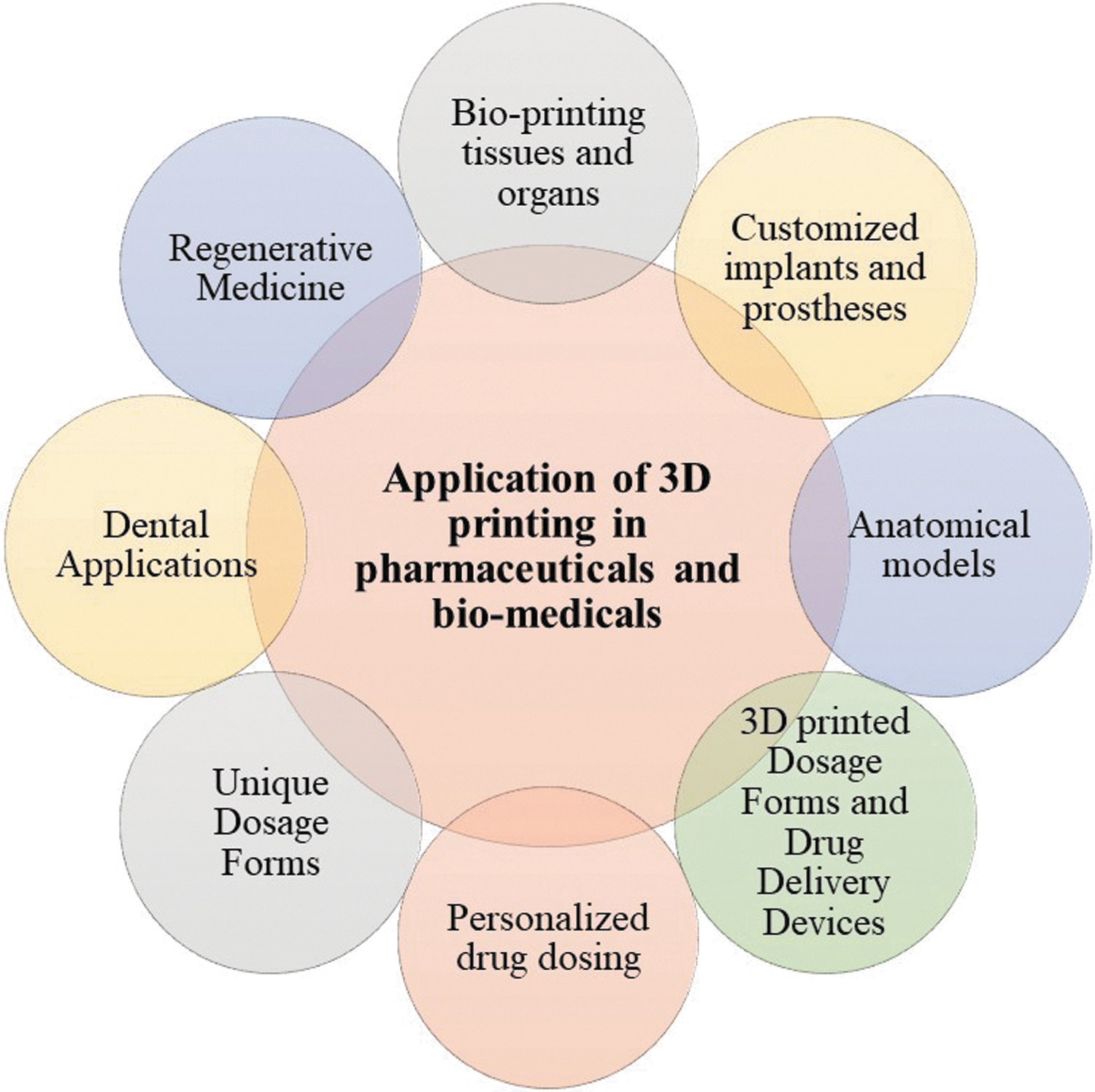
Bioprinting tissues and organs
3D bioprinting is used to create 3D biological structures by depositing living cells, allowing the fabrication of tissues and organs for transplantation. 3D printing helps create microscale organ-on-a-chip models that mimic the structure and function of human organs, facilitating drug testing and disease modeling. Directly creating 3D tissue-like structures, organ printing makes use of 3D printing technology to generate cells, biomaterials, and biomaterials containing cells alone or in combination, layer by layer. 160 A knee meniscus, heart valve, spinal disc, as well as other kinds of cartilage and bone, have all been produced using 3D printers by researchers. 161 Organ and tissue failure due to trauma, congenital abnormalities, advanced age, etc. is a major medical problem that is now treated by transplants from deceased or live donors. However, only a lucky handful survive after receiving an organ, and the rest inevitably perish owing to a lack of donors. Furthermore, organ transplant treatments are so costly that they are out of reach for regular people. Finding donors who are a suitable tissue match is problematic for transplant surgery. 162
Making the necessary tissue or organ using the patient's body cells reduces the chance of tissue or organ rejection and considerably reduces the need for immunosuppressants.163,164 Normal tissue engineering practices include isolating stem cells from a tiny tissue sample, combining them with a growth agent, and then multiplying them in the laboratory until sufficient numbers have been reached. To direct the cells proliferation and differentiation into a mature tissue, the cells are then seeded onto scaffolds. Digitally controlled speed, drop volume, precision, cell concentration, and printed cell diameter are some of the extra advantages of 3D bioprinting above traditional tissue engineering. 165
Scaffolds are made from a wide variety of materials, each one selected for its ability to support a certain kind of tissue and its ability to withstand a specific amount of force. According to the literature, hydrogels are the best material for constructing soft tissues. 166 Although organ printing is still in its early stages, various studies have shown its viability as a concept. 3D printing has been used to create prosthetic ears, cartilage, bone, and a heart valve. 167 Using 3D bioprinting technology, Wang et al. deposited diverse cell types inside several biocompatible hydrogels to create an artificial liver. 168 Since this technique has such enormous promise, it may help researchers discover novel therapeutic medications at a much lower cost and in much less time.
Customized implants and prostheses
Virtually any shape is possible for implants and prostheses thanks to the conversion of X-ray, magnetic resonance imaging (MRI), or CT scan data into digital 3D print files. 169 The fabrication of dental, vertebral, and hip implants have all been done using this method. Support from imaging modalities such as MRI and CT scans, as well as imaging modalities such as X-ray, allows for the creation of implants and prostheses of any imaginable form. 170 Standard surgical implants and prosthetic limbs can be made to order in as little as 24 h. While implants for the spine, teeth, and hips have been made, validating them is a lengthy procedure. Surgeons formerly had to hand-make metal and plastic parts, conduct bone grafting, and utilize drill machines to adjust implants to reach the correct shape and size. This is also true in neurosurgical procedures, where the skull's nonstandard form makes standardization a difficult task.
The following are some instances of 3D printed implants and prostheses that have been both commercially and medically successful: At the BIOMED Research Institute in Belgium, the first titanium mandibular prosthesis printed using a 3D printer was successfully implanted. Layer Wise is a producer of implants for the dental, orthopedic, maxillofacial, and spinal fields. Invisalign braces are another commercially viable application of 3D printing. A 3D printed prosthetic ear that could pick up electromagnetic frequencies was developed utilizing silver nanoparticles, chondrocytes, and silicon. Because everyone's ear canal is somewhat different in shape, 3D printing provides a personalized fit for each receiver while also allowing the devices to be mass-produced fast and economically. This technology has had a significant impact in the area of hearing aids, with 3D printers now producing 99% of all customized hearing aids. 171
Anatomical models
3D printing produces anatomically accurate models of patient-specific organs, aiding surgeons in preoperative planning and training. Developing 3D printed anatomical models for medical professionals to practice and enhance their surgical skills. In particular, 3D printed neuroanatomical models may present a visual example that will be beneficial to neurosurgeons. Some of the most complex bodily structures in humans. Due to the particular and complicated nature of human anatomy, doctors must have a thorough understanding of their patients' unique structures before performing any medical treatments on them. As such, 3D printed models have become an indispensable resource for surgical techniques. Since the human brain is one of the body's most complicated systems, 3D printed representations of its anatomy are a big help to neurosurgeons. It can be challenging to obtain comprehensive information on the relationships between the skull's architecture, the brain's structure, the cranial nerves, and the arteries from radiography's 2D images alone since even a minor error in medical therapy could have disastrous consequences.
Here, 3D models come into play due to their realism and ability to compare and contrast normal brain structure to a brain with deformity or lesions, which offers safer surgical procedures to doctors. The Kobe University Hospital in Japan has utilized 3D printed models made from patient organ replicas to learn how to accurately manufacture a donor liver with minimal tissue loss. To remove plaque from the aorta during surgery, doctors have employed a 3D printed replica of a calcified aorta. 3D printed replicas of preterm babies airways were used to investigate the effects of aerosol medicine delivery on lung function. 172
3D printed dosage forms and drug delivery devices
3D printing allows the fabrication of personalized and complex drug formulations, including tablets with controlled release profiles and specific dosages tailored to individual patient needs. Combining multiple drugs into a single dosage form, known as polypills, for improved patient compliance and simplified administration. One of the techniques used in the pharmaceutical sector for both research and production is 3D printing because it allows for exact control of droplet size and dose, excellent reproducibility, and the capacity to produce dosage forms with intricate drug-release patterns. Utilizing 3D printing, it is also possible to standardize complicated medication production processes, making them easier to use and more practical. The advancement of customized medicine may also greatly benefit from 3D printing technology. 173 Rastpeiman et al. fabricated a 3D printed facile extended-release tablet of Ticagrelor by utilizing 3D printing technology. 174 Su et al. prepared chitosan/sodium alginate/nanoclay multifunctional 3D printed hybrid scaffolds grafted with caffeine for local medication release treatment during breast cancer surgery. 175
Personalized drug dosing
3D printing enables the creation of customized medications based on an individual's specific health needs, including dosage strength and combination therapies. Customized medical devices, such as implants and prosthetics, are designed to fit a patient's unique anatomy. The goal of drug development should be to maximize treatment effectiveness while minimizing the risk of adverse reactions; this is made possible via the use of 3D printing to create individualized medicines. Tablets are the most common dosage form because they are easy to make, patients tend to take them as prescribed, and there is little to no discomfort involved in taking them. Tablets are created by combining powder materials, grinding them, and then dry and wet granulating the resulting mixture. However, there is no current technology for creating individualized pills or other solid dose forms. Drugs may quickly suffer deterioration in the conventional method of producing tablets, changing the therapeutic efficacy of the final product if strict standards are not followed.
Traditional techniques also are not suitable for making tailor-made dosage forms with features such as prolonged stability, a different drug release profile, and intricate geometries. 176 The proper dose may be administered with knowledge of the patient's pharmacogenetic profile and other parameters (such as age, race, and so on), as 3D printed medications with narrow therapeutic indices are easy to produce. The development of wholly novel formulations, such as pills containing a mix of several pharmaceutically active ingredients or provided as multireservoir printed tablets, is another significant use of 3D printing. As a consequence, people with a variety of conditions may have their formulation made at a medical institution in a multidose form, enabling individualized dosage and improved adherence. 177 Algahtani et al. fabricated 3D printed capsule shells for personalized dosing of cyclosporine-based self-nanoemulsifying drug delivery systems (SNEDDS). 178
Unique dosage forms
Inkjet-based or inkjet powder-based 3D printing is the main 3D printing technique utilized in the pharmaceutical production industry. These technologies enable the fabrication of an infinite number of dosage forms, which is likely to pose a dilemma for traditional medication manufacturing. Several innovative dosage forms, such as microcapsules, hyaluronan-based synthetic extracellular matrices, antibiotic printed micropatterns, mesoporous bioactive glass scaffolds, nanosuspensions, and multilayered drug delivery systems, have previously been created using 3D printers. Sen et al. used inkjet 3D printing to create an amitriptyline hydrochloride tablet. 179
Dental applications
In the realm of dentistry, regenerative medicine holds significant promise for innovative and personalized approaches to address various oral and dental challenges. 180 Prosthetic equipment including crowns, bridges, and implants are frequently made via 3D printing. 3D printing is used to make customized orthodontic equipment, such as braces and aligners, for increased comfort and efficacy. Braces and supports, among other customized wearables, may be made for individual patients thanks to 3D printing.181,182 Iezzi et al. fabricated the 3D printed implant with a porous structure and also evaluated the in vitro response of osteoblasts, fibroblasts, mesenchymal stem cells, and monocytes. 183
Regenerative medicine
Regenerative medicine is a multidisciplinary field focused on harnessing the body's natural regenerative capabilities to repair, replace, or regenerate damaged tissues and organs.184,185 This cutting-edge approach integrates principles from biology, engineering, and medicine to develop innovative therapeutic strategies.186,187 Advanced technologies such as 3D bioprinting play a crucial role in creating intricate scaffolds and structures that mimic the natural architecture of tissues. 188 3D printing is helping to produce bioinks and scaffolds for use in regenerative medicine. Cartilage regeneration 189 is one particular area of regenerative medicine where 3D bioprinting is being used.190,191 Bioprinted cartilage structures may be beneficial for patients whose degenerative disorders or injuries have destroyed their cartilage. 192
In one study, Shen et al. studied the potential cartilage regeneration impact of a GelMA/SG bioink with outstanding overall performance, which was printed using a DLP 3D printer to create the scaffold loaded with cells. 193 Lin et al. studied the use of cellulose derivative-based bioinks and 3D bioprinted nanocellulose in bone and cartilage tissue engineering. 194
Challenges
Software development and capabilities
Software development plays a crucial role in the capabilities and advancements of 3D printing technology. Some of the challenges such as a longer production timeline, limited recyclability, and risk of litigation are given below: The manufacturing time is extended because of the software involved in the product's design and manufacture. 197 The difficulty lies mostly in recycling materials. There is a lot of trash produced by printing on little products, and much of it is not recyclable. 198 One of the biggest problems with 3D printing is protecting the intellectual property of the created design. For the reason that 3D printing makes it simple to replicate product designs, counterfeiting has become a major problem. 199
Data storage requirements
Data storage requirements in 3D printing can pose several challenges due to the nature of the technology and the characteristics of the data involved.200,201 Here are some challenges related to data storage in 3D printing,202,203 such as file size, version control, data integrity, access control, data transfer speeds, long-term storage, collaboration challenges, backup and redundancy, and security concerns. 204
Cybersecurity risks
Cybersecurity hazards include the dangers connected with a network compromise by hackers. Network breaches, digital sabotage, and design theft are all examples of this. 205 The phrase “cybersecurity risk” refers to the risk of financial loss, reputational injury, or business interruption as a result of inadequately secured data held in computer systems. 206
Safety aspects
Any medicine formulation must also take into account safety considerations. When some compounds are fused, extruded, or heated, they may emit poisonous airborne particles that may irritate the skin or the lungs. Therefore, regular operating procedures and safety measures should be adhered to limit contact with potentially hazardous materials. 207 The FDA released a recommendation on technical problems for the regulation of 3D printed medical devices in 2017, concentrating on device design, manufacture, and usage. Because each 3D printed medical device may require its independent evaluation of safety and efficacy, these regulations may not apply to all of them. The FDA also authorized the first printed pills, although 3DP pharmaceuticals currently lack standards and processes. 5
Clinical pharmacy practice
Before 3D printing can be extensively employed in hospitals, several challenges must be addressed. It first requires highly skilled professionals to be there to handle the seemingly invincible technological challenges. 5 QC of printed formulations presents a related challenge, necessitating the use of nondestructive and applicable methods. Multiple process analytical technologies (PATs) have previously overcome this problem by precisely controlling the product and process quality. It has been shown that the PAT model for determining drug distribution and concentration in tablets and oral films may be used in conjunction with Raman confocal microscopy and near-infrared spectroscopy. 208 The expense of putting 3D printers in hospitals has to be considered. It is important to think about the packaging and labeling requirements in a clinical setting for personalized medicines.
Furthermore, determining which type of printer is best suited for a medical context is challenging because each of the printing platforms discussed above has its own set of benefits and drawbacks. As a result, further research and development are needed to create “the perfect 3D printer” for clinical applications, which must be fast, easy to use, cheap, and have great clarity. 5
Anti-counterfeiting
The spread of counterfeit medications is a big worry with the advancement of 3D printing technology, especially given the absence of written laws and guidelines to address this issue. Sometimes the quality of these fake drugs is questionable. They are simple and inexpensive to forge. These drugs are harmful to humans and may lead to a variety of complications if taken internally. According to the World Health Organization, low- and middle-income countries spend an estimated $30.5 billion annually on substandard and fake pharmaceuticals. Inkjet printing was also employed in a project to create a new anti-counterfeit tracking system for 3D printed pharmaceuticals. 209 The outside of the 3D printed printlets had data matrices and QR codes designed to be read by a mobile device. These were developed to indicate very particular details about the medicine, the patient, and the doctor. The tracking and authentication systems of pharmaceutical formulations would also benefit from an increase in the number of coloring agents and excipients used in inks since this would enable the randomly generated code to contain millions of potential outcomes. 210
Bula et al. created a drug-laden encoded 3D biodegradable polymer microlabel to thwart fraud using laser engraving and micromolding of QR codes; this label would work with drugs in a variety of dosage forms, from troches to powders to granules. The laser cutter was used to establish the amount of roughness required for the transparent polymer surface, which in turn would define the variation in gray levels required for the QR code's micropattern to be formed. 211 In addition, a smartphone application that can scan the multicolor 3D QR code and offer accurate and pertinent pharmacological information has been developed. 212 Verghese et al. coupled nanoparticles with red, blue, and green light-emitting diode (LEDs) to further regulate the overlap of the three inks. A smartphone app was developed to decipher the vibrant 3D QR code, which carries prescription information. The availability of more data storage possibilities was also influenced by the development of multilayer printing and splitting technologies. 5
Regulatory aspects
The absence of guidelines for the use of 3D printing in building construction is also problematic. It would be challenging to utilize 3D printing in a building in a manner that complies with all the construction laws and guidelines since there are no established restrictions for its usage. 213 The lack of a regulatory agency is a key impediment to the widespread adoption of this technology for use in pharmaceutical formulation manufacturing. In 2017, the FDA provided guidelines describing the regulatory standards for medical device manufacture. Although various 3DP medical devices are now on the market, the FDA has only authorized one 3DP pharmaceutical medicine (SPRITAM®). Currently, no regulatory criteria exist for the creation of 3DP dosage formulations. In addition, it is not clear if final product approval will be the only thing that needs regulatory clearance, or whether permission would be required for all stages of product design and production.
The FDA now considers a tablet containing several medications to be a “novel combination drug formulation.” For patient protection, serious clinical studies are needed. In addition, any location that employs a 3DP to produce and distribute pharmaceutical formulations needs to be accredited as a GMP facility. So, it is important to create appropriate regulatory rules for 3DP pharmaceutical formulation production and distribution. Additional regulatory context may be found in the technical concerns for additively made medical devices released by the U.S. FDA. The regulatory standards known as GMPs, good documentation practices, and good laboratory practices are a few that are used to guarantee consistent quality in manufacturing. 5
Cell viability
One of the biggest challenges is keeping cells viable during the printing process while also making sure the printed tissues work. Cell health may be impacted by the printing process itself, including shear pressures and temperature changes. 214 Cell survival depends on maintaining ideal environmental parameters, such as pH and temperature, during printing and post-printing culture. Variations under these circumstances can be harmful to the health of cells. Further detailed information on the survival and performance of the printed cells may be obtained by evaluating their functionality and tracking the expression of certain biomarkers. 215 Retaining cells within printed constructions over extended periods is crucial to the success of applications such as tissue engineering. Over time, sustained efforts are required to enhance the functioning and sustainability of printed tissues. 216
Ethical and legal concerns
It can be difficult to decide who owns 3D-printed biological materials and to navigate the ethical and legal issues that surround their usage, particularly in the context of customized medicine. 217 The production of customized tissues or organs presents concerns with permission and ownership. Who is the legal owner of the bioprinted organs, and how is the participation of the subjects obtained? Products that are bioprinted, particularly those used for medical applications, have to follow regulations. It is imperative to guarantee that the technology satisfies safety and effectiveness standards to safeguard public health. 218 Liability determination in the event of faulty medical procedures or bioprinted items is a complicated legal matter. 219 Assuring accountability requires establishing accountability for unfavorable results. 220
Future Perspectives
Many experts predict that the pharmaceutical industry will usher in a new digital pharmacy age once 3D printing and other cutting-edge technologies are fully integrated. When paired with electronic prescriptions and noninvasive diagnostics or medication monitoring systems (such as AI and point-of-care testing), in response to these monitored outputs, 3D printing may provide a digital and decentralized platform for the development of personalized pharmaceuticals. This optimism for 3D printing is shared by many scientists, and each day comes new study publications that contribute to the expanding body of literature indicating the promise of 3D printing for application in pharmaceutical research and clinical practice. Despite its youth, the pharmaceutical industry has been active for over 200 years, and as a result, it has developed a solid set of production procedures that assure the safe and successful creation of pharmaceuticals. However, alternative flexible production processes may be necessary to keep up with the industries and individual patients ever-changing demands for customized oral medications.
Most of the field's published research to far has only included one significant participant. To enhance the acceptance of 3D printing research within the community, it is crucial to adopt a multidisciplinary approach that involves key stakeholders, including clinicians, patients, and representatives from the pharmaceutical industry. By facilitating collaborative discussions, these stakeholders can collectively explore the prospects of this technology in the sector and identify streamlined pathways for conducting animal and human studies. Such initiatives will benefit both the pharmaceutical industry and patients, as 3D printing will transition from a theoretical possibility to a practical and groundbreaking manufacturing technology.
By combining several medications into a single dose, we can guarantee that our patients get their full course of prescribed therapy on schedule, with the best possible degree of safety and the least possible amount of toxicity. This ensures that individuals have access to health treatments that are efficient, cost-effective, and timely. It is expected that improved methods of customizing medicine (pharmacogenomics) will develop, making it possible to tailor not just the active ingredients but also the release profile of a drug to suit the requirements of an individual's patient. Personalized nutraceutical solutions may be designed to satisfy the nutritional requirements of people who take supplements to enhance their health as a result of the growing significance of pharmacogenomics.
Customized cosmeceutical goods may be 3D printed at retail locations, complete with active ingredients in the correct concentrations, to treat individuals unique skin problems as prescribed by dermatologists. 3D printing offers a promising solution for individuals who experience severe reactions to components commonly used in cosmeceuticals. With this technology, it becomes possible to exclude these substances from one's formulations, allowing for customized and personalized cosmetic products.
To ensure the integrity and privacy of sensitive information, effective measures must be implemented. Significant research is also being done in the area of biofabrication, particularly about the creation of artificial tissues and organs. Biofabrication of organs such as kidneys, hearts, blood vessels, bones, and skin grafts offer hope for improvements in the treatment of diseases associated with organ failure. The field of regenerative medicine stands to benefit greatly from the current study.
Conclusions
Over time, 3D printing is poised to be a transformative technology with profound implications for both the medical and industrial sectors. This innovation ensures on-demand access to medical solutions. In the pharmaceutical realm, 3D printing holds the potential to fabricate personalized tablet coatings through the amalgamation of various polymers with different concentrations, allowing for tailored dosage form properties such as stimulus-triggered release, altered release patterns, and duration. As its convenience becomes ingrained in daily life, 3D printing is anticipated to become an integral aspect of people's routines. The evolution of 3D printing in pharmaceutical and biomedical industries has witnessed significant achievements, ranging from initial customization of dosage forms to recent advancements in bioprinting tissues and organs.
Future breakthroughs in drug discovery, patient-specific treatments, and the realization of regenerative medicine stand to revolutionize health care substantially. Given the reliance on digital transmission for CADs and printing conditions in 3D printing, it is imperative to manage data security and accessibility prudently. The convergence of creativity, collaboration, and regulatory adaptability is poised to usher in a new era in health care, wherein 3D printing assumes a pivotal role in shaping the course of medical research and practice.
In addition, fostering a regulatory framework that encourages innovation while addressing ethical and safety concerns is vital for the sustained growth of 3D printing in various sectors. Embracing this proactive and adaptable approach will enable stakeholders to harness the full potential of 3D printing technologies, fostering a landscape of innovation and continuous improvement.
Footnotes
Authors' Contributions
S.S. and M.K. conceptualized, collected the literature, and wrote the article. D.K. and S.K. collected the literature. S.C. edited and reviewed the article. A.B. conceptualized, supervised, reviewed, and edited the article.
Data Availability
No, I do not have any research data outside the submitted article file.
Author Disclosure Statement
No competing financial interests exist.
Funding Information
No funding was received for this article.