




Abstract
This review explores additive manufacturing (AM) strategies across disciplines for designing with responsive biomaterials and presents a vision of how printed responsive biomaterials (PRBs) can be integrated into everyday objects and buildings to enhance environmental and human health. Advancements in biomaterials science, biological materials manufacturing, synthetic biology, biomedical engineering, bio design, and living architecture are ushering in a new era characterized by multisensory interactions within everyday products and built environments. The material systems developed in recent research demonstrate the ability to interact with their environments through biological, chemical, or physical processes, yielding functionalities desirable in daily-use products. These include self-healing, health diagnostics, pathogen neutralization, adjustable stiffness, strain detection, threat visualization, shapeshifting, toxin trapping, stress correction, waste processing, and energy generation. Here we review examples of AM of biobased environmentally interactive materials using biopolymer composites, electrochemical and resistive devices, active molecules, bio sensors, living cells, spores, or cell-free sites, resulting in genetically active, and physical and chemical interactive systems. We highlight their robustness and evaluate their potential for scaling up into designs and architectures on Earth and beyond.
Introduction to Printed Responsive Biomaterials
Complex material systems in nature assemble adaptively based on environmental cues harnessing molecules to build structures, grow, and repair them. They also remain responsive throughout their lifetime as they evolve, navigate habitats, sustain themselves, and ultimately decompose. Man-made additive manufacturing (AM) of biobased materials with active components can create responsive architectures and products that not only assemble like organisms do, but also maintain environmental responsiveness, and can even be programmed with unprecedented function and interactivity.
Research on materials that actively and dynamically respond to their surroundings has been ongoing since the early 2000’s with visionary theories and early prototypes influencing the fields of personalized prosthetics, sensing devices, medical implants, smart diagnostics, self-assembled furniture, responsive apparel, swarm robotics, and intelligent construction. Initial work used materials such as technical metals, composite ceramics, or synthetic polymers to achieve responsiveness in systems.1–7 However, in recent years researchers have dedicated special attention to the use of renewable and bio-based materials, sustainable synthesis, minimum energy, and maximum environmental integration, of newly designed materials and products to improve their ecological footprint and contribute to human and planetary health.1,8–12 To do so, strategies may be borrowed from biomedical fields where tissue scaffolds or drug delivery devices for regenerative medicine are made from a subset of biomaterials that interact with the biochemical processes of the human body. Researchers in the projects reviewed below use hydrogels from biopolymers, such as proteins and polysaccharides, that seamlessly integrate with human health and break down safely in the environment, combined with other natural aggregates and fillers. Sometimes synthetic polymer blends are used as substrates on top of which responsive water-based systems operate. These material systems can encapsulate living cells or tailored chemical reactions to dynamically adapt to our fluctuating physiological conditions. AM is at the forefront of such biomaterial systems enabling; complex natural morphologies-like porous solids and irregular lattices-, precise control over material distribution to the micron, and graded functional properties and responses. These are crucial properties for tuning chemical and biological activity within structures.13–15
Latest work has produced a catalog of opportunities for printed biomaterials to transform, interact, and adapt at the molecular level that today’s design fields can harness into everyday objects. The next sections discuss a curated selection from multiple disciplines, chosen for their scalability and applicability in design and architecture. We define Nonliving Printed Responsive Biomaterials (PRBs) as PRBs that host biochemical reactions facilitated by proteins and polysaccharides that can be paired with active compounds such as dyes, enzymes, nanoparticles, etc. These materials can monitor water, analytes, and pathogens; visualize heat, light, radiation, and pH; and shape-shift to confer support and airflow in wearables and structures. We define Living PRBs as printed materials that can be from biological or from synthetic origin, that host DNA-encoded interactions contained within living cells or in cell-free form. These material systems allow tissue and organ regeneration, interface with human skin for health monitoring and enhancement, and adjust to extreme marine, weather, and extraterrestrial environments.
Nonliving PRBs
Programmed material systems can change their properties when receiving stimuli from the environment such as heat, light, pH variation, chemical substances, electrical, magnetic, or mechanical input. 16 Responses of nonliving materials are usually colorimetric, electrochemical, or shapeshifting, which allows humans to either diagnose a change in the environment by reading values and seeing color change, or to augment the mechanical properties of a structure via a change of conformation (Figure 1).
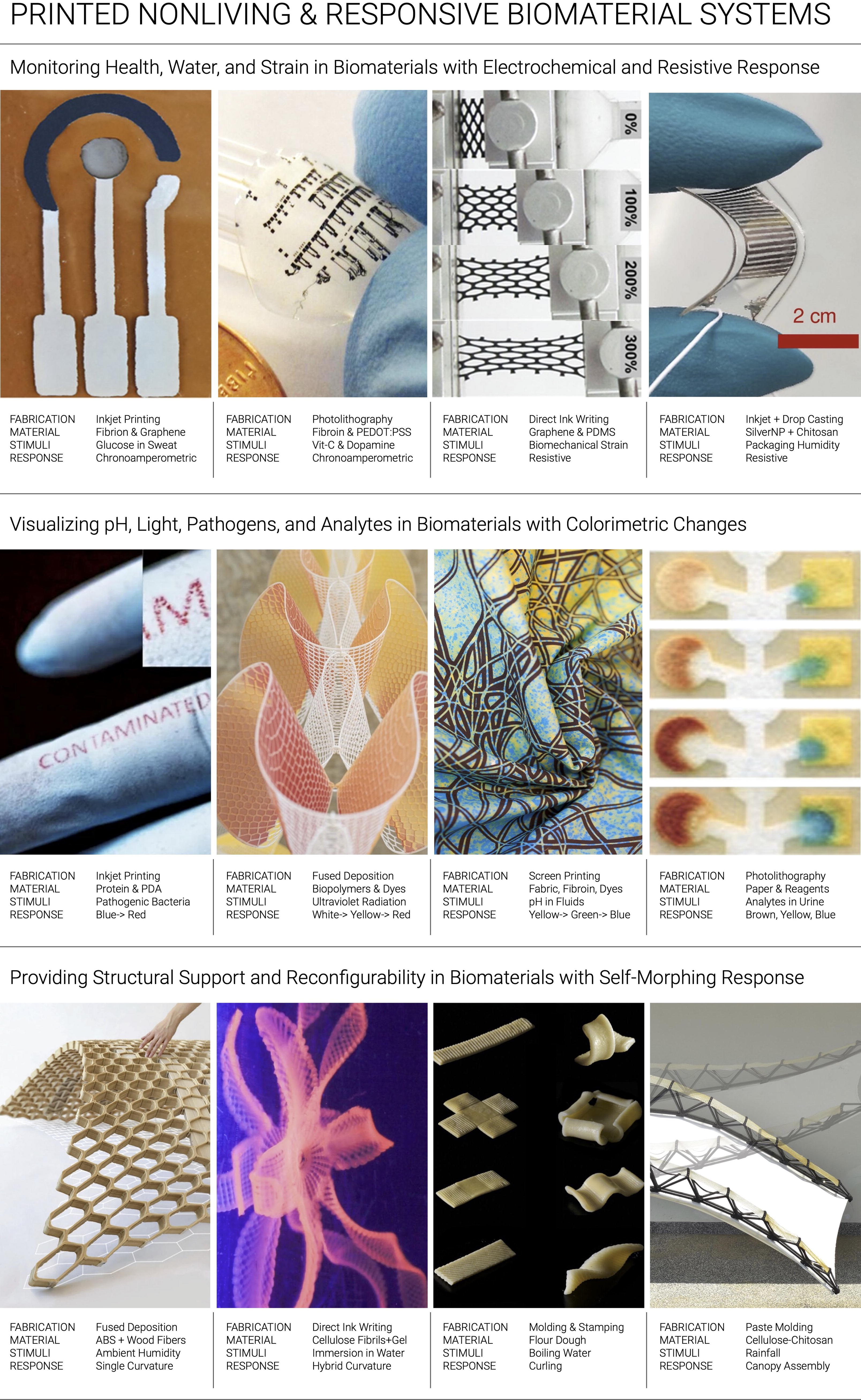
Nonliving PRBs diagnosing human health parameters, pH changes, presence of pathogens, and monitoring water quality, strain, light, radiation, or humidity with responsive electrochemical, resistive, colorimetric, or self-morphing mechanisms. PRBs, printed responsive biomaterials.
Many additively manufactured solutions employing these strategies use fossil materials, harsh chemical synthesis, high energy, toxic compounds to soil and air, or other environmentally harmful methods.1,17,18 However, emerging compounds that break down naturally use water as their primary solvent and are made of biodegradable and biocompatible biological polymers and proteins such as gelatin, kappa-carrageenan, sodium alginate, chitosan, silk fibroin, hyaluronic acid, keratin, egg albumin, wheat gluten, and can include other natural gellants, thickeners, plasticizers, or active molecules, as will be discussed below. Because of their aqueous makeup AM techniques to make nonliving PRBs with these materials are inkjet printing, screen printing, or direct ink writing. Inkjet printing uses low-viscosity substances, screen printing can employ higher viscosity inks, and hydrogels used in extrusion-based layered direct ink writing can be cross-linked or bulked with fillers to achieve structural integrity during and after printing. In all contexts, solutions can be functionalized with other polymers or active molecules for responsiveness.
Monitoring health, water, and food in biomaterials with electrochemical sensing
Electrochemical Sensors (ESs) are devices that convert the effect of chemical reactions on the surface of electrodes into electronically readable values. 19 They have been used in a wide range of commercial applications since the second half of the twentieth century and are designed to detect, for instance; clinical analytes in biomedical, forensic, and pharmaceutical applications; toxic gasses and pollutants like pesticides and heavy metals in environmental monitoring; and sulfites, phenols and neurotoxins in food quality assessment. 19 As AM increases precision, printing of these small scale responsive devices is gaining traction as it can be used to fabricate both the substrate and the conductive parts in any shape, size, configuration, and material composition. 11
Typically, additively manufactured ESs are made of layered conductive paste, dielectric paste, and inert substrate. 11 Examples embracing sustainable solutions are rising as green electrode materials maintain or even boost surface activation capacity and present inexpensive, sensitive, simple, and biodegradable solutions.11,17 Polylactic acid (PLA) and polyhydroxyalkonate (PHA) are industrially biodegradable plastics extracted from renewable resources that can be 3D-printed. They have been recently tested for fabrication of electrodes in ESs both as inert substrate and as conductive element when doped with graphene or carbon. 11 Perhaps more exciting are proteins and biopolymers used in printed ESs such as silk fibroin and cellulose which are extracted from abundant sources of silk moth cocoons and plants respectively.
Fully biodegradable printed ESs with chronoamperometric response from silk fibroin and conductive polymers can form micropatterned films. These contain enzymes in fabrics and skin patches to detect substances related to severe health conditions or to development of bones, muscles and blood vessels like lactate, dopamine, ascorbic acid, and glucose, while remaining flexible to biomechanical deformation.9,20,21 Their promise to scale is robust and can lead to cost effective distributed sensing in wearables. Cellulose is the most mature technology for sustainable ESs and can make both substrate and paste in printed ESs to transport fluids with analytes to electrodes through its fibers by capillarity. These paper based ESs can be made flexible, transparent, and, importantly, will naturally degrade in soil. Cellulose nanofiber pastes for direct ink writing can too be made conductive using carbon black and biochar for electrode production as fewer toxic alternatives to certain inorganic semiconductor materials. 11 Cost is lowered dramatically in detecting glucose, uric acid, lactate, proteins, and heavy metal ions, which makes them suitable to be distributed globally to enhance public health with examples in agrifood sector, water quality, and medical intervention.22–26
Monitoring environmental forces in biomaterials with simple electrodes
Environmental forces discussed in this section include humidity, pressure, and strain acting on everyday products and foods, industrial settings, human cells, and the surface of the human body. Electronics development has propelled many of today’s commodities and life-saving devices, however materials employed contribute to environmental depletion. 27 As smart products with electronic sensing become mainstream, new research inspects AM as a technique to propose intricate and conformal shapes, alleviate waste output, reduce energy in production, rapidly generate iterations, and transition to bio-based sensing pastes and substrates.28–32
Resistive humidity sensing, for example, can be supported by biomaterials, which tend to be very sensitive to water. Applications are in moisture-sensitive domains such as spoilage monitoring in food and agriculture, clean rooms in semiconductor production and automotive industry, textile industrial drying, weather monitoring and prediction, ventilation control and structural health monitoring in the built environment, gas purification environments, and process monitoring in chemical, electronics, pharmaceutical, cosmetics, and biomedical analysis industries.29,30,32 Biodegradable hydrophilic compounds are particularly helpful here and results show excellent sensing using proteins or biopolymers like cellulose, lignin, keratin, or starch. 34 An egg albumin protein humidity sensor was fabricated using an all-printed technology from silver nanoparticle ink and spin coated egg albumin. 29 Similarly, another fully additively manufactured humidity sensor was inkjet-printed from silver nanoparticles onto a drop casted chitosan film. Chitosan is a long chain polysaccharide from shrimp shells that swells in the presence of water enhancing sensitivity of the device. It showed great performance as well as transparency and flexibility after repeated bending which envisions suitability for many medical applications. 32 In another instance, wheat gluten protein was used as a layer to monitor relative humidity in food packaging. The protein was deposited on a printed interdigitated capacitor and performed very well at signaling to prevent irreversible alteration of food texture and microbial growth during storage. 28 Interestingly wheat gluten protein is already used in food packaging and interfacing with printed sensing on its surface would facilitate integration and scale up greatly.
Another resistive electronic strategy is used in touch sensors for next-generation green electronics such as wearables and e-skins. Current materials employed are not environmentally friendly, difficult to recycle, and expensive such as plastics, glass, and metals. 34 Paper substrates can also be beneficial here. A nano paper-based touch sensor was fabricated via inkjet-printing with paper made from cellulose pulp nanofibrils and a conductive ink inkjet printed on top. Results were more economical, transparent, flexible, and recyclable. 34 Another example of resistive touch sensing employed 3D-printing of carrageenan; a polysaccharide obtained from red seaweed. The device was manufactured on a tabletop printer with syringe pneumatic extrusion describing; an active layer sheet from carrageenan and carbon nanotubes, followed by a separator, an interdigitated pattern made of silver nanoparticles, and finally all packaged in polyethylene layers for use. Excellent printability and resistive response were reported towards the development of sustainable resistive sensors. 35
Monitoring forces acting on surfaces is key to personalized healthcare, human motion detection, human—machine interfaces, on soft robotics applications 36 or even at the nano scale on cell morphogenesis, migration, polarization, proliferation, and single molecule behaviors via mechanobiology using applied mechanical forces or cells. 37 Traditional strain sensors based on metals or semiconductors tend to be rigid and with limited sensing range, and conventional fabrication such as mask lithography and laser cutting lack the versatility to produce easily customizable, micro-fabricated biosensors in an efficient, cost-effective manner.37,38 Examples of strain sensors that are flexible, conformal, ultrasensitive, environmentally-friendly, and economical are being developed with 3D-printing technologies using kappa-carrageenan networks deriving self-healing properties, 31 copolymers and nanowires, 29 composite body patchable dough from carbon nanotubes and graphene, 39 or intricate lattices of graphene and polydimethylsiloxane mixture. 38
Importantly, humidity, pressure, and strain are encountered every day in objects and architectures around us. Their forces and effects would be very interesting to monitor and visualize to better inform designs, diagnose issues in building construction, customize apparel, and make food streams safer.
Visualizing heat, light, analytes and pathogens in biomaterials with colorimetric changes
Colorimetric sensing is one of the most straightforward sensing techniques as it provides quick, naked-eye-observable, low-cost, reproducible, and satisfactory determination of environmental toxicities. Active molecules perform colorimetric sensing within materials. The color intensity of their response is proportional to analyte concentration which can be observed directly without any equipment.40–42 Additive techniques used to fabricate colorimetric sensing sites are screen printing, photolithography, and direct ink writing, either to add sensitive thin local areas on substrates, guide substances on substrates, or form objects sensitive throughout their volumes.
Measuring and visualizing acidity or basicity in fluids with single use pH paper is perhaps the oldest colorimetric sensing method dating from the 1930s and made by impregnating paper strips with a mixture of dyes extracted from lichens. Recent advances look at cyclical monitoring with reversible inks from biomaterial blends. A formulation of pH responsive inks was developed that can be efficiently screen-printed onto fabric substrates in high-resolution deterministic patterns for health diagnostics. 42 It combined sodium alginate gum as thickener with silk fibroin protein encapsulating colorimetric pH-responsive molecules of nitrazine yellow, bromocresol green, and phenol red to monitor a wide spectra of pH variation in human sweat, rain, tears, or tap water. This platform emulates commercial ink viscosity and resolution and can be screen printed on athletic bracelets and t-shirts, fashion scarfs, and large-scale tapestries, maintaining sensitivity over many sensing cycles and reporting data on diet, stress, or pollution.9,42
Relevant molecules to track colorimetrically are lactate, glucose, or proteins. In 2007, pioneer work patterned paper with mm-sized channels to guide fluids to colorimetric sensing sites. Chromatography paper was layered with photoresist using photolithography and exposed paper channels absorbed and directed sampled urine by capillary action to reagent test areas. 23 Newer paper-based wearable patches can monitor lactate in real time. Lactate oxidase (made by bacterial cultures) and horseradish peroxidase (an enzyme found in the roots of horseradish) were added to a silk fibroin protein solution to form a chromogenic enzymatic ink able to visualize lactate concentration. This compound was then applied to a paper substrate using a laser jet printer and distributed as sites in transparent skin-conformal films to monitor athlete fatigue during exercise. 25
The presence of pathogens can also be visualized colorimetrically in printed devices. A formulation of biomaterials solution was functionalized to colorimetrically detect bacteria and designed to be inkjet printed on surfaces. Polydiacetylene vesicles were conjugated with goat IgG antibody and immobilized and stabilized in a regenerated silk fibroin solution. This ink was printed on laboratory gloves and exposed to Escherichia coli bacteria making it change color from blue to red and presenting a great precedent for much needed visual contamination detection. 43
Screen-printed textiles that are able to sense pH in scarves, tapestries, and t-shirts, 42 expand the use of responsive systems in design along with other exciting printed thermochromic and photochromic objects. Technologies used are direct ink writing and fused deposition modeling. Direct ink writing of biomaterial blends was developed to substitute animal leather constructs in fashion and upholstery. Biomaterial composites of chitosan and silk protein showed new routes for tough and strong, environmentally friendly leather-like materials enabling a wide variety of motif resolution and flexibility, offering new pathways to sustainable production. These leather-like blends were printed to form a fashion clutch and augmented by embedding and stabilizing thermochromic powder pigments reactive to human temperature ranges. 44 More recently latticed ovals were printed using fused deposition of bioplastics from blends of PLA and PHA, then pastes from sodium alginate, cellulose, and photochromic powders were laid on top. After drying, ovals were bent into shape and assembled, forming large canopies able to change color with ultraviolet radiation evidencing invisible environmental threats damaging skin and eyes worldwide. 40
Providing support and reconfigurability in biomaterials with Self-Morphing response
Inspired by actuation in the natural world 45 and stemming from research in self-morphing materials in biomedical and robotic applications,18,46–49 there is a growing interest in design and engineering to develop large-scale self-organizing materials and structures displaying programmed folding and curling phenomena.46,50–54 Self-morphing response is achieved in research by means of 4-dimensional AM (4D-printing) defined as using the same techniques of 3D-printing but with the 4th dimension being time-dependent shape change after printing. 55
Precedents in engineering of biodegradable soft robots are proposed for a range of intelligent applications involving shape transformation in response to external stimuli such as heat, pH, and light and, more importantly, programmed decay after use in exploratory missions or remote area surveys. 18 In biomedicine, 4D-bioprinted hydrogels for tissue engineering applications are able to self-form from flat sheets to pipes, or from unfolded sheets to cubes, via the combination of two biomaterials with different swelling rates when hydrated.49,56 This is beneficial in noninvasive regenerative medicine to create new space in, for instance, contracted air and blood ways within the body. Research on nonsynthetic tough and stretchable hydrogels for sustainable applications has been underway for a decade and promises to help advance mechanisms of deformation and energy dissipation, and expand the scope of hydrogel applications in morphing matter.57,58
Hydration and anisotropic swelling is what most design applications harness to program morphing. Small scale investigations using sustainable materials have produced intricate shapes by folding and curling of additively manufactured hygro-morphs.48,51,53,54,59 Inspired by botanical systems, composite hydrogel architectures were encoded with localized prescribed four-dimensional shape change upon immersion in water, yielding complex three-dimensional morphologies resembling sophisticated flower blooms. This was achieved by shear-induced alignment of cellulose nanofibrils at the printing nozzle during extrusion that were able to later undergo anisotropic swelling. 48 Another group printed semolina flour pasta dough into shape-shifting flat to curled geometries when boiled in water. With this single material they used a simple diffusion-based mechanism in structures by molding and stamping with parametric surface grooves. 54 Elegant and complex nonperiodic tessellations were made flat from pre-stressed contractile unit cells able to soften in water at rates prescribed locally by mesostructured geometry. Different hinges within tessellations were programmed to contract slower and achieve sequential petal folding, almost emulating natural growth and flower blooms. 59 Self-folding curved crease structures were investigated using fused deposition modeling. Hinges, passive, and active layers were designed with surface ridges from inert bioplastic and wood pulp filaments so that curved crease origami structures could self-assemble in humid environments by swelling of wood filaments contained in active layers. Objects derived wearable parts, tessellations, and strong truss-like figures. 53 Directly informed by subsequent transversal and longitudinal bending deformation during desiccation in pinecones, biomimetic 4D-printed autonomous structures were designed capable of such multi-phase movement. Hydromorphic materials were made by combining copolymers with swellable cellulose fibrils and inert acrylonitrile butadiene styrene (ABS) polymer. These have applications in flap and scale structures performing complex consecutive motions for architecture and soft robotics. 51
Wearables printed and morphed by anisotropic swelling are emerging to provide medical bracing and to alleviate transpiration.50,60 Self‐adjusting principles can be 4D‐printed inspired by the twining plant using fused deposition printing of ABS as restricting material and WPC (Laywoo‐D3 & LAYWOODmeta5) as actuating material which contains 40% recycled wood fillers within a polymer matrix. 50 This allows the cured wooden filament to swell directionally and brace a spiraling wearable around the wrist. In another wearable, biohybrid films that can reversibly change shape in response to environmental humidity gradients were developed by additively depositing genetically tractable microbes (i.e., Bacillus subtilis bacterial spores) on a humidity-inert material to form a heterogeneous multilayered structure. This obtained biohybrid films that reversibly changed shape mounted onto flaps in athletic wear. When athletes sweat, spores undergo anisotropic swelling and clothing flaps prop open to promote ventilation for comfort.60,61
At larger scales, shells, canopies, lattices, and timber surfaces can be additively manufactured from biomaterials to also undergo self-morphing induced by anisotropic swelling. For instance, hygro‐responsive canopies were designed for passive actuation using chitosan composites. Cotton-fiber-reinforced chitosan films were able to swell when fixed onto a truss-like surface. Fast actuation was successful under 5 min carrying a 1-m long and 4-m wide surface while responding to rainfall. This shows already scaled up potential in conferring building skins with the ability to assume multiple spatial configurations without added electrical energy and unsustainable machinery. 63 Also envisioned at the building scale, recent research on self-constructing and self-rigidizing timber surfaces integrated hygroscopic morphing with computational design and digital fabrication. This allowed for processing and reassembly of discrete wood elements into large-scale multi-element bilayer surfaces with controlled stiffness. Results spanned self-shaping of double curved lattice shells, creased benches, as well as wide and triple legged arches. This material assembly methodology enables design and control of encoded direction and magnitude for responsive curvature at an expanded scale, and is achieved by additive laying of sheets or by 3D-printing directional polymer-wood-fiber composites.52,63,64
Finally, 4D-printing can derive thermally actuated hydrogels also undergoing anisotropic swelling to self-morph. Mechanically robust hydrogels were designed with swelling-induced actuation. A thermally responsive water flow-controlling valve was printed from covalent crosslinked networks of alginate and poly (N-isopropylacrylamide) which provided both robustness and actuation. Reversible volume transitions showed length changes of 41 − 49% when heated and cooled in water between 20°C and 60°C. The shape change could be cycled several times by changing water temperature. 47 A responsive “bio-structural” hydrogel skin was printed by combining direct ink writing and stereo-lithography from multiple materials to exhibit soft, stiff, and thermally sensitive behavior. It used sodium alginate gel, polyethylene glycolmethacrylate, and poly(Nisopropylacrylamide) polymers. In hot water, the complex structure was able to define a parametrically designed new shape, announcing a future for multiple physical property structures achieved with compound additive fabrication. 65
Towards intelligent response
Nonliving responsive systems discussed above take advantage of AM to precisely control substance distribution, combine different materials in the same construct, and achieve complex shapes unattainable with other fabrication methods. In efforts to propose sustainable alternatives to current methods, new blends of biological polymers and natural fillers are devised that are health enhancing in their function but also in their use, synthesis, and decay, with nontoxic and environmentally friendly solvents and reagents, low sample consumption, and minimum waste. We hint at a future for design where human wellbeing is powered by matter that senses, adapts, and responds to its surroundings. If not only that, but also all of these programmed systems adopt regenerative design constraints, then the wellbeing of the planet is also ensured.
We envision daily life with sweat, water, food, humidity, pressure and strain constantly measured by simple electrodes; heat, radiation, and loads being immediately visualized colorimetrically, and tailored swelling inducing matter to self-morph for health support and structural arrangement. All enabled by responsive consumer products made from environmentally benign materials. When we look far ahead, we find strategies in the living world that go beyond programmed nonliving behavior, and towards responsive intelligence within matter supported by the advent of visionary living materials discussed next.
Living PRBs
AM of natural and engineered living cells in materials and structures presents opportunities for numerous existing and novel applications. These include but are not limited to tissue and organ regeneration, interfaces between human bodies and environment for health monitoring and enhancement, and novel designs for extreme environments such as marine, extreme weather, and extraterrestrial sites. In the realm of printing living materials, AM requires adaptation to support fabrication under moderate temperature and pressure, ensuring a continuous supply of nutrients to sustain cells, accommodating high liquid content of printed materials, and steering clear of harsh chemicals. Moreover, living cells prefer environments characterized by porous structures that boast high surface areas, which are essential for diffusion and nutrient saturation, along with materials that are conducive to cell adhesion and proliferation. In line with these necessities, liquid-based 3D-printing technologies such as inkjet, material extrusion, and light polymerization are being tailored to the specific demands of 3D-printing living structures. 66 Below we discuss how these additive technologies propose new functionalities to improve human and environmental health in wearables, products, and architecture (Figure 2).
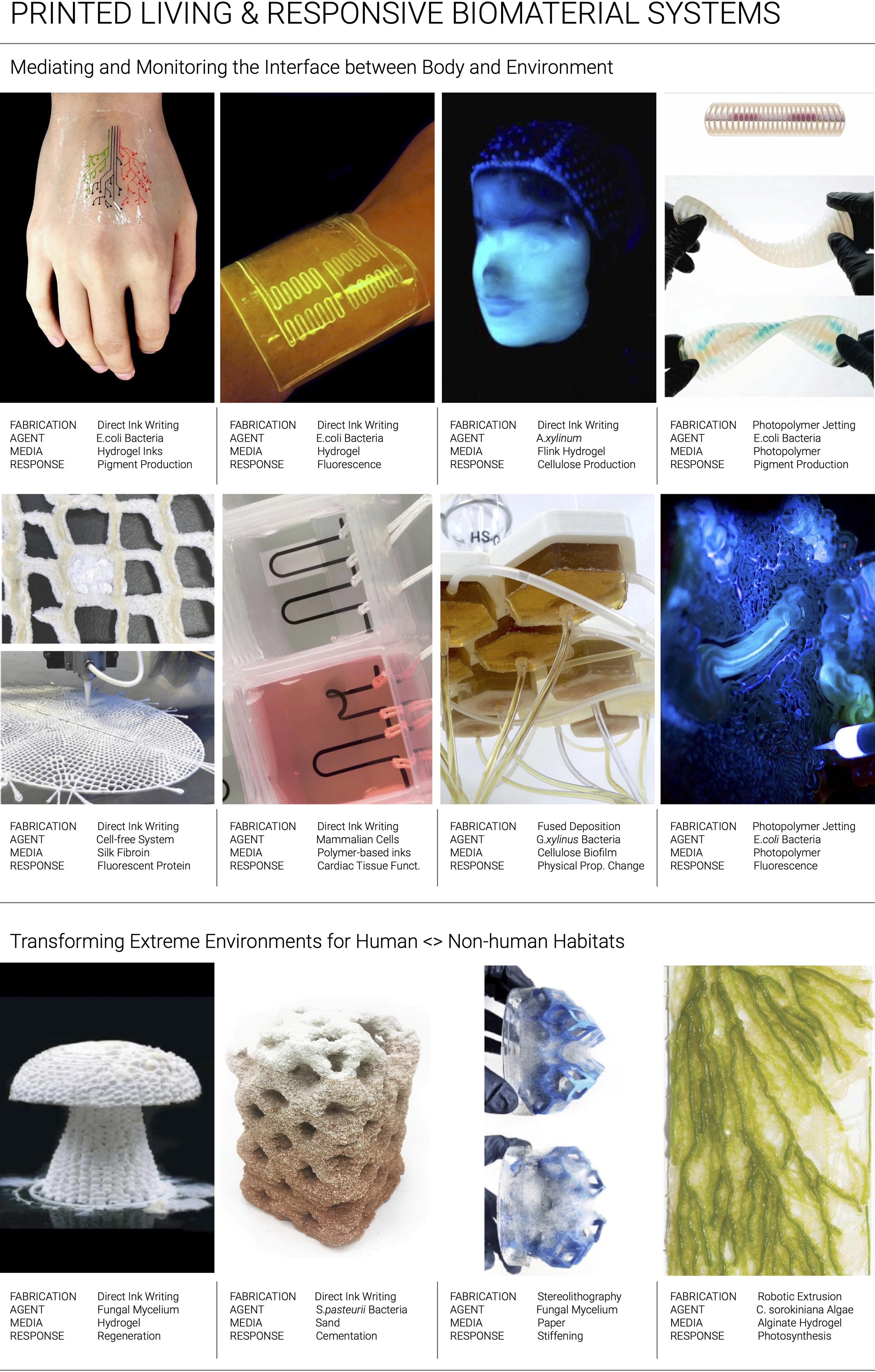
Living PRBs partnering with microorganisms and DNA pathways to mediate body and environment interfaces for enhanced health and wellness function, and transforming habitats by providing new materials, photosynthetic behavior, or structurally strengthening substances on demand. PRBs, printed responsive biomaterials.
Mediating & monitoring the Body-Environment interface
AM is used in regenerative medicine to fabricate 3D-printed structures to repair and replace malfunctioning tissues and organs. For example, bone grafting leverages digital 3-dimensional models, derived from patient-specific medical imaging such as computer tomography, medical imaging using 2D slicing of 3D objects, to guide the creation of scaffolds. These scaffolds are composed of bio-based polymers that biodegrade over time, and permanent graft materials like photopolymers, bioactive ceramics, and bioglass, which mimic bone structure. The temporary biobased layer is bioactive, facilitating cell adhesion and integration with biological tissues, and its porous design promotes cell growth, migration, and vascularization, critical for tissue development. The use of AM for crafting complex, porous geometries aids in providing cells access to essential air and nutrients.
Beyond medical applications such as bone grafting, disease modeling, and drug screening, the technology invites intriguing possibilities in nonmedical fields such as product design, wearables, and architecture. It opens avenues for designing 3D-printed bioactive structures that interact with living cells and organisms, blending seamlessly across various industries. In this section we look at some examples of AM that utilize living cells, native or synthetic, for interfacing the human body with its immediate surroundings. We examine how design and AM support the function of living cells and their continuous interaction with the environment for health and wellbeing.
One application of engineered living cell technology is health monitoring as a human skin interface. Recent work on a “living tattoo” proposed a skin patch for both internal and external continuous monitoring of biochemical markers with visible color outputs.67,68 Cells were programmed with genetic logic gates combining four different chemical signals with visible outputs. A pattern of color and fluorescence evolved in space and time as signals diffused through the layered 3D-printed structure and triggered production of color and fluorescence. 68 The spatiotemporal patterning relies on the precision of 3D-printing, and is also influenced by two key factors: the rate at which signal molecules diffuse through the hydrogel, and the production rate of fluorescent proteins. 67 The living cells were 3D-printed into three-dimensional meshes of tough and stretchable biocompatible hydrogels sustaining high mechanical loads and deformations.57,58
In another example of skin interface, a scan-to-skin approach demonstrated wearable interfaces with tunable textile-like structure and embedded biological responsiveness. Functional living inks enable 3D-printing of cells through direct ink writing by adjusting the composition and viscosity of the printed hydrogel to support bacterial growth effectively. 69 Using this method, spatial adaptation of a synthetic skin interface was demonstrated by scanning a doll face and depositing hydrogel with bacteria cells in a precise manner on its 3D surface. Bacteria cells in the gel formed a cellulose biofilm reinforcing the hydrogel and creating a skin-like surface. 69 The ability of bacteria to produce a cellulose matrix within 3D-printed hydrogel structures was also programmed to be activated by oxygen availability on the surface of the object, showing a potential for self-healing materials. 70 In another skin interface project, cells were programmed to respond to the chemical signals in the active zones of a 3D-printed face mask. A photosensitive support material from Object Connex 500 was customized to create areas where support material was mixed with chemical signals. These areas triggered a response of color production in cells. 71
At the scale of full body interfaces, meter-size printed foldable lattice structures were proposed to clean air by trapping and metabolizing volatile organic compounds (VOCs) as well as releasing olfactory-active components to improve wellbeing. Here blends of proteins and polysaccharides were printed into lattice structures using a custom large-scale direct ink writing platform. 44 Geometric density of lattice motifs was adjusted to allow for post-print incorporation of bioactive sites with embedded cell-free DNA components. Compatibility and activity of pigment-producing cell-free components in blends was demonstrated hinting at a future of bio-responsive products and architectures powered by cell-free technologies enabling living-like function without cumbersome maintenance of living cells. 72 Similarly to rigid-flexible material articulation in nature, the lattices exhibited differentiation to soft zones to template biological activity (exhibiting sparse and porous geometries and properties) and more structural support zones (exhibiting denser, thick, and rigid behavior).73,74
In nature, biological processes most commonly occur in aqueous environments. Containment and compartmentalization in living organisms are achieved through complex membrane structures that regulate the flow of liquids and solutes, principles that can be applied to create multifunctional objects with integrated fluidics. In recent research, AM has been used to design fluidic systems of vessels, tubes, and compartments, called bioreactors, which facilitate biological growth. A miniaturized version of 3D-printed bioreactors, called “organ-on-chip” and “lab-on-chip,” are frequently used to simulate biological environments for applications such as environmental monitoring, disease diagnosis, and drug development.75–77 Recently, an open source community-driven design of 3D-printed fluidic devices has been developed, inviting engineers and designers to propose new uses for this technology.78,79 In this case, as opposed to the zoning of the polymeric lattices in the example above, there is a separation of 3D-printed rigid structures and the contained functional bioactive liquids, cells, and hydrogels. The 3D-printed geometry is designed to contain, compartmentalize, and flow liquid and hydrogel materials to sustain and activate their biological function.
On a larger scale, a human wearable was designed as a system of tubes to flow cells, nutrients, signal molecules, and compounds-of-interest produced by the cells. 80 The wearable was designed to have maximum volume of fluidic channels to culture microorganisms to carry out biochemical processes supporting human life. Multi-material 3D-printer Objet Connex 500 with resolution down to 32 μm voxels was used to print an intricate pattern of 58 meters of internal fluid channels with 1.5 mm inner diameter. A custom liquid support material was used for hollow channel printing. 80 Some other experiments in scaling up fluidic systems for design applications include growth chambers for biofilms with living cells to be 3D shaped on the air-liquid interfaces and pneumatically actuated by liquid and air. 81 In this last example, there is a new direction of using inert bioreactor to facilitate the growth of structural scaffold from cellulose, where the structural network of fiber embeds functional living cells, inventing 3D design strategies with 2D responsive structures that exist in nature, namely the biofilms.
Strategies to contain biological processes in design applications include 3D-printing of biobased scaffolds as well as bioreactors that sustain and regulate biological function. Mentioned projects show a potential for wearable designs to create interactive interfaces that have applications in polluted and extreme environments and create new aesthetic experiences. Continuing the discussion of scaling up living cells in structures we show next how 3D-printing of responsive living systems is adopted in the built environment.
Transforming extreme environments for humans and nonhumans
When working at the scale of architectural construction, materials need to be produced in bulk, be resilient to a wide range of environmental conditions, potentially grow on locally sourced agricultural waste, or upcycle waste from other local industrial processes. One biobased material system that has these properties is the fibrous growth of fungal mycelium. Casting is commonly used for mycelium as it allows standardization and mass production. However, the strength of material depends on the spreading of mycelium fibers through the volume of the substrate, a process facilitated by the air on the surface of the cast volume. 3D-printing of mycelium overcomes the limitations of casting in that it allows for complex geometry and large surface areas that are desirable for maintaining cells active and alive through access to air and nutrients, and access for maintenance. 82
In nature, structures such as fungal combs are porous mycelium composites with large surface area for optimal mycelia growth. 83 Learning from these features, researchers designed and 3D-printed architectural components providing vertical interstitial spaces for convective flow and active interaction with air and water vapor to support mycelium growth. 84 To extend the functionalities of mycelium structures, a recent study demonstrated the potential of 3D-printing living mycelial materials for robotic skins. The porous architecture of 3D-printed lattice structures promoted colonization of cells in a gel that were able to bridge the gaps within hydrogel demonstrating regeneration after damage, and the potential for self-healing. 85
3D-printing of living structural composites such as mycelium at architectural scales has shown applications for self-healing construction materials on Earth, 86 but it has even more exciting potential in supporting human habitats off-planet where mycelia’s natural ability to aggregate waste matter into structures eliminates the need to transport raw materials on-site. 87 Beyond decomposing organic matter for waste processing into fertilized soil or structural materials, bioengineering could enhance mycelia’s capabilities for transforming hostile environments into healthy ones compatible with human life. For example, certain species have been shown to survive simulated Martian conditions, 88 and researchers are exploring mycelia to provide radiation protection through melanin production, as well as regulate humidity and produce energy. 87
Another material process for 3D-printing living structures on and off-Earth is bio-cementation, a sustainable and long-lasting alternative to Portland cement. This process involves bacteria that produce an enzyme (urease) to induce the formation of a cementing agent (calcium carbonate) in granular materials, such as sand or soil. This technique has various applications where structures need to dynamically adapt to environmental conditions, such as stabilizing soil for construction purposes, repairing cracks in concrete, and controlling sand erosion. AM of bio-cemented building components overcomes the limitations of molds such as low exposed surface area that restricts fluid penetration and limits customization. A two-step AM process has been developed to address these limitations, where the first step is selective deposition of sand and urease active calcium carbonate powder in a print volume, followed by treatment with a cementation solution for precise calcite precipitation. 89 As a next step, modifying bacterial mixtures can adjust activity levels within a single sample to create a cementation gradient. Here, the advantages of AM are in tuning the structure both locally to support function and across the volume. There is a vast potential to implement the library of functionally graded material strategies from nature in multi material 3D printing to amplify the structural performance by orders of magnitude.90–92 Similarly, altering temperature has shown to vary biological activity, demonstrating a parallel approach in controlling cementation through biological manipulation. 93 Here, the potential is in adding environmental regulation to AM processes as a way of tuning 3D printed structures.
AM of living biomineralizing structures is being explored also for applications in adaptive marine structures. An engineered co-culture of marine organisms can create deployable structures in aqueous environments by sourcing nutrients from the water and performing calcium precipitation, anchoring itself to the sediment floor and adapting to the local currents and other environmental pressures. Potential applications include supportive marine infrastructure, breakwater assemblies, and near-shore sediment stabilization structures. 94 Another proposed application is self-constructing building foundations. Engineered bacteria could cement soil in response to elevated pressure levels, combining pressure-sensitive genes of E.coli bacteria with the bio-cementation processes of Bacillus bacteria. 95 Additional potential is to program cells to remediate pollutants in the soil, such as Polycyclic Aromatic Hydrocarbon, one of the most common soil pollutants. 96
Natural material systems such as fungal mycelium and bio-cementing bacteria are great candidates for scaling up living technologies due to the high fraction being inert material in which living cells are integrated. Another way to create a living material system is by integrating dormant resilient life forms, such as spores, or printing living cells in material mixes with high water content, such as hydrogels.
Spores are incredibly resilient to harsh environmental conditions such as high temperatures, freezing, high pressure, extreme radiation, and more. DNA instructions within dormant spores are highly protected and can be activated after almost indefinite periods of dormancy. 97 Once germinated, the spores can act as biosensors. A modified MakerBot Replicator combined materials and cell streams for 3D printing, with a redesigned nozzle that mixes a polymer-cell blend just before printing, embedding Bacillus subtilis spores within and on the material’s surface. 98 These spores, acting as biosensors, were programmed to respond to environmental stimuli, enabling post-print activation of the material. In another study, tunable patterns and shapes were printed from a custom mixture of cells, nutrient rich liquid, and alginate gel for viscosity control. 99
Algae is another natural system that has a demonstrated potential for biobased AM. Meter-scale photosynthetic facade panels were fabricated using an industrial multi axis robot arm customized for printing microalgae. 100 The robotic arm deposited three different hydrogels with varying water percentages. The desired component resolution was achieved by characterizing the interplay among different printing parameters, which included air pressure, material viscosity, viscoelastic properties, feed rate, distance from printer to component, width of the nozzle, and print speed. 100 This 3D-printing method could be further developed to embed other living systems, such as cyanobacteria that was previously shown to enhance the strength and stability of a nonliving structure via calcium carbonate biomineralization. 103
A Vision for Responsive Everyday Designs
The scope of this review is living and nonliving PRBs that have the potential to scale into design and architecture, harness AM to innovate during processing and synthesis, and strive to transition to biobased and environmentally benign materials.
AM augments geometries in these systems by (1) precisely controlling resolution, (2) combining multiple motifs in constructs, (3) maximizing surface area, and (4) achieving complex shapes. AM, contrary to extractive technologies, contributes to enhancing material properties during the very process of manufacturing by, for instance, (5) aligning fibers and polymer chains to induce anisotropy, (6) tuning pressure for cell survival in bioprinting, (7) changing speed of deposition to ensure cohesion in aqueous blends, (8) compressing interfaces of hydrogels to prevent dry delamination, and (9) creating functional differentiation via graded properties.
Most of the reviewed examples are manufactured in two dimensions or hollow shells, with homogeneous material makeups, and with one type of responsiveness deployed on top of inert substrates. This is due to limitations in current technology to program matter with multi-response and volumetric graded properties. Nature, however, creates intricate complex structures from soft and hard materials that are spatially articulated from many elements available in the environment molecule-by-molecule and layer-by-layer. Biological materials provide many strategies of containment and support of biochemical processes in soft tissues and capillary networks, embedded in structural skeletons and structures. There is an opportunity to merge current PRB techniques with emerging volumetric multi-(bio)material 3D-printing10,16,44,102,103 as well as to learn from research in synthetic multi-material articulation counterparts.73,76,92,104 We propose future development of PRBs to draw material organization principles from these natural strategies of spatial organization.
Synthetic material articulation strategies have been successfully adapted for multi-material 3D-printing using, for instance, Objet Connex 500 with material resolution down to 10 u. 105 Strategies include: functional grading of soft and rigid material phases; complex geometries for layering and nacreous geometries to prevent delamination; porous geometries to increase and support biochemical exchanges with the environment; multi-scalar porosity to further increase surface area and reduce weight; and many others.106–108 Adapting these spatial soft-rigid strategies in AM with the functional and material properties of PRBs discussed in this article, can provide opportunities for (1) integrating responsive function with structural requirements, (2) adapting PRBs for specific functions in health, wearable, and built applications, and (3) effectively scaling up.
Many challenges exist for developing emergent PRB technologies for architectural and product applications. A major one is developing robust and well-characterized responses to a variety of stimuli in real-world environments. Another is the durability of such responses in use scenarios, for example, washing cycles in wearable applications and weather conditions in construction. Important to discuss is the scalability of these inventions related to biomaterial sourcing in large-scale design and architecture. Design applications of nonliving PRBs require structural biomaterials that must perform mechanically in dry formats. For instance, fibroin, cellulose, or chitosan are structural biopolymers that can do so. Their scalability is underway, and researchers and materials manufacturers are opening the market towards bulk production for nonmedical grade production of these raw materials. To make sure the sustainability aspects of biomaterials are preserved in scaling up manufacturing with PRBs, there is a need to consider steps from cradle to end of life. The stages include production (extraction of all raw materials, processing, transportation), operation phase, and disposal or demolition phase. 109 Unique to PRBs will be consideration of the environmental impact and application-specific impact of the products and dynamics of the biochemical reactions that they carry out throughout their operation. Living PRBs must remain wet most of the time in their design applications to support living organisms. Their scale up is dependent on the development of biomanufacturing, using biological production such as fermentation processes to transition from petroleum-based to biobased food and medicine. However, we envision biomanufacturing of engineered living materials next.6,66,68
A future is coming for designed objects where well-being is ensured because matter not only warns us of pressures in our surroundings but is also able to compute our health and enhance it (Figure 3). Sweat analytes, food, humidity, pressure, and strain can be constantly measured by simple electrodes in food spoilage warning tags, lactate detecting exercise bracelets, or muscle strain-sensing skin patches during physical recovery.21,25,39,110 Electrochemical devices based on enzymatic reactions can also produce power from ambient air moisture. 112 Heat, radiation, water, and loads can be immediately visualized colorimetrically with UV-detecting curtains, water quality monitoring faucet filters, sweat-informed pH-sensing scarfs, or impact-sensitive bike helmets.9,26,42,43,111 Tailored swelling induces matter to self-morph for support and airflow in humidity-mediating window shades, transpiration-induced flapping tank tops, and posture-correcting bracing vests.51,53,112 Living cells can act as skin interfaces to monitor health markers and report by color technologies in development include health-monitoring tattoos,67–69 and we envision more examples: antimicrobial healing shoes and gut biome analyzer in the toilet that coordinates with a gut microbiome supplement maker to help maintain healthy digestion.75,79,113,114 Living materials can be used to grow and remediate built environments, including extreme and extraterrestrial environments. Our vision figure shows an example of built elements from living PRBs that can adapt their density to structural forces acting on them and repair cracks.84–87,89,98 Other examples of functions in buildings performed by living PRBs include metabolizing waste into useful components and modifying indoor air composition, including sensing and trapping VOCs, allergens, and pathogens in air.72,115,116 There is enormous potential for using AM to integrate environmental responsiveness into programmed material systems for an exciting and much needed range of health-promoting functional design applications.
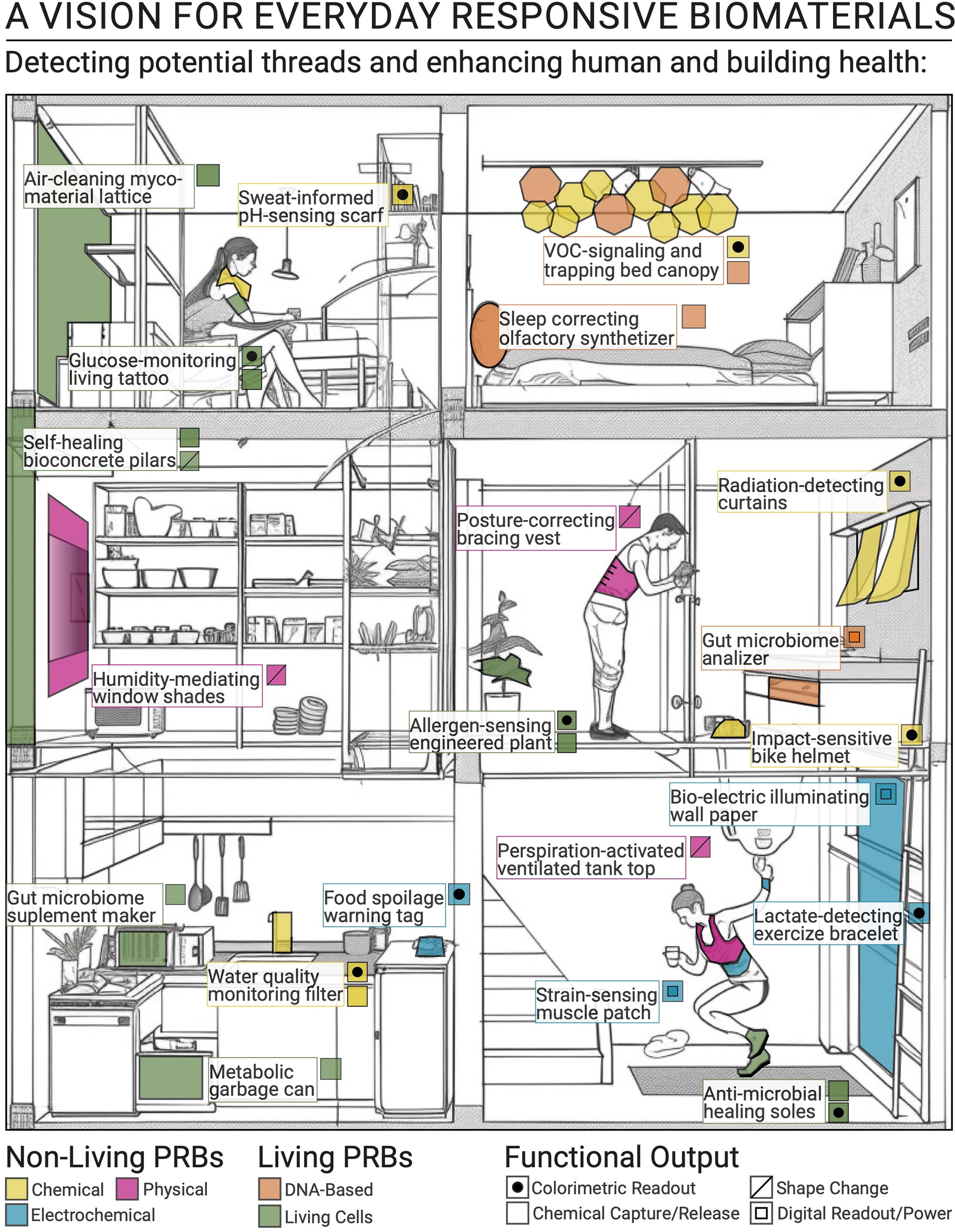
A vision for PRBs in everyday life embedding chemical, physical, and electrochemical reactions, or DNA-based and living cell powered responsive mechanisms. These provide colorimetric readouts, shape changes, substance capture or release, as well as digital readouts for humans to monitor their city, home, diet, and wellbeing and gain the ability to produce and modify substances and structures for healthier living. PRBs, printed responsive biomaterials.
Footnotes
Author Disclosure Statement
The authors declare that the research was conducted in the absence of any commercial or financial relationships that could be construed as a potential conflict of interest.
Funding Information
The authors acknowledge support from the Johnson & Johnson Foundation WiSTEM2D Scholar Award in Design to Dr. Mogas-Soldevila Director of DumoLab Research at the Penn Stuart Weitzman School of Design, as well as Startup Funds Award to Dr. Katia Zolotovsky by Northeastern University.