




Abstract
Background:
Cupping therapy is a popular technique in Traditional Chinese Medicine. Cupping is the application of a vacuum to a closed system cup on a specific area of skin.
Subject and setting:
A 55-year-old, previously healthy man presented at our emergency department (ED) due to tingling and a painful sensation on his back after receiving cupping therapy while on his private airplane. Physical examination of the patient's back revealed multiple blisters within circular marks of differing sizes and varying shades of redness, petechiae, and ecchymosis.
Results:
After regular, judicious changes of sterile dressing over several weeks at our ED, the vesicle healed well and left no visible scars.
Conclusions:
Although bleeding, erythema, edema, and ecchymosis are created on purpose to achieve acupuncture point microcirculation, complications such as burn injury and thrombocytopenia also have been reported. We report a case of cupping-related blisters as a result of changes in atmospheric pressure related to the unexpected descent of an airplane.
Introduction
Case Report
A 55-year-old, previously healthy man presented at our emergency department (ED) due to tingling and a painful sensation on his back after receiving cupping therapy while on his private airplane. The patient ignored the pain and attributed it to the aftereffects of cupping therapy until his colleagues noted vesicles over his back after landing and then removal of the cups.
At presentation at our ED, his vital signs were stable and the medical review of systems revealed no other significant symptoms. His past medical and personal history were also unremarkable. Physical examination of patient's back revealed multiple blisters within circular marks of differing sizes and varying shades of redness, petechiae, and ecchymosis. The lesions were located where the vacuum cups had been originally positioned (Figs. 1 and 2). After thorough sterilization of our patient's back, we used a 27 G × ½-inch needle to aspirate and then covered the lesions with a dressing.
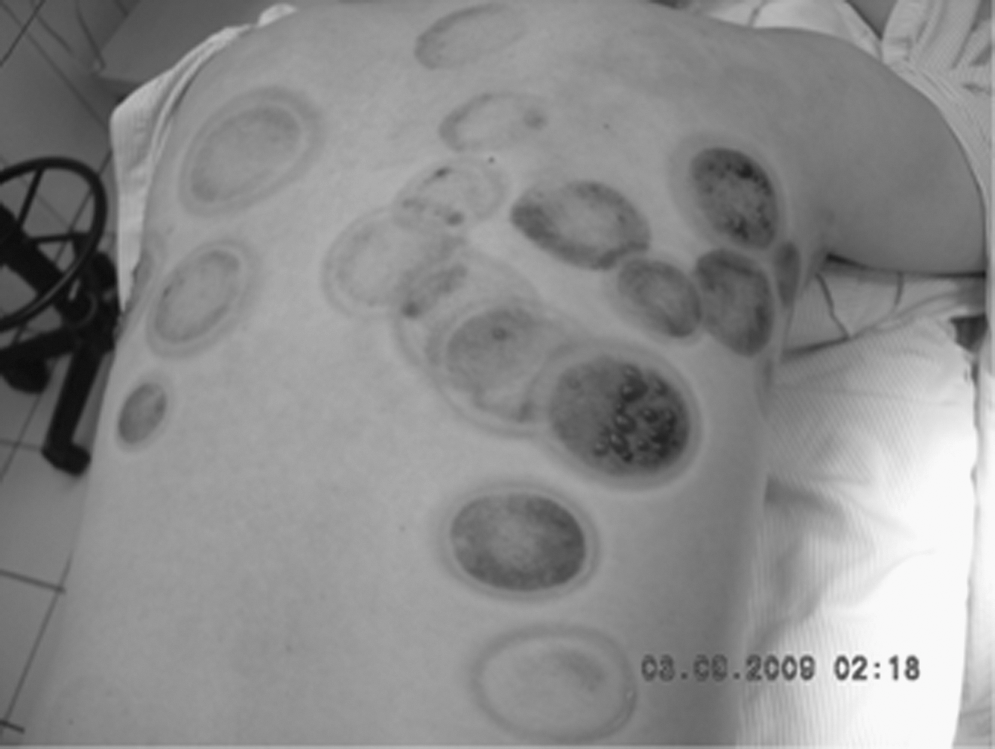
Circular, cutaneous impressions on the back of a male patient as result of vacuum cupping, a Chinese traditional physiotherapy. Ecchymosis, petechiae, and bullae of various sizes and colors are visible where cupping was applied.

Close-up view of the same patient. Sanguineous blisters due to changes in vacuum pressure relating to change in flight altitude are seen.
The fluid in the vesicles was clear and contained neither bloody fluid nor pus aspirate. Nevertheless, the fluid was sent for a laboratory workup. The vesicle fluid analysis came back normal, without signs of infection in the culture, Gram stain, or tissue biopsy. After regular, judicious changes of sterile dressing over several weeks at our ED, the vesicles healed well and left no visible scars. This case serves as a reminder to physicians who have had no prior encounters with cupping of the importance of taking a history and not mistaking cupping-related skin lesions as child abuse when seen in children or as manifestation of a systemic disease. Sterile methods and meticulous wound care are also of importance to prevent superimposed infection or scarring.
Discussion
Cupping therapy has been an integral part of Traditional Chinese Medicine for more than 2000 years. 1 Cupping therapy also has been reported as part of Western medicine as early as 1938 in medical textbooks 2 and as a means of expelling evil spirits. 1 The theory behind cupping in Chinese medicine is that it affects the circulation of certain body areas and is able to modify the bioenergy or qi and, therefore, restore balance to the qi life-force antipoles of yin and yang in the body that, in turn, restore health or relieve chronic pain. 1 –3 Cups are usually placed on the neck, back, abdomen, and sometimes even on the face, depending on practitioner's preference and patient's ailments.
Cup materials have evolved from the original bull horns 1 to those made of glass or plastic. The mechanism of cupping creates a vacuum effect on the skin, with the resulting negative pressure resulting in capillary rupture. Edema, erythema, and ecchymosis of the skin are the aftereffects of capillary rupture. Cups are placed on the skin for 5–10 minutes. The original method employs alcohol-soaked cotton, at the base of the cup, which is then lit. The process of heating and then cooling of air the inside the cup produces the vacuum and suction effects in the closed system. This is why some cupping therapies have burn injuries as a complication. 1 The modern method uses a manual hand pump to produce the suction effect.
According to the patient's statement, the equipment used was a manual hand pump for which apparently normal suctioning pressure was applied. However, after in-depth inquiry, the patient recalled that, during the vacuuming and cupping process, the flight captain decreased the flight altitude unexpectedly to avoid turbulence and a thunderstorm. We suspect that with the decreasing flight altitude and the subsequent increase in cabin pressure, the negative pressure, or vacuum effect, inside the cup increased, according to the ideal gas law. The patient recalled that the plastic cola bottle next to him became compressed during the sudden decrease in flight altitude. Furthermore, the duration of cupping therapy on our patient was greater than 20 minutes. We thus hypothesize that the cutaneous blisters were caused by the creation of a greater than normal vacuum pressure, and the longer vacuum time caused a separation of the epidermal layer from the dermal base of skin.
Alternative therapies have become increasingly accepted in both Eastern and Western cultures, and various cutaneous manifestations of cupping have been reported in the literature. However, to a physician unfamiliar with cupping therapy, misdiagnoses of cupping therapy lesions as cutaneous manifestations of systemic diseases are possible. We report here a different situation, one in which cutaneous blisters can develop during cupping therapy. The change in cabin pressure was thought to have caused the bruising and vesicles noted in our patient. This case serves as a pertinent reminder to physicians who have had no prior encounters with cupping not to mistake skin lesions as child abuse when seen in children or as a manifestation of a systemic disease. 4
This does not, however, detract from the importance of history taking. When physicians encounter patients with the characteristic skin lesions of cupping therapy, they should obtain a history regarding whether the patient had sought alternative therapy. Sterile methods and meticulous wound care are also of importance to prevent superimposed infections or scarring.
Finally, complications of cupping therapy due changes in atmospheric pressure should be part of our patient education when patients have history of cupping therapy or decide in the future to seek alternative therapies. Fortunately, our patient presented early to our ED, where a careful history, early recognition of skin lesions, and meticulous wound care prevented superimposed infections. The lesions healed without subsequent scarring or complications.
Footnotes
Disclosure Statement
No competing financial interests exist.