




Abstract
Background:
Triphala (Sanskrit tri = three and phala = fruits), composed of the three medicinal fruits Phyllanthus emblica L. or Emblica officinalis Gaertn., Terminalia chebula Retz., and Terminalia belerica Retz. is an important herbal preparation in the traditional Indian system of medicine, Ayurveda. Triphala is an antioxidant-rich herbal formulation and possesses diverse beneficial properties. It is a widely prescribed Ayurvedic drug and is used as a colon cleanser, digestive, diuretic, and laxative. Cancer is a major cause of death, and globally studies are being conducted to prevent cancer or to develop effective nontoxic therapeutic agents. Experimental studies in the past decade have shown that Triphala is useful in the prevention of cancer and that it also possesses antineoplastic, radioprotective and chemoprotective effects.
Conclusions:
This review for the first time summarizes these results, with emphasis on published observations. Furthermore, the possible mechanisms responsible for the beneficial effects and lacunas in the existing knowledge that need to be bridged are also discussed.
Introduction
Ayurveda, the Indian system of medicine, is one of the oldest systems of medicines and is accepted in many parts of the world as complementary and alternative medicine. 4 Ayurveda emphasizes disease prevention and promotion of good health by proper lifestyle and adopting therapeutic measures that will rejuvenate the body. 5,6 In Ayurveda, revitalization and rejuvenation therapy is known as Rasayan chikitsa (rejuvenation therapy) and the medication, which is mostly a polyherbal preparation, is termed a Rasayana. 5 –8 Rasayana chikitsa is documented to produce sturdiness of the body, the sense organs, and the teeth, as well as to prevent wrinkling of the skin, graying of hair, promote immune functions, and render longevity. 7,9 –11
Triphala an Ayurvedic Rasayana Drug
Triphala (in Sanskrit tri = three and phala = fruits) is composed of the three myrobalans, Terminalia chebula (Haritaki), Terminalia belerica (Bibhitaki), and Phyllanthus emblica or Emblica officinalis (Amalaki or the Indian gooseberry) (Fig. 1) and is one of the most commonly used Ayurvedic preparations. 12,13 The formulation generally consists of equal proportions of pericarps of these myrobalans. 14 However, a modified formulation consisting of 1:2:4 parts of T. chebula, T. belerica, and E. officinalis are also used. 15 Information on the three constituents is enlisted in Table 1. 16
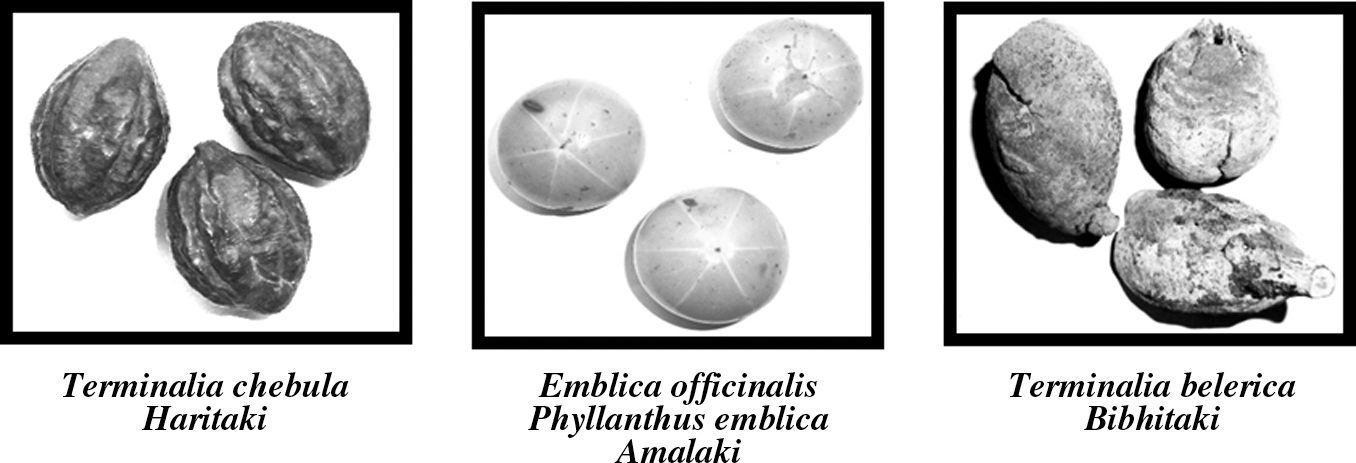
The three individual components of Triphala.
In Ayurveda, Triphala is termed a tridoshic rasayan and to have balancing and rejuvenating effects on the three constitutional elements that govern human life (i.e., vata, pitta, and kapha 8,13 ). In Ayurvedic practice, Triphala is used for gastric disorders such as digestion problems, poor food assimilation, cleansing of colon, constipation, and tonifier of the gastrointestinal tract and colon. 12 It is also recommended to be used for cardiovascular disorders, ophthalmic problems, liver dysfunction, and for inflammation and complications of the large intestine. 17 Triphala has been reported to be of use in treating anemia, jaundice, constipation, cough, asthma, fever, chronic ulcers, leucorrhoea and pyorrhea. 12,17
Triphala and/or its individual plant constituents have been reported to possess antibacterial, antimalarial, antifungal, antiallergic, and antiviral activities in different study systems. Triphala is a cardiotonic and exerts its protective effect by improving the blood circulation, reducing myocardial necrosis and serum cholesterol levels, and strengthening the capillaries. It is also hepatoprotective and improves liver function. The decoction of Triphala has been found to treat leukorrhea in women. 12,17 –19
Triphala has been reported to possess antiaging properties and to improve the mental faculties. 12,16 Triphala has been found to potentiate the adrenergic function, thereby enabling the body to recover from stress. 12,18,19 Exploratory studies performed in the past decade suggest that Triphala possess antioxidant, antimutagenic, antineoplastic, chemoprotective, radioprotective, and chemopreventive effects. Herewith an attempt is made to summarize the results of the various experiments performed on these aspects of Triphala.
Triphala as an Anticancer Agent
In vitro studies
Experimental studies have shown that the extracts of Triphala possess dose- and time-dependent cytotoxic effects in various cultured cancer cell lines: Shionogi 115, a mouse breast cancer cell-line 20 ; barcl-95, mouse transplantable thymic lymphoma cells 21 ; MCF-7 and T47D, human breast cancer cell-line 20,21 ; PC-3 and DU-145, human prostate cancer cell lines 20 ; and Capan-2 and BxPC-3, human pancreatic cancer cells. 22 Studies also suggest that at equal concentrations the cytotoxic effects of Triphala were negligible or less in the normal human pancreatic ductal epithelial cells (HPDE-6), 21 human breast cells (MCF-10 F), human peripheral blood mononuclear cells, mouse hepatocytes, and splenocytes. 21,23 All these reports suggest the effectiveness of Triphala as a nontoxic selective antineoplastic agent.
The extract of Triphala and its individual constituents were investigated for their inhibition of DNA synthesis in S115, MCF-7, PC-3, and DU-145 cell lines. The extract of Haritaki was observed to be the most effective followed by the Triphala, Amlaki, and Bibitaki. 20 Gallic acid, which is an important constituent of all of the three fruits (Haritaki, Amlaki, and Bibitaki) also exhibited a similar type of cytotoxic effect on all cell lines. 20 The inhibition of DNA synthesis resulted in a proportionate decrease in cell replication and proliferation.
Treatment of MCF-7 and T47D cells with Triphala caused reproductive cell death, and this effect was both dose and time dependent. 23 At equivalent concentrations, the MCF-7 cells were more sensitive than the T47D cells. 23 Triphala caused DNA fragmentation in MCF-7 cells as evaluated by the DNA fragmentation assay. 21 It also increased the phosphorylation of H2A.X at Ser-139, a marker for DNA double strand breaks in the Capan-2 cells. 22
Treatment with Triphala also induced apoptosis in the MCF-7, T47D, barcl-95, Capn-2, and BxPC-3 neoplastic cells. 20 –22 However, it failed to induce apoptosis in normal human pancreatic ductal epithelial (HPDE-6) cells, thereby reaffirming that its effect was selective to the neoplastic cells. 22
Studies also showed that the quantum of apoptotic effect was dependent not only on the concentration and time of Triphala treatment but also on the cell's intrinsic ability. The MCF 7, a p53+/+cell line, was more sensitive to undergo apoptosis than the p53-/- T47D cells. 21 Treatment of MCF-7 cells with pifithrin α, a known inhibitor of p53, reversed the effects. 23 Similar results were also observed in the Capan-2 cells, thereby validating the role of p53 in Triphala-mediated apoptosis (Fig. 2). 22
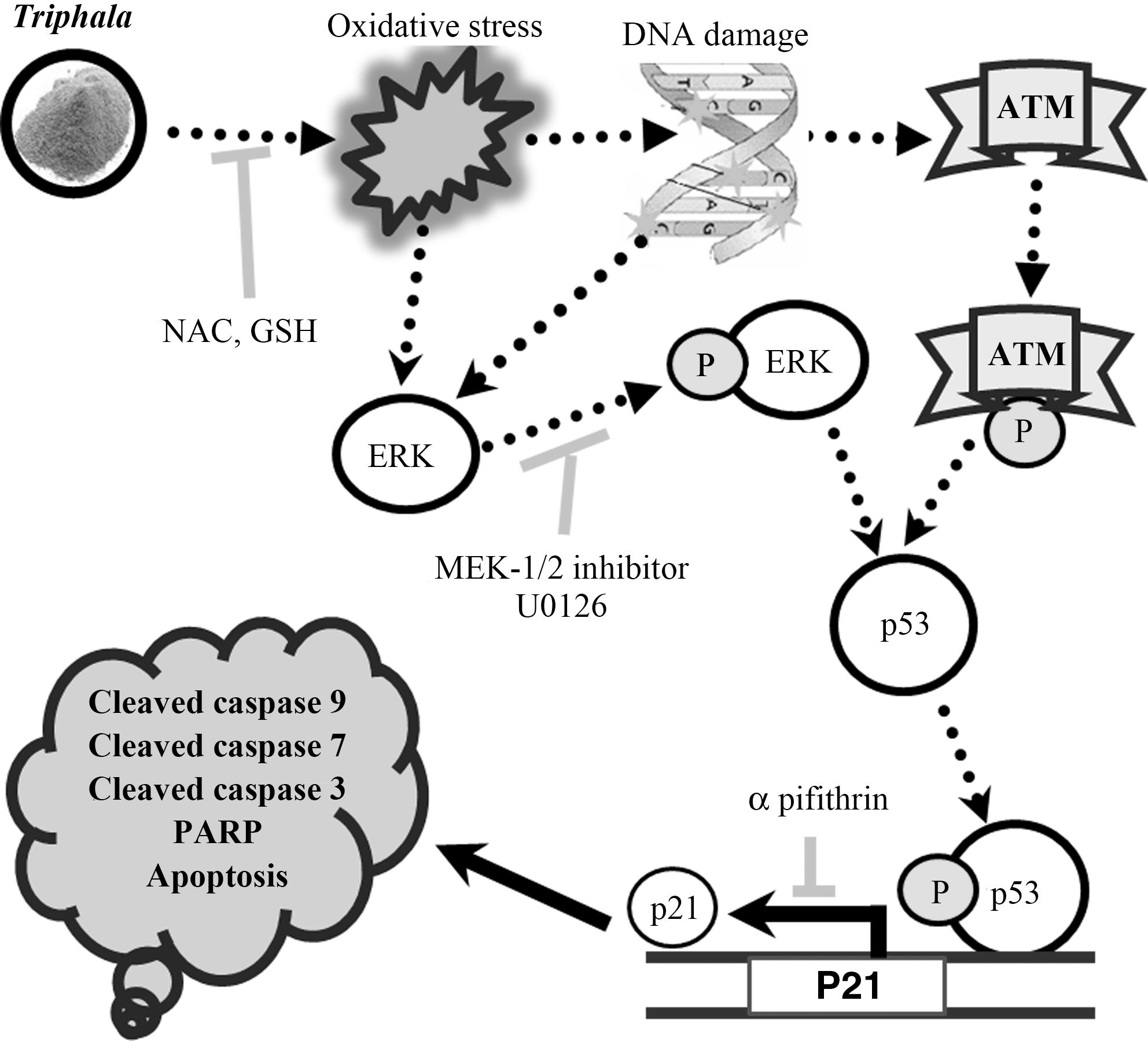
Schematic representation of the molecular mechanisms responsible for the apoptosis induction by Triphala in neoplastic cells (⊥ = inhibits). NAC, N-acetylcysteine; GSH, glutathione; PARP, poly (ADP-ribose) polymerase; ERK, extracellular signal-regulated kinase; P, phosphorylated; ATM, ataxia telangiectasia mutated.
Mechanistic studies showed that Triphala increased the intracellular levels of reactive oxygen species (ROS) in the neoplastic cells MCF-7, T47D, Capan-2, and barcl-95 cells as compared to the normal MCF-10 and mouse hepatocytes and splenocytes. 21 –23 However, pretreatment with antioxidants glutathione (GSH) and N-acetylcysteine (NAC) inhibited the cytotoxic effect of Triphala on MCF 7, T47D cells, and Capan-2, confirming that generation of ROS is a trigger for cell death and apoptosis and also that its inhibition reverses the process (Fig. 2). 21,23
In Capan-2 cells, Triphala-induced apoptosis was linked with the phosphorylation of p53 at Ser-15 and ERK at Thr-202/Tyr-204. The effect was blocked when the cells were pretreated with an antioxidant NAC, suggesting the involvement of ROS generation. Pretreatment of cells with pifithrin-α or U0126, the specific inhibitors of p53 or MEK-1/2, decreased the Triphala-induced apoptosis. Pretreatment with NAC or U0126 also decreased the Triphala-induced p53 transcriptional activity (Fig. 2). 22
Animal studies
Feeding Triphala to mice bearing barcl-95 or human pancreatic cancer cells, Capan-2 resulted in a significant increase in the apoptosis. 21,22 Detailed molecular studies showed that feeding of Triphala to the Capan-2 pancreatic tumor-xenograft increased the number of apoptotic tumor cells and cleaved fragments of caspase-3 and poly (ADP-ribose) polymerase (PARP), with concomitant increase in the activation of p53 and ERK. 22 The results also indicate that inhibition of DNA synthesis and induction of apoptosis contribute toward selective cytotoxicity, which will ultimately result in tumor regression and decrease in tumor volume. 22
Feeding Triphala did not show any signs of discomfort or impaired movement. suggesting it was devoid of systemic or cognitive toxicities. 21,22 All these observations suggest that Triphala possess selective cytotoxic effects on neoplastic cells, was not toxic to the normal cells, and did not possess inherent toxic effects, characteristics that qualify it to be safe and prospectively of immense use in clinics.
Chemoprotective effects
Methotrexate, an antifolate drug, is of immense use in clinics as an anticancer and immunosuppressive agent. However, its efficacy is often limited by its enterotoxicity. 15,24 Nariya et al. 15 studied the enteroprotective effects of two types of Triphala formulation, the conventional equal proportionate formulation and the unequal formulation (1:2:4 of T. chebula, T. belerica and E. officinalis) against the methotrexate-induced intestinal damage in rats. 15
Coadministration of both Triphala equal or unequal formulations at 540 mg/kg with methotrexate significantly restored the depleted protein level in brush border membrane of the intestine, phospholipid and glutathione content, and decreased the myeloperoxidase and xanthine oxidase level in intestinal mucosa of rats. 15
The unequal formulation showed significant decrease in permeation clearance of phenol red with significant attenuation in the histopathological changes, level of disaccharidase in brush border membrane vesicles, and lipid peroxidation content of intestinal mucosa. 15 Of the two formulations, the unequal formulation was observed to be better than the conventional formulation. The authors propose this effect to be due to the increased quantity of Bibitaki and Amlaki, which are well-established Rasayana plants with powerful antioxidant and free radical scavenging effect. 15
Radioprotective effects
The use of ionizing radiation, although useful, is associated with the development of side-effects due to normal tissue damage. A therapeutic agent that can differentially protect the normal cells against the radiation-induced damage at nontoxic concentrations has been a long sought goal and still remains an area of intense focus. 25 Studies have shown Triphala to possess radioprotective effects when administered through both intraperitoneal 18,19 and oral routes. 26
Treatment of mice with different doses of aqueous extract of Triphala consecutively for 5 days before irradiation delayed the onset of mortality and reduced the symptoms of radiation sickness. The best protection was observed for 10 mg/kg Triphala cohorts, 18 as it increased the radiation tolerance by 1.4 Gy and caused a dose reduction factor of 1.15. 19 Acute toxicity study showed that the median lethal dose (LD50) dose of Triphala was 280 mg/kg body weight and that the optimum protective dose was 1/28 of its LD50 dose by the intraperitoneal route. 18
Triphala, when administered orally for 14 consecutive days (7 days prior to and also after radiation, pre–post group) is also reported to protect mice against radiation-induced sickness and ill effects. The radiation-induced mortality was reduced by 60% in mice fed with 1 g/kg body weight of Triphala. 26 However, Triphala was not effective when administered after irradiation (postirradiation treatment), suggesting its benefit to be only when radiation exposure is planned. 26 Triphala decreased the radiation-induced oxidative stress, increased the antioxidant defenses, and inhibited the DNA damage (discussed in the Mechanisms responsible for section). 26
Chemopreventive effects of Triphala
Preventive medicine is becoming a cornerstone in health and importantly with cancer. 1 Chemoprevention is a protective approach for controlling cancer and involves the use of specific nontoxic natural products or synthetic chemical agents to reverse, suppress, or prevent premalignancy before the development of invasive cancer. 1,27 Preclinical studies have shown that feeding of Triphala to mice reduced the benzo(a)pyrene-induced forestomach papillomagenesis in a dose- and time-dependent manner. 27
Short-term feeding of 2.5% and 5.0% Triphala incorporated diet for 56 days (2 weeks before, 2 weeks after, and during the 4 weeks of carcinogen treatment) decreased the tumor incidences by 77.77%. With increase in the feeding time to 180 days (2 weeks before, during the 4 weeks of carcinogen treatment, and until the end of the experiment), a further decrease (66.66% and 62.50%) in the incidence and tumor burden was also observed. The preventive effect was both concentration and time dependent. 27
Feeding a 2.5% Triphala diet was observed to be more effective in reducing the tumor indices when compared to its individual constituents of Bibitaki, Amlaki, and Haritaki, clearly suggesting an additive effect. 27 Long-term treatment of 5% Triphala alone (no carcinogen) did not give rise to any tumor or did not have any apparent toxic effect on the survival or body weight gain profile of the animals, clearly suggesting the nontoxic nature of Triphala. Biochemical studies showed that Triphala increased the antioxidant status of animals and prevented lipid peroxidation (explained in the Mechanisms responsible for section). 26
Studies have shown that oral intubation of BaP initiates mutagenesis in gastric cells and with time a montage of normal, mutated, preneoplastic, and cancerous cells ensues. Triphala was administered to animals through diet, making the phytochemicals in direct contact with the walls of the forestomach, the target site for BaP-carcinogenesis. In light of Triphala's ability to selectively induce apoptosis in neoplastic cells, 21 –23 it is logical to speculate that similar mechanisms might have operated and resulted in reduction in the tumor incidence and multiplicity.
Mechanisms responsible for the chemoprotective, radioprotective, and chemopreventive effects of Triphala (Fig. 3)

Some of the protective mechanisms responsible for the radioprotective and chemoprotective effects of Triphala. Arrows pointing up depict increase, while arrows pointing down signify decrease.
Free radical scavenging
Triphala is reported to be effective in scavenging nonbiologic and stable free radicals, 2,2-diphenyl-1-picrylhydrazyl and 2,2'-azino-bis(3-ethylbenzthiazoline-6-sulphonic acid), 28 –30 as well as the biologic superoxide, hydroxyl, peroxy, and nitric oxide radicals in cell free assay systems. 28 –31 Triphala was effective in inhibiting superoxide-induced hemolysis of red blood cells, thereby reiterating its cytoprotective effects. 28 Naik et al. 28 have observed that Triphala and its constituents possess free-radical scavenging activities and also that Haritaki was better than Amlaki and Bibitaki. 29 The hydromethanolic extract of the Triphala and its constituents possessed superoxide radical-scavenging and hydroxyl radical-scavenging effects. 31
Increase in antioxidant enzymes
Sandhya et al. 26 also observed that feeding of 1 g/kg body weight of Triphala increased the superoxide dismutase levels in the mouse intestine. It increased the hepatic levels of glutathione, the activities of antioxidant enzymes superoxide dismutase and catalase, and levels of phase 2 enzyme glutathione S-transferase and glyoxalase 1. 27
Decrease in cell damage
On exposure to cytotoxic agents, the cells release certain enzymes that are surrogate markers for the health status of the tissue. Deep et al. 27 have observed decreased levels in lactate dehydrogenase activity in the liver of mice fed with Triphala. Feeding of Triphala before exposure to radiation also decreased the levels of xanthine oxidoreductase in the mouse intestine. 26
Inhibition of lipid peroxidation
In vitro assays suggest that the extract of Triphala and its constituents Haritaki, Bibitaki, and Amlaki is reported to inhibit Fe3+/ADP/ascorbate, 28 Fe (2+)/ascorbate, 31 and radiation-induced lipid peroxidation. 29 Feeding of a diet incorporating Triphala for 2 weeks to mice also reduced the levels of lipid peroxidation in the liver. 27
Anti-inflammatory effects
Studies confirm that persistent inflammation leads to cancer, and its inhibition is a means for chemoprevention and cytoprotection. Rasool and Sabina 32 have observed that feeding Triphala prevented the Freund's adjuvant–induced arthritis and inflammation in mice and also that this effect was better than that of indomethacin, a known anti-inflammatory drug. The levels of lysosomal enzymes, tissue marker enzymes, glycoproteins, and paw thickness were decreased and to near normal conditions. 32
Antimutagenic effects
Mutations are precursors for carcinogenesis and studies by Kaur et al. 33 have shown that the water, chloroform, and acetone extracts of Triphala possess antimutagenic effects in the Ames histidine reversion assay with TA98 and TA100 tester strains of Salmonella typhimurium. The authors studied the antimutagenic effects of Triphala extracts against the environmentally relevant direct-acting mutagens 4-nitro-o-phenylenediamine and sodium azide, and the indirect-acting 2-aminofluorene. The results showed that the aqueous extract was ineffective and that the acetone extract showed maximum inhibition against both classes of mutagens. 33
Anticlastogenic effects
Studies by Naik et al. 29 have shown that Triphala and its individual constituents prevented the γ-radiation-induced DNA clastogenesis in the plasmid DNA (pBR322) in vitro. Later, Sandhya et al. 26 observed that Triphala reduced the DNA damage in leukocytes and spleen cells of mice subjected to whole body irradiation. These results suggest that the cell-free observations extended to the in vivo systems.
Immunomodulatory effects
Triphala is reported to possess immunomodulatory activities, a property with immense use in cancer prevention and treatment. Studies by Srikumar et al. 34 have shown that administration of Triphala enhanced the avidity index and the neutrophil function, antioxidant activities, and decreased corticosterone levels in animals exposed to noise stress. 34,35
Amlaki is reported to enhance the natural killer cell activity and antibody-dependent cellular cytotoxicity in BALB/c mice bearing Dalton's lymphoma ascites tumor and that this contributed toward increasing the lifespan of the tumor-bearing mice. 36 In view of these observations, as Amlaki is a part of Triphala, it is safe to accept that a similar mechanism might be operating in the prevention of stress and cancer.
Conclusions
Studies in the recent past indicate the immense potential of Triphala in cancer prevention and treatment. However, gaps in the studies conducted are apparent, which need to be bridged for Triphala to be of regular use in cancer treatment and prevention. While most of the research has been with experimental animals and helps to validate the applicability on the human system, in vitro studies will facilitate a better understanding of the mode of action, particularly those responsible for the chemopreventive, radioprotective, and chemoprotective effects.
The mechanism of action of polyherbal drugs and their extract preparations differs in many respects from that of synthetic drugs or single substances. 18,19 It can be characterized as a polyvalent action and interpreted as additive or, in some cases, potentiating. 18,19 Among the three components of Triphala, existing literature suggests that it possesses antineoplastic, radioprotective, chemoprotective, and chemopreventive effects (summarized in Table 2). 37 –62
The better enteroprotective effects of 1:2:4 of Triphala over the conventional 1:1:1 combination (where Amlaki is in four parts) further supports this assumption. It is quite possible that the Bibitaki and Haritaki would potentiate/synergize the beneficial effects of Amlaki. The observation by Deep et al. 27 that at equivalent concentration, Triphala was more effective than the individual constituents in exerting its chemopreventive effects supports this hypothesis. Studies should also be planned on understanding the role of each constituent in rendering the beneficial effects.
As there is considerable variation in the chemical composition among various samples of Triphala, it is imperative that a quality control be established for the authenticity of the plant and the presence of active phytochemicals in the required levels. In this regard, the availability of authentic metabolite standards for quantification of the phytochemicals will make the scientific observations more reliable and reproducible.
Studies should also be conducted with tumor-bearing animals of different histological and metastatic potentiality to observe for the antineoplastic effects and normal tissue protection with both radiation and chemotherapeutic agents. Chemopreventive and chemoprotective studies should also be extended to other cytotoxic and carcinogens because then the efficacy of Triphala as a broad-spectrum cytoprotective agent will be realized.
Triphala has never been scientifically studied for its anticancer, cytoprotective, antimutagenic, immunomodulatory, or chemopreventive effects in humans. Pilot studies with a small number of healthy individuals should be initially performed to understand the maximum tolerable dose. Later, trials to validate the experimentally observed anticancer, radioprotective, chemoprotective, and chemopreventive effects need to be performed as then the efficacy will be clearly understood.
Footnotes
Acknowledgments
The author is grateful to Rev. Fr. Patrick Rodrigus (Director), Rev. Fr. Denis D'Sa (Administrator), Dr. Sanjeev Rai (Chief of Medical Services), and Dr. Jai Prakash Alva (Dean) of Father Muller Medical College for their unstinted support. He is also thankful to Dr. G.C. Jagetia, Dr. B.S. Rao, Dr. K.J. Malagi, Dr. M.S. Kamath, Dr. J.G.R. Soloman, Dr. Koteshwar Rao, and Dr. M.S. Vidyasagar for their help during his PhD endeavors in Kasturba Medical College, Manipal, India.
Disclosure Statement
No competing financial interests exist.
This article is dedicated to the Ayurvedic physicians whose contribution to humankind is unrecognized.