




Abstract
Background:
Health research consists of multiple disciplines that conceptualize and operationalize health in different ways, making integration of knowledge difficult. To help researchers and practitioners study and intervene on complex health processes, comprehensive integrative frameworks linking multiple disciplines and bodies of knowledge must be developed.
Aim:
This research article presents a conceptual framework of health integrating multiple elements from biomedical, psychosocial, behavioral, and spiritual research. We integrate different perspectives using a transdisciplinary approach.
Methods:
The framework includes discipline-specific constructs and domains, outlines their interactions, and links them to a global or holistic concept of health. In this context, health is an emergent individual experience transcending objective and subjective classifications of health and disease.
Conclusions:
Integration of evidence and knowledge from multiple sources should enhance our understanding of health processes and should yield new means of improving human health in the future.
Introduction
Conventional frameworks and theories typically organize knowledge in multicausal and additive ways, and often link elements from few disciplines. Despite the advantages of multidisciplinary approaches over unidimensional perspectives, these frameworks systematically fail to represent the dynamic and emergent nature of human health. 1,2 Indeed, studying self-perceptions of health demonstrate that people's general experience is sometimes poorly associated with objective measures of health, but that self-perceptions can be reliable and powerful predictors of future health outcomes, 3,4 raising the possibility that subjective data “may be at least as important as objective data.” 5 In light of current health concepts, researchers are still unclear as to how subjective health experiences relate to objective clinical measures of health status, and how they interact over time to influence objective health outcomes. 5 –7 To overcome this conceptual challenge, we present an integrative conceptual perspective, the Global Health Framework, which captures the emergent nature of human health.
The Global Health Framework builds from historically established disciplinary foundations to present a unifying conceptual framework of health providing a global, integrative, nondualistic and transdisciplinary perspective. Since health processes are multifaceted and multidimensional, progressive research initiatives can gain in validity and applicability by emerging from a joint-integrative thinking process between researchers of various disciplines. 8
This article integrates evidence-based elements (constructs, interactions, and causal relationships) from multiple disciplines and areas of research into a unifying transdisciplinary framework. To accomplish our objectives, we extensively searched and integrated the literature for general health models and theories across scientific domains. The resulting Global Health Framework thus presents a transdisciplinary approach to health that incorporates a range of factors from objective clinical measures used in biomedicine, to subjective health experiences relevant to psychology, behavioral and social sciences, and spirituality. Based on the framework, we conclude that factors of an individual's life interact in complex ways to generate a global experience, called Health, which emerges from the integrative, dynamic whole rather than from the sum of the parts. 9 The main utility of this framework is not to explicitly model relationships between variables, but to provide an evidence-based global perspective of health processes to guide transdisciplinary research, training, and health care practice.
Defining Health
Health is a complex multifaceted and multidimensional concept, and its operationalization differs widely, depending on the context or discipline in which it is used (see 10 –13 for examples). The World Health Organization defines health “as a state of complete physical, mental and social well-being and not merely the absence of disease or infirmity.” 14 Health has also been described as “healthy body, high-quality personal relationships, a sense of purpose in life, self-regarded mastery of life's tasks, resilience, trauma, and change.” 15 These definitions reflect the different domains of health—biologic, psychologic (affective and cognitive), social, behavioral, and spiritual. 15 –17
One view of health is that it is a “holistic” phenomenon experienced uniquely by each individual. 18 –21 From this perspective, quality of life and subjective well-being are generally considered important health outcomes. 22,23 Epidemiological findings have highlighted the predictive power of subjective health perceptions (e.g., self-rated health) on health outcomes, including mortality. 3,24 –26 The study of self-rated health suggests that individuals experience and rate their health in a way that is not predictable based on specific objective measures of health. 3,27 Moreover, precise measurements of biologic and physiologic function often do not correlate well with symptoms 28 –30 and future health outcomes. 31,32 Subjective perceptions of health may therefore be at least as important as objective measures at influencing health outcomes.
Profound interconnections between different health outcomes also exist. Evidence from multiple scientific fields and subdisciplines have established complex and clinically significant relationships among biologic–psychologic, 33,34 biologic–social, 35 –37 biologic–behavioral, 38 psychosocial, 39,40 psychospiritual, 13 and biologic–spiritual domains. 41 For example, optimism is a significant predictor of physical health outcomes, 42 whereas social conditions and experiences, such as social isolation, can influence gene expression and susceptibility to chronic diseases. 35,43,44
Given the multidisciplinary nature of health, coupled with the observations that both subjective and objective experiences can be important determinants of well-being, it is clear that “health” is a complex phenomenon. The term phenomenon denotes the emergent aspect of health, meaning that health is expressed in various ways and the individual's experience of health is nonreducible to specific sets of factors. Rather, factors interact in a way that the whole is greater than the sum of the parts. 1,9 When applied to human health, this principle entails that future health outcomes (pain, disease progression, level of functioning) do not only depend on the level of certain blood biomarkers, on the number of social interactions, or an individual’ specific coping strategy, but may rather depend on the global integration of these factors for each individual. Health and disease processes have an individual, unique, and dynamic character. 9
Therefore, an adequate conceptualization of health must situate health domains (organized from discipline-specific constructs) and their specific variables as dynamically interacting and interrelated domains of the whole, not as distinct parts. Health is an experienced state as opposed to an outcome that is accurately measured or calculated by decomposing a person into separate constituents. Health is defined here as a global state of the person, simultaneously reflecting the emergent properties of environmental and individual factors from different domains, and directly influencing specific health outcomes in individually tailored ways. This idea differs from disease-based biomedical or biopsychosocial models that conceptualize health as a finite measurable outcome. 45 Assembling and acquiring new knowledge that will lead to more comprehensive, less fragmented understanding of human health requires that we understand, build from, and transcend the existing frameworks/theories/models that have informed our current knowledge about health.
Conceptual Frameworks Used in Health Research
The biomedical model
The biomedical model has guided most medical research, training, and practice over the last century. 45 It provides a structure to seek molecular causes of disease and holds two major assumptions: First, it assumes that the source of disease ultimately lies in molecular mechanisms and events. 46,47 Within this perspective, the absence of disease is the prime condition defining health; therefore, disease is not identifiable in the absence of clinically observable disturbances. Health and disease are seen as dichotomous outcomes where an individual is either healthy or sick. The second assumption is that the mind and the body are processes that have no association. These reductionist and dualistic qualities suggest that the biomedical model draws heavily from the biologic domain of health with little regard for psychosocial or social health domains. 45
However, nonbiologic aspects of health are reported to interact in complex ways to influence biologic and physiologic outcomes, underscoring limitations of the biomedical framework. For example, psychologic states including well-being, anxiety, and depression are well associated with multisystemic physiologic dysregulations and abnormal levels of circulating biologic markers and cytokines. 48,49 This close association between the mind and the body processes has been well established and should be recognized as an important element in conventional and alternative medicine. 50,51 In contrast to the biomedical model, the biopsychosocial model provides a template to study the association between the mind and the body. 52,53
The biopsychosocial model
The biopsychosocial model aimed to expand the biomedical framework's scope to include biologic, psychologic, and social aspects of human health. 54,55 A goal of this framework was to account for complex disease states whereby etiology and progression are not limited to biologic processes. In recent years, due to the increasingly evident multidimensional nature of health and illness, many have argued that the biopsychosocial model represents a more comprehensive framework for health research and health care than the biomedical model. 6,56 –58 Indeed, compared to the unidisciplinary structure of the biomedical model, the biopsychosocial model establishes a structure for multidisciplinary work by juxtaposing several disciplinary concepts within a hierarchical framework encompassing fundamental systems (molecules, cells) to higher-order systems (person, society/nation). The development of this model led to a call for a paradigm shift, which provided a critical impetus for the emergence of progressive multidisciplinary fields of research such as psychoneuroimmunology, psychosocial oncology, and behavioral medicine, to name just a few. 6
Although the biopsychosocial model has several advantages over unidisciplinary models, it is conceptually limited. It is generally limited to biologic, psychologic, and social constructs and used as a causal deterministic paradigm focusing on clinical outcomes. 17,59 Most importantly, the biopsychosocial framework neglects subjective or global health experiences, especially positive health experiences (e.g., well-being, optimism), which can influence clinical outcomes. To develop a holistic understanding of health, one must integrate and transcend the objective and subjective dichotomy in order to grasp the underlying dynamic process. Our understanding of health as a complex phenomenon suggests that health and disease states emerge from dynamically interacting and holistic systems 9,21 calling for integrative levels of analysis where factors combine in multiple, nonadditive, and reciprocal (bidirectional) ways. 60,61
The Global Health Framework
The Global Health Framework addresses the challenge of conceptualizing health based on the current state of knowledge in different scientific domains. Our goal is to structure a perspective of health respecting key principles identified from multiple fields of research and disciplines. The proposed framework (1) accounts for complex associations and bidirectional relationships linking health domains, which conceptually positions health domains and their associated factors heterarchically/holarchically among each other; 62,63 (2) positions self-perception of health as an important factor linked to health domains; 3 (3) incorporates well-established epidemiological and clinical variables (e.g., biologic, physiologic, socio-economic) associated with discipline-based domains; and (4) includes transdisciplinarity as an organizing principle. 2,64
These important principles operate among five main health domains: biologic, psychologic (affective and cognitive), social, behavioral, and spiritual (Fig. 1). The range of biologic factors include higher-order biologic processes (e.g., circadian rhythms, appetite regulation); physical function and mobility (e.g., activities of daily living, exercise capacity, cardiovascular function); physiologic functions (e.g., blood glucose metabolism, hormone synthesis); molecular and cellular events (e.g., chemotaxis, phosphorylation reactions); and genetic/epigenetic events (e.g., transcription/translation, gene silencing). Elements of the psychologic domain can be subdivided in two broad categories of processes: affective, related to the emotional processes (e.g., affect, emotions); and cognitive, related to the intellectual processes (e.g., beliefs, attitudes). Social factors consist of socio-economic status (e.g., income, work and employment, education level), social support and positive relationships (e.g., presence of significant other, family), and culture and lifestyle (e.g., diet, transport, cultural practices). 37 Behavioral factors include health-risk (e.g., smoking, alcohol consumption, other addictions) and health-promoting (e.g., exercise, relaxation) behaviors. 31,65 And finally, spiritual factors include sense of purpose and meaning in life, and a sense of connectedness with the self, others, and a larger reality. 16,66,67
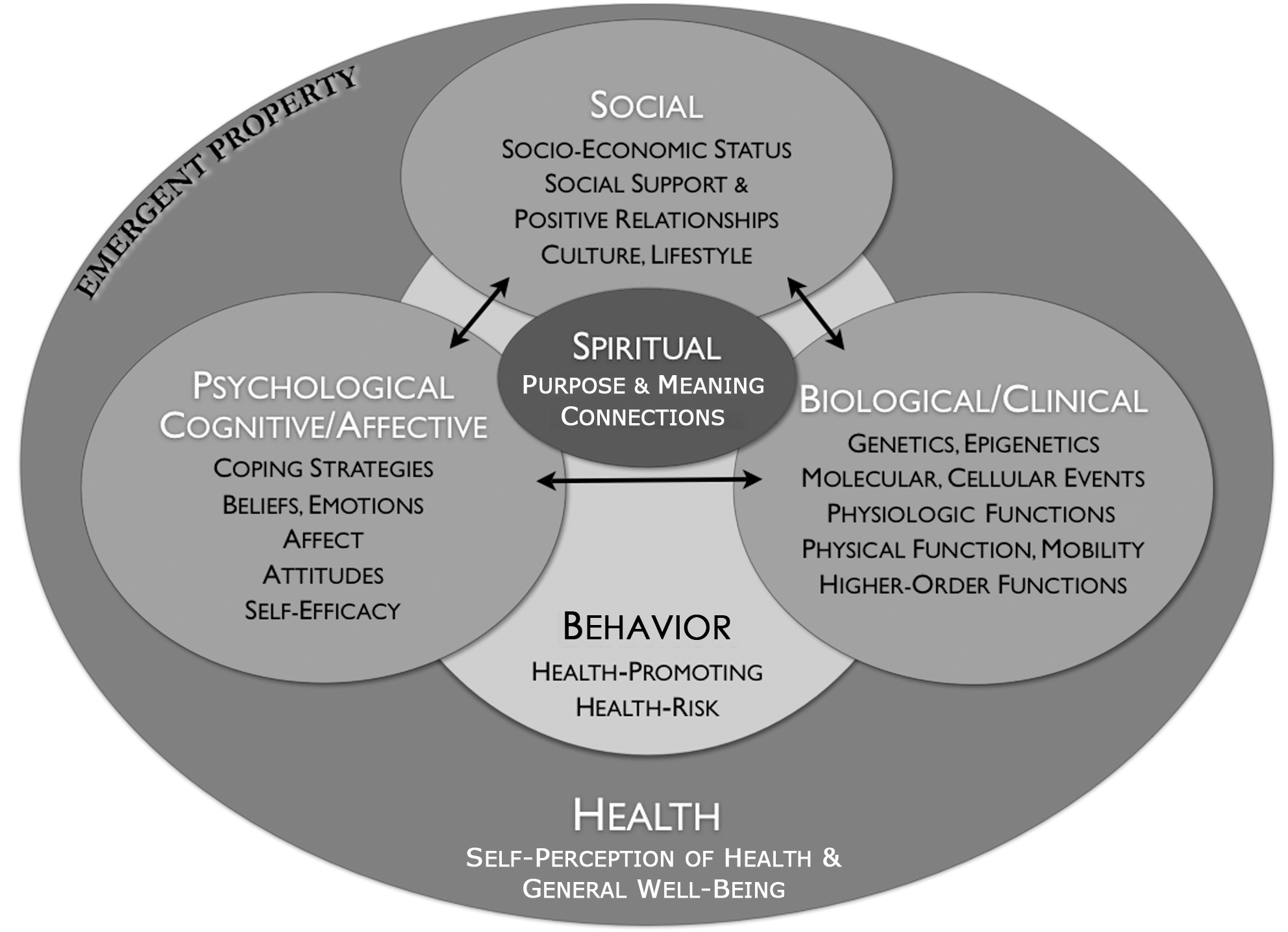
Health is the global state of the person, emerging from the complex interaction of several components, and simultaneously influencing specific expressions of illness/wellness among the five domains. The relative importance of each domain varies between individuals and over time. Arrows and zones of overlap between domains indicate potential interaction between elements of the framework.
In this transdisciplinary framework, interrelated health domains interact holistically as a whole system. Each domain is associated with every other element, either directly or indirectly, within global health (Fig. 1).
The major conceptual difference between the Global Health Framework and the biomedical and/or biopsychosocial models 55,68,69 is that this framework does not assume hierarchical or linear relationships among its factors. Rather, it considers these factors as expressions or outcomes of the global health state. Each domain and its factors are concurrent but conceptually distinct expressions of the complex dynamics of the health state. For instance, multiple expressions of illness and wellness such as organ function, systemic processes of allostasis, and quality of life are related outcomes. In addition, this framework does not clearly distinguish the mind and the body processes but transcends both to inform a “holistic” concept of their interaction. Health, or global health, is a dynamic higher-order construct that simultaneously influences, and is influenced by, a multitude of factors. Health therefore emerges, not as the cumulative sum of measurable factors linked causally, but as a complex phenomenon emerging and transcending its separate parts. Self-perception of health and general well-being are used in the Global Health Framework as an overreaching construct that best captures the multidimensional and holistic nature of health.
Implications of the Global Health Framework
The main contribution of this framework is that it links disciplinary constructs and concepts with important subjective and emergent properties related to self-perception of health. The overall emerging picture is one where health is a global state experienced by the person and expressed in unique individual ways.
The global health perspective may partially help to orient new investigative avenues concerning the origin of human health problems, including medically unexplained symptoms; 70 the frequent co-occurrence of psychiatric morbidity and chronic medical conditions; 71,72 and diseases and syndromes where high levels of mind–body interactions are apparent such as in irritable bowel syndrome 73 and chronic pain. 74 Multisystemic and subclinical disease processes—notably those related to stress and allostatic load 75 —may deserve careful examination when appraised from this framework. The transdisciplinary space symbolized by the global health state might allow for conceptualizations of chronic illnesses not as isolated anomalies, but as global disturbances partially expressed through physical symptoms. 76,77 So far, current uni- and multidisciplinary approaches have failed to provide effective explanations and solutions to the increasing burden of chronic diseases in society. 78 Recently, transdisciplinarity is emerging as an analytical framework useful to design solutions for complex problems and to generate new knowledge. 61,79 The Global Health Framework presents a logical structure articulating a holistic health perspective to inform research and understand these problems from a transdisciplinary, holistic viewpoint.
Complementary and alternative medicines (CAM) share a common emphasis on patterns of the whole individual rather than isolated problems in separate bodily subsystems. 1,9 The investigation of many understudied albeit popular and widely utilized CAM (e.g., acupuncture, homeopathy, qi gong, osteopathy) 80,81 may also benefit from this framework because it grounds holistic thinking in empirical categories of knowledge (disciplines). 82 Health researchers from different fields may also find this framework useful to situate their area of research within the broad human experience, and to contemplate potential interactions with other aspects of human health susceptible to affect individuals' global health. In research, specific aims and the choice of outcome measures depend on the framework underlying a researcher's study and thinking. This Global Health Framework provides an integrative perspective to overcome the intellectual difficulty of envisaging holistic health/disease processes. Some CAM may have the potential to influence global health states directly, via as yet unidentified pathways, without exerting their effects directly on biologic or psychologic pathways.
Within the proposed framework, medical technology and other therapeutic approaches valuing different types of outcomes (complex health states and holistic outcomes) must coexist. 9 Research is needed to establish and validate clear holistic health outcomes and intervention strategies aimed at promoting health, well-being, and healing. These might prove to be especially valuable in situations of chronic diseases where global and contextual impediments to healing do exist. Continuing to establish improved guidelines, tools, outcome measures, and perhaps new methods to investigate complex and dynamically interacting aspects of health should be an important task for researchers and practitioners.
Conclusions
How we conceptualize and operationalize health has important consequences for research and health care practice. However, this question is seldom directly and globally addressed. Instead, specialized disciplines operating from reductionist perspectives study in-depth aspects of biologic, psychologic, social, behavioral, or spiritual domains, resulting in a fragmentation of knowledge. Such work informs us on the details of “the parts” but tells us little or nothing about the “whole.” Nonetheless, knowledge provided by disciplines is essential to build the strong foundation for integrative transdisciplinary work if it is used adequately. Poorly integrated disciplinary research may lead to a conception of human health reduced to a set of outcome measures decomposed for pragmatic reasons and ease of study. Accurate conceptualizations of health can result in research initiatives taking into consideration the full range of factors affecting an individual's global health, and may hopefully lead to interventions operating from comprehensive and integrative concept of health that produce optimal community impact. The Global Health Framework proposes the appropriate use of domain-specific knowledge and provides a template to use this knowledge to solve holistic health problems.
At the present time, health research oscillates from biomedical to multidisciplinary models. Medical practice, however, is still deeply rooted in the biomedical model. 51 Given our increasing understanding of the complexity and very nature of health as an emergent experience, we propose the Global Health Framework as a way to frame and facilitate a nondualistic, integrative, and transdisciplinary thinking. Researchers and clinicians using transdisciplinary (holistic) perspectives to interpret their findings or diagnostic symptoms may be more likely to arrive at practical conclusions that will yield important knowledge about and individual's health state and facilitate individualized care. 61,83 As such, the systematic integration of current knowledge in ways that reflect the complex, dynamic, and emergent aspects of human experience should contribute to our ever-evolving comprehension of health as a complex phenomenon. The Global Health Framework provides a template to accomplish these goals.
Footnotes
Acknowledgments
MP is a Canadian Institute of Health Research Strategic Training Fellow in Psychosocial Oncology and holds a PhD fellowship from the National Science Engineering Research Council of Canada. CS holds a career award from the Fonds québécois de la recherche sur la société et la culture.
Disclosure Statement
No competing financial interests exist.