




Abstract
Introduction:
Anatomy has been at the foundation of medical students' training. In recent decades, medical programs in many countries have undergone major reform in both pedagogy and content. These reforms generated intense debates, focusing mainly on the way the new programs affected medical graduates' knowledge of anatomy and their clinical capabilities. Anatomy, however, is not only core to medicine, but also to a number of allied and complementary health disciplines. While the evaluation of anatomy teaching and learning in the medical programs has been heavily scrutinized, anatomy education in the complementary and alternative medicine (CAM) professions, including those, such as chiropractic, in which anatomy has traditionally been one of the main preclinical subjects, has been less frequently evaluated.
Objectives:
The study aimed to make a preliminary assessment of the final year chiropractic students' knowledge of anatomy using the “carpal bone test.”
Subjects and methods:
The testing was conducted on the final-year chiropractic students at Macquarie University in 2009. In this test, the students were given 5 minutes to label an illustration of the bony skeleton of the carpal region. The results of this assessment were then compared to results of previously published surveys using the “carpal bone test.”
Results:
A total of 84 students participated in the study. Thirty-eight percent (38%) of students identified all eight bones, while 60% of students identified five or more carpal bones. The most frequent correctly identified bone was the pisiform, followed by the scaphoid bone (82% and 74% of students, respectively). The trapezium and trapezoid bones were least frequently identified: both by 52% of students each. These results were generally better than those of the previously tested final-year medical students.
Discussion and conclusions:
The importance of anatomy in chiropractors' education has been generally acknowledged. This study suggests that the comparatively high number of hours devoted to anatomy in Macquarie University chiropractic curriculum and underpinning of clinical skills to anatomy knowledge in the senior year have increased retention of anatomy knowledge. The study, preliminary in nature, has also recognized the need for more detailed assessment of teaching and learning of the basic medical sciences in chiropractic and other CAM disciplines.
Introduction
One of the driving forces of this change was a need to incorporate the rapid advancement in the medical sciences and the emergence of new specialist disciplines, as noted recently by the Dean of Harvard Medical School: “In recent decades, scientific knowledge has changed dramatically, once-settled scientific principles have been replaced by more sophisticated concepts and entirely new disciplines, and parallel changes have occurred in medical practice and health care delivery. In the face of these new realities, medical school curricula have had to adapt.” 1 In addition to these pressures, other factors have further contributed toward the recent changes in anatomy courses, namely, increasing pressure to deliver academic research, shortages of teaching staff and cadaveric resources, and concerns regarding occupational health and safety. 2 –5
One of the most relevant and recent paradigm shifts in medical education has been the revision of most programs to include problem-based learning (PBL). This modality was developed in 1969 at McMaster University Medical School in Canada. 6 The closer student–faculty learning environment fostered in this approach has necessitated a transition in the teaching of anatomy away from the time-intensive cadaveric dissection (alleviating the cost and burden of obtaining and maintaining appropriate cadaveric resources) toward a more prosection-based laboratory session. 2 –4,7,8
One of the major advantages of PBL is that it presents the medical curriculum in clinically relevant situations, thus encouraging a deeper learning approach and reducing the information load, while also teaching generic skills (like teamwork, problem solving, and communication).
There has been substantial discussion on how these changes affect the competency of medical graduates and their clinical skills. 5,9 –11 Careful evaluation of the “new” PBL curricula has resulted in major reviews and in one documented case in Australia, a recommendation to substantially increase anatomy teaching time. 12 In current literature there exists much debate on the effectiveness of PBL versus the traditionally taught courses. Thus far, the results of empirical studies trying to establish an efficiency of one approach over the other have been inconclusive. 13 –17
It has now become clear that educational strategies need to be underpinned by evidence. 13 A study that attempted to provide such evidence for anatomy teaching practice was that of Spielmann and Oliver. 18 In their study, they assessed the anatomy knowledge of senior students and recent graduates, using a “carpal bone test” administered to the fourth and fifth (final) year medical students at the Edinburgh University Medical School, as well as to preregistration house officers and senior house officers (SHOs). The participants had to correctly label the carpal bones on an illustration of the bones of the wrist and hand provided. The study concluded that the senior medical students had poor recall, as only 16% (4 of 25) correctly identified all eight bones and 38% (8 of 25) correctly identified five or more bones, while “the SHOs results were more reassuring” as 9 out of 10 tested SHOs could identify all 8 bones. 18 A subsequent study at St. Andrews University, using the same test, demonstrated significantly better results in first-year students when compared to those in senior years. 19 It was concluded that the retention of anatomy knowledge obtained in the first year through to the later years is one of the greatest challenges of the discipline.
It would appear that most of medical education studies on anatomy teaching and learning focus on medical programs and students. This is not surprising considering the importance of the discipline to the practice of medicine. Anatomy, however, is not limited to medical practice. It plays an equal if not more important role in the practice of a number of allied and complementary health disciplines. 20 Those based on manual therapies such as physiotherapy and chiropractic are probably the best examples. 20 While anatomy teaching in these disciplines has remained mostly “traditional,” it has also been affected by changes in anatomy education, albeit in a different way than medicine. While there is some pressure to decrease the time devoted to anatomy, the anatomy teaching hours in most of the manual therapy schools have remained comparatively high. While Chiropractic is undoubtedly one of the health professions that is underpinned by a thorough knowledge of anatomy, very little research in chiropractic anatomy teaching and the anatomy competencies of senior year students and recent graduates has been published to date. 21,22 If the discipline of chiropractic is to advance in tandem with international medical education trends, an evaluation of current methods needs to inform significant paradigms shifts. Thus, this study aims to make a preliminary assessment of the final-year chiropractic students' knowledge of anatomy using the “carpal bone test.”
Subjects and Methods
The study was carried out on the final (fifth)-year chiropractic students at Macquarie University in 2009 after receiving ethical clearance from the University's Ethics Review Committee. The test was administered without prior indication during a well-attended tutorial. Immediately prior to testing, all students present were informed of the aim of the study, that participation was voluntary, and that the test was not part of the University assessment.
The “carpal bone test,” formulated by Spielmann and Oliver, 18 was utilized. In this test, the students were given an unlabeled illustration of the bony skeleton of the carpal region of the upper limb and were asked to identify the carpal bones with a time limit of 5 minutes, and under the normal university conditions applied for assessment. The test was collated and results were presented using descriptive statistics (histograms). The χ2 test (with Yates correction) was used to establish significance in frequency of correct answers between this cohort of chiropractic students and the medical students tested by Spielmann and Oliver. 18
Results
This final-year Macquarie cohort had 110 registered students, of which 84 attended the tutorial. All students present (n = 84), participated in the study. Of these, 32 (38%) students identified all 8 bones, while 50 (60%) identified five or more carpal bones (Fig. 1). The most frequent correctly identified bone was the pisiform—69 (82%) students, followed by the scaphoid bone, 62 (74%) students, while the trapezium and trapezoid bones were least frequently identified (Fig. 2)—both by 40 (52%) students each. In addition, the triquetrum and trapezoid were most frequently misspelled.
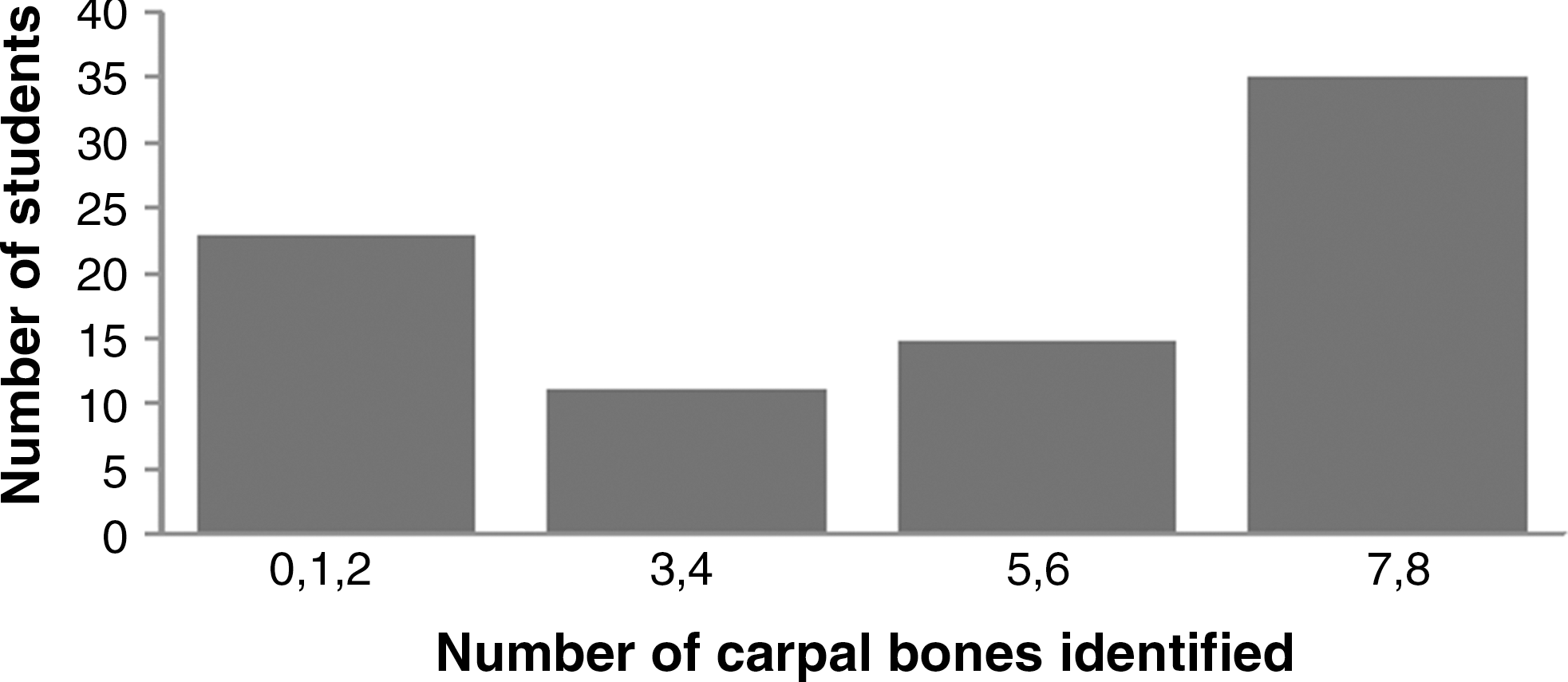
The number of identified carpal bones.
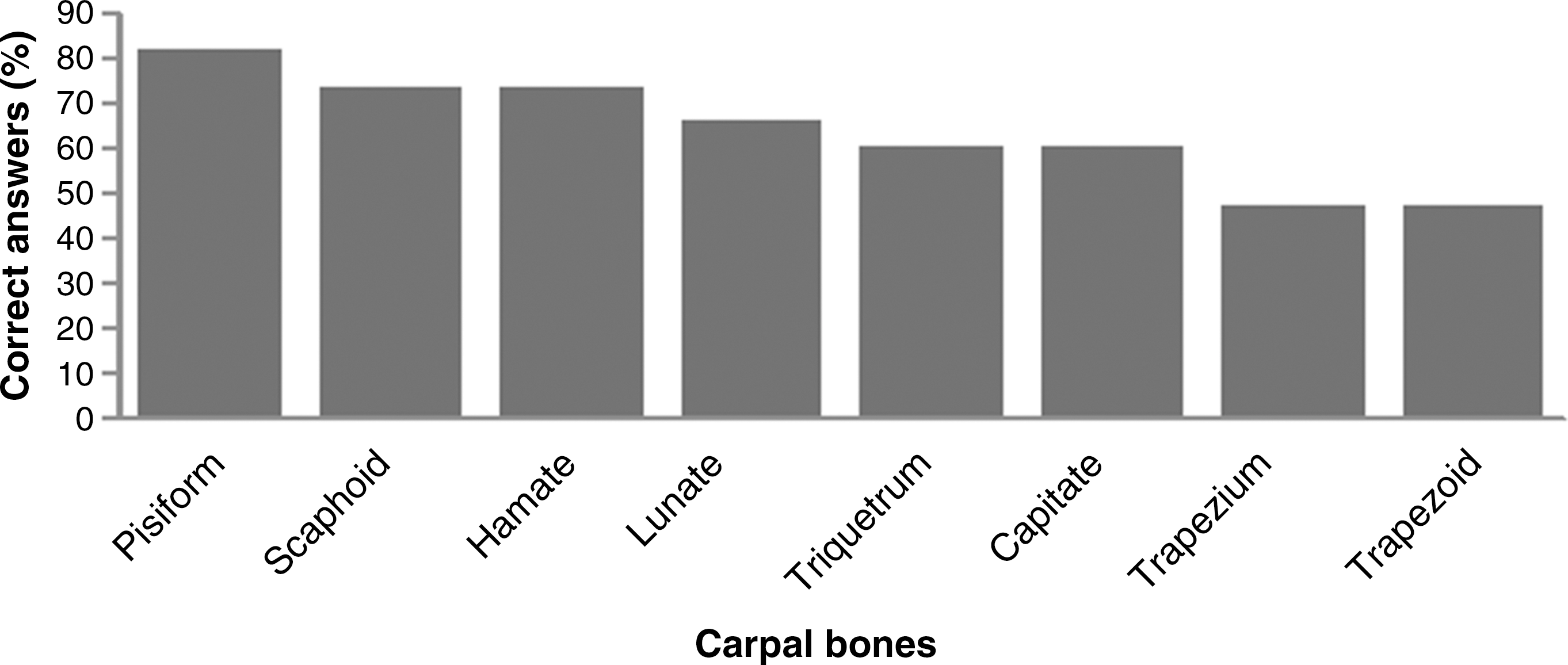
The identification of specific carpal bones.
Overall, the chiropractic students performed better than the medical cohort surveyed by Spielmann and Oliver. While 16% of the fourth- and fifth-year medical students at the Edinburgh University correctly identified of all eight carpal bones, 38% of the final-year chiropractic students at Macquarie University managed to do so. The difference between these cohorts, however, was not statistically significant (χ2 = 3.312; p = 0.0688). However, a statistically significant difference was present (χ2 = 4.809; p = 0.0283) when comparing the correct identification of five or more carpal bones in these cohorts: 32% medical students and 60% chiropractic students. 18
Discussion
Macquarie University is one of the three Australian universities offering the chiropractic degree. Chiropractic education at Macquarie commences with 3 years of undergraduate studies, after which a student is awarded a Bachelor of Chiropractic Science degree. This degree is not sufficient to enable a graduate to practice as a chiropractor. For this, an additional 2 years of postgraduate studies (coursework) is required. Successful completion results in a Master of Chiropractic degree. Upon completion of both the undergraduate and postgraduate components, students are able to gain registration to practice as a chiropractor.
While the chiropractic program is constantly being debated and challenged, 23,24 it would appear that it is generally acknowledged that anatomy is the most important preclinical subject. Within the program, anatomy has attempted to incorporate modern teaching methods. The chiropractic curriculum at Macquarie University complies with the World Health Organization (2005) guidelines 25 and the requirements of the Council on Chiropractic Education Australasia (2003), 26 both of which emphasize the importance of anatomy.
At Macquarie University, chiropractic students learn anatomy over the first 3 years, through the six one-semester courses. Students attend courses in the first year on introductory anatomy and histology; in the second year, on limb anatomy, trunk wall and visceral anatomy; and in the third year on head and neck anatomy and neuroanatomy. The second and third year anatomy is taught at the University of Sydney (due to the lack of facilities at Macquarie University) with an array of approaches utilizing primarily prosected material. In the postgraduate years (years 4 and 5), students are exposed to anatomy in four one-semester courses in radiology and within several clinical subjects.
This constant exposure and reinforcement of anatomical knowledge results in students' retaining much of the anatomy that they are taught. The results of the current study, when compared to those obtained on Edinburgh University medical students, appear to corroborate this. Considering the nature of the chiropractic practice and also the greater time devoted to anatomy in this program, the relatively better performance of these chiropractic students is not surprising. Nevertheless, there remains room for improvement in the anatomy education of this group of students with, perhaps, greater vertical integration and more emphasis on clinical relevance.
There are some similarities and differences between the two groups of students. In both groups, the larger, more commonly injured bones were the most commonly recognized. 18 A major difference in the two cohorts was that in the Macquarie cohort, the most correctly identified bone was the pisiform, while in the medical cohort this bone was the fifth most correctly identified bone. This is most likely due to the pisiform being a bony landmark in chiropractic, where it is a commonly used as a contact point on the practitioner's hand for manipulations.
Spielmann and Oliver 18 also stated that the trapezium, trapezoid, and triquetrum bones were frequently confused with each other. This was a similar finding in the current study and is perhaps not surprising, considering the similarities in the names of these bones and the tendency of students to use acronyms and mnemonics to study.
In considering the results of this study, it must be kept in mind that the carpal bone test is rather limited and provides only a minimal insight of the students' anatomical knowledge. In continuing this evaluation and to provide a more substantive comparison of medical and allied health professional students' knowledge retention, we will be developing a more extensive database of human anatomy, radiology, and neuroanatomy relevant to clinical practice for future surveys. Future studies would also include students from other universities, other disciplines to which anatomy is integral (e.g., physiotherapy, sports and exercise science, and osteopathy), and recent graduates and practitioners. The impact of in-vogue teaching methods (such as PBL and scenario-based teaching) on student learning and retention will also be explored after surveying current teaching practices in CAM disciplines. The authors' intention in this preliminary study is to create an impetus for faculty discussion and wider collaboration on this subject, with the goal of enriching teaching and learning in the anatomical sciences and in CAM programs.
Conclusions
Anatomy remains one of the core preclinical subjects in chiropractic education. To ensure quality of learning and teaching and to inform curriculum reform, regular assessment of students' knowledge of anatomy should be carried out. This preliminary study suggests that the anatomy knowledge of the final-year chiropractic students at Macquarie University is fairly good although far from ideal and that it can be improved by further curricular interventions. Future, more comprehensive studies should provide further insight into students' knowledge of anatomy and its effect on their clinical capabilities.
Footnotes
Disclosure Statement
No competing financial conflicts exist.