




Abstract
Objectives:
The study investigated the effect of whole-body vibration (WBV) alone and in association with localized radiofrequency on fat deposits in young nonobese subjects.
Methods:
Forty-four (44) healthy, nonobese women aged 25.3±5.26 years, body–mass index (BMI) 21.7±2.47 kg/m2 were randomly assigned to an 8-week trial of WBV (2 sessions per week) or WBV plus localized radiofrequency (WBV+RF) in the abdominal, buttock, and thigh region. Anthropometry, body composition (dual-energy x-ray absorptiometry, DXA), and motor performance were assessed before and after the trial. Data were analyzed by one-way analysis of variance (ANOVA) or ANOVA for repeated measures (group×time).
Results:
Valid data were obtained for 36 women (WBV, n=18; WBV+RF, n=18). Body mass and BMI did not change after trial. Body circumferences were unchanged or slightly reduced, with no difference between groups. Skinfold thickness was significantly reduced at several sites in the whole study population (n=36), reduction being higher at the thigh site in the WBV+RF group. According to DXA analysis, total body lean mass increased (p=0.009) and total body fat mass decreased (p=0.036) in the whole study population after trial with no significant difference between the WBV and WBV+RF group in spite of larger absolute changes in the latter. Standing long jump improved after trial with no change in flamingo balance test.
Conclusions:
An 8-week WBV training is effective in inducing positive body composition changes as well as increased muscle strength in women; it could be recommended as an alternative/complementary tool in physical activity or fitness programs as it is well tolerated. The current data give limited support to the association of localized RF treatment and WBV training as synergistic in inducing body fat mass loss; such a beneficial effect should be further investigated in subject with larger subcutaneous fat deposits (i.e., overweight or obese).
Introduction
Whole-body vibration (WBV) is increasingly being used in rehabilitation and in sports medicine as a reliable, effective tool to ameliorate muscle strength and neuromuscular function in healthy adults of various ages and patients with back pain as well as to increase bone mass. 11 –14 In general, physical activity is known to increase energy metabolism, leading to increase in bone mass and lean mass while decreasing fat mass 15 ; WBV has been shown to increase energy metabolism by increasing oxygen uptake as well as heart rate and blood lactate concentration. 16,17 These findings support the hypothesis that chronic exposure to WBV would affect body composition. Further, recent findings showed that WBV is able to reduce the differentiation of adipose precursor cells to adipocytes in young mice 18 and body fat accumulation in adult female rats without affecting lean mass, 19 suggesting a potential role for WBV in preventing/treating overweight and obesity. However, evidence that WBV affects human body composition is very scarce. In one study, 20 24 weeks of WBV were associated with a 2.2% increase in fat free mass, but no significant changes were observed in percentage body fat, skinfold thickness, or body mass. Therefore, there is a need for studies aimed at defining the ability of WBV to modify body composition.
In the present study, we exploited the potential of a unique device coupling WBV and localized RF heating, the BIOPLATE-RF, in order to assess its ability to affect body composition in nonobese young women; the underlying hypothesis was that combination of both treatments would yield additive effect on subcutaneous fat. In order to explore the functional outcomes of treatment, motor performance was also evaluated.
Materials and Methods
Subjects
Healthy, active female volunteers from the Sports and Exercise School of the University of Verona were enrolled in this study from September 2008 to April 2009. Inclusion criteria were as follows: age >18 years and <30 years, a record of moderate physical activity, no pharmaceutical drug intake affecting body composition in past 3 months, no signs/symptoms of disease, and no contraindication of vibration exercise. Exclusion criteria were overweight (body–mass index [BMI] >25), ongoing hypoenergy diet, and agonistic sport activity. The above criteria were inspired by the current prevalent utilization of WBV and RF devices in nontherapeutic settings.
A total of 44 women (age 25.3±5.26 years; height 1.65±0.067 m; weight 59.0±6.30 kg; BMI 21.7±2.47 kg/m2) were recruited for the study, and written expression of informed consent was obtained. The study protocol was in accordance to the Helsinki Declaration (2008 revision). After recruitment, subjects were randomly assigned to one of two groups: namely, WBV and WBV+RF (WBV+RF). The two groups underwent the protocol depicted in Figure 1. All subjects were instructed not to change alimentary habits or level of physical exercise during treatment; compliance with instruction was checked at the end of trial. A total of 8 subjects (18% of recruited subjects) did not complete the trial or were excluded from analysis due to side-effects (persistent headache after vibration, n=1), failure to comply with the protocol (changes in diet or physical activity, n=3), or voluntary dropout (n=4); therefore, the final study population comprised 36 subjects. The two groups (WBV, WBV+RF) comprised 18 subjects each; the characteristics of the two groups are summarized in Table 1.
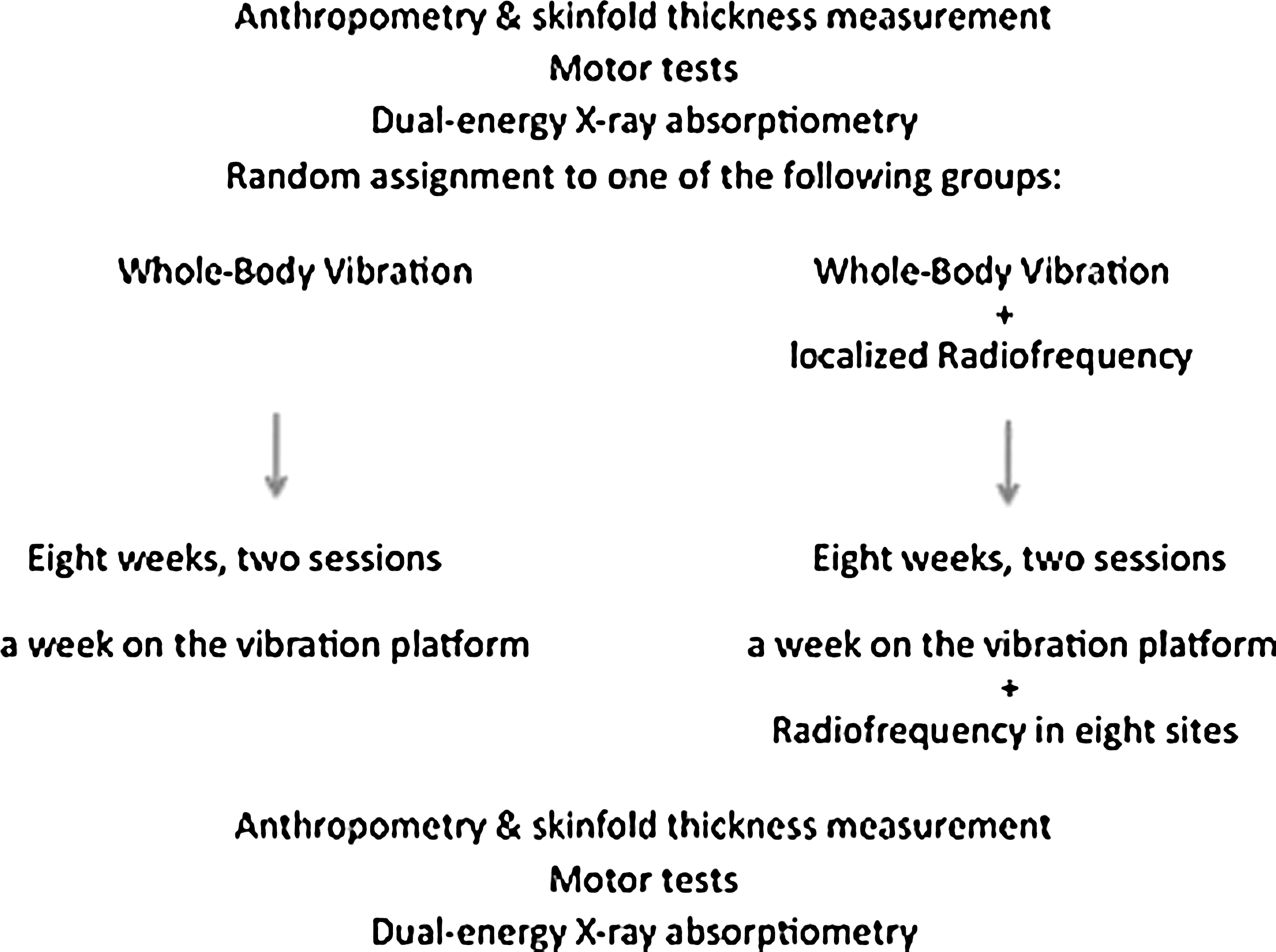
Outline of the study protocol.
No significant differences were present between groups (one-way analysis of variance).
Data are means±standard deviation.
BMI, body–mass index.
Anthropometry and body composition analysis
Weight was taken at the nearest 0.1 kg with an electronic scale (Tanita electronic scale BWB-800 MA [Wunder SA.BI. Srl], max 200 kg); height was measured with a stadiometer Harpenden (Holtain Ltd., Crymych, Pembs., UK) to the nearest millimeter; body circumferences were measured with a fiberglass tape at the arm (relaxed), waist, hip, thigh, and calf according to Lohman et al. 21 Skinfold thickness was measured with a Harpenden caliper (Gima, Milan, Italy) at the triceps, axillary, subscapular, suprailiac, abdominal, anterior thigh, and calf site according to Norton and Olds. 22
Total body and regional composition (lean mass, fat mass, and mineral mass) was evaluated by means of dual-energy X-ray absorptiometry (DXA) using a total body scanner (QDR Explorer W, Hologic, MA; fan-bean technology, software for Windows XP version 12.6.1) according to the manufacturer's procedures. The scanner was calibrated daily against the standard supplied by the manufacturer to avoid possible baseline drift. Whole body scanning time was about 7 minutes; the total X-ray irradiation absorbed by a subject was 5 mrems or lower, which is about 10% of standard chest x-ray film. All scanning and analyses were performed by the same operator (CM) to ensure consistency. For the standard regional body composition estimations, hologic software readings divided the body into trunk, upper limb, lower limb, and head. A specific region of interest labeled “thigh” was identified in both lower limbs by tracing a line connecting the distal border of the ischiatic tuberosities and the articular line of the knees.
Motor tests
The physical fitness assessment included the standing long jump for muscle strength and the flamingo test for balance. 23 For standing long jump, the subject stood behind a line marked on the ground with feet slightly apart; a two-foot take-off and landing was used, with swinging of the upper limbs and bending of the knees to provide forward drive. The subject attempted to jump as far as possible, and landing could be on one or both feet. The flamingo balance test was modified as follows: the subject was standing on her preferred leg (eyes closed) on a wooden block lying longitudinally of the set dimensions (30×20×10); the score was the time the subject stayed monopedal (maximum 1 minute). For each test, three trials were performed and the average was the recorded score.
Vibration training and application of RF
All subjects (WBV and WBV+RF groups) trained 2 times a week for 8 weeks on a Bioplate-RF (BIOS, Milan, Italy) vibrating platform generating vertical sinusoidal vibrations. Subjects performed 20 sequential unloaded static exercises involving upper and lower limbs, and the trunk according to a built-in program (#4). The total duration of each session was 19 minutes (14-minute vibration training, 5-minute rest), each exercise for 30–60 seconds; the vibration amplitude ranged from 2.0 to 5.0 mm, and the frequency from 40 to 60 Hz. The WBV+RF group had 5 minutes RF warm-up and 6 minutes RF cooling down before and after training, respectively. RF emission had a frequency of 550 KHz±10% by four channels (eight outputs total), with independent regulation of the power in every channel. RF was delivered using eight adhesive plates placed on the right and left side of the abdomen, the internal and external aspects of the thigh, and the internal aspects of the knee. Each session was led by a trained fitness instructor and supervised by a researcher.
Statistical analysis
Data are presented as means±standard deviation. One-way analysis of variance (ANOVA) was used to test for differences between groups at baseline. Changes in the anthropometric, performance, or body composition parameters for the two groups were analyzed by two-way repeated-measures ANOVA (group×time). Log transformation was done where needed to normalize data. Significance was set at p≤0.05. All statistical analyses were performed using SPSS for Windows version 15.0 (SPSS Inc., Chicago, IL).
Results
Mean body mass and BMI in the WBV and WBV+RF group were similar before and after trial (Table 2).
Differences were not significant (repeated-measures analysis of variance). Data are means±standard deviation.
In the whole study population (n=36), body circumferences (Table 3) were unchanged or slightly reduced after trial, with reduction being significant at the waist (p=0.042) and calf (p=0.043) sites. No difference was found between WBV and WBV+RF in this regard. Skinfold thickness (Table 4) was generally reduced after the trial, with the decrease being significant at the subscapular (p=0.033), axillary (p=0.005), abdominal (p=0.008), suprailiac (p=0.0001), and calf (p=0.028) site. No differences were found between WBV and WBV+RF except for the thigh skinfold, which was reduced in WBV+RF.
p<0.05 versus BT.
Waist and calf circumference were reduced after trial in the whole study population (n=36). No difference was found between the two groups after trial (repeated-measures analysis of variance). Values are means±standard deviation.
p=0.033 versus BT; ** p<0.01 versus BT; §p<0.05 versus WBV.
The axillary, subscapular, abdominal, and calf skinfold were reduced after trial in the whole study population (n=36). No difference was found between the two groups after trial (repeated-measures analysis of variance) except for the thigh skinfold. Data are means±standard deviation.
DXA analysis (Figs. 2 and 3) showed a slight but significant increase of total body lean mass (Fig. 2) in the whole study population (n=36) after trial (p=0.009); the increase averaged 0.2 and 0.6 kg in the WBV and the WBV+RF group, respectively, with the difference not significant (p=0.174) at the set level of significance. Regional analysis (Fig. 2) showed that trunk and lower limb lean mass did not change significantly after the trial, although a slight absolute increase (averaging 0.1 kg) was present in the lower limbs; a significant increase in lean mass was found in the right and left arm (p<0.001 for both); the WBV and WBV+RF groups presented similar values after trial. Total body fat mass (Fig. 3) was reduced in the whole study population (n=36) after trial (p=0.036); regional analysis (Fig. 3) showed a significant decrease of fat mass in both lower limbs (left, p=0.004; right, p=0.018). No significant difference was found between WBV and WBV+RF. A similar pattern was found when the percentage total body and regional fat mass was calculated (not shown). When the “thigh” region (as defined in the Materials and Methods section) was considered, fat mass was found to be lower after trial in the study population (n=36) in both absolute and percent values (p=0.037 and p=0.002, respectively), with no significant difference between groups (mean Δ fat mass: WBV -0.087 kg, -0.5%; WBV+RF: -0.108 kg, -0.8%, p=0.499 and p=0.605, respectively).
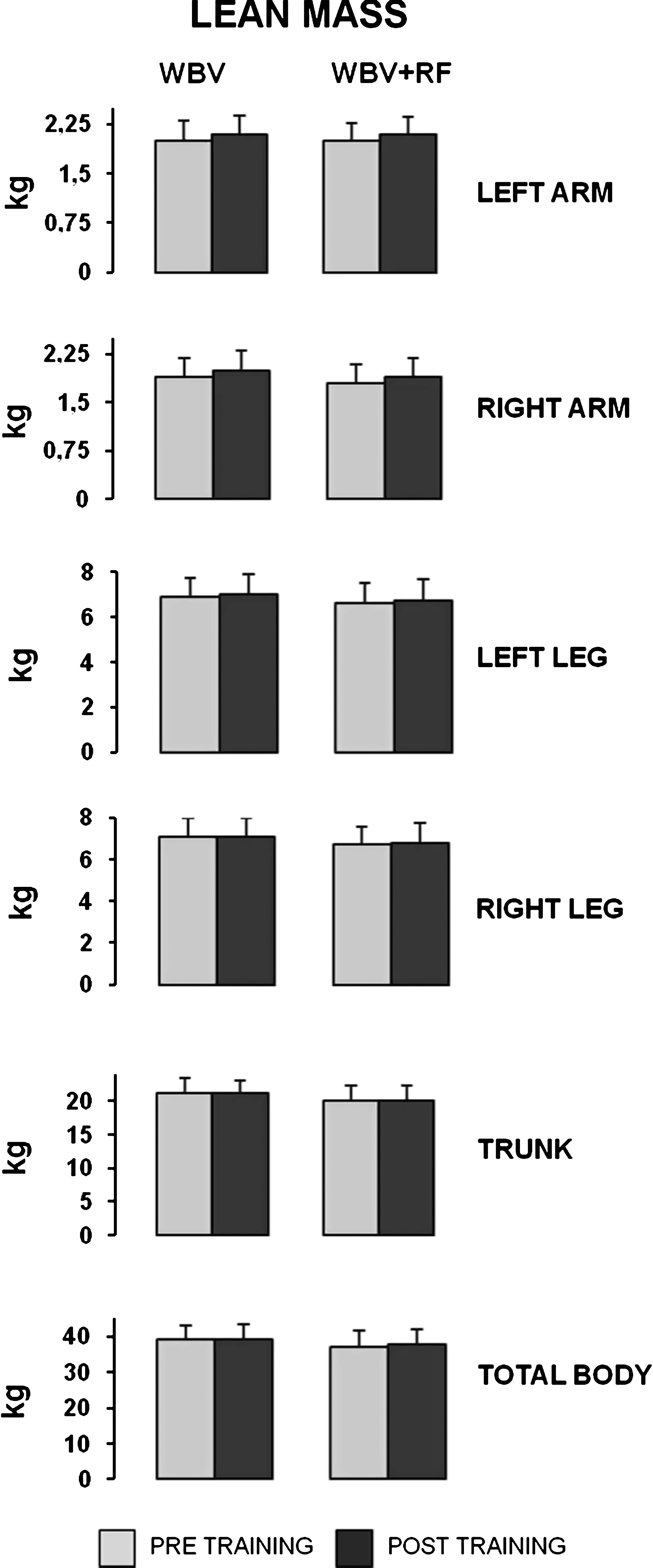
Total and regional DXA analysis of body lean mass in young nonobese women undergoing whole-body vibration (WBV, n=18) or WBV plus localized radiofrequency (WBV+RF, n=18) for 8 weeks. Repeated-measure analysis of variance (group×time) showed significantly increased lean mass after training (black columns) in the arms (p<0.001) and the total body (p<0.009) in the whole study population (n=36); no significant difference was found between WBV and WBV+RF.
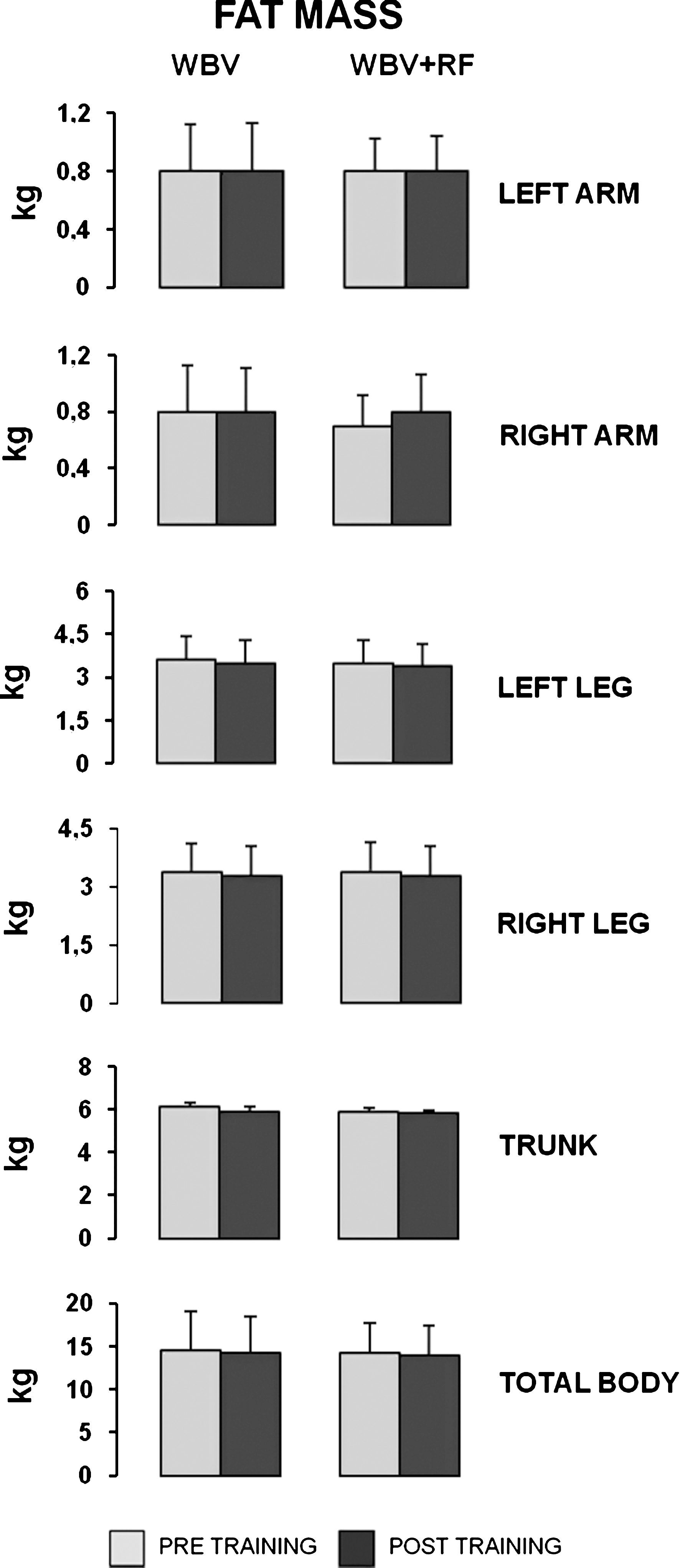
Total and regional dual-energy x-ray absorptiometry analysis of fat mass in young nonobese women undergoing whole-body vibration (WBV, n=18) or WBV plus localized radiofrequency (WBV+RF, n=18) for 8 weeks. Repeated-measure analysis of variance (group×time) showed significantly decreased fat mass after treatment (black columns) in the legs (left, p<0.004; right, p<0.018) and the total body (p<0.036) in the whole study population (n=36); no significant difference was found between WBV and WBV+RF.
Results of motor tests are reported in Table 5. Performance in standing long jump was higher in the whole study population (n=36) after trial (p=0.006). The flamingo balance test showed no significant changes after trial.
p<0.006 versus BT.
The standing long jump increased after trial in the whole study population (n=36); no significant change was found in the flamingo balance test. Data are means±standard deviation.
Discussion
In this work, the effect of an 8-week WBV training in the presence or absence of localized RF on body composition, selected anthropometric parameters, and motor performance in young healthy nonobese women was evaluated.
Vibratory stimuli were suggested as a training modality for athletes following the seminal work of Nazarov and Spivak. 24 According to the results of a recent meta-analysis of 31 studies, vibration exercise is apparently able to elicit chronic muscle adaptations and “can be used to enhance muscular strength.” 25 The Bioplate RF vibration platform used in this work exploits vertical vibration, which is more effective than oscillating vibration in eliciting chronic adaptations 25 ; accordingly, a clear improvement in a typical test for the evaluation of muscle strength performance of lower limbs (i.e., the standing long jump) was found in the sample after 8-week WBV training (Table 5). Instead, coordinative performance, as evaluated by the flamingo balance test, was not affected (Table 5); this finding in young women is supported by previous results showing no effect of vibration training on postural sway during unchallenged stance in young healthy subjects, 26 with no change 27 or improvement in balance in elderly people. 28
As an exercise or training tool, WBV has in principle a potential to affect body muscle and fat mass. Recent evidence 18,19 suggests that WBV is able to affect the amount of fat in rodents; however, the chronic effect of WBV on body fat mass and lean mass has not been defined in the human. This work shows now that WBV training is able to increase lean body mass while reducing body fat mass (as assessed by DEXA) and subcutaneous fat (as assessed by skinfold thickness) in young nonobese women. These results are supported by previous findings in untrained females of similar age 20 showing a significant 2.2% increase in fat-free mass (as assessed by underwater weighing) in the absence of changes in body mass after 24 weeks of WBV. However, in that study 20 no change in the percent body fat was found after treatment. The positive effect of WBV on lean mass is apparently maintained in older women. 29 Therefore, it can be suggested that WBV training is able to positively affect body mass composition in young nonobese females by increasing the amount of lean mass and possibly reducing fat mass.
In this work, we used an innovative vibration platform (BioplateRF) coupling vibration and localized delivery of RF; RF was delivered at the abdomen (two plates) and in the buttock/thigh region (six plates). Results show that at the total body level, RF did not add to the WBV effect; this was expected because of the short overall time of RF delivery, the relatively small skin surface involved, and the modest amount of subcutaneous fat in our nonobese subjects. However, when the thigh is considered (i.e., the region where most RF plates were applied), anthropometry showed unchanged thigh circumference in the two groups after trial, in the presence of a significantly reduced thigh skinfold in the WBV+RF group (Table 4), suggesting larger loss of subcutaneous fat in this group; consistently, DXA analysis of the “thigh” region showed a larger albeit nonsignificant mean decrease of fat mass in the WBV+RF versus WBV group in both absolute amount (-0.108 versus -0.087 kg) and percentage (-0.8 versus −0.5%).
Conclusions
These results show that chronic WBV training is effective in inducing positive body composition changes as well as improved motor performance in nonathlete, nonobese young women; therefore, it could be recommended as an alternative/complementary tool in programs designed for the ever-increasing healthy population seeking advice for fitness/wellness. The persistence of such changes over time requires further investigation. WBV training is well tolerated and is being evaluated in dieting overweight/obese subjects as a countermeasure to the inappropriate reduction of lean mass associated with weight loss. 30 The current data give limited support to the association of localized RF treatment and WBV training as synergistic in inducing body fat mass loss; such a beneficial effect is being further investigated in subjects with larger subcutaneous fat deposits (i.e., overweight or obese).
Footnotes
Acknowledgments
The authors would like to thank the volunteers who took part in this study for kind cooperation. This study was supported in part by BIOS srl in the form of a research contract.
Disclosure Statement
CM and CZ were the recipients of a research contract from BIOS srl. RP is consultant to BIOS.