




Abstract
Objectives:
The aim of this study was to determine the effects of workplace manual technique interventions for female participants on the degree of joint range of motion and on the level of musculoskeletal ache, pain, or discomfort experienced when performing workplace responsibilities.
Design:
Nineteen (19) female volunteers were given chair massages on-site twice per week for 1 month.
Settings/location:
Participants included individuals in administration and management from a company in Ljubljana, Slovenia.
Subjects:
A total of 19 female volunteers 40–54 years of age enrolled for this study. Fifteen (15) of them completed all measurements.
Interventions:
The Cornell Musculoskeletal Discomfort Questionnaire was used, and range-of-motion measurements in degrees were taken.
Outcome measures:
Subjects completed a series of self-report questionnaires that asked for information concerning musculoskeletal discomfort for the neck, upper back, and lower back in the form of a body diagram. A range-of-motion test (to compare the change in joint angles) was performed with a goniometer to assess cervical lateral flexion, cervical flexion, cervical extension, lumbar flexion, and lumbar extension.
Results:
Between the first and the last measurements, a significant difference (p<0.05) was found in increased range of motion for cervical lateral flexion (28.8%). Wilcoxon signed rank test showed a significant increase (p<0.05) in range of motion for cervical lateral flexion (42.4±6.3 to 48.3±7.3), cervical extension (63.2±12.4 to 67.2±12.3), and a significant decrease (p<0.05) in the Cornell Musculoskeletal Discomfort Questionnaire values for the neck (2.7±0.8 to 1.9±0.6) and the upper back (2.7±0.7 to 2.2±0.8) from the phase 2 to 3. Significant reductions were also shown in the Cornell Musculoskeletal Discomfort Questionnaire values for the neck (2.8±0.8 to 1.9±0.6) and the upper back (2.7±0.8 to 2.2±0.8) from the phase 1 to 3.
Conclusions:
On-site massage sessions twice per week for 1 month are the most effective interventions (compared to one session or no massage intervention) for decreasing the duration of musculoskeletal ache, pain, or discomfort and for increasing range of motion.
Introduction
The most common health outcome of muscle disorders is a sensation of pain,
6,10
when pain is defined as an unpleasant sensory experience associated with actual or potential tissue damage.
10
Posture-related pain is one of the most common factors in the early stages of musculoskeletal disorders,
11
and loss of muscle function, along with the increase in intramuscular connective tissue stiffness, results in decreased range of motion (ROM).
12
Flexibility (generally referring to the degree of normal motion available) is necessary for efficient movement.
12
The decrease in overall musculoskeletal flexibility (also due to physiologic changes that occur with aging) may lead to incorrect body alignment, chronically tight muscles, a decline in the efficiency of daily activity performance
Therefore, a cycle of relaxation between contractions with well-structured breaks spaced at shorter intervals for pain-afflicted people with restricted ROM plays a crucial role in preventing the development of musculoskeletal disorders. It is a well-accepted clinical observation that massage and stretching decrease muscular-tension pain, 13 and massage therapy is usually very effective in reducing soft-tissue pain that is related to posture. 14 Different studies have shown the effectiveness of massage therapy as a component for increasing ROM and decreasing pain in patients with shoulder discomfort 15 or low-back pain. 16,17
Anma is a traditional Japanese massage based on the principles of Traditional Chinese Medicine. 18 The founder of modern seated massage is generally acknowledged to be David Palmer, who was inspired to adapt Anma techniques and create acupressure-based massage routines for the seated position. 14 Anma is not a therapeutic massage, since it is beyond the scope of the seated acupressure body worker to treat specific ailments or illnesses. 19 The aim of this study was to determine the effect of acupressure workplace chair massage interventions on self-reported musculoskeletal ache, pain, or discomfort, as well as to measure changes in the participant's ROM as possible indicators to demonstrate improvement in musculoskeletal discomfort.
Materials and Methods
Participant selection
The study was approved by the Sports Faculty Ethics Committee, and all subjects gave their informed consent. Prior to the first session, participants completed a medical case history form. Employers allowed participants to attend massage intervention sessions in place of regular breaks. A total of 19 female volunteers 40–54 years of age enrolled in the study.
Description of interventions
Phase 1
Each of the female volunteers started in a control group. First, they completed the Cornell Musculoskeletal Discomfort Questionnaire (CMDQ) and demographic data. Participants took a 15-minute break from work twice per week for a 1-month period.
Phase 2
Each of the same female volunteers was then assigned to an experimental group. First, they completed the CMDQ for the second time and they were then given 15-minute on-site chair massages twice per week for another 1-month period. Before the first massage session, a ROM test was performed to assess neck (cervical) lateral flexion, cervical flexion, and extension and back (lumbar) flexion and extension. After the first massage, these procedures were repeated.
Phase 3
The same procedures conducted for the first session were repeated for the last massage during the final week of research. At the conclusion of the study, participants completed the CMDQ for the last time.
On-site massage program
For the purposes of this study, 15-minute on-site massage sessions (Fig. 1) were offered twice per week for 1 month in an office room with constant temperature and daylight. Participants were fully clothed and comfortably sat on a specially designed ergonomic chair. All massages were performed by 2 licensed massage therapists with several years of practice in acupressure chair massage techniques. This procedure, which is mostly used in Anma, is a pressing technique, where deep pressure is applied. Pétrissage (kneading), tapotement (percussion), and passive stretching (where the subject is relaxed while the stretch is performed by a massage therapist) (Fig. 2) were also used. The treatment was limited to the neck, shoulders, and upper and lower back.
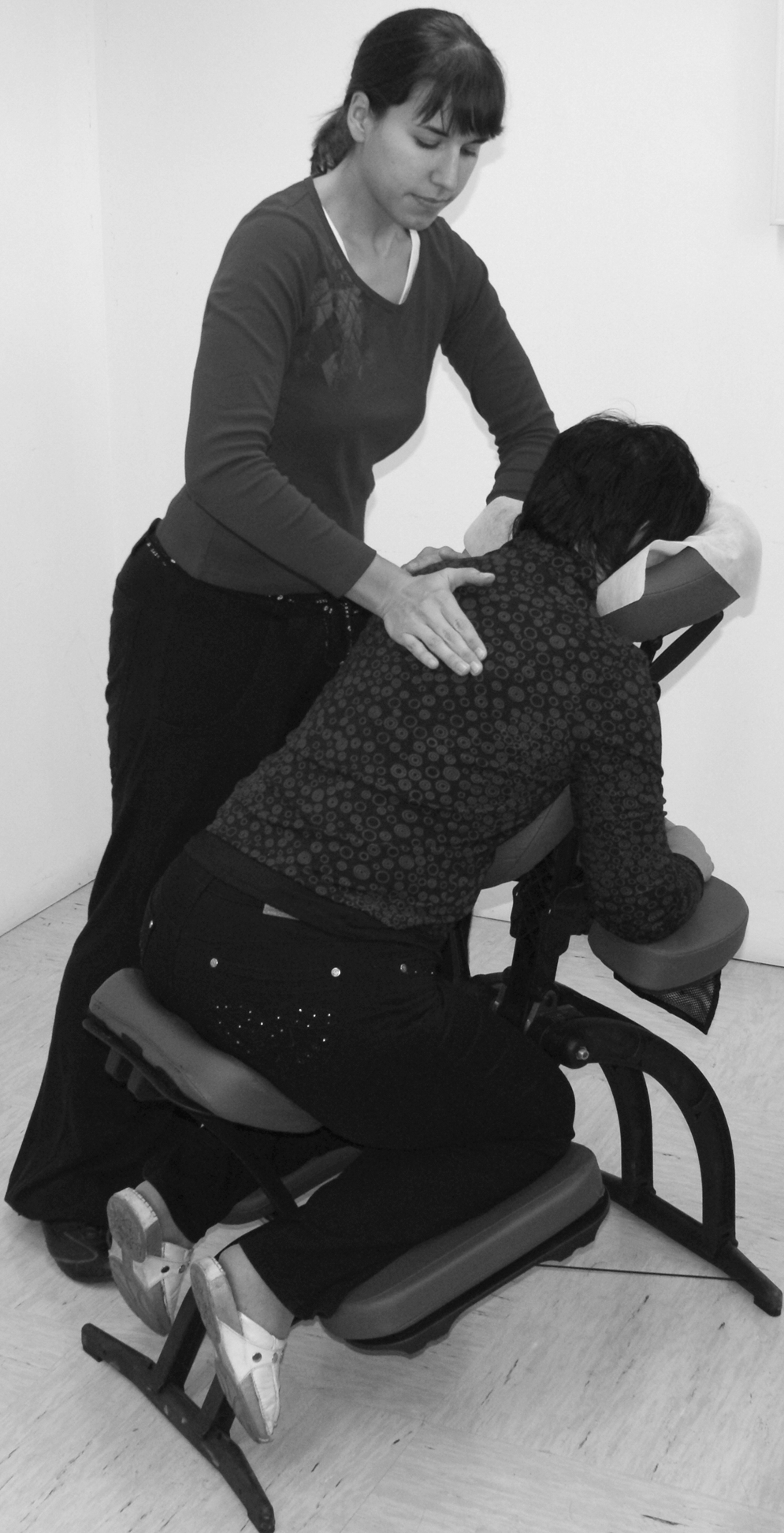
Massage therapist performing an on-site chair massage.
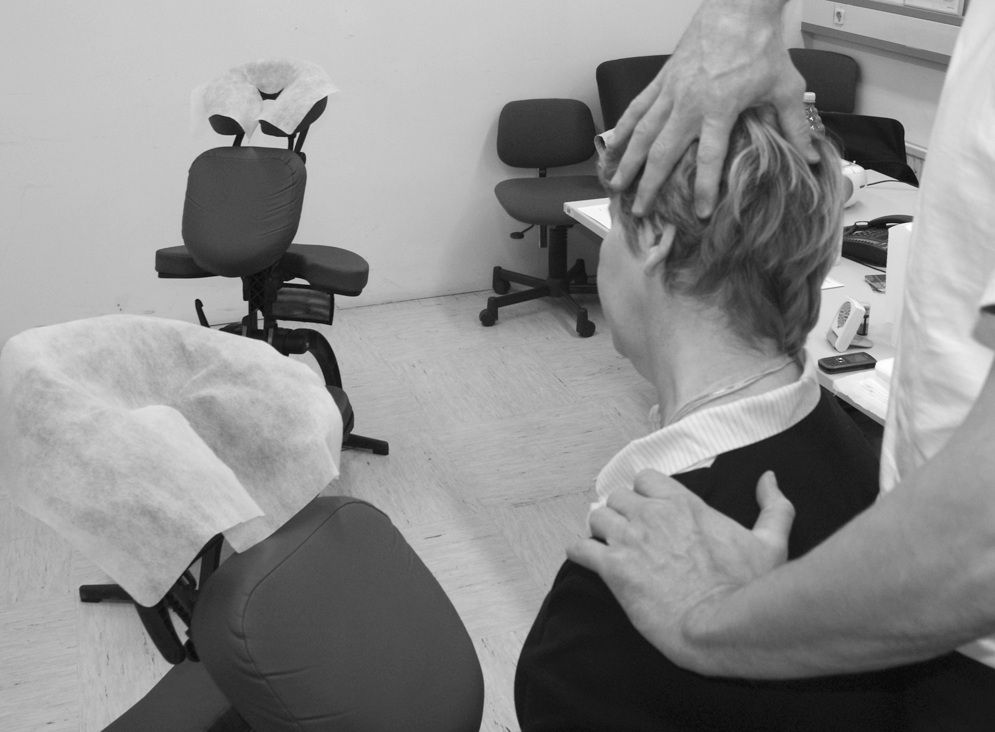
Massage therapist performing passive stretching as a part of the on-site chair massage.
Data collection
To measure maximum ROM in degrees, a goniometer was used, which is a reliable and valid tool for the measurement of trunk and cervical mobility. 20 A ROM test was performed with a goniometer to measure cervical lateral flexion, cervical flexion (Fig. 3), cervical extension, lumbar flexion, and lumbar extension. Each participant put her head in a neutral position and the goniometer was placed on the top of the head and set to zero. After the neck flexion, extension, and lateral movement, the results were read. The rotation was not measured, since participants were not in a supine position. For lumbar measurements, the participant stood upright with her legs shoulder width apart and the goniometer was placed on the region of spine to be tested (between L4/L5) and set to zero. Participants were then instructed to bend forward and backward while maintaining a straight-leg position. After lumbar flexion or extension, the results were read. One (1) measurement was performed on each site in each session. Participants were told to inform the examiner immediately when the ROM sensation became painful, and at that point the motion was stopped and the results were read.

Measuring cervical flexion with a goniometer.
In the study, participants were also asked to complete a female CMDQ sedentary worker questionnaire (The Human Factors and Ergonomics Laboratory at Cornell University, 1994). 21 Subjects completed a series of self-report questionnaires that asked for information concerning musculoskeletal discomfort for all body segments in the form of a body diagram. However, for the purpose of this study only information relating to the neck, upper back, and lower back was used. These questionnaires asked subjects to rate discomfort on the following scales: frequency of ache, pain, discomfort (1=never/2=1–2 times last week/3=3–4 times last week/4=once every day/5=several times every day); intensity of ache, pain, discomfort (1=slightly uncomfortable/2=moderately uncomfortable/3=very uncomfortable); ache, pain, discomfort interference with work (1=not at all/2=slightly interfered/3=substantially interfered). 22
Statistical analysis
All statistical analyses were performed using SPSS version 15 (SPSS Inc., Chicago, IL). Demographic and ROM data were analyzed using standard descriptive statistics (mean, standard deviation, and percentage). To estimate the differences in the degree of ROM between sessions, mean results of measurements before and after the first and the last session for cervical flexion, cervical extension, lumbar flexion, and lumbar extension were compared (for cervical lateral flexion, the mean pairwise differences between the ROMs of the left and right sides were computed). The level of significance was established as p<0.05. For the CMDQ questionnaire, variables were computed (combined Q1-Q2-Q3) for the neck, upper back, and lower back in all phases. The reliability of a CMDQ for new computed variables was relatively strong (regarding small sample size), although it was a little lower than the usually accepted value (Cronbach α was 0.679).
Wilcoxon signed rank test was used to assess statistically significant changes from the phase 2–3 for mean degree of ROMs and from the phase 1–2, 2–3, and 1–3 for new computed variables for mean CMDQ answers. Wilcoxon signed rank test showed a significant difference at p<0.05.
Results
Demographic data
Nineteen (19) female volunteers participated in the first session, and 15 of these participants completed the study. One (1) participant withdrew from the study after the first set of measurements due to personal problems; 3 others were not able to attend measurements during the last session. The mean age of the volunteers was 46 years±4.6, mean number of hours using a computer during a work day was 6.2±1.2, and the mean number of hours sitting during a work day was 8.2±2.4. The volunteers reported that they are often tensed, stressed, or under pressure. All of them have a nonspecific, frequent ache, pain, or discomfort in the neck, or upper or lower back area for a period longer than 1 month. They did not suffer from (or were diagnosed with) any specific musculoskeletal disorders. The mean number of massage sessions completed was 6.8±1.3, and during the research period they did not attend any other massage or therapeutic treatment.
Changes in mean degree of ROMs from phases 2 to 3
All degrees of ROM were higher in the last session (before and after) for all measurements, except for lumbar extension, where measurements were lower for the last session (Fig. 4).

The difference in degree of range of motion (ROM) between before and after the first and the last sessions for the neck and back. ROM (°), range of motion (degrees); CER LFL-FL-EXT, mean measurements for cervical lateral flexion (mean left and right), cervical flexion, cervical extension; LUM FL-EXT, mean measurements for lumbar flexion, lumbar extension; session, on-site chair massages.
The changes between the first measurements (before the first session) and the last measurements (after the last session) in degree of ROM were the greatest for cervical lateral flexion (the average between left and right measurements), which was 11.4o (28.8%), 7.7o (12.7%) for cervical extension, 5o (9.6%) for cervical flexion, 5.5o (8%) for lumbar flexion, and the lowest (as negative change) −5.2o (-20.2%) for lumbar extension. The greatest increases in degree of ROM appeared between the first and the last measurements for cervical lateral flexion, flexion, extension, and lumbar flexion. However, for lumbar extension, the highest increase in degree of ROM appeared between the first and the second measurements at 2.2o (8.6%).
There were significant differences between the first and the last measurements (p<0.05) pertaining to increased ROM for cervical lateral flexion (28.8%).
The difference in ROM values between phases 2 and 3 shows that the average was higher for the last massage session (before and after) than for the first massage session (before and after) in terms of cervical lateral flexion (42.4o–48.3o), cervical flexion (54.6o–55.2o), cervical extension (63.2o–67.2o), and lumbar flexion (71.1o–71.9o), but not for lumbar extension (28.8o–20.2o) (Table 1).
Values are means±standard deviations.
p<0.05 by Wilcoxon signed ranks test.
ROM (°), range of motion in degrees; CER LFL-FL-EXT, mean measurements for cervical lateral flexion (mean left and right), cervical flexion, cervical extension; LUM FL-EXT, mean measurements for lumbar flexion, lumbar extension.
Wilcoxon signed rank test showed a significant increases (p<0.05) for the average ROM, for cervical lateral flexion (p=0.001), and cervical extension (p=0.008) from the phase 2–3. For the remaining measurements, significant differences were not found.
Changes in mean CMDQ answers from phases 1–2, 2–3, and 1–3
Phase 1 shows CMDQ (average Q1-Q3) values prior to the beginning of the study (neck: 2.8, upper back: 2.7 and lower back: 2.6). Phase 2 shows CMDQ (average Q1-Q3) after completed break sessions (neck: 2.7, upper back: 2.7, and lower back: 2.9). These results indicate that the break sessions were not effective in reducing average CMDQ values from phase 1 (except in the case of neck discomfort). However, the results for the phase 3 show that completed massage sessions are effective in reducing average for Q1-Q3 in all selected body parts (neck: 1.9, upper back: 2.2, and lower back: 2.2) from phases 1 and 2 (Table 2).
Values are means±standard deviations.
p<0.05 by Wilcoxon signed ranks test.
CMDQ, Cornell Musculoskeletal Discomfort Questionnaire mean for questions 1–3.
Wilcoxon signed rank test showed a significant reductions in CMDQ responses (lower duration of ache, pain or discomfort; if ache, pain or discomfort were experienced, level of discomfort and interference with ability to work were lower) at p<0.05. Reductions were shown for the neck (p=0.002) and the upper back (p=0.017) from the phase 2–3, for the neck (p=0.004), and the upper back (p=0.027) from the phase 1–3.
Discussion
In this study, it was demonstrated that seated acupressure massage sessions increased joint ROM in cervical lateral flexion, cervical flexion, and cervical extension in female office workers who had restricted ROM due to pain or stiffness. The massage sessions had little effect on lumbar flexion ROM, except for lumbar extension. After massages, participants reported lower duration of ache, pain, or discomfort and lower interference with daily work activities due to musculoskeletal pain. Regaining better ROM and decreases in perceived pain can have positive impacts on postural alignment, coordinated motion, work performance, and injury prevention.
In studies where authors assessed the efficacy of manual acupressure, acupressure was an effective method for short-term neck pain relief and reducing low-back pain. 23,24 One (1) study 25 reported that traditional Anma therapy and rest intervention were effective in reducing chronic muscle stiffness in the necks and shoulders of female volunteers. In the case of on-site chair massage and pain relief, one study 26 of health care workers demonstrated initial improvements in pain severity after on-site chair massage treatments, with the greatest benefit for individuals who had pre-existing musculoskeletal symptoms. One (1) study 27 also showed that immediately after the chair massage, many participants reported renewed muscular flexibility and decreased pain. In another study, 28 a 15-minute workplace-based chair massage treatments for hospital staff significantly lowered pain intensity and tension levels.
Stretching has been shown to improve joint ROM, and to help facilitate relaxation, injury prevention, and performance improvement. 12 In one study, 29 mobility improved similarly in those who received manual therapy followed by stretching exercises as well as in those participants who performed stretching followed by manual therapy. Both strategies proved to be effective short-term treatments for reducing both spontaneous and strain-evoked pain in patients with chronic neck discomfort. Different studies have demonstrated the beneficial effect of stretching in preventing work-related musculoskeletal disorders, since the physiologic effects of stretching may contribute to reducing discomfort and pain. 30
Immobility may lead to shortened muscles, 12 and various theories have been proposed to explain increases in muscle extensibility after stretching. 31 Most of these theories advocate a mechanical increase in the length of the stretched muscle due to its viscoelastic properties. 31 However, this increase in length is transient, with its magnitude and duration being dependent upon the duration and type of stretching applied, and most of these studies suggested that the effects observed could be explained due to modified sensation. 31 In a separate study, 32 where the effects of a stretching program on muscle extensibility and stretching tolerance in patients with chronic musculoskeletal pain were investigated, results showed that stretching did not increase muscle extensibility, but it did improve stretching tolerance (less perceived pain when a particular stretch is applied to the muscle).
Despite widespread and increasing use of massage for pain reduction and improvement of flexibility, longer treatment periods with greater number of subjects are needed to assess the long-term effects of such interventions.
Conclusions
On-site chair massage sessions were effective interventions to lower the duration of ache, pain, or discomfort. If ache, pain, or discomfort were experienced, the level of musculoskeletal discomfort and interference with daily work activities were lower than those experienced by workers who took regular breaks instead of massage sessions. One (1) massage session is also more effective in increasing the degree in ROM as compared to no massage sessions, but is less effective than twice per week massage sessions for 1 month, which proved to be the most effective course of intervention.
Footnotes
Acknowledgments
The authors thank the massage therapist Mitja Kovačič for performing chair massage sessions. We are also thankful to all the participants in the study, for their willingness and cooperation.
Disclosure Statement
No competing financial interests exist.