




Abstract
We present a case of a critically ill infant with severe multidrug-resistant Pseudomonas aeruginosa pneumonia and bacteremia who was treated with garlic and antibiotics after in vitro demonstration of a change in the resistance pattern via the disc diffusion method on garlic-treated Mueller Hinton agar. To our knowledge, this is the first report of therapeutic garlic use in a critically ill infant in the literature.
Introduction
Case Report
The patient was a 1-month-old boy with d-transposition of the great arteries who had an arterial-switch operation. He had a complicated postoperative course due to low cardiac output syndrome, arrhythmias, and Klebsiella pneumoniae pneumonia followed by Stenotrophomonas maltophilia sepsis and pneumonia. While the patient was being treated with intravenous (IV) trimethoprim-sulfamethoxazole, his bronchoalveolar lavage fluid showed growth of multidrug-resistant Pseudomonas aeruginosa (MDR PA). The pathogen was also identified in the subsequent blood cultures. The synergy tests did not suggest any effective antibiotic regimen. Combinations of ceftazidime, cefepime, amikacin, piperacillin-tazobactam, and trimethoprim-sulfamethoxazole were used for almost 3 weeks with no success. The patient had developed bilateral diffuse infiltrates and air leaks that necessitated multiple chest tube insertions. He remained intubated and supported with escalating ventilatory settings. His endotracheal tube aspirate samples repeatedly grew MDR PA. Literature search identified the potential role of garlic in boosting antimicrobial effects of antibiotics. 3
The extract of garlic was prepared, and 1 mL was added to Mueller Hinton agar as described by Rasmussen et al. 2 When the extract was dry, the antibiogram was performed via the disc diffusion method using the Clinical and Laboratory Standards Institute criteria. Compared to the standard antibiogram, there was a 10-mm increase in the amikacin zone, and an 11-mm increase in the piperacillin zone on the garlic agar. This finding was interpreted as an in vitro additive and synergistic effect (Fig. 1). After explaining our findings and the experimental nature of the planned garlic treatment to the family, informed consent was obtained. Empirically, 1 g of fresh garlic puree was mixed with formula and given twice a day via a nasogastric feeding tube for 3 weeks. The patient received IV amikacin and piperacillin-tazobactam therapy for 18 and 11 days, respectively. After 7 days of administration of garlic and the above antibiotic regimen, the endotracheal tube aspirate and blood cultures were negative for Pseudomonas aeruginosa. His clinical status gradually improved, and he was discharged home 3 months postoperatively. He was doing well at follow-up visits and at 1 year of age.
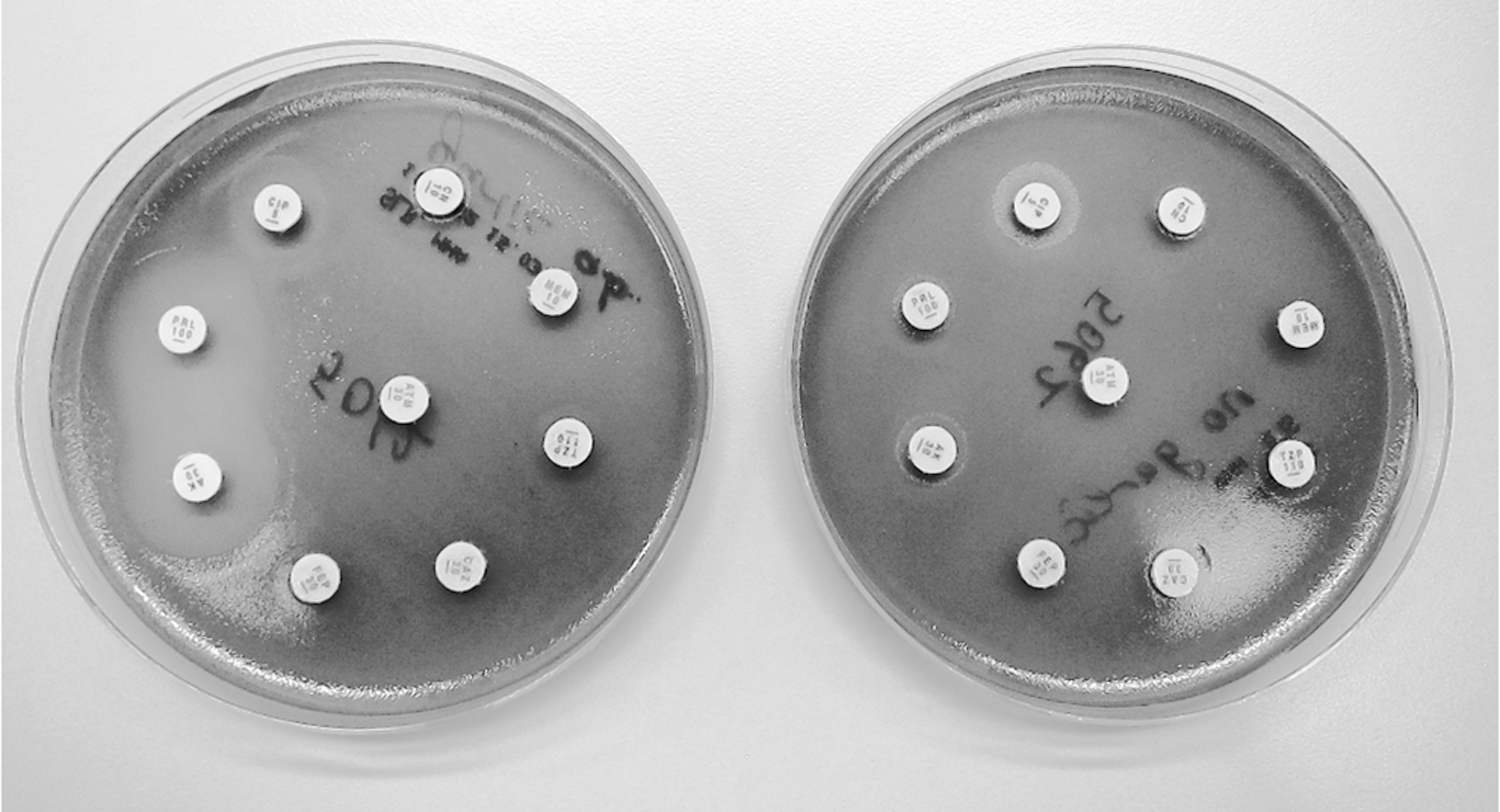
Antibiograms via disc diffusion method with garlic added agar (left) and plain Mueller Hinton agar (right). Antibiotic discs are as follows: PRL (piperacillin), AK (amikacin), FEP (cefepime), CAZ (ceftazidime), TZP (piperacillin–tazobactam), MEM (meropenem), CN (gentamicin), CIP (ciprofloxacine), and ATM (aztreonam).
Discussion
Ventilator-associated pneumonia (VAP) is the second most common hospital-acquired infection among pediatric and neonatal intensive care unit patients, and it contributes to poor outcome and the high cost of care. 4 Prior antibiotic exposure together with prolonged mechanical ventilation poses an enhanced risk for the development of VAP with resistant organisms, as seen in our case. Such infections often involve the biofilm of growth, which adds to the bacterium's tolerance to the antimicrobial treatment. QS renders the biofilm bacteria highly tolerant to otherwise lethal doses of antibiotics, and protects against the bactericidal activity of polymorphonuclear leukocytes. Garlic extract is shown to have active QS-inhibiting properties in vitro. 2 In a murine model, garlic blocks QS and promotes rapid clearing of pulmonary P. aeruginosa infections. 5
Garlic has been used since ancient times, with many claimed benefits, including antimicrobial, antiviral, and antifungal properties. The most common side-effects are gastrointestinal problems and garlic breath. 6 Two (2) case reports suggest a possible increase in the risk of bleeding with garlic use. 7,8
When conventional therapies fail, enteral garlic administration could be considered if there is a change of the antibiotic resistance pattern in vitro with garlic, with risk–benefit assessment. Although there was a resolution of the multidrug-resistant infection and improvement in the clinical status of the patient, more studies are needed to prove the efficacy of this therapy.
Footnotes
Acknowledgments
The authors would like to thank Alp T. Ozturk, who suggested garlic as an adjunct therapy.
Disclosure Statement
No competing financial interests exist.