




Abstract
Objectives:
The patient's impression of the doctor is an important factor in a clinical consultation, and the doctor's attire also plays a great role in promoting trust and confidence in the patients. Previous studies have shown that a doctor in a white coat will appear more professional, confident, and trustworthy. The objective of this study was to investigate whether the influence of a doctor's attire applies for both Western and Oriental medical doctors.
Methods:
Before a clinical consultation, 153 patients were asked to assess photographs showing an identical doctor wearing four different dress styles. The patients were divided into two groups: One group was told that the doctor in the photograph was a Western doctor, whereas the other group was told that the doctor was an Oriental medical doctor. Patients' ratings of preference for competency, trustworthiness, comfortableness, and treatment choice were then measured and compared.
Results:
Patients preferred a doctor in a white coat the most, giving highest ratings for competency and trustworthiness, while reporting to feel most comfortable with a doctor in traditional dress. No difference was found between Western and Oriental medical doctors. Patients prefer their doctors to wear white coats, regardless of whether the doctor is a Western or Oriental medical doctor, even though patients feel more comfortable with doctors wearing traditional dress.
Conclusions:
The preference about doctors' attire symbolizes the perception of patients regarding their doctor's image. Taking the historical and symbolic meaning of the doctor's white coat together, this clear preference of patients for the white coat might imply that patients require a more scientific and professional image, regardless of whether the doctors are Western or Oriental medical doctors.
Introduction
Many studies have investigated the influence of doctors' attire on patients. Even though the country and the medical field of the doctors were different, in most of the studies, patients seemed to prefer the white coat. 6 –8 In an Australian study, patients answered that doctors wearing the white coat was better “for identification purposes” or because “it looked more professional.” 9 In a British study, most doctors said that they preferred the white coat because of “easy recognition by colleagues and patients due to the continuity of dress.” 10 Also in Japan, patients claimed that the white coat determined “the image of physicians” and signaled “professionalism.” 11 Taken together, it looks like patients want their doctors to be easily recognizable and identifiable as professional medical doctors, whereby the white coat seems to be one of the most important symbols of medical doctors. 12
Looking back, the white coat was not always a symbol for medical doctors. The white coat started first in science laboratories, used by chemists and physicists. At that time, the medical profession was not well trusted by people. Most of the healing methods used by the practitioners were a hodgepodge of rather roughly tested prescriptions, hardly to be distinguished from quackeries and healing cults. 13 However, with the astounding progress of science and its validated methods, the medical field also had to change and turn to science. It was then, in the late 19th century, when surgeons and physicians started to wear the white coat, and it soon became a symbol for the successful symbiosis of science and medicine, demonstrating authority and professionalism. 14 Since then, the image of doctors in the West became associated with the white coat.
Recently, the field of alternative and complementary medicine became quite popular and widespread in the West. Many doctors are interested in healing methods that were originally used in a field called Oriental medicine, but also with several other names such as Traditional Chinese Medicine/Traditional Korean Medicine/Japanese Kampo Medicine, or East Asian Medicine. 15 In East Asia, traditionally, most patients were treated by Oriental medical doctors, before Western medical doctors started to gain respect and popularity. Even these days, many patients in East Asian countries have the choice to either see a Western or an Oriental medical doctor.
Having both choices, would there be a difference for Western medical doctors and Oriental medical doctors in the eyes of the patients? Would patients favor different attires depending on whether their doctor is a Western medical doctor or Oriental medical doctor? No studies have asked this question yet, and the purpose of this study was to investigate this by comparing the preferences of patients for different doctors' attire for Western and Oriental medical doctors.
Methods
Participants
In the present study, a total of 153 patients (male=49, female=104) were invited to participate. The patients' age ranged between 20 and 80 (average=43.3) and no limitations were set for the purpose of their enrollment in the clinic. Written consent and basic demographic data such as name, age, gender, and address were acquired from all participating patients by a questionnaire. This investigation was conducted in accordance with the guidelines of the human subjects committee of Kyung Hee University, Seoul, Republic of Korea.
Study design
When the patients came to participate in this study, identical photographs of the same medical doctor (female, age in the mid-30s) wearing four different kinds of attires—Casual, Suit, Traditional, White Coat—were shown to the participants (Fig. 1). The Traditional was a traditional Korean-style dress, similar to a dress style as it was worn a few hundred years ago, only a little bit more practical and modern. The face expression, pose, accessories and environment were kept exactly the same, as can be seen in Figure 1.

Identical doctor dressed in four different attires:
Patient groups
The participants were divided into two groups. The first group (Western Medical Doctor Group; male=29, female=48) were told that the doctor in the photograph was a Western medical doctor, whereas the second group (Oriental Medical Doctor Group; male=20, female=56) were told that the doctor in the photograph was an Oriental medical doctor. Then the participants had to watch the photographs via the same 17-inch PC monitor. They watched the photographs with the four different attires. To each photograph, they had to answer four different questions: (1) Who looks most competent? (2) Who looks most trustworthy? (3) Who will make you feel most comfortable? and (4) Who would you like to choose to get your treatment?
Questionnaire evaluation and statistical analysis
After obtaining all answers to the questions from all participants, the questionnaires were evaluated. The rank of preference was determined for each question, and compared using the Friedman analysis method. The preference for both a Western medical doctor and an Oriental medical doctor was compared for each question using the Mann–Whitney U analysis. For statistical analysis, SPSS 13.0 was used and the statistical significance level was set for p<0.05.
Results
Patient demographic data
The sample population comprised 153 adult outpatients, 49 male and 104 female, with the mean age of 43.3 years. The “Western medical doctor” group consisted of 77 patients, 30 male (38%) and 48 female (62%), with the mean age of 42.6 years. The “Oriental medical doctor” group consisted of 76 patients, 20 male (26%) and 56 female (74%), with the mean age of 44.9 years.
Patients' rank of preferences
Figure 2 shows the order of preferences of the patients for the four different doctors' attires such as Casual, Suit, Traditional, White Coat. The rank of preferences are presented in each graph, for the four different questions asked; (A) who looks most competent, (B) who looks most trustworthy, (C) who will make you feel most comfortable, (D) who would you like to choose to get your treatment? In general, the patients preferred the white coat the most, regardless of Western medical doctor or Oriental medical doctor. For the questions regarding competence (Fig. 2A) and trustworthiness (Fig. 2B), the order of preferences of the patients was white coat–traditional–suit–casual. For the question of how comfortable they feel (Fig. 2C), the order of preferences of the patients was traditional–white coat–suit–casual, giving the highest rank to the traditional dress. To the question, who they will choose for their treatment (Fig. 2D), again, patients preferred the white coat the most. Interestingly, when the traditional dress was worn by both Western and Oriental medical doctors, patients had a higher preference for getting treated by an Oriental medical doctor. Otherwise, the white coat was preferred in most of the conditions. Table 1 shows the mean rankings for the doctors' attires and for the four different questions in numbers. The patients in both groups were able to range their order of preferences from 1 to 4, and the mean as well as the standard error of the mean were calculated.
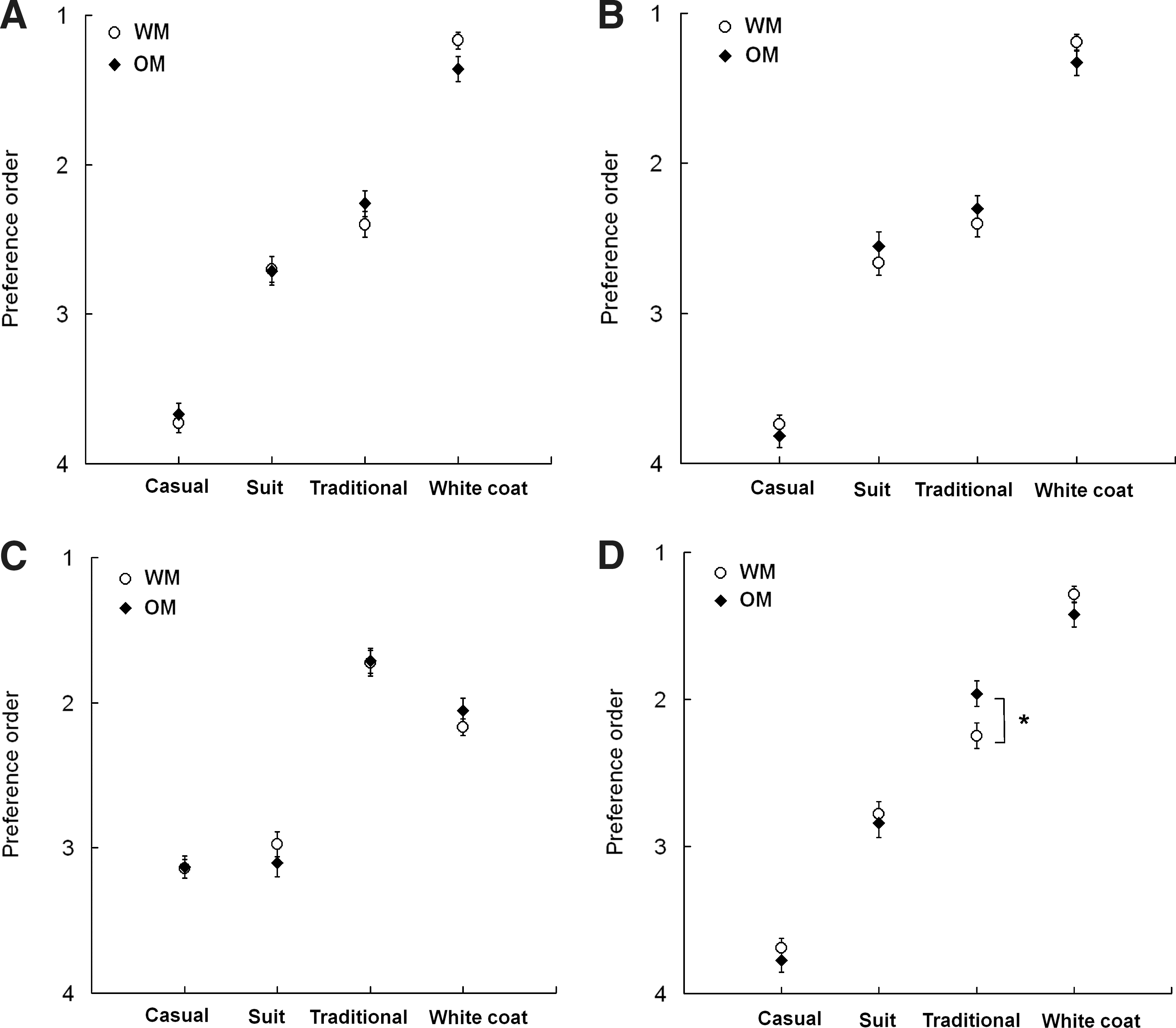
Patients' order of preference to each question depending on four different doctors' attire:
Data are mean (standard error) of preferences as ranked from 1 to 4.
WM, Western medical doctor; OM, Oriental medicine doctor.
Discussion
In the present study, patients preferred a doctor to wear a white coat, regardless of whether they thought the doctor was a Western or Oriental medical doctor. They answered that the doctor looked more competent (Fig. 2A) and trustworthy (Fig. 2B) in the white coat, and that they would also choose a doctor in a white coat for their treatment (Fig. 2D). These results are consistent with previous studies investigating Western medical doctors' attire. 6 –11
For Oriental medical doctors, the common attire for treating patients was a traditional dress, since Oriental medical doctors have been practicing healing for more than 2000 years in East Asia. 16 For a long time, the attire of the Oriental medical doctors also played an important part in the rituals of healing. 4 Therefore, the preference of patients for the white coat, also for Oriental medical doctors, is a somewhat surprising result.
This result could be interpreted in various ways. Since the last century, science and technology showed incredible development, which has also greatly affected the field of medicine by the invention of new diagnosis tools and more effective treatment methods. 14 Western medicine improved greatly in symbiosis with modern science, and medical doctors gained respect and a new authority in curing the sick. 12 The white coat, in this context, became a new potent symbol of the authority of science and the art of healing. 17 Considering this, it is possible that, similarly to the circumstances when the white coat was first introduced to Western medicine, patients now expect the field of Oriental medicine to become more modern and science based. At least, the present results indicate that patients expect the same degree of “professionalism” and “authentication” signaled by their attire from Oriental medical doctors as from Western medical doctors.
When comparing a Western medical doctor and an Oriental medical doctor in the same traditional dress, the preference of patients for the Oriental medical doctor was higher than for the Western medical doctor. The difference was statistically significant (Fig. 2D). This suggests that competence and trustworthiness reflected in the doctor's attire influences the patient's choice for treatment, but still, patients feel more comfortable with a traditional dress, when they are seeing an Oriental medical doctor. These results are consistent with previous studies, reporting that patients feel more comfortable with other attire than the white coat. 18
In sum, it might be possible that the expectation of patients regarding their traditional healers has also changed in the East. Even for seeing Oriental medical doctors, they prefer the white coat significantly more than traditional dress. Considering the symbolic meaning of the white coat, this preference might represent patients' needs and expectations. Currently, when patients in the East visit an Oriental medical doctor, they want scientifically proven and validated methods rather than completely traditional methods.
Still, there are certain limitations to this study. First, the present study was conducted in Korea (Asia). If the study had been done somewhere else (European or North-American countries), the results could be different, because the social perception of the patients differs from society to society. Second, the sample size was not very large. Although it shows a significant tendency, a bigger sample size could reveal more. Third, it is known that patients with different complaints also expect a different treatment method. In this study, all kinds of patients were recruited without any limitations set on their diseases. So, subsequent studies might be necessary.
Conclusions
In recent years, methods from Oriental medicine have become more popular than before. Treatment methods from Oriental medicine, such as acupuncture, are also being increasingly used by Western medical doctors. On the other hand, the field of Oriental medicine also is changing, starting to adapt methods from the fields of neuroscience, physiology, and psychology, to investigate the efficacy and mechanisms of traditional treatment methods, such as acupuncture. Oriental medicine doctors also want a symbiosis with science, by utilizing/adapting modern scientific methods. In the present study, the expectation for doctors' attire was the same for Western as well as Oriental medical doctors; the white coat was most preferred. This might imply that patients now require the same image for their treating doctor, even for Oriental medical doctors. It should be less “traditional” but more “scientific” and “professional,” just as the white coat symbolizes.
What kind of implications could that have for treating physicians? Establishing a good patient–doctor relationship is important for the treatment of patients, and the doctor's attire plays a significant role in it. Caring about what to wear is directly related to what kind of doctor's image is presented to the patients. However, wearing a white coat, compared to other kinds of attire, would be recommended to appear more competent and trustworthy.
Footnotes
Acknowledgments
This research was supported by Basic Science Research Program through the National Research Foundation of Korea (NRF) funded by the Ministry of Education, Science and Technology (no. 2005-0049404).
Disclosure Statement
No competing financial interests or exist.