




Abstract
Objectives:
A number of studies suggest that postprandial hyperglycemia produces oxidative stress, leading to complications associated with diabetes. However, hyperglycemia-induced oxidative stress may affect groups of people other than diabetics, such as smokers and athletes with specific diet plans. Based on previous reports that seated breathing meditation reduces hyperglycemia, the present study was designed to determine the effects of diaphragmatic breathing on postprandial plasma glycemia, insulin, oxidative stress, and antioxidant levels in athletes with normal glucose metabolism.
Design:
Data collected before and after consumption of a 900-calorie breakfast composed of 80% carbohydrates, 10% proteins, and 10% lipids were analyzed. Ten (10) minutes after the meal, 8 subjects spent 40 minutes performing diaphragmatic breathing in a quiet place. The other 8 subjects, representing the control group, spent the same time sitting in an equivalent quiet place reading a magazine.
Subjects:
Data from 16 amateur male cyclists age 30.12±4.9 years (±SD) were analyzed. Their mean height and weight were 177.81±5.3 cm and 71.40±5.2 kg, respectively. All subjects underwent a physical examination and were determined to be in good health.
Outcome measures:
Blood samples were collected immediately before the meal as well as 1 hour and 2 hours after the meal, and plasma levels of glucose, insulin, reactive oxygen metabolites, and biologic antioxidant potential were determined. Heart rate was also recorded.
Results:
Results show that in normal subjects, acute hyperglycemia induces free-radical production while reducing the antioxidant levels (p<0.05). Diaphragmatic breathing reduces heart rates (p<0.01), increases insulin (p<0.05), reduces glycemia (p<0.01), and reduces free-radical production as indicated by the higher antioxidants levels (p<0.05).
Conclusions:
Diaphragmatic breathing, likely through the activation of the parasympathetic nervous system, increases insulin, reduces glycemia, and reduces reactive oxygen species production.
Introduction
Because a single short-term exposure to high levels of glucose is sufficient to cause oxidative damage, 11,12 hyperglycemia-induced oxidative stress may affect groups of people other than people with diabetes, such as smokers, who commonly experience altered postprandial glucose metabolism. 13 Moreover, in Western societies, the postprandial state comprises a considerable part of the day and the high obesity rate is suggestive of poor eating habits associated with an excessive caloric intake. Additionally, athletes with specific diet plans frequently incur elevated postprandial plasma glucose levels. Thus, achieving a thorough understanding of postprandial physiology is important.
The authors commonly work with endurance athletes, particularly cyclists. Because they expend a large amount of energy, these athletes consume high-calorie meals with approximately 70%–85% of the calories coming from carbohydrates that have a high glycemic index. 14 –16 This eating pattern is followed frequently during the training season and especially prior to a race. Although this regimen is being revised by nutritionists and trainers, the pre-race meal generally contains 3500–4000 kcal, 70% of which come from carbohydrates. The pre-race breakfast consists of 800–1000 kcal with approximately 80% carbohydrates. In subjects with normal glucose metabolism, postprandial plasma glucose levels do not reach the high levels measured in those with diabetes. Nevertheless, postprandial glucose peak is associated with a decrease in antioxidants and a concomitant increase in markers of oxidative stress also in subjects with normal glucose metabolism. 1,8 Therefore, the athletes represent a proper model to study the relation between postprandial plasma glycemia and oxidative stress.
Interestingly, a recent study of Chaiopanont 17 demonstrated that seated breathing meditation exerts a hypoglycemic effect on patients with type 2 diabetes. Because hyperglycemia is directly linked to oxidative stress, meditation could reduce oxidative stress and its damaging effects.
The authors recently demonstrated that relaxation induced by diaphragmatic breathing (DB) increases antioxidant defenses and decreases oxidative stress in athletes after exhaustive exercise. 18 However, this earlier study revealed the involvement of pathways not directly related to glucose metabolism. On the basis of previous reports that seated breathing meditation reduces hyperglycemia, 17 the authors designed the present study to determine the effects of diaphragmatic breathing on postprandial plasma glycemia, insulin, oxidative stress, and antioxidant levels in athletes with normal glucose metabolism.
Materials and Methods
Subjects
A retrospective analysis of data collected as part of a monitoring program was performed during the training season of a local team. Because the outcome of a race depends on the amount of available energy, these athletes frequently monitor several parameters of their plasma levels in relation to meals and exercise in order to determine their metabolic needs during a race. Moreover, because about 40 athletes supplemented their workouts with DB, to determine the effects of DB on postprandial glucose metabolism and oxidative stress, data were randomly selected of 16 subjects over a sample of about 200 cyclists. The procedures followed were in accordance with the ethical standards of the responsible committee on human experimentation and with the Helsinki Declaration of 1975, as revised in 1983.
Data from 16 amateur male cyclists age 30.12±4.9 years (±SD) were analyzed. Their mean height and weight were 177.81±5.3 cm and 71.40±5.2 kg, respectively. All subjects underwent a physical examination and were determined to be in good health. None of the subjects had taken medications or supplements within the past 10 days that might alter the study outcome. Furthermore, no subjects had a history of medical or surgical events that could affect the study outcome, including cardiovascular disease or metabolic, renal, hepatic, or musculoskeletal disorders.
Experimental procedure
The effects of DB on postprandial oxidative stress were determined by analyzing data collected before and after consumption of a 900-calorie breakfast composed of 80% carbohydrates, 10% proteins, and 10% lipids. Ten (10) minutes after the meal, 8 athletes spent 40 minutes performing DB in a quiet place. A few days before data collection, subjects of the studied group were trained to relax by performing DB and concentrating on their breath. All the subjects followed the same procedure. The other 8 subjects, representing the control group, spent the same time sitting in an equivalent quiet place reading a magazine. Subjects of the control group were selected among those not performing DB.
Blood samples were collected immediately before the meal as well as 1 hour and 2 hours after the meal, and plasma levels of glucose, insulin, reactive oxygen metabolites (ROMs), and biologic antioxidant potential (BAP) were determined. Heart rate was also continuously monitored for 2 hours following the meal.
Determination of ROMs
Oxidative stress was measured by performing the dROMs test, which determines the level of ROMs. 19 ROMs are produced by interaction of ROS with organic substrates such as carbohydrates, lipids, amino acids, proteins, and nucleotides. 20 Of the known ROMs, hydrogen peroxides are considered markers and amplifiers of oxidative stress. 21 The dROMs test is based on the concept that plasma hydrogen peroxides react with the transition metal ions liberated from proteins in the acidic medium and are converted to alkoxy- and peroxy- radicals. These newly formed radicals are able to oxidize N,N-diethyl-para-phenylenediamine to the corresponding radical cation, and the concentration of this cation can be determined by spectrophotometry (absorption at 505-nm wavelength). The dROMs test is expressed in U CARR (Carratelli units) where 1 U CARR=0.08 mg H2O2/dL. Values higher than 300 U CARR are indicative of ongoing oxidative stress.
Determination of biologic antioxidant potential
Antioxidant defense status was assessed by performing the BAP test, which measures plasma levels of antioxidants. The BAP test is based on the ability of a colored solution, containing a source of ferric (Fe3+) ions bound to a special chromogenic substrate, to decolorize when the Fe3+ ions are reduced to ferrous ions (Fe2+). This reduction occurs only when the solution is added to a reducing/antioxidant system. First, 50 μL of ferric chloride reagent is transferred into the cuvette containing the thiocyanate derivative reagent. The resulting colored solution is gently mixed by inversion and then subjected to a 550-nm photometric reading. Then, 10 μL of plasma are added to the same cuvette, and the solution is gently mixed and incubated in a thermostatic block for 5 minutes at 37°C. After incubation, the sample is tested for absorbance at 550 nm. BAP test results are expressed in μmol Fe2+/L of sample. Samples with values greater than 2200 μmol Fe2+/L are considered to have normal BAP.
The dROMS and BAP tests were performed using apposite kits and the appropriate FRAS4 instrumentation (Free Radical Analytical System 4, Health & Diagnostics Limited Co., Parma, Italy).
Determination of plasma glucose and insulin
Plasma glucose concentrations were determined by an enzymatic kit. Insulin levels were determined by chemiluminescence. Both the tests were performed by a local laboratory analysis.
Measurement of heart rate
Heart rate (HR) was monitored to identify any DB-induced activation of the parasympathetic nervous system (PNS), which also controls insulin secretion and tissue sensitivity to insulin. The HR was measured for 20 seconds prior to and 1 hour and 2 hours after the meal using a Polar cardio-frequency meter (Polar Electro Italia S.p.A.). The means were used for comparison between groups.
Statistical analysis
Distribution of variables was assessed by the Kolmogorov-Smirnov test. Results were normally distributed. The combined effect of the two factors (time and DB) on glucose, insulin, ROMs, BAP, and HR was analyzed by repeated-measure two-way analysis of variance (ANOVA) followed by the Student-Newman-Keuls test (post-hoc comparisons). A p-value <0.05 indicated statistical significance. Statistics were compiled using Statistica 7 (StatSoft, Inc., USA) software.
Results
Glucose and insulin variation
Figures 1 and 2 show the levels of insulin and glucose from each group at baseline and both times following the meal, respectively. ANOVA revealed a significant effect of time on plasma glucose [F(1,46)=732.66; p<0.01] and insulin [F(1,46)=132.99; p<0.01] levels.

Effects of diaphragmatic breathing (DB) on plasma glucose levels after a meal rich in carbohydrates. n=8. **p<0.01 (Student-Newman-Keuls test, DB versus control group).
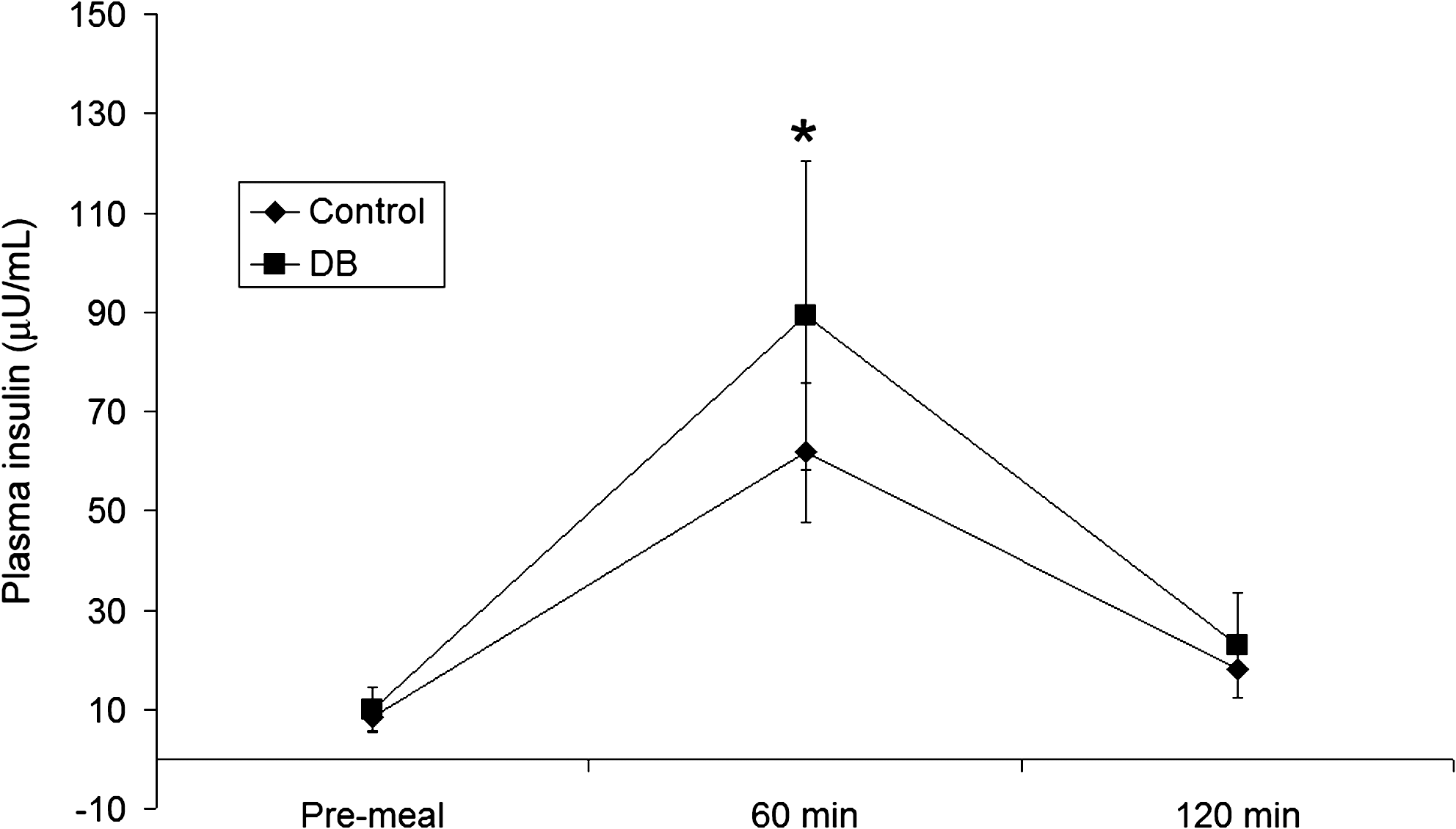
Effects of diaphragmatic breathing (DB) on plasma insulin levels after a meal rich in carbohydrates. n=8. *p<0.05 (Student-Newman-Keuls test, DB versus control group).
More importantly, ANOVA [F(1,46)=6.21; p<0.05] and post-hoc comparisons (p<0.01, DB versus control group) revealed that DB significantly reduced plasma glucose level 60 minutes after the meal. The interaction between time and DB was significant [F(1,46)=4.40; p<0.05]. Two (2) hours after the meal, differences in glucose levels between the groups were not statistically significant.
The decrease in plasma glucose corresponds with the DB-induced insulin increase as shown in Figure 2.
ANOVA revealed a significant effect of DB [F(1,46)=6.64; p<0.05] on insulin levels. Post-hoc comparisons confirmed that, 60 minutes after the meal, insulin plasma levels were higher in the DB group as compared with the control group athletes (p<0.05, DB versus control group). The interaction between time and DB was significant [F(1,46)=5.29; p<0.05]. Two (2) hours after the meal, differences in insulin levels across groups were not statistically significant.
Changes in ROMs
Figure 3 shows ROMs levels before and after the meal in both the groups.
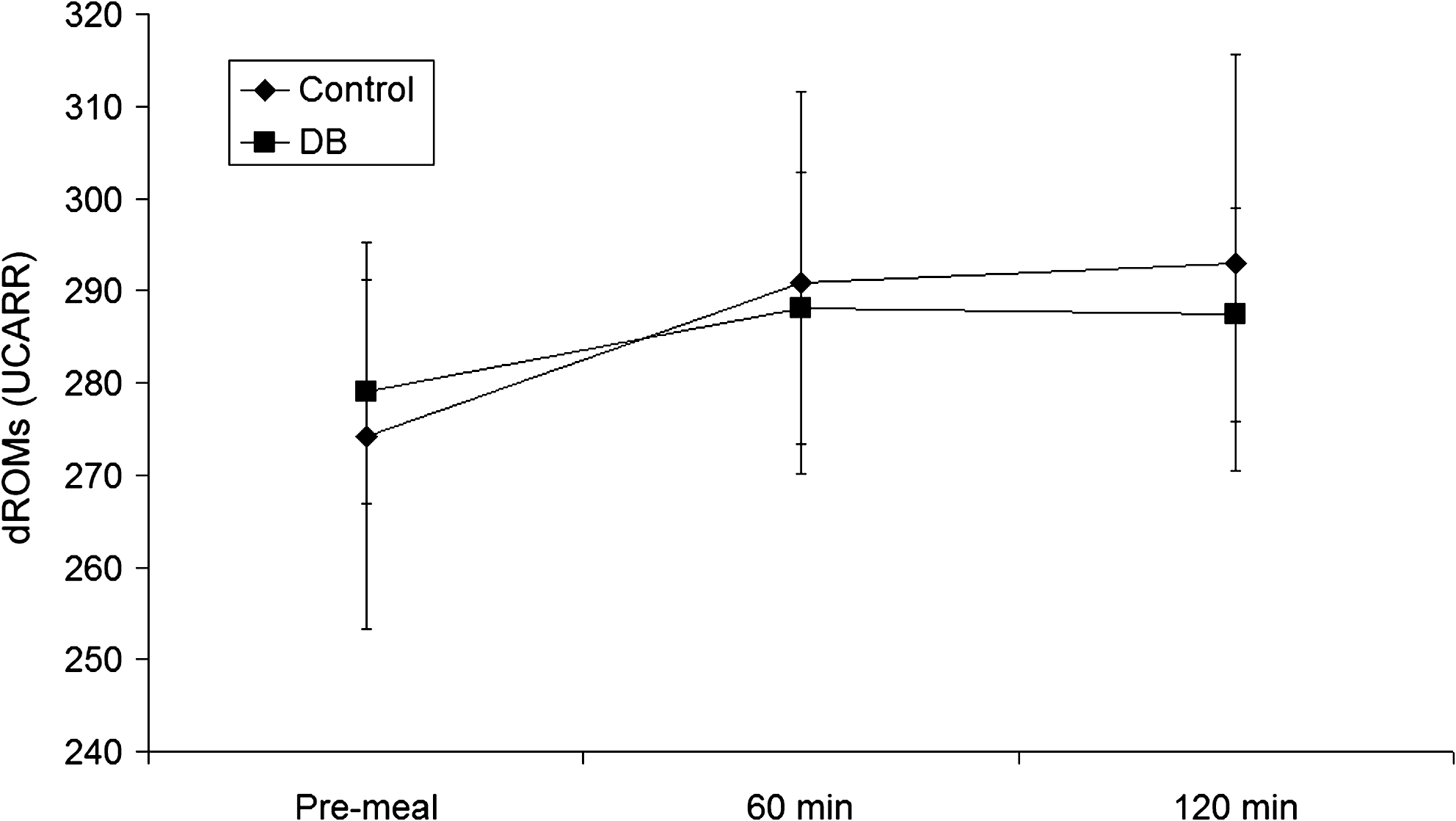
Effects of diaphragmatic breathing (DB) on test that determines the level of reactive oxygen metabolites (dROMs) after a meal rich in carbohydrates. 1 U CARR=0.08 mg H2O2/dL.
The overall ANOVA revealed a significant effect of time on ROM levels [F(1,46)=178.88; p<0.01]. Post-hoc comparison evidenced that time effect was significant in both of the groups (p<0.01). The effects of DB on ROM levels were not statistically significant [F(1,46)=0.018; p>0.05].
Biologic antioxidant potential
BAP levels revealed the effects of postprandial hyperglycemia on oxidative stress. Results are shown in Figure 4. ANOVA revealed a significant effect of time on BAP levels [F(1,46)=15.97; p<0.01]. Post-hoc comparisons evidenced that the BAP decreased significantly only in the control group after the meal (p<0.01). This result confirms that there is have a useful model to determine the effect of hyperglycemia on oxidative stress.

Effects of diaphragmatic breathing (DB) on biologic antioxidant potential (BAP) levels after a meal rich in carbohydrates. n=8. **p<0.01 (Student-Newman-Keuls test, DB versus control group).
Moreover, ANOVA revealed a significant effect of DB on BAP levels [F(1,46)=4.71; p<0.05]. Post-hoc comparisons confirmed that 120 minutes after the meal, the mean level of BAP in athletes who performed DB was significantly higher than that of the control group athletes (p<0.05, DB versus control group). The interaction between time and DB was not significant [F(1,46)=3.25; p>0.05].
Heart rate
Two-way ANOVA analysis was performed and revealed a significant time [F(1,46)=177.96; p<0.01] and DB effect [F(1,46)=6.84; p<0.05]. Post-hoc comparisons confirmed that 60 minutes after the meal, the mean HR in athletes who performed DB was significantly lower than that of the control group athletes (p<0.05, DB versus control group).
Figure 5 shows the mean values of HR for both groups. The interaction between time and DB was significant [F(1,46)=11.82; p>0.01].
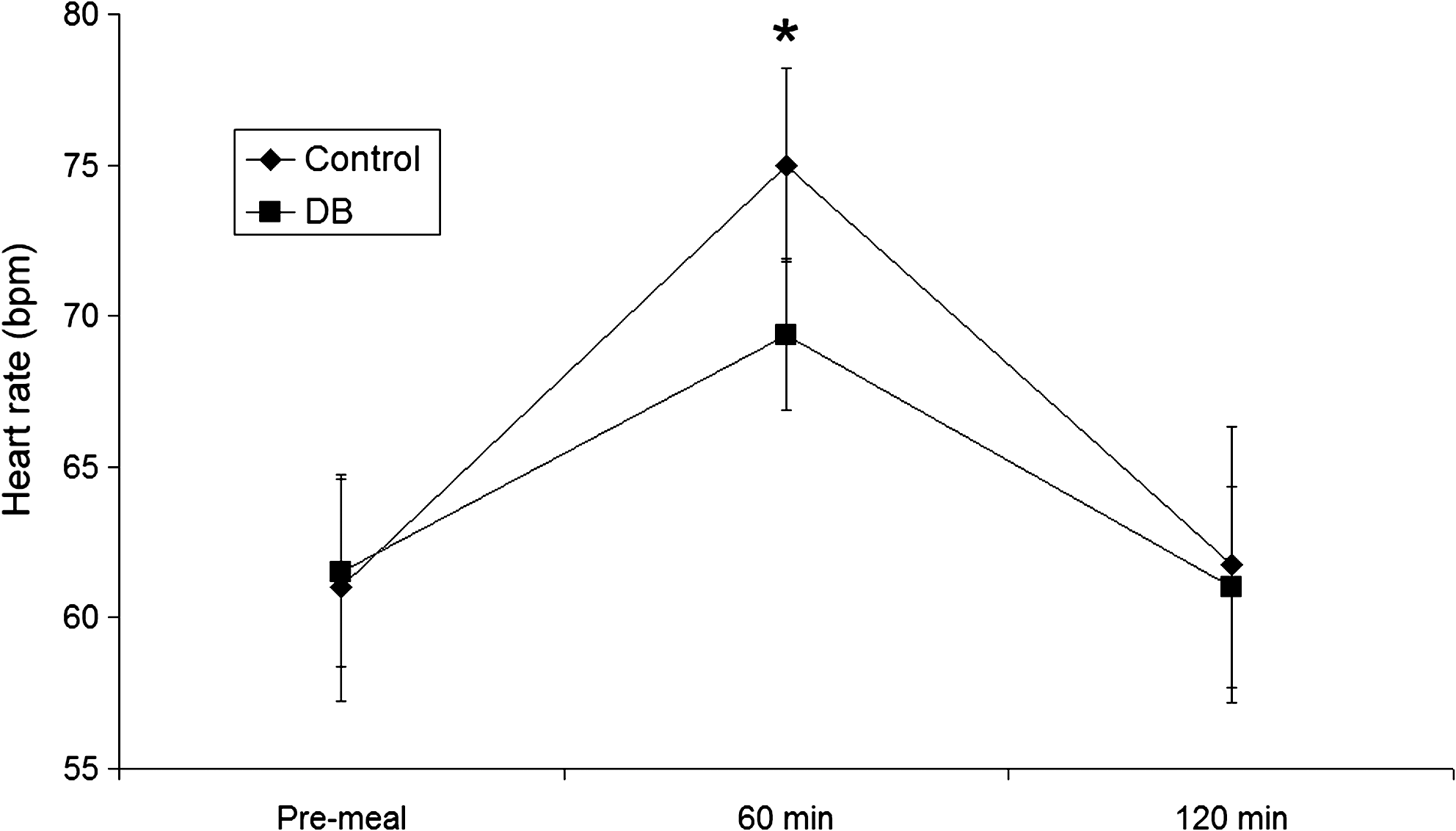
Heart rate levels after a meal rich in carbohydrates. DB, diaphragmatic breathing. n=8. *p<0.05 (Student-Newman-Keuls test, DB versus control group). bpm, beats per minute.
Discussion
This study demonstrates a significant effect of DB on postprandial plasma levels of antioxidants. This effect is achieved through the modulation of insulin and resultant glucose metabolism. The effects of DB on ROM levels were not statistically significant. This result was expected because the postprandial increase in ROMs induced by a meal is likely to be hindered by the antioxidant defense system. In this context, the effect of hyperglycemia on oxidative stress must be determined indirectly by analyzing the levels of plasma antioxidants. Actually, in individuals with normal BAP levels, the excess levels of ROS are promptly neutralized by the antioxidant barrier before production of ROMs. This scenario is particularly true in athletes, whose metabolisms are adapted to compensate for the ROS induced by exercise. 22 On the contrary, when the ROS production reaches high levels, as in diabetics, BAP could be inadequate to neutralize them, and the increase in ROM levels is thus a marker of oxidative stress. Because of these protective mechanisms, as in many other studies, 1 –6 indirect evidences were obtained to support the hypothesis that acute hyperglycemia induces the production of free radicals. Indeed, BAP levels significantly decrease after a meal rich in carbohydrates in the control group in this study.
We detected higher antioxidants levels in subjects who performed DB. Whereas in other circumstances DB can modulate the antioxidants levels with more complex mechanisms, 18 in this case, the increase in levels of antioxidants can be directly related to the reduction of free radicals production. In fact, if DB decreased ROS levels, antioxidants levels were higher in the DB group than in the control group because antioxidants were not consumed in oxidants neutralization.
Hyperglycemia is associated with oxidative stress and an impaired antioxidant barrier. 1 –8 This mechanism seems to be responsible in important disorders that affect people with diabetes, such as cardiovascular diseases and atherosclerosis. However, as reported previously by other researchers, 1,8 the present study shows that acute hyperglycemia is associated with postprandial free radicals production in subjects with a normal glucose metabolism. Particularly for endurance and resistance athletes, oxidative stress occurs frequently and can last for long periods. 23 –27 Beyond the long-term effects, in athletes the oxidative stress may affect sporting performance and may cause fatigue, muscle damage, and reduced immune function. 28,29 Together with intense exercise, a diet rich in carbohydrates can contribute significantly to the increase of oxidative stress. Since this study recently demonstrated that DB reduces exercise-induced oxidative stress, 18 DB may represent a useful technique to protect athletes from adverse effects of free radicals.
Because the mechanisms that link hyperglycemia with oxidative stress are equivalent in normal and diabetic subjects, it is plausible that the beneficial effects of DB can be of use in persons with diabetes. Furthermore, because in people with diabetes hyperglycemia-induced oxidative stress leads to serious disorders, the positive effects of DB could be greater in these patients.
As in the Chaiopanont study, 17 the data of this study show that breathing relaxation reduces plasma glucose. Moreover, this study shows that DB exerts this effect by increasing postprandial plasma insulin. Also, studies on long-term implementation of relaxation procedures produced similar results. 30 –34 In these studies, relaxation was shown to have protective effects in individuals with diabetes mellitus by decreasing oxidative stress and improving antioxidant status through the modulation of insulin levels. Although prolonged relaxation procedures are plausible methods to control stress, and thus cortisol levels, with a positive effect on glucose metabolism, in the present study, the acute effects of a short DB procedure on insulin levels should involve faster mechanisms than mechanisms that control long-term effects of relaxation. This study's explanation of the DB effects is that the pancreas is controlled by the PNS, which, among other functions, promotes the secretion of insulin and increases tissue sensitivity to this hormone, thus promoting the storage of glucose. Because it has been demonstrated that relaxation procedures shift the autonomic nervous balance toward parasympathetic activity, 35 –39 the authors propose that postprandial DB activates the PNS and thus induces insulin secretion in the pancreas. Indeed, in support of this proposal, DB also causes a reduction in heart rate, which is a process controlled by the PNS.
DB is a fairly straightforward procedure. The only issue would be to stay focused on breath; therefore, a short training would help to improve concentration. Subjects were not familiar with DB and so were trained a few days before data collection. Based on the results obtained by other researchers with long-term relaxation procedures, 20 –23 it is plausible to expect that a longer DB training would be even more effective.
All subjects followed the same procedure. However, it is believed that similar techniques would elicit comparable results. Being concentrated on breath is a very important component of DB procedure and makes the difference with a simple rest. Actually, it is likely that subjects of the control group unconsciously conducted DB while reading. However, subjects of the studied group reported that the act of performing DB being concentrated on the breath is relaxing, a sort of meditation, while unconscious DB is just restful.
Indeed, the differences between the control and DB groups confirm this observation and demonstrate the efficacy of the procedure adopted.
Data were collected during the training season, and it is believed that this has characterized the results of this study. Probably, different effects of DB would be expected without physical activity, which itself is sufficient to alter the plasma oxidant and antioxidant levels. For example, the suspension of exercise decreases oxidant production, so antioxidant defense increases. Moreover, during exercise, antioxidants are upregulated and also mobilized from tissues to blood. 40 Conversely, exercise represents an ideal situation for leveling parameters among subjects, which might be too heterogeneous for a statistical comparison of different experimental groups.
As a widespread procedure, we determined ROS metabolites. Measuring ROS directly in vivo is difficult because they are unstable and have very short-lived intermediates. Free radicals can be detected directly in conditions that limit its use in vivo. 41
Oxidative stress represents an imbalance between the production of ROS and the BAP. Oxidants and antioxidants levels are strictly interdependent, and an excessive increase of ROS level is promptly neutralized by the antioxidant systems. Therefore, defining a situation of oxidative stress on the basis of plasma levels of oxidant and antioxidant is not easy. This is particularly true when the increment in ROS production is not particularly elevated or, as for athletes, the organism is adapted to frequent elevated ROS levels.
In this study, the authors evidenced a decrease of postprandial BAP levels only in the control group, and a partial effect of DB on oxidative stress. The increase of ROMs was probably not sufficiently elevated to reveal the effect of DB. Additional studies, also in different circumstances, will contribute to elucidate the effects of DB on postprandial oxidative stress.
Conclusions
Overall this study shows that in normal subjects, acute hyperglycemia induces ROS production while reducing the BAP levels. DB, likely through the activation of the PNS, increases insulin, reduces glycemia, and reduces ROS production. In addition to athletes, who can experience postprandial oxidative stress due to exercise, DB is a procedure that may interest people with diabetes or obesity as well as smokers because these groups of people typically have impaired postprandial glucose metabolisms.
Footnotes
Acknowledgments
This study was supported by the School of Pharmacy, Unit of Experimental Medicine and Public Health, University of Camerino.
Disclosure Statement
No competing financial interests exist.