




Abstract
Background:
Gastric bezoar is a collection of indigestible material in the stomach. It is a relatively rare disease. In this case report, it is shown that Traditional Chinese Medicine (TCM) was effective in treating a patient with gastric bezoar.
Subject and setting:
A 47-year-old female patient who had undergone Billroth II gastrectomy for gastric cancer had been experiencing abdominal pain and distension for 1 month. She underwent gastroscopic examination at our outpatient department; the gastroscopy showed a bezoar (7×4×2 cm in size) in her remnant stomach. Treatment using a Chinese herbal decoction was suggested.
Results:
The gastric bezoar dissolved after 2 weeks of regular therapy with San Jie Pai Shi decoction. No complications or adverse effects were noted during the TCM treatment.
Conclusions:
This case showed that TCM was an effective and alternative treatment option for patients with gastric bezoar.
Introduction
Case Report
A 47-year-old female patient presented to the outpatient department in October 2010, with discontinuous abdominal pain and distension (for a month). The patient had no history of allergies, smoking, or alcohol consumption. She had been diagnosed with gastric cancer a year previously and had undergone Billroth II gastrectomy. During the physical examination, review of systems was significantly only for upper abdominal tenderness without rebound tenderness. Laboratory tests yielded the following findings: normal results in routine stool and urine tests and urine trypsinogen-2 test; blood hemoglobin, 127 g/L. Ancillary tests were performed, and gastroscopy showed a bezoar (7×4×2 cm) complicated with mucous edema and erosion in her remnant stomach, but no gastric ulcers were found (Fig. 1).
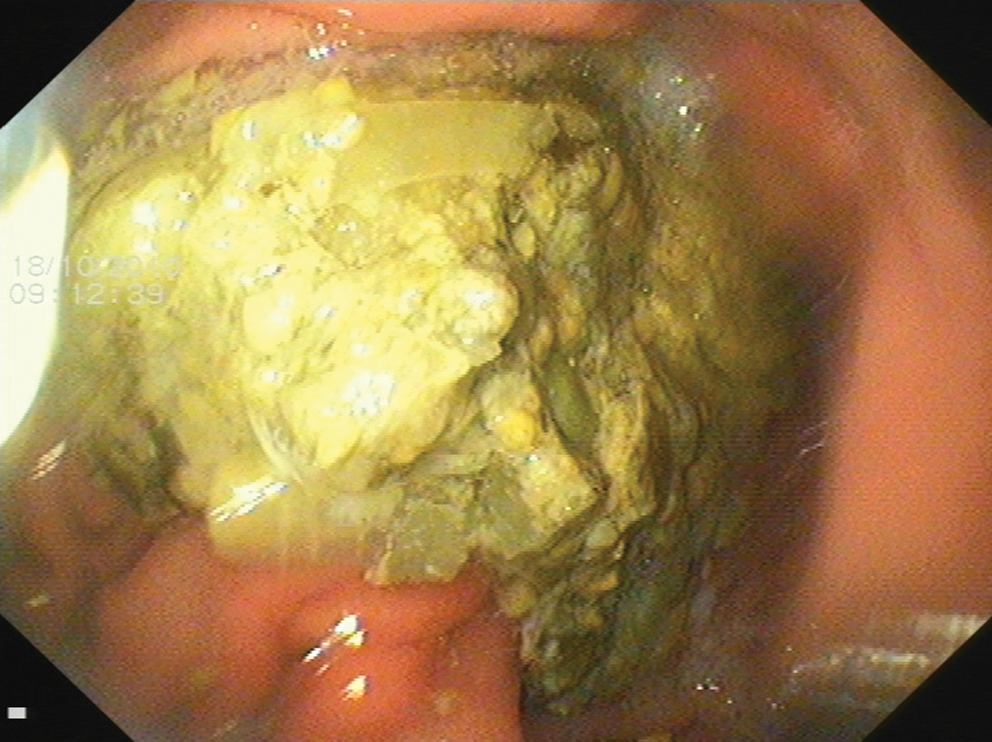
Gastric bezoar located at the anastomotic stoma of the remnant stomach.
Traditional Chinese Medicine (TCM) treatment was suggested using San Jie Pai Shi decoction, which was prescribed by Dr. Cao Rui, a TCM doctor from the traditional medicine department of the Beijing Chao-Yang Hospital. The main ingredients of this decoction are as follows: 10 g of Codonopsis pilosula, 6 g of Radix glycyrrhiza, 12 g of the rhizome of Atractylodis macrocephalae, 9 g of the cortex of Magnoliae officinalis, 12 g of immature bitter orange, 12 g of the endothelium corneum of Gigeriae galli, and 9 g of Rheum officinale. The ingredients were boiled in 200 mL water for 20 minutes (twice a day for 2 weeks). After 2 weeks, gastroscopic examination showed that the gastric bezoar had dissolved (Fig. 2).

Gastric bezoar dissolved after 2 weeks of Traditional Chinese Medicine treatment.
Discussion
Based on their composition, gastrointestinal bezoars are classified into phytobezoars (indigestible cellulose, tannins, and lignin derived from ingested vegetables and fruits), trichobezoars (hair), lactobezoars (concentrated milk formula), and a mixture of medications and food bolus. 1
A diospyrobezoar is a type of phytobezoar caused by persimmons; diospyrobezoars are created by the overingestion of unripe or astringent persimmons, which are rich in soluble tannins, especially on an empty stomach. In the presence of dilute hydrochloric acid in the stomach, the tannins undergo polymerization to form a coagulum, which includes cellulose, hemicellulose, and proteins; this coagulum forms the basis for the formation of the bezoar. Diospyrobezoar formation is commonly associated with previous gastric surgery, dental problems, poor mastication, and excessive consumption of persimmons. 3,4 Gastric operations may reduce gastric motility and delay gastric emptying. Loss of pyloric function, gastric motility, and hypoacidity play important roles in diospyrobezoar formation. Previous gastric surgery (truncal vagotomy plus pyloroplasty or subtotal gastrectomy plus gastroenterostomy) has been shown to be the contributing factor in 20%–90% of the postoperative cases of diospyrobezoars. The interval between gastric operation and bezoar detection was 9 months to 30 years. 2 –6 The current patient presented with a gastric bezoar a year after her Billroth II gastrectomy operation.
The clinical manifestations of gastrointestinal bezoars include abdominal pain, abdominal distension, nausea, vomiting, dyspepsia, acid regurgitation, and even gastrointestinal hemorrhage. 1,2,5 The diagnosis of gastrointestinal bezoars depends on the results of plain abdominal radiography, barium studies, ultrasonography, computed tomography scan, and endoscopy. 6 –9
Western medical treatments for gastrointestinal bezoars include conservative modalities (gastric lavage, endoscopic disruption, and so on), conventional surgery, and videolaparoscopic surgery. 7,8,10 –14
With regard to gastric bezoars, TCM has its own theories and treatment approaches. According to TCM, gastric bezoars are usually caused by eating persimmons and hawthorns on an empty stomach, and these bezoars occur mainly in older persons and patients with prolonged illness and weak constitutions. Furthermore, the key factor in the development of gastric bezoars is stagnation of Qi in the stomach, without any normal upward or downward functional activities. The most important pathological mechanism in the development of bezoars is stagnated Qi, followed by indigestion, Spleen deficiency, imbalance in Phlegm, and Blood stasis. Therefore, treatments should aim at reducing the adverse Qi, helping digestion, soothing the Liver, strengthening the Spleen, regulating the Stomach, resolving the imbalances in Phlegm, and improving Blood stasis.
The authors' digestive department handles over 100,000 outpatient consultations and over 10,000 cases of gastroscopy annually, and each year, about 10 patients are diagnosed with gastric bezoars. In 2010, 10 patients (4 men and 6 women), aged 47–79 years, were diagnosed with gastric bezoars by using gastroscopy; all the patients had a history of eating persimmons or hawthorns on an empty stomach, especially during autumn and winter (the seasons when mature persimmons and hawthorns are available). Nine (9) patients showed gastric ulcer complications, and they were treated with San Jie Pai Shi decoction (the longest treatment time was 3 months) and proton pump inhibitors (omeprazole magnesium enteric-coated tablets). Of the 9 patients, 8 showed relief from their symptoms in 3 months, and 1 of them underwent endoscopic disruption.
In this study, the female patient did not show digestive ulcer complications, and the authors used the San Jie Pai Shi decoction as the only treatment. The gastric bezoar dissolved after 2 weeks, and the patient's abdominal pain and distension were relieved. The patient was advised to avoid eating persimmons and hawthorns on an empty stomach.
In summary, according to TCM, gastric bezoars are usually caused by eating persimmons and hawthorns on an empty stomach, and they mainly occur in older persons and patients with prolonged illness and weak constitutions. This case study reports the case of a female patient who had a gastric bezoar and who had, in the past, undergone Billroth II gastrectomy for gastric cancer and had a history of eating persimmons on an empty stomach. The patient was successfully treated using TCM (San Jie Pai Shi decoction) for 2 weeks without any adverse effects. Therefore, this case showed that TCM is an effective and alternative option for patients with gastric bezoars.
Footnotes
Disclosure Statement
No competing financial interests exist.