




Abstract
Background:
The case of a 32-year-old Malay woman who developed postpartum stroke is reported.
Methods:
The patient received a series of urut Melayu, the traditional Malay massage, sessions at one of the newly established integrated hospitals in the country.
Results:
After 14 urut Melayu sessions, she improved tremendously in her speech and fine motor skills and regained her activities of daily living.
Conclusions:
This use of urut Melayu to complement rehabilitation care in patients poststroke is promising.
Introduction
A case is reported of a patient who had a postpartum stroke and who experienced positive outcomes following urut Melayu at one of the integrated hospitals.
The patient had signed a consent form for the publication of this case study and the use of her photographs. The final manuscript was also sent to her to confirm the accuracy of the report.
Case Report
A healthy 32-year-old primigravida with an unremarkable prenatal course was admitted to a private hospital following contraction pain. Due to fetal distress, she underwent an emergency lower segment cesarean section. After delivery, she developed a postpartum hemorrhage attributed to uterine atony resulting in an emergency subtotal hysterectomy. She was ventilated and managed by the Obstetrics & Gynaecology and Anaesthetics Team. Her subsequent recovery was complicated by hypoxia ischemic encephalopathy, resulting in a dense stroke to the right side of her body (Fig. 1).
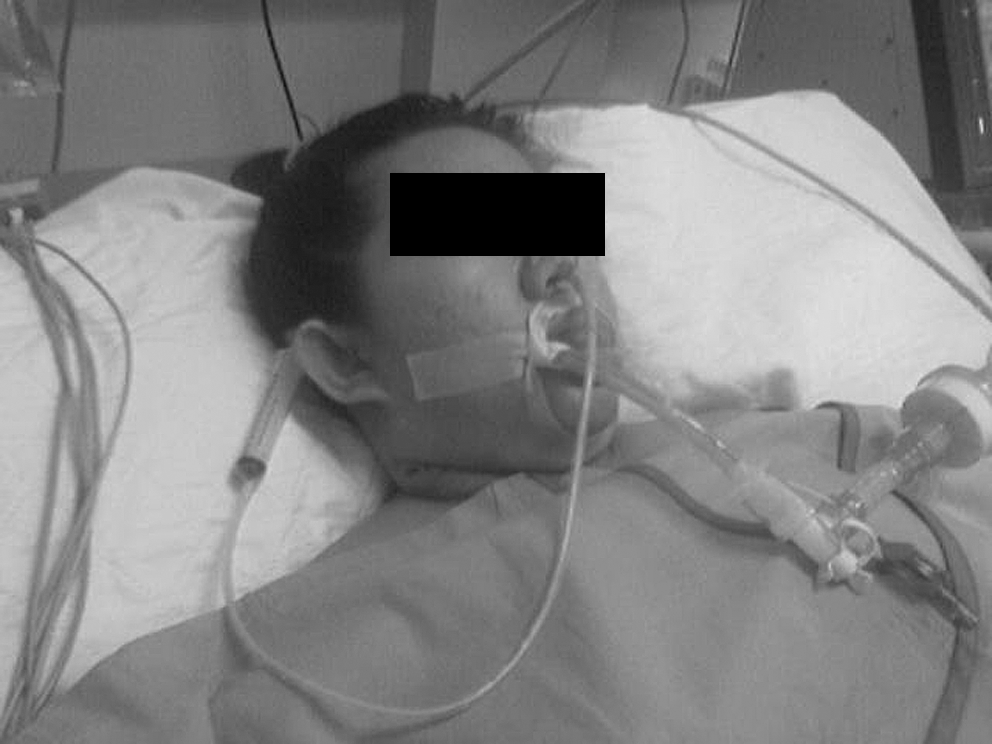
Patient unconscious in the intensive care unit (June 27, 2008).
She had regular physiotherapy and speech therapy. On postpartum day 48, she was well enough for discharge with a tracheotomy in situ, although she still had significant slurring of speech, needing help with her Activities of Daily Living (ADL) and only able to mobilize with a wheelchair. Treatment at the Traditional and Complementary Medicine (T&CM) Unit of one of the integrated hospitals was then suggested to her.
At the T&CM unit, she was screened for suitability to undergo T&CM modalities and was offered either urut Melayu or acupuncture. The patient and her husband chose urut Melayu and the first session of cycle 1 was started on the same day. At this point, the patient was not receiving any medical drug or treatment. Her complete case progression is presented in Table 1.
T&CM, Traditional and Complementary Medicine; ADL, activities of daily living.
On November 10, 2008, 3 months after her first session, the patient received her final urut Melayu session. She came with her husband and daughter and walked aided by her walking frame from the parking lot to the T&CM unit (about 50 m). She could sit on her own, holding her daughter. She could stand unsupported for 1 or 2 minutes. Her speech had remarkably improved and was almost normal apart from some slight stuttering. She was able to lie on the urut Melayu couch with minimal aid and could sit up from a lying position by herself. She excitedly reported that she could do all her five ADL unaided. Her sleep and appetite had remarkably improved, which showed in her weight gain and positive mood. Her handwriting was also more legible although, albeit done slowly. Her positive improvements had boosted her self-esteem and she hoped to be able to work again in the near future. (see Fig. 2 for improvements in her right hand.)

On the fourth session of urut Melayu, the patient could lift up her right hand to 90° (August 25, 2008).
Six (6) months after the stroke (Fig. 3), she had progressed from doing her daily activities on a wheelchair to walking about with the support of the walker. She had resumed her job as an educational technologist/instructional designer in a local private open university. Some of her fine motor skills had returned so that she could now type on the computer and carry out her routine chores. Her words were articulated better and expressed with more variation in tone. She appeared happier and had come a long way from the onset of her postpartum stroke. She continued to seek urut Melayu from the same T&CM unit off and on.

(Left to right) Patient, urut Melayu practitioner, nurse, and author FF.
Her husband, who had earlier given up his job to take care of her, had also resumed his post as an Assistant Engineer.
Discussion
This case study exhibited the potential of urut Melayu as a complementary rehabilitative care for poststroke. In Malaysia, urut Melayu has been sought for many years for postpartum care, sprains, aches and pains, as well as bone-setting. Based on feedback from several local urut Melayu practitioners, it is thought that the shorter the duration between stroke onset and urut Melayu initiation, the higher is the likelihood of positive outcome. An earlier study reported better outcomes associated with early initiation of treatment 2 as well as repeating urut Melayu at regular intervals. However, this patient, like other similar patients in the integrated government hospitals, can only be referred for urut Melayu once discharged. This explained the delay in receiving urut Melayu by this patient.
The patient also received whole body massage regardless of the part or side of the body that was affected by the stroke, since all diseases are interconnected and pain or disorder in one part of the body may have its source in another part. This holistic approach to pain and disease is common throughout all practices of T&CM. 4 The use of Serai Wangi (Cymbopogon nardus [L.] rendle) in urut Melayu helps to reduce friction and has a relaxing effect. 5 However, more focus was given to the affected upper and lower limbs. The intensity of the urut Melayu also depended on the patient's pain threshold.
Massage therapy had been reported to be an integral part of a growing number of people's holistic health regimens. 6 According to Cherkin et al., massage is superior to self-care and acupuncture for lower back pain. 3
Goats reported that massage can increase blood and lymph circulation, bringing stagnant blood back to the heart and allowing fresh oxygen and nutrients to be delivered to the tissues. 7 It also increases the lymph circulation, allowing this system to efficiently remove metabolic wastes and toxins from the tissue. Additionally, massage can increase local circulation to problem areas, allowing for faster healing time, reduced tension, and increased functionality of the tissue and increased range of motion at the joint. This could perhaps explain how the patient's physical mobility had improved. The positive outcome of urut Melayu in improving the patient's mood is supported by Shulman and Jones' study, 8 which reported the effectiveness of massage to reduce anxiety.
Nevertheless, there is much need for future studies on urut Melayu. At the very least, this study should be followed by a case series. There is always the problem of interpretation that goes with a single report, because one may wonder if the urut Melayu actually had specific healing effects, especially as improvements came so rapidly after initiation of massage. Specific measures to indicate improved blood flow, lymph flow, color, pulse, sensation, and mood would be invaluable.
Conclusions
This study found urut Melayu to be a promising complementary rehabilitative method in postpartum stroke. Further research is warranted to add to the current dearth of knowledge on this subject.
Footnotes
Acknowledgments
We thank the Director-General of Health Malaysia for permission to publish this article. We also wish to express our appreciation to the patient, her husband, and staff of the T&CM unit for their cooperation in this study. This study was funded by the Ministry of Health Research Grant NMRR-09-23-3278 and was approved by the Medical Research Ethics Committee, Approval No. P09-33.
Disclosure Statement
There is no commercial association that might create a conflict of interest in connection with this article. All authors are affiliated with the Ministry of Health Malaysia and receive no financial benefit from the publication of this study.