




Abstract
Objectives:
Patients with cancer who use complementary and alternative medicines (CAMs) in conjunction with chemotherapy treatment are at risk of manifesting anticancer drug–CAM interactions (DCIs), which may lead to negative therapeutic outcomes. This article describes a novel iPhone application developed for the Mobile Internet, called OncoRx-MI, which identifies DCIs of single-agent and multiple-agent chemotherapy regimen (CReg) prescriptions.
Methods:
Drug-, CAM-, and DCI-related information was compiled from various hardcopy and softcopy sources, and published literature from PubMed. Overall management plans for the CRegs were then developed. The iPhone Web documents were constructed using Adobe software and programming scripts, and mounted onto a third-party server. DCI searches are based on CReg acronyms, and OncoRx-MI is designed to fit the iPhone screen configuration for improved usability. A small usability study was also carried out and the user feedback presented.
Results:
OncoRx-MI is able to detect over 2700 interactions between 256 CRegs and 166 CAMs, making up a total of over 4400 DCI pairs. The CAMs are classified into seven categories based on their uses in supportive care, and non-cancer-related CAMs are also included. The majority of the DCIs are pharmacokinetic in nature (79%), involving the induction and inhibition of the cytochrome P450 isozymes and p-glycoprotein. Pharmacodynamic DCIs include hepatotoxicity (39%), altered corticosteroid efficacies (30%), and increased risks of hypoglycemia (4%), hypertensive crisis (2%), bleeding, and serotonin syndrome (1% each).
Conclusions:
OncoRx-MI is the first mobile application of its kind that allows searching of DCIs for CRegs through 3G networks, and is intended to improve pharmaceutical care of patients with cancer by assisting health care practitioners in managing CReg interactions in their clinical practices.
Introduction
The advent of third-generation (3G) networks and mobile handheld devices has enabled numerous health care applications to be developed, such as Epocrates Rx 8 and Lexi-Comp ON-HAND. 9 Although drug information databases on mobile devices tend to be less comprehensive in terms of completeness and scope compared to their online counterparts, 10,11 the use of such mobile applications among health care professionals will nevertheless continue to grow as there is a need for these applications in the health care setting. 12 However, to the authors' knowledge, there is currently no application that has been designed to identify DCIs of chemotherapy regimen (CReg) prescriptions. A mobile application that draws on the utility of 3G and Wi-Fi networks will be useful in both the hospital and clinic settings for health care professionals who may need to check for DCIs on the spot during patient consultations. Thus, the objective of this study was to develop a novel database application for the Mobile Internet called OncoRx-MI, the purpose of which is to detect DCIs of both single-agent and multiple-agent CReg prescriptions. The initial phase concentrates on developing this application using the iPhone as a prototype, since there is a demand from clinicians for health care applications specific to the iPhone, due to its superior functionality and ease of use. 13
Methods
Development of the OncoRx-MI application
The OncoRx-MI application is a further development of the CAM module in its parent OncoRx database, which was created for Internet browsers on computers. A summary process of developing the OncoRx-MI application is shown in Figure 1. The list of ACDs and CAMs was compiled based on the methods previously described for OncoRx.
14
Information on the pharmacokinetics of ACDs and the characteristics and uses of CAMs was collated from various hardcopy and softcopy resources.
15
–25
In addition, a list of single-agent and multiple-agent CRegs that were approved by the U.S. Food and Drug Administration or positively evaluated in Phase II and III trials and published in English-language journals was compiled from PubMed using the keywords
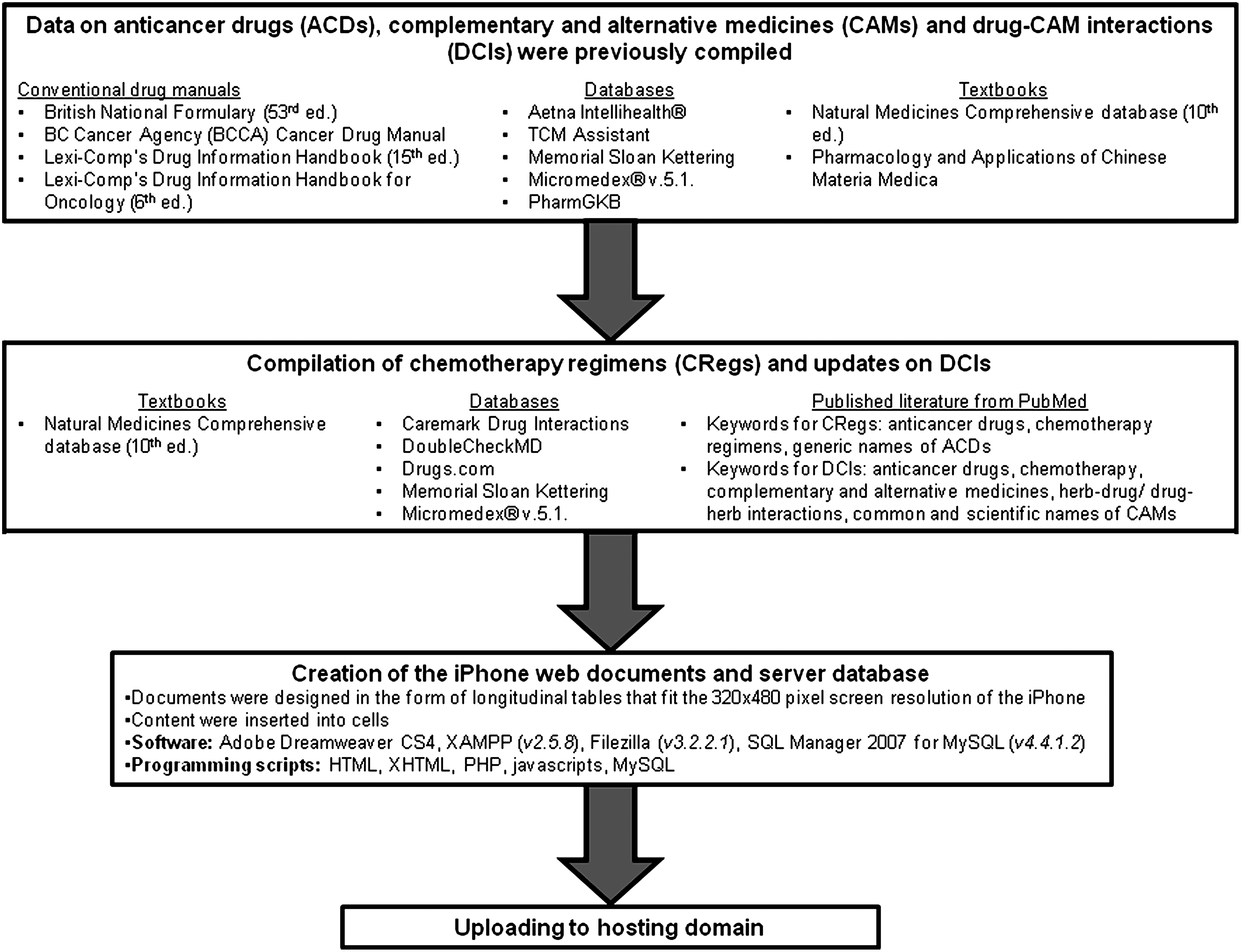
Summary workflow for developing the OncoRx-MI application.
The iPhone Web documents were created using Adobe Dreamweaver CS4 and a combination of hypertext markup languages, javascripts, and hypertext preprocessor (PHP5) scripts. The application was specifically designed to provide a 320×480-pixel Web-browsing environment via the iPhone's Multi-Touch interface. 29 The documents were then uploaded and hosted from a third-party domain. 30
Search interface of OncoRx-MI
OncoRx-MI is an oncology-specific application that detects DCIs between CRegs and CAMs, and is coupled to an online database located at

Interaction search between the chemotherapy regimen DHAP (consisting of the drugs dexamethasone, cisplatin, and cytarabine) and licorice in OncoRx-MI.
Under the section on detected DCIs, the information is organized into interaction effects, severities, mechanisms of interactions, substantiating evidences and references, as well as overall management plans for the CRegs. As an example, the interaction between the chemotherapy regimen DHAP, used for the treatment of non-Hodgkin's lymphoma, 31 and licorice is described (Fig. 3). The regimen DHAP consists of three drugs (dexamethasone, cisplatin, and cytarabine), of which 2 DCI pairs are detected by OncoRx-MI with licorice. The DCI between dexamethasone and licorice, substantiated by a patient case report, leads to an increased duration of corticosteroid activity and an increased risk of potassium depletion. 32 –35 Another DCI detected with cisplatin leads to a decreased therapeutic efficacy of the ACD based on an animal study. 36 OncoRx-MI does not detect an interaction with cytarabine. Consequently, OncoRx-MI recommends that a suitable noninteracting alternative herb be considered by the clinician in consultation with a registered herbalist, naturopath, and/or Traditional Chinese Medicine (TCM) practitioner, but if concomitant use of the herb and the regimen is warranted, the patient should be monitored for altered therapeutic efficacies and safety of the two regimen drugs. Additionally, a nonexhaustive list of other noninteracting CAMs that are used for cancer treatment or prevention, and inflammation, is also provided to complement the knowledge and experiences of herbalists, naturopaths, and TCM practitioners, so that they can make better-informed decisions as to which CAMs to prescribe.
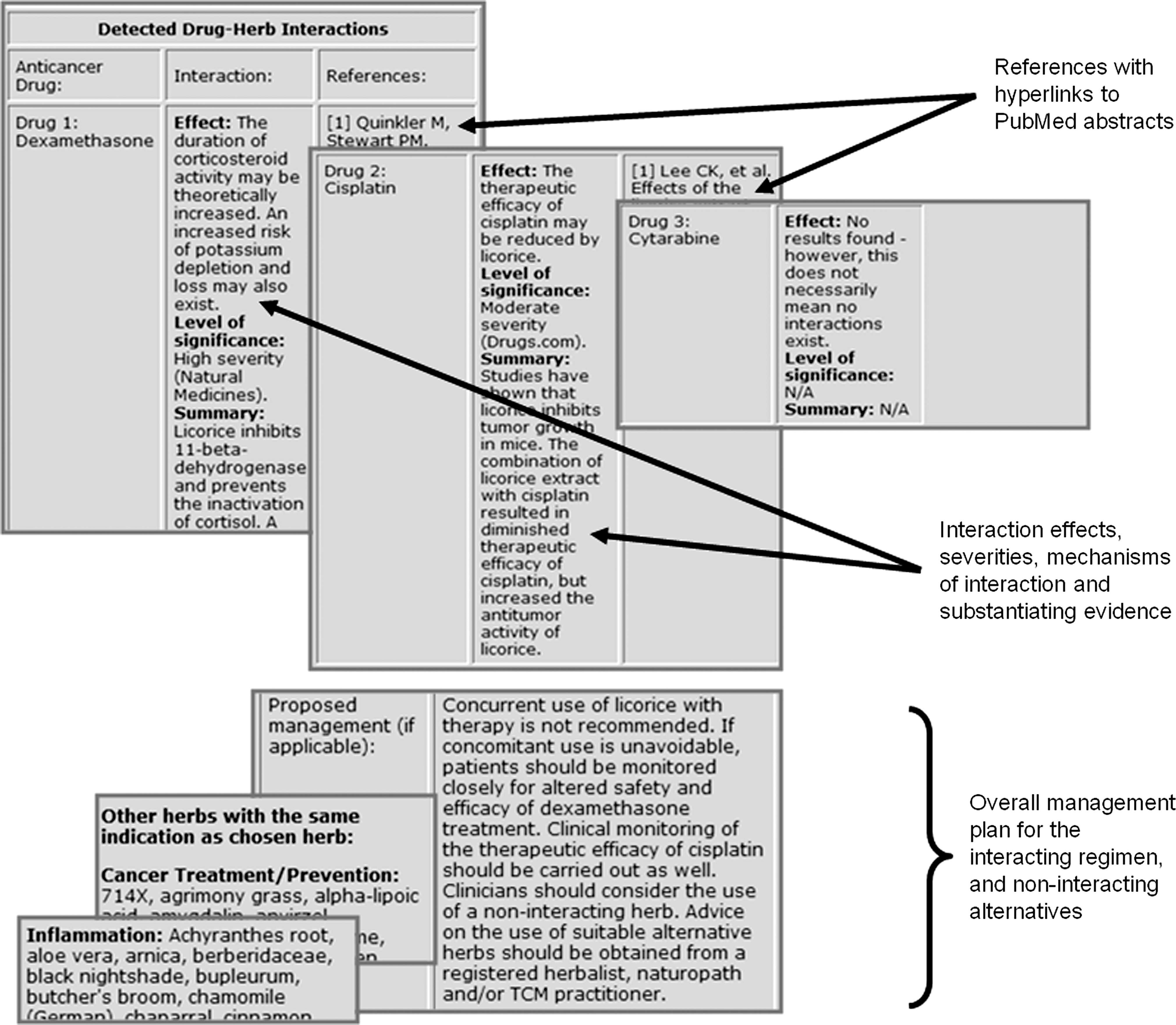
Screenshots of results page showing the interaction between the chemotherapy regimen DHAP (consisting of dexamethasone, cisplatin and cytarabine) and licorice.
Usability study on the OncoRx-MI database
During the period from July 21, 2010 to January 31, 2011, a specific online form was created to seek feedback from users regarding the OncoRx-MI database. Users who registered for an account to the database during this period were asked to provide their feedback via the link to the online form together with their login information in the e-mails sent to them. However, completion of the survey was voluntary, and users who successfully completed the online form were considered as consenting to the survey. The form asked the users to comment about the usefulness of the OncoRx-MI database in relation to their current sources of oncology DCI information, as well as its relevance to their clinical practice. For usefulness, they were asked to rate the database in terms of information on the drugs, CRegs and CAMs, interaction-related content, management plans, noninteracting alternatives, and usability with 5 scale points (a lot better, a little better, makes no difference, a little worse, a lot worse). For clinical relevance, they were asked whether this database increased their knowledge on managing oncology DCIs, improved their drug-related decision making, and whether it was a useful tool in practice. Users could agree, disagree, or remain neutral to these questions.
Results
OncoRx-MI database statistics
The OncoRx-MI database consists of a total of 256 single-agent and multiple-agent CRegs and 166 CAMs. The CRegs are classified based on the types of cancer they treat (Table 1). On the other hand, the CAMs are classified into seven categories according to their uses in cancer therapy (Table 2). Other non-cancer-related CAMs used by patients with cancer are included as well.
Chemotherapy regimens that are indicated for multiple conditions are classified into their respective categories.
Complementary and alternative medicines that have multiple uses are listed in their respective categories.
OncoRx-MI can detect 2750 pairs of interactions between CRegs and CAMs, making up a total of 4408 DCI pairs. CAMs for cancer treatment and prevention (39.0%) and inflammation (16.8%) have the highest proportions for CReg–CAM interacting pairs, while those for alopecia (0.1%) and nausea and vomiting (4.1%) have the lowest (Table 3). Majority of the DCIs are pharmacokinetic in nature (79%), involving the inhibition and induction of the cytochrome P450 isozymes (CYP2C9, 2C19, 2D6, 3A4) and induction of p-glycoprotein. On the other hand, pharmacodynamic DCIs include hepatotoxicity (39%), altered corticosteroid efficacies (30%), increased risks of hypoglycemia (4%), hypertensive crisis (2%), serotonin syndrome, and bleeding (1% each).
CAMs that have multiple uses are listed in their respective categories.
Percentages may not add up to 100% due to rounding of data.
User demographics and feedback on the database
As of February 2011, there were a total of 130 users of the database. Most users were from the United States and Canada (41%), followed by Europe (23%). Surprisingly, large proportions were also from Australia (16%), Asia (9%), and the United Kingdom and Ireland (5%). Other users included those from the Middle East (3%), South America (2%), and New Zealand (1%). Approximately 42% of the users were from academia or affiliated with an academic institution, and nearly half (46%) were working in hospitals, cancer/medical centers, and health service provider organizations. A small percentage of users were in private practice, from nonprofit governmental organizations or resource providers of cancer drug and integrative medicine information, and pharmacies and the pharmaceutical industry (2% each).
Approximately 64% were health care professionals, inclusive of pharmacists (28%), physicians (25%), nurses (9%), and other allied health professionals (2%). Among the first three groups of health care professionals, a large percentage specialized in oncology (36% pharmacists, 47% physicians, and 75% nurses). The proportion of naturopaths was also high (13%), edging over that of nurses. Researchers and trainees/students made up approximately one fifth of the users, with the latter including those from medicine, pharmacy, life sciences, and biomedical engineering fields.
A total of 26 of 70 users (37%) completed the feedback form from the period of July 21, 2010 to January 31, 2011. On the whole, the majority of those who completed the feedback form agreed that the database in this study was better than their current sources of oncology DCI information (Table 4), with 23 users indicating that the content on drugs, regimens, and CAMs was better than their current sources of information. The same number of users also felt that the interaction-related data provided by OncoRx-MI was better. One user indicated that the content in OncoRx-MI was “a lot worse” because he could not find interactions with a curcumin product. However, curcumin was indexed under a different name (turmeric) in the database. In his comments, he stated that he would like to see more CAMs in the database so that more DCIs could be identified, but nevertheless, he agreed that this database would be useful with a continual expanded list of interactions.
CAMs, complementary and alternative medicines.
Nineteen (19) users indicated that the management plans provided by OncoRx were better than their current information sources, but only a little more than half (15 users) indicated the same for the noninteracting alternatives. The same number of users indicated that OncoRx-MI's ease-of-use was better, but 2 users also indicated that its usability was “a little worse.” According to the feedback from 1 of them, he felt confused due to the multiple selections of drug and CAM categories, and said that he preferred to have just one selection of the ACD and interacting CAM. In fact, this option is provided for users as the default search interface. A statement describing this default search interface as part of the instructions might clarify users' doubts on how to carry out a search in OncoRx-MI.
In terms of clinical relevance, 20 users indicated that OncoRx-MI was a useful tool in their practices, and that it also helped increase their knowledge on managing oncology DCIs. There were 21 users who also indicated that the database helped improve their drug-related decision making. One (1) user, who was an oncology practitioner, found this database useful when handling a patient query about DCIs. Despite several neutral ratings and some discontent regarding the amount of drugs that OncoRx-MI can identify interactions with, many of the users gave positive comments regarding the database, saying that OncoRx-MI was “much more complete for oncology regimens and CAMs.” One (1) user suggested that more practitioners should know about the database, while another mentioned that the alternative medications suggested by OncoRx-MI could help improve pharmaceutical care by providing “clear instructions on drugs to take and drugs to avoid.” The following comment given by a user summarizes how users felt regarding the usefulness of OncoRx-MI: I have found the level of detail with regard to the interaction to surpass that in most other databases.…There are a couple [of] interactions identified in your database that are completely lacking in other databases.…The referencing is excellent.…I usually check more than a single database and I have added OncoRx to my list of routinely searched databases. —Feedback comment by a user
Discussion
As far as the authors know, there is currently no oncology-specific database that caters to the search of DCIs via individual ACDs and CRegs. OncoRx-MI, where “MI” stands for the Mobile Internet, is the first database application of its kind that allows users to search for DCIs of CRegs on Smartphones.
OncoRx-MI is different from its online parent version (called OncoRx) that was previously published on the World Wide Web. 14 OncoRx-MI caters to a smaller resolution of mobile devices, and the interface has been modified to allow better usability for iPhone users. The data in OncoRx-MI is organized in longitudinal format, so that users can scroll in an up–down fashion instead of panning sideways to read the DCI information. In addition, users do not need to frequently zoom in and out of the iPhone screen to read the DCI content. This not only saves the hassle, time, and frustration on the clinicians' part during on-the-spot patient consultations, but may also reduce the risk of misinterpretation errors, since it allows them to concentrate on a particular piece of information they require to manage the DCI. Emphasis has been placed on reducing the screen resolution of OncoRx-MI to one that is optimal for mobile Web browsing without compromising in terms of drug- and interaction-related content. By leveraging on the use of 3G networks via mobile devices, the DCI content obtained by the mobile user is exactly of the same quality as that acquired using the online version.
The primary advantage of OncoRx-MI is that it enables the search for DCIs of CRegs quickly and conveniently in the clinical setting. This is practical since patients with cancer are often on combination regimens within which the individual drugs are usually standard. DCI information is usually limited and scattered among the various available sources, which include primary literature, databases, 23,24 textbooks on CAMs, 20,25 and conventional drug information manuals. 15,17,18 As such, to conduct a comprehensive search of DCIs with a particular combination CReg, clinicians need to plow through a large number of resources and make sense of the huge amount of data themselves. Furthermore, due to the time limitation during patient consultations, clinicians may be prone to errors of omission during an interaction search, which can pose a risk of patients suffering from serious DCI effects. OncoRx-MI is able to hasten the search process because it is a centralized database that has information collated from a variety of sources and includes DCIs identified based on similar metabolic pathways and class effects. By allowing searches based on acronyms of CRegs rather than by individual ACDs, OncoRx-MI not only reduces the time and effort required to search for DCIs of a particular combination regimen, but also reduces the probability of drug-related problems.
Furthermore, OncoRx-MI provides users with conflicting information regarding DCIs that are substantiated with references, as well as overall management plans for the interacting CRegs, so that clinicians can have a holistic understanding of the interaction and better manage the patient based on clinical judgment. In addition, OncoRx-MI draws on the popularity of mobile handheld devices and the widespread availability of 3G and Wi-Fi networks to deliver information regarding DCIs to clinicians “on-the-spot” during patient consultations, as and when required. This can be helpful to clinicians working in inpatient settings due to the existence of certain environmental barriers in hospitals, such as connection or firewall issues that impede intranet access, and/or old, slow, or limited number of computers in wards or treatment areas. 37
Limitations and future work
The main limitation of OncoRx-MI is that the interaction search is limited to a CReg–CAM pair at any one time. Searches including two or more CAMs with CRegs will require separate search entries. It is intended that future updates of OncoRx-MI will allow users to search for multiple CReg–CAM interactions, as well as to include DCI information with other natural products and dietary supplements, such as vitamins and minerals. Besides the iPhone, the OncoRx-MI interface has not been tested on other Smartphones. As such, differences in the layout of the interface and slight discrepancies in the screen resolution may occur when OncoRx-MI is assessed using other mobile handheld devices. Ongoing improvements to the compatibility of OncoRx-MI with other mobile devices are being made so that a wider target audience of health care professionals can be reached. Improvements in usability of the interface will also be considered in future versions. OncoRx-MI is nonetheless still useful in its current phase because it is able to detect a considerable number of interactions between CAMs and the CRegs used in clinical practice.
Conclusions
OncoRx-MI is the first mobile Web-based application of its kind targeted to detect DCIs for CRegs. It is intended to complement other currently available mobile drug interaction resources for detection of DCIs. This application is useful to health care practitioners in the clinical oncology setting, or to those who deal with patients with cancer in their daily practice. It is also of assistance to clinicians who are new to oncology practice, and other clinical specialists who may not be familiar with chemotherapy. It is hoped that OncoRx-MI will increase the awareness of DCIs among health care professionals working in the clinical oncology setting, and can ultimately improve the pharmaceutical care of patients with cancer.
Footnotes
Acknowledgments
This article is written within a project funded by the start-up grant awarded by the Faculty of Science, National University of Singapore.
Disclosure Statement
The authors have no conflicts of interest that are directly relevant to the content of this study.