




Abstract

Head acupuncture for Parkinson's disease by row acupuncture method along Bladder meridian/channel of foot greater Yang and Governor vessel.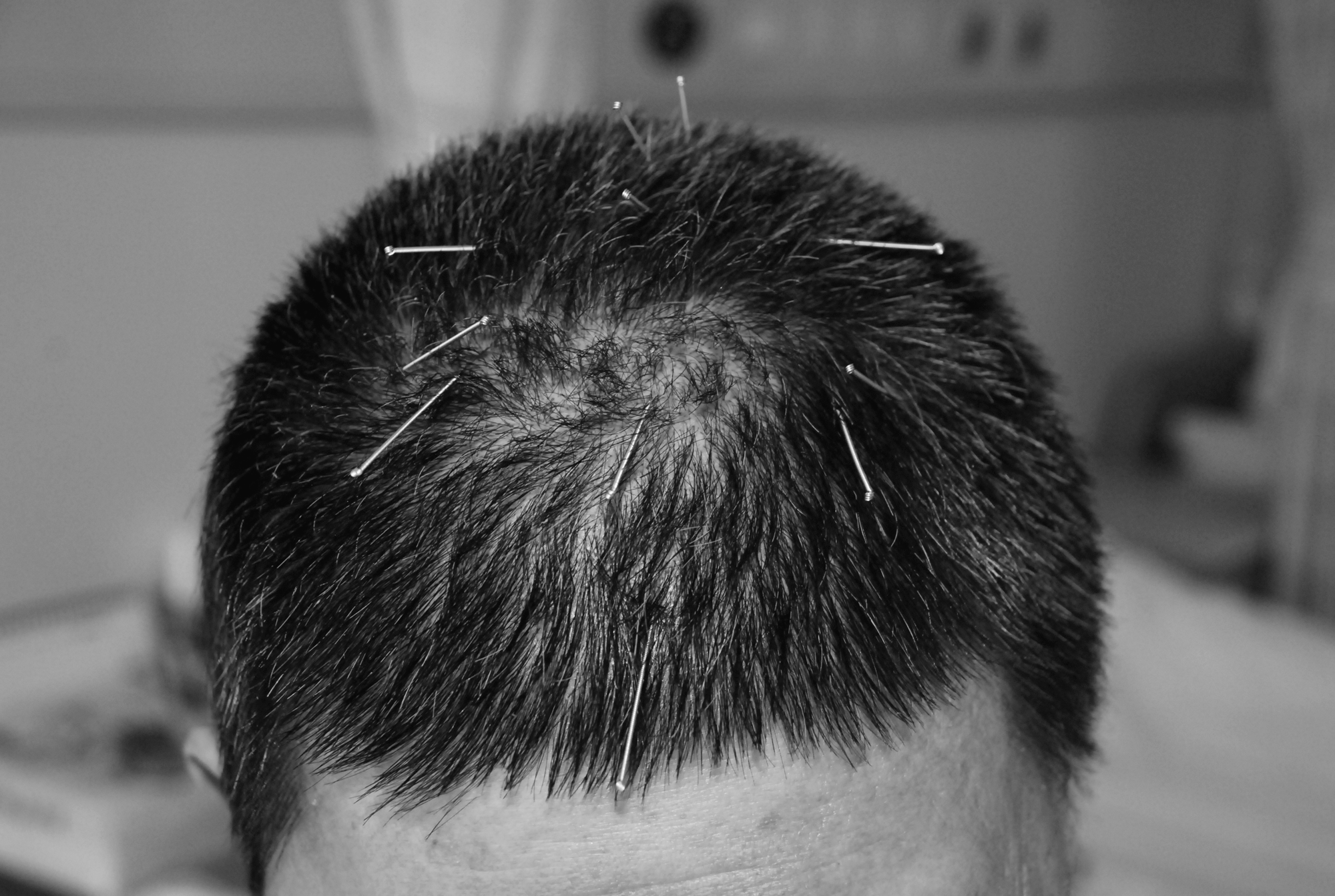
The most appreciable distinction between China and the West in treating PD is the use of Traditional Chinese Medicine (TCM) therapy, which includes Chinese herbal medicine (CHM), acupuncture and other nonmedication therapies. For example, cupping therapy refers to a method of applying acupressure by creating a vacuum on the patient's skin. This therapy is able to dispel stagnation and influence the flow of energy and blood in the body. Cupping is one of the oldest medical practices and has a history of more than 2000 years in China,
4
but varieties of it have also been used in other countries such as India, Arabia, Central Europe, and parts of Africa.
5
The earliest extant Chinese prescription book, Wushierbingfang (Prescriptions for Fifty-two Diseases; 476–221
In recent years, public awareness of TCM for PD is increasing. The important characteristic of China's national medical system is that TCM and Western medicine complement and cooperate with each other, being responsible together for the health care of Chinese people. The Chinese Government is reforming the national health care system and has published the first 3-year action plan (2009–2011). 11 Chen Zhu, the Minister of Health in China, emphasized the policy of paying equal attention to Western medicine and TCM. 11 In 2009, the State Council issued a document called Several Opinions of the State Council on Supporting and Promoting the Development of TCM Industry. It proposes to continue to stick to the guideline of equality between TCM and Western medicine and giving TCM full play. The opinions point out that supporting and promoting the development of TCM plays an important role in deepening the health system reform and in improving the heath condition of the people. We believe that this health care system and health insurance plans will benefit most of the patients with PD in China.
After 30 years of reform and opening up in the academic field, PD recently has drawn increasing attention to Chinese scholars. 12 In Zhang's study, 3 a strikingly large number of PD sufferers were unaware of having the disease, with a rate as high as 48% and even higher in rural areas, and 63% of the patients had not received treatment with levodopa. However, the incidence and survival rate of PD in China are similar to those in developed countries where most patients are diagnosed and received levodopa treatment. The possible reason is that TCM works as a compensation for the lack of standard Western-style medical care for patients with PD because of economic reasons and easy access to TCM therapy in China. Managing scarce resources and health care effectively and efficiently is an important part of the health system reform. We believe that TCM for PD remains a high priority, especially in rural areas. In the future, it will be necessary to do more epidemiological investigations on the usage rate of TCM for PD and to what extent local TCM treatments can influence the natural history of PD.
Supportive scientific evidence is gradually beginning to emerge from recent clinical studies, suggesting that TCM has potential benefits for patients with PD. Dopamine replacement therapy is still the most effective treatment for PD, but this mainstay of pharmacologic treatment is usually complicated by highly disabling fluctuations and dyskinesias. 13 Supported by government grants, three high-quality studies on CHM for PD were performed and published recently. 14 –16 A multicenter, randomized, double-blinded, controlled clinical study showed better efficacy of CHM plus levodopa than the placebo plus levodopa in improving motor dysfunction and relieving muscle tension. 14 A multicenter, double-blinded, layered, randomized and grouped, placebo-controlled clinical trial indicated that combined use of CHM and levodopa for treating PD patients with Hoehn & Yahr grade 1.5–3 can significantly improve patients' motor syndrome and the quality of life, and reduce the dosage of levodopa required. 15 A multicenter, randomized, nonplacebo-controlled trial showed that the combined use of CHM and levodopa can obviously relieve the patients' motor symptoms, and increase on-time duration and reduce off-time duration. 16 Furthermore, application of acupuncture therapy has become more frequent in treating PD. A systematic review showed that there is evidence indicating the potential effectiveness of acupuncture for treating PD, and the 13 most commonly used acupoints were GB20 (80%), DU16 and EX-HN1 (40%), BL9, BL10, DU17, DU21, GB5, GB6, GB19, GB34, LI4, and MS6 (30%). 17 Another systematic review and meta-analysis of acupuncture treatment for PD indicated that acupuncture is safe and effective in the treatment of PD and acupuncture plus Western drugs may be superior to Western drugs alone, in spite of the defects in the methodological quality of the included trials. 18 The row acupuncture method was created by modern practitioners based on the combination of ancient acupuncture manipulation with modern clinical practice. The row acupuncture method is a multi-acupuncture method, with the puncture being more intensive on certain local parts of the human body and arranged in a line. 19 The row acupuncture method can enhance channel Qi and accelerate the recovery of neuromuscular function. We often give head acupuncture for PD treatment using row acupuncture method along BL and GV (Fig. 1). Good-quality policymaking depends on high-quality information. Hopefully there will be increased numbers of high-quality trials to assess TCM monotherapy and/or TCM combined therapy for patients with PD.
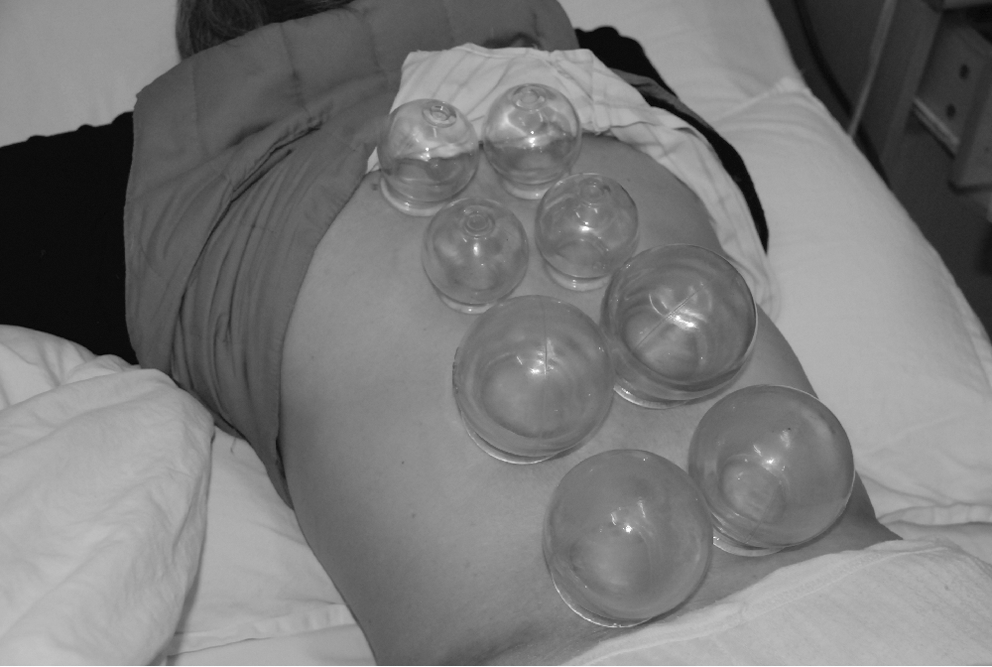
Cupping therapy for Parkinson's disease by row cupping method along Bladder meridian/channel of foot greater Yang (BL). The skin will become reddened due to local congestion of blood flow. Generally, the cups will be left for about 10 minutes. The cupping therapy will be done once a day or once every 2 days and 10 times as a course of treatment.
Until now, no modern therapy for PD has been shown to be neuroprotective, and patients continue to experience progressive deterioration of body functions, daily activities, and participation. There is an enticing but unconfirmed prospect that a number of agents besides levodopa might protect against worsening neurological disability. 1 Growing data have suggested that Chinese herbs and herbal extracts have potential clinical benefit in retarding the progression of PD by attenuating degeneration of dopamine neurons and symptoms, promoting neuronal survival and neurite growth, and facilitating functional recovery of brain injures. 20 We look forward to seeing neuroprotective drugs from CHMs and achieving the critical goal of slowing the progression of disability. However, CHM may interact or interfere with Western pharmaceutical drugs. At present, little is known about CHM–levodopa interactions. Thus, appropriate methods should be developed to determine the safety of combined medication.
Parkinson's day has been held annually on April 11 since 1997 on the birthday of Dr. Parkinson. The day is partly intended to boost awareness of this disorder and to spur new research and treatment innovations. PD has existed in different areas of the world since ancient times, and people have to deal with it with different cultures and methods. Traditional therapies in the form of herbal preparations containing anticholinergics, levodopa, and monoamine oxidase inhibitors were used in the treatment of PD in India, China, and the Amazon basin. 21 Currently, near two thirds of patients with PD worldwide resort to various kinds of complementary or alternative medicine, which may influence the motor and/or nonmotor symptoms of PD, and/or the effectiveness of dopaminergic therapy, to alleviate the progressive functional disabilities caused by the disease. 22 China has the largest number of PD cases in the world, but in a country with a medical system in which TCM and Western medicine complement and cooperate with each other, but with a lack of access to Western-style medical care in some areas, a great number of PD patients have been using, are using, or will potentially use TCM for disease treatment. Therefore, we hope that the increase of public awareness of TCM therapy for PD can promote prevention and treatment of PD in China and also in the world.
Footnotes
Acknowledgments
This work is supported by the Development Funding of Zhejiang Extremely Key Subject of Pharmacology and Biochemical Pharmaceutics; the Project of Wenzhou Municipal Science and Technology Bureau in Zhejiang province (H20070044, Y20080145); Administration of Traditional Chinese Medicine of Zhejiang Province (2010ZQ010); Xinmiao Planning Project of Science and Technology Department of Zhejiang Province (2008R40G2090034); and by Open Research Fund of Zhejiang First-foremost Key Subject-Acupuncture & Moxibustion (ZTK2010A03).
Disclosure Statement
No competing financial interests exist.