




Abstract
Objectives:
Application of transcutaneous electrical nerve stimulation over acupuncture points (Acu-TENS) is a noninvasive intervention that has recently been shown to alleviate dyspnea in patients with stable chronic obstructive pulmonary disease (COPD). This case report aims to explore the role of Acu-TENS in patients diagnosed with COPD during the acute exacerbation.
Study design:
The study design was a case report.
Setting:
The study was conducted in an inpatient setting.
Subject:
The subject was a 74-year-old man admitted to the hospital due to acute exacerbation of COPD (AECOPD).
Intervention:
Treatment consisted of application of TENS on EX-B1 (Dingchuan) for 45 minutes.
Outcome measures:
Oxygen saturation, heart rate, and dyspnea score were measured before, immediately after, and 45 minutes after Acu-TENS intervention. Other than the physiologic measures, 10 mL of venous blood was taken from the cubital vein for assessment of β-endorphin level, white blood cell count, tumor necrosis factor–α (TNF-α), and C-reactive protein (CRP) level before and immediately postintervention.
Results:
Postintervention, improved oxygen saturation, and reduction in heart rate and dyspneic sensation were observed accompanied by a raised blood β-endorphin level but the level of white blood cell count, TNF-α, and CRP remain unchanged.
Conclusions:
Application of 45 minutes Acu-TENS appeared to alleviate symptoms in a patient with AECOPD. The role of adjunctive Acu-TENS therapy during acute exacerbation warrants further investigation.
Introduction
Case Report
A 74-year-old Chinese man, an ex-smoker for the last 10 years, was admitted to a local, large district hospital with a diagnosis of AECOPD. His presenting complaints were increased shortness of breath and volume of yellow purulent sputum over the previous 10 days. On admission, his body temperature was 38°C and his blood pressure 161/85 mm Hg. He had a heart rate of 103 beats/minute and an oxygen saturation (SpO2) of 75% on room air, which increased to 94% with 2 L/minute O2 given via a nasal cannula. No heart murmur was heard on auscultation. Arterial blood gas analysis indicated an increased level of blood p
Early on the second morning after admission, prior to receiving inhaled bronchodilator therapy, the patient consented to Acu-TENS application in conjunction with conventional oxygen therapy (2 L/minute) via a nasal cannula for managing his AECOPD. The skin area of acupoint—EX-B1 (Dingchuan, located at 0.5 cun lateral to the lower border of the seventh cervical vertebrae, where cun is defined as the distance between medial creases of the interphalangeal joint of the middle finger)
5
–7
was cleaned by alcohol swab. Electrodes, placed bilaterally over EX-B1, provided electrical pulses 200 μs in width at 2-Hz burst mode via a TENS machine (ITO ES320, Japan) for 45 minutes. The intensity of stimulation was adjusted to the maximally tolerable level but short of pain. The treatment duration lasted 45 minutes. During the intervention, heart rate and oxygen saturation were monitored by a pulse oximeter (Pulsox-3, Konica Minolta, Japan). Before, immediately, and at 45 minutes after the intervention, parameters including FEV1 (by a spirometer, Pony, Cosmed, Italy), heart rate and Sp
After the Acu-TENS was commenced, heart rate progressively decreased from 98 to 86 beats/minute over the course of the intervention. This decrease in heart rate was sustained for 45 minutes after intervention (83 beats/minute), while the Sp
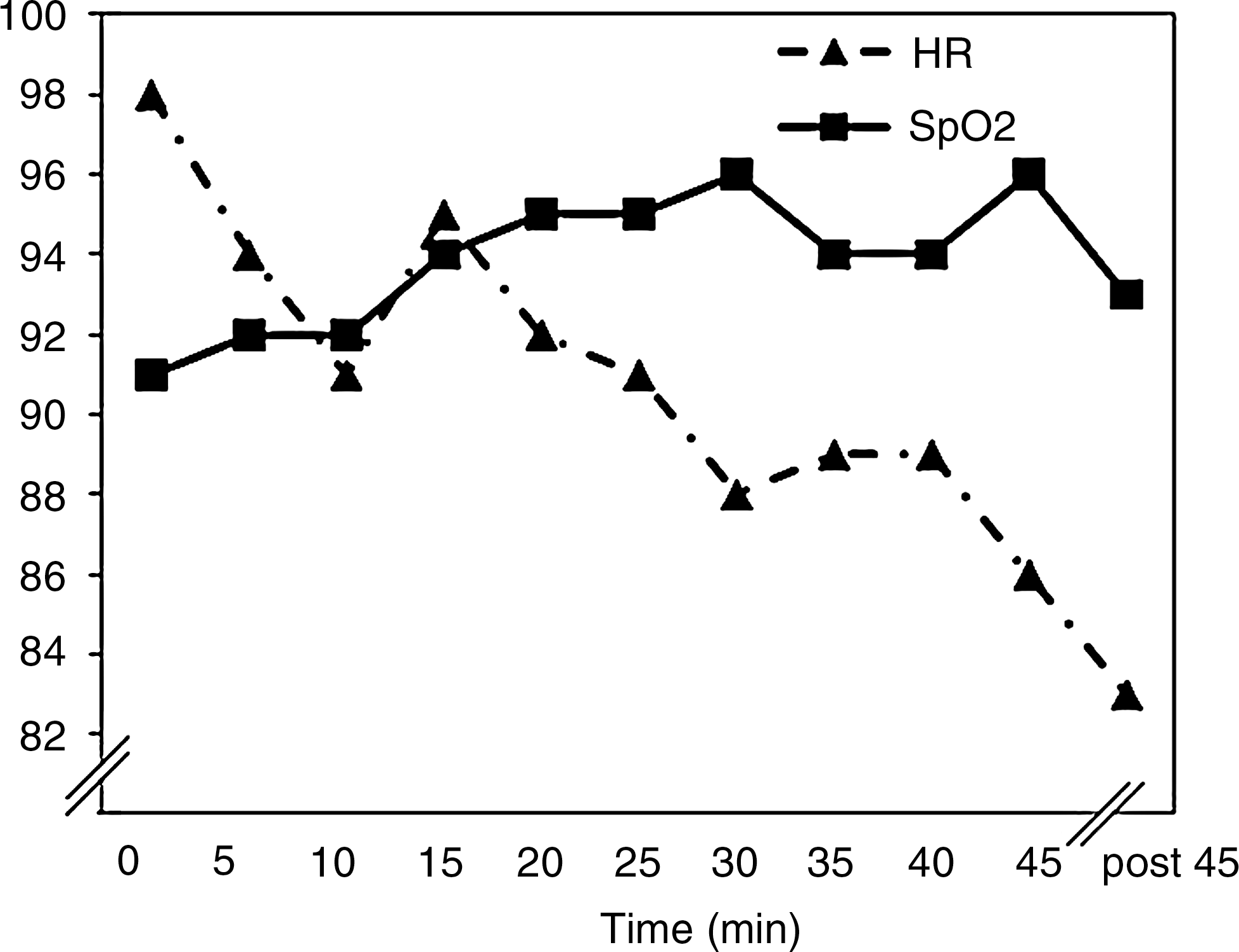
Changes in heart rate (HR) and oxygen saturation (Sp
TENS, transcutaneous electrical nerve stimulation; DVAS, dyspnea visual analogue scale; FEV1, forced expiratory volume in 1 second; TNF-α, tumor necrosis factor-α; CRP, C-reactive protein; N/A, not applicable.
Discussion
According to the concepts of Traditional Chinese Medicine, each acupuncture point is function specific. Dyspnea is one of the most disabling symptoms during acute exacerbation of patients with COPD. The acupoint EX-B1 (Dingchuan) was thus chosen for this patient because previous studies have shown this point to be effective for management of dyspnea in patients with COPD 5,6 and with asthma. 7 To evaluate the efficacy of this function-specific acupoint in the management of acute exacerbation of COPD, a single-point protocol was used. This current case study is the first to examine the effect of Acu-TENS in patients with COPD during an acute exacerbation.
During AECOPD, the enhanced inflammatory response, both locally and systemically, increases the airway hyperresponsiveness, oxygen demand, and ventilatory drive, leading to increased body stress. Acu-TENS appeared to improve oxygen saturation as well as reduce dyspneic sensation. These changes were also accompanied by a threefold increase in the β-endorphin level. β-Endorphin is believed to induce an effect on μ-opioid receptors, the consequence of which is a reduction in breathing frequency. 8 Endogenous opioid is associated with a modulation of dyspnea with acute bronchoconstriction 9 and has a blunting effect on perceptual responses, thus reducing the intensity of the dyspnea sensation. 10 It has previously been shown that a 4-week Acu-TENS program led to a reduction in oxygen desaturation when patients with COPD undertook a 6-minute walk test. 6 The increase in oxygen saturation (from 91% to 96%) observed in this case provides further evidence to suggest that Acu-TENS may influence oxygenation at times of increased demand.
The literature shows that different stimulation frequencies induce a wide range of endorphins. Low-frequency TENS triggers the release of endorphin, 11 and met-enkephalin, 12 mediated via μ-opioid receptors. 13 High-frequency TENS is reported to induce dynorphin (Han et al., 1991) via δ-opioid receptors. 12 Met-enkephalin and dynorphin are associated with pain relief but β-endorphin, mediated via the μ-opioid receptors, 14 modulates the respiratory rhythm-generating center to reduce respiratory frequency, 8 leading to reduced ventilation. 10 Animal studies suggest that β-endorphin modulates the bronchomotor tone via β-adrenoceptor-mediated bronchodilation. 15 The effect of β-endorphin released by TENS has been reported to last 45 minutes. 6,16 This may explain why the improved outcome was sustained for 45 minutes after Acu-TENS intervention in this case.
It is hypothesized that the progressive decrease in heart rate could be associated with a reduction in work of breathing (relief of dyspnea and reduction in respiratory rate). As previously suggested, 17 Acu-TENS may slow heart rate through modulation of the autonomic nervous system.
There are inherent limitations with a single case study, such as this patient not being representative of patients with AECOPD, and placebo effect of Acu-TENS. Bearing in mind such limitations, this case study suggests that Acu-TENS may be a useful adjunct for management of COPD patients through influences that optimize oxygenation and alleviate dyspneic sensation during an AECOPD.
Conclusions
Application of 45 minutes of Acu-TENS appeared to improve oxygen saturation, and reduce heart rate, respiratory rate, and dyspneic sensation in a patient with AECOPD. Dyspnea is a major reason for hospitalization. With symptom reduction, it is possible that hospitalization may be averted and further lung function deterioration alleviated. The effectiveness of adjunctive Acu-TENS therapy in AECOPD warrants further investigation.
Footnotes
Disclosure Statement
No competing financial interest exists.