




Abstract
Dear Editor,
As we debate the advantages of effectiveness versus efficacy studies and the benefits of nested qualitative research, I propose that we concurrently explore the contextual importance of the diagnoses under investigation. From the Greek diagignōskein—discern, diagnosis means to identify the nature of a problem. 1 Although simple, the definition does not convey the prevalence of diagnoses in our daily lives, nor the corresponding significance we attach to them. Diagnoses and/or the diagnostic process abound in our daily activities from car maintenance to encounters with crying children. With regard to significance, our ability and the abilities of those we interact with to correctly diagnose and treat situations as they occur affect our interpretation of the success or failure of the encounters, which ultimately influences our behaviors and expectations.
The pervasive nature of diagnoses and their influence on behavior and expectations necessitates an understanding of their role in medicine. Diagnosis is key to progression through health services, specialist care, and illness validation. 2 A diagnosis associates a patient's symptoms with a valid illness, and therefore allows the patient to assume illness behaviors such as absence from work. Additionally, patients may derive therapeutic efficacy from the diagnosis. 3 These ideas come from the biomedical literature, which dominates the medical arena and drives research. As such, Traditional Chinese Medicine (TCM) practitioners receive instruction in biomedical diagnosis, and TCM research typically recruits patients based on their biomedical diagnosis. This practice has spawned debates over the recruitment of patients by biomedical versus TCM diagnoses. Although I agree that this debate is necessary, we have yet to determine the role and/or interpretation of TCM diagnosis from the practitioners' and/or patients' perspectives. I suggest that if we explore the role of TCM diagnoses from multiple perspectives, we would be better able to develop arguments for and/or against their use in research as well as make comparisons to the role of biomedical diagnoses.
My diagnosis hypothesis is twofold: (1) TCM practitioners contextualize a biomedical diagnosis according to the biomedical characteristics they consider relevant, which influences how a particular diagnosis is incorporated into treatment; and (2) the way in which TCM practitioners contextualize biomedical diagnoses may be visualized on a continuum. The first aspect of the hypothesis generates questions about “the practitioner's perception of the importance/relevance and applicability of the biomedical diagnosis” and “How/does a patient's biomedical diagnosis influence consultation, treatment, and follow-up?” Interviews suggest that practitioners contextualize irritable bowel syndrome (IBS) according to its biomedical characteristics such as “episodic nature.” 4 Additional comments such as “junk diagnosis” indicate that the practitioners do not perceive IBS to be a useful diagnosis. Although comments suggest that the diagnosis may influence the consultation process, they do not suggest that it is important to the treatment design. Based on the practitioners' contextualization of IBS, the diagnosis would likely fall on the lower end of the continuum (Fig. 1). Figure 1 illustrates that the continuum is anchored on one end by biomedical diagnoses that are perceived to have low value and/or utility in TCM practice and therefore may not contribute to treatment design, and on the other end by diagnoses that are perceived to be valuable and/or are utilized in treatment design. In contrast to IBS, a fellow practitioner-researcher suggests that fertility diagnoses are important to both the consultation process and treatment design (i.e., point selection) placing it on the high end of the continuum.
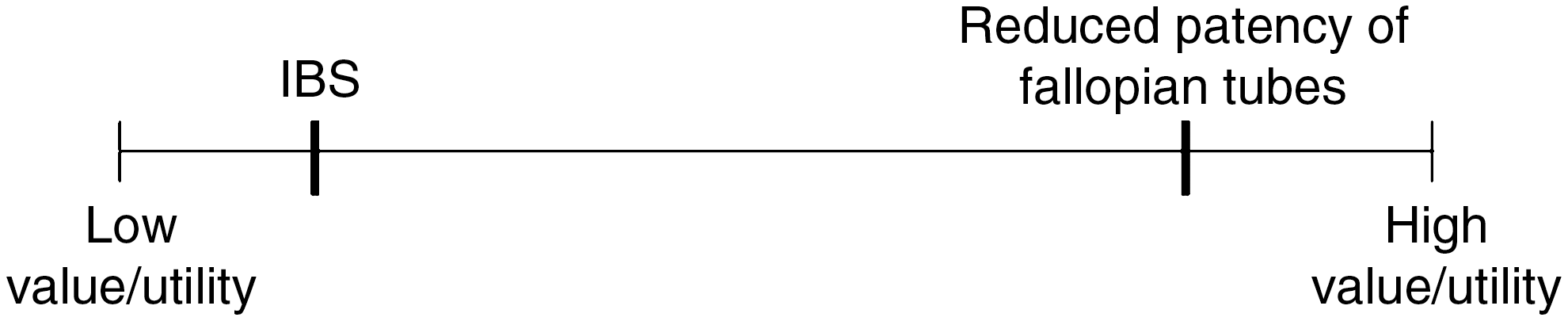
Traditional Chinese Medicine contextualization of biomedical diagnoses continuum. IBS, irritable bowel syndrome.
With regard to research, the practitioners' contextualization of biomedical diagnoses has important implications. Research studies of biomedical diagnoses on the high end of the continuum may benefit from recruiting patients by their biomedical diagnosis, while studies of diagnoses on the low end may benefit from recruitment by TCM diagnosis or common symptoms. Note that a diagnosis' location on the continuum does not reflect the suitability of fixed point or pragmatic treatments. The use of specific acupuncture points may be studied concurrently, but is not equivalent to the contextualization or utilization of a biomedical diagnosis.
In addition to initiating a self-reflexive exploration of how TCM practitioners contextualize biomedical diagnoses, I encourage researchers to explore the importance of TCM diagnoses. Given that diagnosis is the cornerstone of biomedical practice and it may, to some extent, influence patients' outcomes, we should investigate how patients interpret their TCM diagnosis and its impact on outcome, and assess the practitioners' value and utilization of TCM diagnoses. One study reports a lack of consistency among TCM diagnoses and treatments for low back pain, and suggests that the inconsistency may reflect the unimportance of diagnosis to treatment design. 5 More research is necessary to determine whether this finding is consistent across various TCM diagnoses, or if TCM diagnoses also fall along a continuum of value and utilization. Although the hypothesis emphasizes the role of diagnosis in TCM practice, it may also be applicable to other CAM disciplines that use a mixture of biomedical and discipline-specific diagnoses in research and practice.
Footnotes
Disclosure Statement
No competing financial interests exist.