




Abstract

Introduction
The Bedes or Badiyas are an indigenous community of Bangladesh. They live on boats and are referred to as the “river gypsies.” Bangladesh has over 100 large and small rivers flowing through the country. The Bedes seldom live for a long time in any place, but travel throughout the country in their boats and ply their trade in the numerous villages by the rivers. It has been opined by some that the Bedes may be descendants of the Mon-tong-Mangta tribe of Arakan region in present day Myanmar. The Bedes, however, claim that they came around 700
The Government of Bangladesh, in recent years, has been trying to settle the Bede community (whose members are highly scattered) in riverside villages for accurate census of the Bede population, as well as to provide education and other services to children and adults. One such group of the Bede people has been settled by the Bangshi River in Porabari village of Savar Municipality in Dhaka district, Bangladesh. The population of this community numbers around 12,000. Although the community has been given land by the river and presently resides in permanent houses, they also have their own boats and frequently travel to various areas of the country. Because Savar is on the outskirts of the capital city, Dhaka, the community is fast accommodating to a semi-urban lifestyle and now even possesses various electrical appliances in their homes. Their children are also attending modern educational institutions. The women earn extra income by selling trinkets, pots, pans, semiprecious stones, and other sundry items to surrounding village people, while the men are engaged in various kinds of trade or labor. As a result, traditional medicinal knowledge and practices are dying out and are currently practiced only by a few old practitioners whose patients are mostly elderly. In an ethnomedicinal survey conducted among the traditional medicinal practitioners of the Bede community of Porabari, it was noticed that 2 of the traditional practitioners were regarded by the Bedes as specialists for treatment of both common and unusual maladies through use of amulets, garlands, or incantations. It was further noticed that besides medicinal plants, body parts of animals, reptiles, fish, gastropods, and birds as well as broken glass were used in their amulets and garlands. It was the objective of the present survey to document these unusual modes of treatment from these 2 practitioners and the ingredients that they prescribe for their patients for both common and esoteric diseases. The term “esoteric” is used to denote something that cannot be described as a common physical sickness and may have a psychic or spiritual basis.
Materials and Methods
The present survey period lasted from June 2009 until December 2010. Teams of interviewers would go to the survey area, namely, Porabari village, which lies beside the Bangshi River in Savar Municipality of Dhaka district, Bangladesh. A group of Bedes have been settled in the village for over 2 decades by the Government of Bangladesh through giving them land and assisting them to build up permanent homes as well as providing them with primary education and health care services. The population, according to the leaders of the community, numbered about 12,000 during the survey period. The interviewers were followers of Islam and belonged to the mainstream Bengali-speaking community of Bangladesh, and were ethnically different from the Bedes. The Bedes have now mostly converted to Islam, but still maintain many of their animistic worships (like Pujas) while at the same time following the Islamic ritual of praying and observing the Islamic holy days. At first, the Bedes demonstrated a hostile or indifferent attitude toward answering questions. The practitioners would refuse to answer any query or give any information. However, perseverance over a couple of months and continuous visits overcame this indifference and hostility, and then the community, particularly the traditional medicinal practitioners, answered questions freely. Initial breakthrough was made after calling 1 elderly practitioner “Nana” (Bengali for maternal grandfather) and another comparatively younger practitioner “Khala” (Bengali for aunt), and making it a point of visiting their homes and showing every form of respect such as giving them “Salams” (Islamic way of greeting a person by saying “As-salamu Alaikum” meaning “Peace be upon you”) and sitting at their feet. Nana was especially instrumental in securing the cooperation of the other practitioners. Notably, in Bengali culture, Nanas and Khalas are affectionate terms to address the elderly, and such persons usually show endearment to the persons addressing them in such a manner.
A preliminary survey was conducted about the number of traditional medicinal practitioners who still practiced the Bedes' traditional form of medicine. Thirty (30) practitioners were identified, 28 of whom had a treatment method that mainly consisted of administration of medicinal plants for curing with various remedies. However, 2 practitioners were also identified who, according to members of the Bede community, engaged in “specialized” forms of treatment of common ailments as well as psychologic distresses through use of amulets, garlands, or incantations and performance of magical rites. Informed consent was obtained from the 2 practitioners, namely, Mr. Nurul Haq, who practiced Bede traditional medicine, and Ms. Urmila Begum, who besides practicing traditional medicine, also performed the work of a midwife. The informants had no objections to their names being used in any publications; in fact, they agreed readily to their names being mentioned, because in their opinion, this would enhance their reputation. The informants also did not have any objections to details of various amulet ingredients being published. Interviews were conducted in the Bengali language, which was spoken by both practitioners and interviewers. Information was gathered with the help of a semistructured questionnaire and open-ended interviews, where the practitioners were allowed to speak at length on any diseases or treatments they wished with infrequent interposition from the interviewers. Plant species as mentioned by the practitioners were collected with their help and taxonomically identified by Mr. Manjur-ul-Kadir Mia, ex-Curator and Principal Scientific Officer of the Bangladesh National Herbarium at Dhaka. Animal species as mentioned by the practitioners were taxonomically identified through visits to the Dhaka Zoo and the Bangladesh National Museum at Dhaka, where stuffed specimens of various animal species are on display. Help was obtained from competent personnel of both Dhaka Zoo and Bangladesh National Museum (Animal Section) for identification of various animals. Relevant plant and animal specimens or parts of specimens were deposited at the University of Development Alternative.
Results
A total of five classes based on profession were found to exist within the Bede population. Vaidyas, who were either males or females, treated patients according to their traditional medicinal system and used mostly plant-based materials for treatment of ailments. Shandars (mostly females of all ages) sold sundry items including bangles, ear rings, finger rings, pots, pans, and other hand-made products to households of adjacent villages. Shapurias (all males) were involved in snake catching, snake dancing, and treatment of snake bites. In fact, the word shapuria in Bengali denotes someone who deals with snakes. Bajikars (all males) earned their livelihood from juggling acts or showing monkey dances. Tantriks (also known as Ojhas) could be either male or female. This last class was considered by the Bedes to be the most powerful, since according to them they were proficient in black magic, possessed occult powers, knew incantations and magical rites, and as a result, had the ability to either help or harm somebody. The Tantriks also dispensed medicines for both common illnesses as well as uncommon illnesses, the latter, which for want of better terms, are being named in the present article as “psychosomatic” or “esoteric” disorders. The 2 persons interviewed in the present survey were Tantriks by profession.
Many types of sickness, according to the Bedes, can be a result of “bad blood” or due to “evil eye” or “evil wind,” or spell casting. Bad blood was the result of accumulation of toxins in the blood because of various problems like inadequate digestion of food or consumption of “wrong food items,” which can result in disease of a particular organ of the human body. This was the opinion of the Vaidyas, who would then prescribe appropriate medicinal plants for treatment of the disease or to “purify blood.” Under certain circumstances, “bad blood” would be removed by cupping (i.e., sucking out of blood with the help of a sawed-off cow or buffalo horn). However, the Bedes also thought that certain diseases such as toothache were the result of worm infestations and so all diseases were not attributed to “bad blood” alone. “Evil eye” and “evil wind” were, respectively, sicknesses from obtaining the evil eye from another person, or getting the evil wind, particularly while traveling. One can get the evil wind from places like graveyards and cremation grounds or when traveling alone during night-time. A patient may determine whether he or she has gotten the evil eye or evil wind, or such determinations can be made by the practitioner, which in these types of cases were mostly Tantriks. The two Tantriks surveyed in the present study believed that many common diseases may also occur through the evil eye or evil wind falling on any particular person, or be a result of spell casting, in this case the victim being the patient.
Twenty-four (24) formulations were obtained from the two Tantriks. The results are shown in Table 1. The various illnesses for which the formulations were used ranged from common illnesses such as colds, coughs, pain, tetanus, and hemorrhoids to esoteric disorders such as “getting the evil eye,” “not getting the person of desire,” or to “protect oneself from black magic or spell casting” (locally known as ban mara, where an enemy uses black magic to harm somebody; incidentally, the same formulation is used to subjugate another person). Of the 24 formulations, 1 formulation was used to get rid of snakes from snake-infested houses, and as such cannot be classified as treatment of any illness. This has been included to show the extent of a Tantrik's formulations and because incantations and magical rites are involved in the process. Incantations and amulets were also used to protect someone from “spell casting.”
Amulets are usually made of silver, aluminum, or brass and can be rectangular or cylindrical in shape. One side of the amulet is open through which ingredients are inserted followed by closure with wax.
The mainstream traditional practitioners of the Bengali-speaking population of Bangladesh, known as Kavirajes, call another plant, Terminalia arjuna (Roxb. ex DC.) Wight & Arn. (family: Combretaceae; English name: White murdh) by the name of Arjun.
The various formulations used included parts from eight plant species, one fish, one reptile, three birds, three gastropods (snails), and four animals (some of the plant and animal parts used are shown in the figures on the first page of this article). The sole fish species, Epinephelus coioides, was used in three formulations, all for treatment of pain. In two instances, for treatment of waist pain and rheumatic pain, the bones of this fish were used in combination with the plant Martynia annua. The dried flesh of a mammal, Panthera pardus (leopard), was advised to be taken orally in combination with leaves of Piper betle or fruits of Musa sapientum (banana) to avoid pregnancy. It is to be noted in this context that such use of leopard flesh as a contraceptive was usually sought from the Tantriks by Bede women, who may be having an illicit affair and so preferred the confidentiality of the Tantriks rather than visiting any modern clinics or doctors to get contraceptive pills. As a rule, the Bedes did not use any contraceptives.
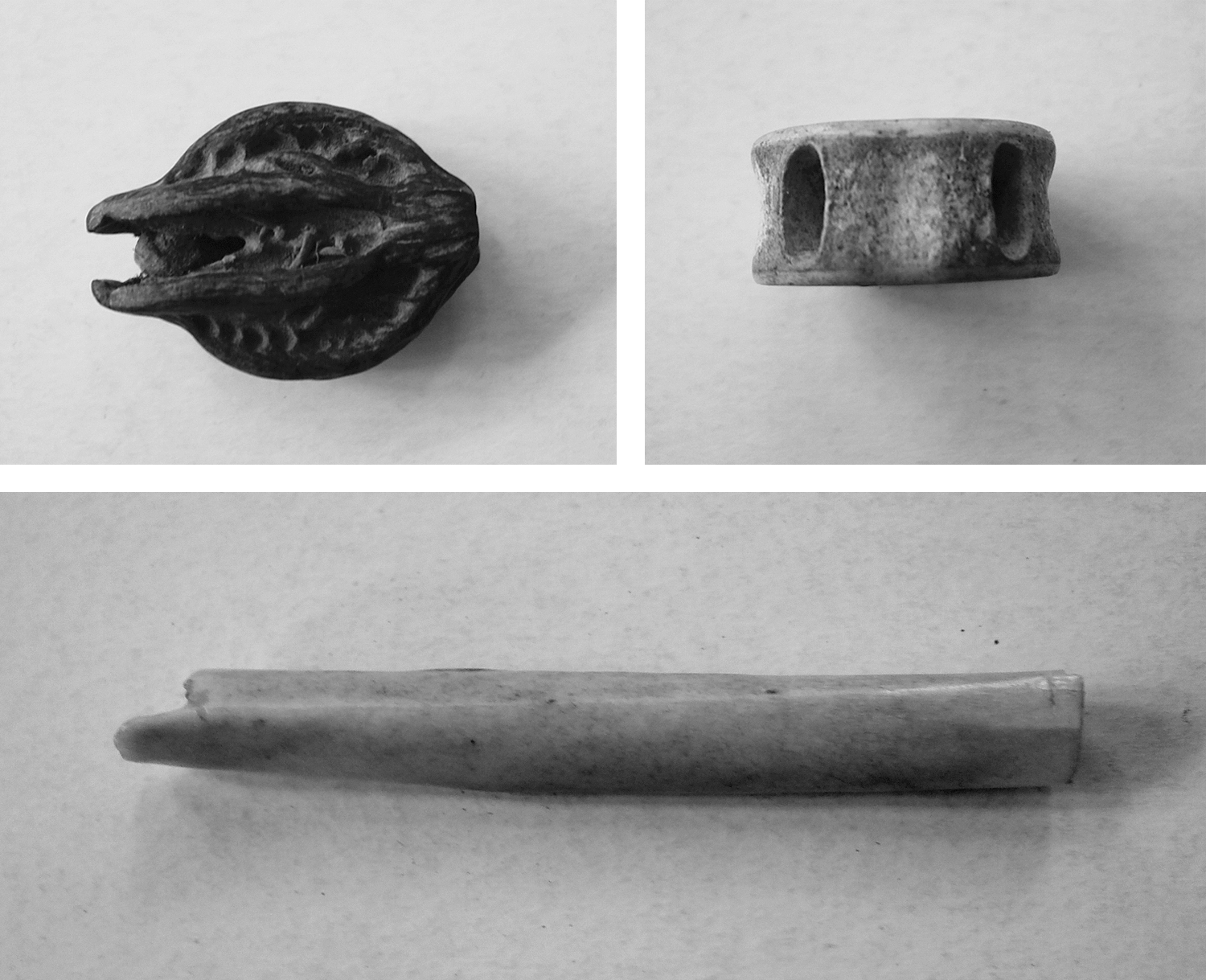
Amulets were prescribed 11 times in the 26 prescribed remedies. In four instances, the sealed amulets containing various ingredients were to be washed with water and the water orally taken, while in one instance, the amulet was to be soaked in mustard oil, and the oil massaged onto the affected body part. Amulets could be worn around the neck or waist with a piece of string. Amulets had to be worn alone and not used in combination with any herbal or modern medicine. However, depending on the amulet, the Tantrik may place restrictions on certain food items, the usual items being beef and the fish, Tenua ilisha. Garlands were prescribed seven times and advised to be worn around the neck, chest, or waist, depending on the malady. There was one instance where ear rings of the plant, Adenanthera pavonina, were to be worn as treatment for excessive bleeding during menstruation. Finger rings made from scales of the pangolin, Manis crassicaudata, were advised to be worn as treatment for hemorrhoids. Males in Bangladesh wash the anal region following defecation, with water using the left hand, while females wash both anal and vaginal regions with water using the left hand following defecation and urination. The Tantriks believe that touching the anal region with a ring made from scales of the pangolin cures hemorrhoids.
Discussion
The various formulations as shown in Table 1 were chosen on the basis of their uncommon nature. Traditional Bede medicinal practitioners belonging to the Vaidya class mostly use preparations of medicinal plants for treatment. Tantriks, who are also another class of Bede traditional medicinal practitioners, use plant and animal parts in addition to items like broken glass, for which no conceivable hypothesis can be deduced as to its medicinal properties (for instance, pieces of broken mirror are pierced, tied with a string, and advised to be worn around the neck as treatment for colds in young children). Moreover, items are hung around various parts of the body sealed in amulets or hung as garlands. Such treatments can only be termed as esoteric, for there is no topical or oral administration of items, and thus it is difficult to envisage how such use can result in cure. Even if the amulets are washed with water or soaked with oil, and the resultant water or oil orally or topically administered, since the amulets are made of metal and sealed with wax, it is difficult to conceive how any chemical ingredient from plant or animal parts used in amulets can get through the metal and wax barrier and get to the human body. The same applies to garlands, which are only in touch with the body.
Amulets were used generally as a last resort by the Bede patient, whose condition had not improved with treatment given by the Vaidyas. The Bedes believed that amulets have extraordinary powers and that wearing them will get rid of their illnesses in a short time. However, at the same time, amulets can be dangerous if worn wrongly, or if someone takes them off forgetfully, or the string tying the amulet gets broken. Under these circumstances, amulets can do the patient a lot of harm, and so amulets were only taken when the patient felt that other traditional means of treatment were not giving successful results. Some Bedes, however, preferred amulets to hide their sickness (especially those suffering from evil eye, evil wind, or spell casting) from other members of the community. Amulets were worn usually around the neck or around the waist, and sometimes on the arm. All these body parts could be hidden under garments, and so any amulet tied to these body parts would also remain hidden from public view. Amulets were not observed to be worn as status symbols or to impress others but as mentioned earlier, were hidden under garments. The price of an amulet depended on the ingredients used and as observed, ranged from Bangladesh Taka 100–5000 (US$ 1.5–70). The Tantriks were observed to accept other items in lieu of cash, mostly from wealthy patients, the most common item being furniture (for some poor patients, the Tantriks were observed to give them free amulets). It is to be mentioned in this regard that not only members of the Bede community, but also educated and affluent people from Dhaka city were often observed to visit the Tantriks regarding their medical problems. Amulet wearing is an established practice in Islam, but such amulets contain Surahs (verses) from the Quran. Wearing of amulets containing plant or animal parts is forbidden in Islam; nevertheless, many Muslims of Bangladesh do so when their sicknesses cannot be successfully treated with allopathic or other forms of traditional medicine. The Bede tradition of wearing amulets containing plant and animal items thus may be considered un-Islamic and possibly be a remnant of their indigenous beliefs and practices.
Use of amulets, arm rings, and cultural rituals for disease treatment has been described before. 8 Animal-based (including reptiles) remedies have also been reported in complementary medicines from different parts of the world. 9 –13 Traditional remedies for “magical” ailments, nervous system and psychosomatic disorders has been reported from Northern Peru, where “bad air,” “bad wind,” fright, “evil eye,” and envy are seen as common illnesses. 14 However, it can be said that a psychosomatic element is present in virtually all diseases, where the patient's degree of confidence plays a major role in the healing process. We prefer the term “esoteric” to describe some of the maladies treated by the Bede Tantriks as well as some of their treatments. For instance, not only the tracheal bone of Anser anser (Greylag goose) is involved for treatment of asthma, coughs, and mucus, but the amulet containing the tracheal bone piece should also contain a piece of rope used to commit suicide by a male or female. Moreover, the suicide must have taken place on a Saturday or a Tuesday only. The amulet is washed with water and the water should be taken on Friday only. Similarly, to protect oneself from “spell casting” (which illness by itself is esoteric), a bone from a dead illegitimate child is brought on a Saturday night, incantations chanted over the bone, a small piece of the bone is sealed in amulet, the amulet is soaked in water, and finally the water is taken on an empty stomach on a Saturday morning. The treatment is highly esoteric to say the least. Even if one assumes that a person may fall sick by thinking oneself to be “spell-casted,” or if such is a manifestation of weak nerves, it is difficult to see how the treatment can overcome any nervousness, unless the cure itself is a byproduct of the level of confidence restored in the sick person through use of items, which may seem to the person to have special “magical” curative properties.
A number of animal parts used by the Tantriks in amulets or administered orally have become extremely rare in Bangladesh. Leopards (Panthera pardus), Western hoolock gibbon (Hoolock hoolock), or gharial (Gavialis gangeticus) are seldom observed within the country, and even then in other remote parts of Bangladesh. However, the area of the present residence of the Bedes had extensive forests nearby even 70 years ago, and such animals were common. The use of such animal species may have stemmed from times when forests covered a large area of the country and the animal species were common. Presently, the Bedes mostly obtain such animal items from India. Moreover, it is to be noted that only a very small portion of animal part is directly taken or put in an amulet. A typical cylindrical amulet is about an inch long and half an inch in circumference; a rectangular amulet is usually ¾×¾×¼-inch in size. Thus, any part of an animal put within an amulet has to be extremely small. From that point, the ulna bone of H. hoolock or the jaw bone of G. gangeticus can be used in thousands of amulets over decades, when broken into amulet-sized pieces. Also contrary to our expectation, the Tantriks commented that use of amulets has not decreased in modern times. The Bangladeshi population (both mainstream people of Islam and Hindu religion) has traditionally possessed a strong belief in the supernatural and continue to do so. As such, wearing of amulets is common, and the affluent section of Dhaka city people who visit these Tantriks offer them substantial payments by means of which the Tantriks can procure the various animal species used in amulets from India (particularly from Assam, which borders Bangladesh and where forests and animals are still relatively abundant).
It may be concluded that treatments prescribed by the Bede Tantriks, particularly the use of amulets, garlands, or exotic items (such as rope used for hanging or bone of a dead illegitimate child) are completely esoteric in nature. Nevertheless, the fact remains that they have been used for centuries and continue to be used even at present. It remains to be ascertained whether the treatments actually cured the ailments for which they were prescribed, or whether they merely serving as placebo effect through soothing the nerves and restoring the confidence level of a patient to the point of cure.
