




Abstract
Objectives:
Traditional knowledge suggests that Bacopa monnieri enhances cognitive performance. Such traditional beliefs have now been scientifically tested through a handful of randomized, controlled human clinical trials. The current systematic review aimed to examine the scientific evidence as to whether Bacopa can enhance cognitive performance in humans.
Design:
A systematic review of randomized controlled trials is presented. Multiple databases were systematically searched by multiple authors. Relevant trials were objectively assessed for methodological quality.
Subjects:
The subjects studied were adult humans without dementia or significant cognitive impairment.
Interventions:
B. monnieri, including Bacopa extracts, were administered over long-term supplementation periods.
Outcome measures:
Any validated cognitive test, whether a primary or secondary outcome.
Results:
Six (6) studies met the final inclusion criteria and were included in review. Trials were all conducted over 12 weeks. Across trials, three different Bacopa extracts were used at dosages of 300–450 mg extract per day. All reviewed trials examined the effects of Bacopa on memory, while other cognitive domains were less well studied. There were no cognitive tests in the areas of auditory perceptual abilities or idea production and only a paucity of research in the domains of reasoning, number facility, and language behavior. Across studies, Bacopa improved performance on 9 of 17 tests in the domain of memory free recall. There was little evidence of enhancement in any other cognitive domains.
Conclusions:
There is some evidence to suggest that Bacopa improves memory free recall with evidence for enhancement in other cognitive abilities currently lacking perhaps due to inconsistent measures employed by studies across these cognitive domains. Research into the nootropic effects of Bacopa is in its infancy, with research still yet to investigate the effects of Bacopa across all human cognitive abilities. Similarly, future research should examine the nootropic effects of Bacopa at varied dosages and across different extracts.
Introduction
Studies conducted on animals were among the first to investigate the cognitive- enhancing effects of Bacopa. 2 Using an alcoholic extract (40 mg/kg orally for 3 days), Singh and Dhawan showed that Bacopa improved learning in a shock-motivated brightness discrimination task and attenuated memory deficits induced by the administration of various neurotoxins. 3 Preclinical work suggests that Bacopa's mechanisms of action on the central nervous system are varied and include antioxidant activity (across various Bacopa extracts), 4 –7 β-amyloid scavenging properties (Bacopa ethanol extract: 40 or 160 mg/kg orally), 8 protection against β-amyloid-induced cell death (Bacopa ethanol extract administered to cultured neurons), 9 modulation of frontocortical and hippocampal acetylcholine levels (5–10 mg/kg Bacopa extract administered to animal models of Alzheimer disease), 10 and modulation of cholinergic neuron densities (Bacopa ethanol extract: 20–80 mg/kg orally ). 11 Such effects of Bacopa have been attributed to the saponins contained within Bacopa, most notably that of bacoside A. 1
Of late, there have been a large number of studies exploring the cognitive-enhancing effects of Bacopa in humans. Although a previous review has provided an excellent general overview of Bacopa's reputed health benefits, 1 to the authors' knowledge, no study has systematically reviewed the cognitive-enhancing effects of Bacopa in humans. Furthermore, since the review by Russo and Borrelli, 1 several key trials in the area have surfaced. Consequently, this review aimed to qualitatively examine the cognitive-enhancing effects of Bacopa in humans. A qualitative systematic review of relevant trials was performed to explore the long-term effects of Bacopa extracts on any validated cognitive outcome.
Methods
Database searching
The electronic databases SCOPUS, PubMed, and the Cochrane Library were searched until April 2011 by combining the following key words and truncations:
Trial selection
Located trials were considered appropriate for review if they used Bacopa as a monotherapy, examined the effects of Bacopa on valid cognitive outcomes, used a randomized and controlled design, and had adequate methodologic quality as defined by a score of at least 5 on the augmented Jadad scale. To limit heterogeneity at the study level, trials were only considered appropriate for review if they were conducted in adult samples without cognitive impairment and if they administered Bacopa daily over a long-term supplementation period, defined as 4 or more weeks. Articles of all languages were considered appropriate for review.
Quality rating
Each trial was analyzed for methodologic quality using a purpose-designed modified Jadad scale 12 as first developed in Sarris and Byrne. 13 Using the modified Jadad scale, studies were objectively assessed for quality and given 1 point when each of the following criteria was satisfied: (1) Was the study described as randomized? (2) Was the randomization protocol detailed and appropriate? (3) Was the study described as double-blind? (4) Was the blinding process detailed and appropriate? (5) Did the study have a control group? (6) Was the control detailed and appropriate? (7) Were there adequate exclusion criteria? (8) Was the intervention used at a therapeutic dose? (9) Was there a description of withdrawals and dropouts? and (10) Were the data clearly and adequately reported? Using this scale, each trial was given a score between 0 and 10, with higher scores reflecting superior methodologic quality.
Outcomes
Any valid test of cognitive performance was considered appropriate for review, whether a primary or secondary outcome. Cognitive tests were grouped into true cognitive abilities, as guided by the extensive factor analytic work by Carroll. 14 These cognitive abilities include the following: (1) reasoning, which includes general, quantitative, syllogistic, and verbal reasoning as well as induction; (2) language behavior, which includes vocabulary, spelling ability, phonetic coding, and verbal comprehension; (3) memory, which includes associative memory, free recall, visual memory, and memory span; (4) visual perception, which includes figural relations, closure speed, and perceptual speed; (5) auditory perception, which includes pitch discrimination; (6) number facility, which includes the ability to compute basic numerical operations; (7) mental speed, which includes processing speed and simple reaction time; and (8) idea production, which includes abilities in producing words, ideas, and figural creations such as originality and word fluency.
Data handling
The systematic review process, including article searching and assessment of inclusion criteria, was completed independently by 3 researchers (JK, CN, and MPP) with disagreements resolved according to consensus of the entire research group. Four (4) authors (MPP, JK, CN, and JS) independently rated the methodologic quality of each study using the modified Jadad scale again, with results later compared and a final score agreed upon according to group consensus. The data gathered from each study included general study descriptives as well as all cognitive outcomes and their reported significance. Cognitive outcomes from each study were grouped into the true cognitive abilities by 2 neuroscientists (MPP and CS). To limit the likelihood of a Type I error, the following protocol was followed. First, when a study had multiple testing time points, only the results from the longest follow-up time point were included in review. Second, a single cognitive test, from any given study, was only grouped into the one cognitive ability most representative of the original task.
Results
Of the 64 located studies, 10 were deemed to be relevant randomized controlled trials (Fig. 1). Of these 10 trials, 4 were excluded for not meeting the inclusion criteria, leaving 6 studies for review.
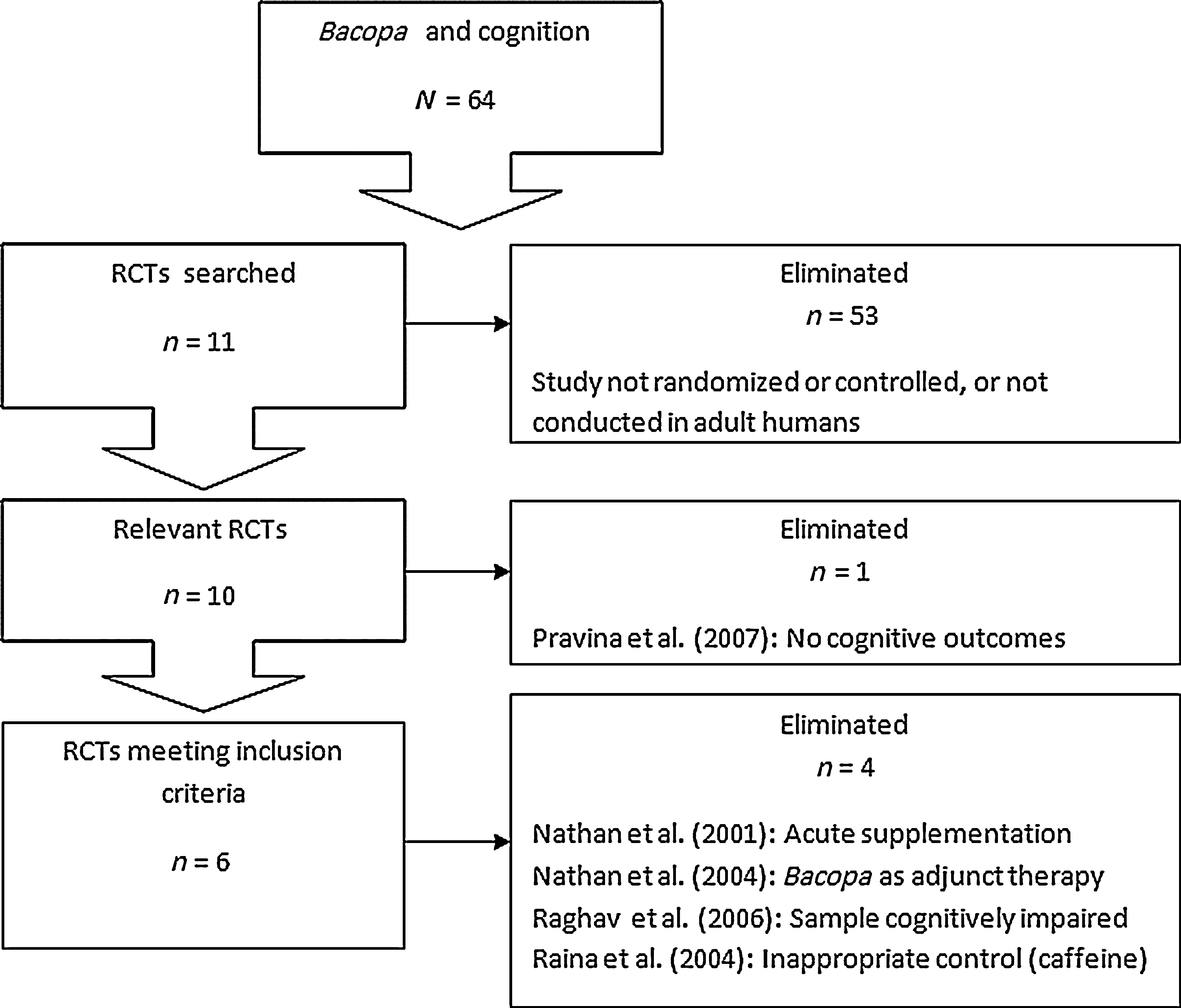
Systematic review flowchart. RCT, randomized controlled trial.
The characteristics of the six studies included in this review are shown in Table 1. Studies were relatively homogeneous. All were conducted over an intervention period of 12 weeks and all were randomized, parallel group, double-blind, and placebo-controlled trials. Sample populations were comparable both in age range and in that subjects tended to be healthy without any chronic illnesses. Although one study recruited a sample with subjective memory complaints, the sample was apparently free from cognitive impairment. 15 Despite no studies using intention-to-treat analysis, the average quality of trials was high (modified Jadad scale mean score=8.5/10).
Duration of supplementation.
All cognitive abilities investigated are listed, regardless of significance.
Quality rating based on augmented Jadad scale.
BM, Bacopa monnieri; DB, double-blind; PC, placebo-controlled; PG, parallel groups; ITT, intention-to-treat analysis used; NS, not specified; yr, years; Visual P, Visual perception; Mental S, mental speed; Language B, language behavior; Number F, number facility.
With respect to the interventions, three studies used KeenMind™ Bacopa supplements, two used BacoMind,® and one used Mediherb®. Across supplements, extract dosages ranged from 300 to 450 mg per day. The KeenMind Bacopa supplement is derived from the stems, leaves, and roots of Bacopa and is extracted with 50% ethanol. BacoMind is a Bacopa supplement, extracted from alcohol and standardized to contain nine active constituents. 16 Both KeenMind and BacoMind have an herb-to-extract ratio of 20:1, and both provide a daily oral dosage equivalent to 6000–9000 mg of dried herb. The Mediherb supplement is manufactured from the dried aerial portions of Bacopa extracted with a methanol-to-water ratio of 70:30. The one study to use the Mediherb Bacopa extract supplemented at 300 mg extract per day. The dry extract ratio is 50:1, providing a daily oral dosage equivalent to 1500 mg of dried herb.
Table 2 outlines the cognitive tests used in each study grouped into the true cognitive abilities defined by Carroll. 14 This method of grouping allows for all cognitive outcomes to be compared across studies. As seen in Table 2, bold font is used to indicate when performance on a cognitive test was significantly improved by Bacopa, as reported in the original study. Across trials, there were no cognitive tests in the areas of auditory perceptual abilities or abilities in producing and retrieving words, ideas, and figural creations. Only two studies examined the effects of Bacopa on reasoning abilities, with no evidence of any enhancement following Bacopa supplementation. 17,18 Only one study investigated the effects of Bacopa on language behavior 17 and one study investigated its effects on number facility, 15 again without any evidence of improvement in either of these cognitive abilities following Bacopa. Five (5) studies used a total of nine cognitive tests indicative of visual perceptual abilities. 15,17 –20 The only two of these tasks to show any enhancement following Bacopa were the Stroop (reduced reaction time) 19 and rapid visual information-processing tasks (fewer false alarms). 20 Three (3) studies (six cognitive tests in total) measured the effects of Bacopa on mental speed. 17,20,21 The only task showing improvement after Bacopa was inspection time, 17 with no reductions evident in choice or simple reaction time.
DS, digit symbol; RVIP, rapid visual information processing; SRT, simple reaction time; CRT, choice reaction time; AVLT, auditory verbal learning test; IR, immediate recall; DR, delayed recall; WAIS, Wechsler Adult Intelligence Scale; WM, working memory; rec, recognition.
p<0.05, ** p<0.01, *** p<0.001. Bold font is used to indicate when performance on a cognitive test was significantly improved by bacopa, as reported in the original study.
Every study included in this review administered tests of memory. Given the richness of information available, this factor was subdivided into the more specific facets of memory identified by Carroll. 14 These domains include (1) memory span: the quantity of information one can recall in order following a single exposure to the information; (2) associative memory: the ability to recall or recognize information paired (associated) with other arbitrary information; (3) free recall memory: recall of arbitrary information when the information to be recalled exceeds the quantity of one's memory span; (4) meaningful memory: the ability to recall or recognize information when the information to be remembered has meaning; and (5) visual memory: recall or recognition of visual material that cannot be easily recoded into a nonvisual modality. 14 The long-term effects of Bacopa administration on these abilities of memory are also presented in Table 2. Again, a cognitive task is highlighted in bold font if performance on the task was improved by Bacopa, as reported in the original study.
As displayed in Table 2, the majority of tests were in the domain of free recall memory, with the most frequently used test being the auditory verbal learning test. Of the 17 tasks in this domain, 9 reported a significant effect of Bacopa on free recall memory. 15,17 –19 Of the six tests representative of memory span, performance on only one task was significantly improved by Bacopa. 15 There were four tasks in the domain of meaningful memory involving the recall of short stories and passages. 15,21 None of these tasks was improved by Bacopa. In the domain of visual memory, there were nine tasks across studies. 15,18 –21 Performance on only one of these tasks was significantly enhanced by Bacopa supplementation. 15
Discussion
The current systematic review of randomized, controlled trials revealed some evidence to suggest that Bacopa is efficacious in improving the learning and free recall of information. This suggests that Bacopa could potentially be clinically prescribed as a memory enhancer. At present, there is insufficient evidence to suggest that Bacopa improves other domains of cognitive performance in healthy nondemented subjects. Although this may reflect heterogeneity in the cognitive tests used across studies, available evidence suggests that Bacopa is more efficacious in improving memory free recall than other aspects of cognitive performance. This review also highlights the focus on testing the memory-enhancing effects of Bacopa at the expense of other cognitive domains.
The focus toward testing memory over other cognitive domains most probably stems from Bacopa's long-standing Ayurvedic reputation as a potent “memory enhancer.” Although the first randomized controlled human clinical trial to explore the long-term effects of Bacopa on cognition reported both enhancement in memory and cognitive speed, 17 follow-up research has not given mental speed (or other cognitive domains) the same attention as memory.
Between studies, there was remarkable homogeneity in the durations of supplementation and dosage sizes with all trials supplementing for 12 weeks. Studies using the same Bacopa extracts tended to supplement at comparable dosages, with KeenMind used at 300–400-mg extract across three studies and BacoMind used at 300–450-mg extract across two studies. This indicates that trials in the area have generally adhered to the recommended daily dosages. To advance current knowledge, future research in the area is required to manipulate dosage sizes and supplementation durations. Given that studies using Bacopa acutely have not produced significant findings 22 and that long-term studies have all been of short duration (3 months), future studies are needed to explore the effects of Bacopa on human cognition over longer supplementation periods. The implementation of longer supplementation periods may also allow for examination of the effects of Bacopa on cognitive decline.
The current review provides future studies with the justification for examining the effects of Bacopa on memory free recall. However, future research is also required to investigate the effects of Bacopa on those cognitive abilities that have been overlooked, including reasoning, mental speed, idea production, language behavior, and number facility.
Strengths of the current review include the breadth of literature searched, the conformity to Preferred Reporting Items for Systematic Reviews and Meta-Analyses (PRISMA) standard, 23 the objective assessment of trial quality by numerous authors, and the stringent inclusion criteria employed. Importantly, trials were rather homogeneous in terms of sample populations, supplementation periods, and administered dosages. Furthermore, included trials were of high quality and all were randomized, placebo-controlled, and double-blind, extending confidence to the cumulative results. The following limitations warrant discussion. This review was limited to qualitative analysis, given the variation in cognitive tests used between studies and the fact that different extracts of Bacopa were compared. An objective meta-analysis in this area is impractical, given that most relevant studies have utilized multiple cognitive tests indicative of a single cognitive ability. Thus, hand picking one of many cognitive tests to include in meta-analysis, in order to satisfy the independence of samples assumption, would be a subjective and therefore flawed exercise. As variations in quality and bacoside content exist between Bacopa products, different products may differentially affect cognitive outcomes. This is something not accounted for when results were pooled in the current review. Only through continued research into the cognitive-enhancing effects of Bacopa will any differential effects between supplements become evident.
Conclusions
There is some evidence to suggest that Bacopa enhances memory free recall in nondemented subjects, and thus Bacopa could potentially be clinically prescribed as a memory enhancer. At present, there is insufficient evidence to suggest that Bacopa can enhance other domains of cognitive performance. This may reflect heterogeneity in the measures employed by studies across these cognitive domains. Research into the cognitive-enhancing effects of Bacopa is still in its infancy, with future research required to explore the cognitive-enhancing effects of Bacopa at different dosages, over longer supplementation periods, and in specific populations. Future research is also required to explore the effects of Bacopa on those cognitive domains shown to be under-researched in the current review.
Footnotes
Acknowledgments
Matthew P. Pase is funded by a Menzies Foundation Scholarship in Allied Health Science. Jerome Sarris is funded by an Australian National Health & Medical Research Council Trainee Fellowship (NHMRC funding ID 628875). The review was funded in part by an Australian Research Council (ARC DP1093825) Discovery grant to Con Stough and Andrew B. Scholey.
Disclosure Statement
No competing financial interests exist for any authors. All authors declare no conflicts of interest.