




Abstract
Objectives:
In line with increasing complementary medicine (CAM) use, the Australian government has committed considerable resources to the training of CAM practitioners. However, it has generally failed to complement this support with regulation or accountability measures. This is particularly true in Australia's largest CAM profession (naturopaths), which remains entirely unregulated but attracts approximately AUD$40 million each year in government funding for its education sector. This article explores the consequences of such unfettered support on professional outcomes.
Design:
Data on Australian government funding for naturopathic student places were collated and compared with various outcome measures including research and professional outcomes.
Results:
Lack of accountability measures attached to government support has enabled the proliferation of commercial education providers in the sector. This is often at the expense of the university sector, which is financially disadvantaged in naturopathic education delivery through extra academic and research obligations not shared by private for-profit providers. The major beneficiaries of government funding have facilitated few formal contributions to naturopathic research or professional development, whereas those with the highest research, professional, and academic output attracted the least government funding. Course content has declined in the previous 5 years, and government funding is still directed to courses that do not meet the minimum education levels for the prescribed government definition of naturopath. Unfettered support has also resulted in a significant increase in student numbers growth, which significantly outstrips growth in utilization, potentially affecting the profession's sustainability.
Conclusions:
Lack of regulation in naturopathic education has resulted in significant risks to patients (through reduced standards) as well as the naturopathic profession itself. Although CAM advocates often focus on pushing for government support for the development CAM, support without the development of appropriate regulatory and accountability measures can ultimately be detrimental to the development of CAM.
Introduction
Given the important primary care role that naturopaths appear to play in the Australian health care sector, maintaining the quality of naturopathic providers through regulated educational standards is essential. Some commentators have highlighted the potential role that an appropriately trained naturopathic workforce may have in addressing future health care challenges, 6 which further begets the need for increased attention on the regulation of naturopathic educational standards.
However, the current legislative and regulatory environment in Australia has contributed to significant heterogeneity of naturopathic standards, particularly in the naturopathic education sector. This is exacerbated by fragmentation of the profession, conflicting interests, and marketplace pressures, all of which has resulted in a significant and rapid change in the sector. These developments may have significant ramifications for not only the quality of practitioners entering the health sector as primary contact practitioners, but also for the development and sustainability of the profession.
Despite the significance of the profession in Australian health care, there has been little detailed analysis of the Australian naturopathic education sector. This article will review current developments in this sector, and outline the impact of various legislative and regulatory arrangements on the profession; explore how these affect the ability of the education sector to provide suitably qualified graduates and support the profession; and consider potential regulatory arrangements that are available to protect not only the public, but also graduate and professional outcomes.
Naturopathic Education in Australia: An Overview
Various government reports have specifically identified naturopathic training as an area in which minimum benchmarks should be clarified. 1,7 These reports have generally recommended statutory regulation, rather than industry accreditation, with a 4-year minimum degree qualification set as the initial entry standard for practice. Currently there is no legal barrier to entry into naturopathic practice, or protection of naturopathic title in Australia, meaning that any individual may enter naturopathic practice without training with no fear of legal consequence. 8 As a result, in 2004 it was found that approximately 10% of naturopaths had no formal training at all. 1,9
Formal naturopathic education in Australia has two distinct levels of qualification that are available concurrently and overseen by different regulatory bodies. The first is a skills-based vocational course (advanced diplomas), and is considered the minimum level of qualification required to practice by most associations. This qualification is monitored by state-based vocational training government departments and is based upon a defined set of competencies as set out in the National Health Training Package. This package describes naturopathy with reference to its modalities, identifying nutrition and herbal medicine as core components, with a compulsory third elective in either homeopathy or massage, 10 rather than the broader principles-based definition favored by the naturopathic community. 11
The second level of qualification, an accredited bachelor degree, has been offered more recently than the advanced diploma and has only been available since 1995. 12 Enforcement of standards at this level is undertaken either externally for private colleges by state-based government offices of higher education, or internally for self-accrediting public universities. The delivery of bachelor-level training of naturopaths may be viewed as a positive step toward improved educational standards for graduating naturopaths and aligns with the government's own Australian and New Zealand Standard Code for Occupations definition of naturopaths, which describes the profession as “Skill Level 1” (commensurate with other primary care health professions), which requires a degree or higher level qualification. However, higher education accreditation through these government departments is largely associated with the governance, epistemology, and pedagogy of the courses offered, with professional associations usually consulted to determine practitioner-specific course content.
Numerous tensions and inconsistencies exist between the concurrent training and delivery of these two levels of qualification. One such issue is the tension between skills and attributes of graduates of the vocational education and training (VET) and the higher education sectors. The nature of VET courses is to focus on skill-based competencies whereas higher education degrees value critical analysis and independent thinking. As a result of this contrast, there is a potential difference in attributes for graduates from either course.
Attempts to move away from a skills-based definition of naturopathy (as described in the National Health Training Package) to a more principles-based definition have been hindered by the difficulty in codifying naturopathic principles into a framework that can be used by education providers and regulators, 13 though international efforts to accomplish this are under way. 14 This difficulty has allowed some Australian education providers to advertise their courses as being certified with poorly recognized and often dubious international accreditation bodies as part of their marketing approach. 13
The culmination of these factors is significant variation between naturopathic courses in Australia. Course contact hours for the 33 formal naturopathic courses offered in Australia ranged between 1240 and 4018 hours over a period of between 2 and 4.5 years. 10 The clinical components of these courses ranged between 198 and 800 hours. These figures imply but do not specifically describe the variable capacity for practice exhibited by different course graduates. Although preliminary attempts to map different practice patterns of naturopaths in Australia have been undertaken, 16 this is an area requiring more detailed exploration.
The Role and Impact of Professional Associations on Training
Naturopathy in Australia is self-regulated by professional associations—of which there are many (over 90 in 2004)—and some professional associations set independent minimum education standards for naturopathy practitioners as new members. Although this is argued by some to provide the necessary controls 17 , in reality there is distinct variation in standards between these groups. Graduates from unaccredited courses may still gain membership via individual assessment, or through grandfather clause arrangements. The result is marked heterogeneity in recognition of courses (and subsequently in graduates) among professional associations, with only 2 of 33 training providers recognized by the five largest professional associations.
Other factors outside of course content or training quality may affect accreditation of education providers by professional associations, such as geographical location, political culture, and historical activity. 18 For example, competitive pressures for members may encourage associations to accredit local colleges to enhance their presence in these areas. Furthermore, many professional associations were formed from splits from parent organizations due to disagreements on issues—including the amount of biomedical and science training required in naturopathic training—resulting in variation in entry standards. 19
This heterogeneity creates difficulties for the public in determining the level of training of their naturopaths. Compounding this is the fact that no protection of title exists for naturopathic titles in Australia, meaning that persons with little or no training at all may use this term to practice. Fragmentation of the naturopathic associations in Australia, and the competitive pressures this creates for members, has led some commentators to note that this has resulted in associations either reducing or resisting increases to their entry standards regarding educational requirements for fear of market disadvantage, with the result that course accreditation is aimed at the lower, rather than higher end of the spectrum. 1,9,10,20
Conversion Courses
In addition to conventional bachelors degree courses, four Australian universities offer “conversion courses” to VET graduates (upgrading their qualifications to a degree). Most of these courses do not include units specific to naturopathy or components designed to extend clinical practice skills and generally have no clinical component. 10 Many of these institutions form “partnerships” with VET providers, who market the conversion option as a “degree pathway,” falsely giving the impression that the vocational course may have independent accreditation equivalent to degree-level training.
Moreover, the existence of conversion courses may encourage substandard vocational naturopathic programs. Though 95% of VET sector naturopathic courses are accredited, 10 they remain of varying quality, and are assessed on vocational competency criteria, rather than criteria generally acceptable for a primary care provider such as a naturopath. 1 In some cases, conversion courses are partnered with unaccredited providers, which has led some commentators to suggest that these universities may be abusing their self-accrediting authority for financial gain due to competitive market pressures in the Australian education sector. 8 While the universities often confer these degrees, there appears to be little actual interaction between the university component of the curriculum and the component offered by private VET providers, and quality assurance mechanisms that would ordinarily be part of the first years of university education are not necessarily applied by the conferring university to the initial course offered by the vocational sector. 10,12 The variability of vocational courses that feed into such conversion programs means that even graduates with the same “conversion” degree from the same institution cannot be assumed to have had the same level of training.
Tensions Between Public and Private Providers
Corporate for-profit private education organizations backed by venture capital now have a dominant role in the complementary medicine education sector in Australia (Figs. 1 and 2). 21 In contrast to corporate for-profit education, the public university and nonprofit sector in naturopathy education has diminished, with no providers in these categories currently offering naturopathic training. There seem to be complex reasons for the decline and abolishment of naturopathy courses in public universities, possibly not least due to the issues described in this article. Universities are subject to various restrictions, obligations, and standards required of a public provider that do not extend to the private sector, reducing the ability of these institutions to remain financially competitive with private providers, who have no such obligations.
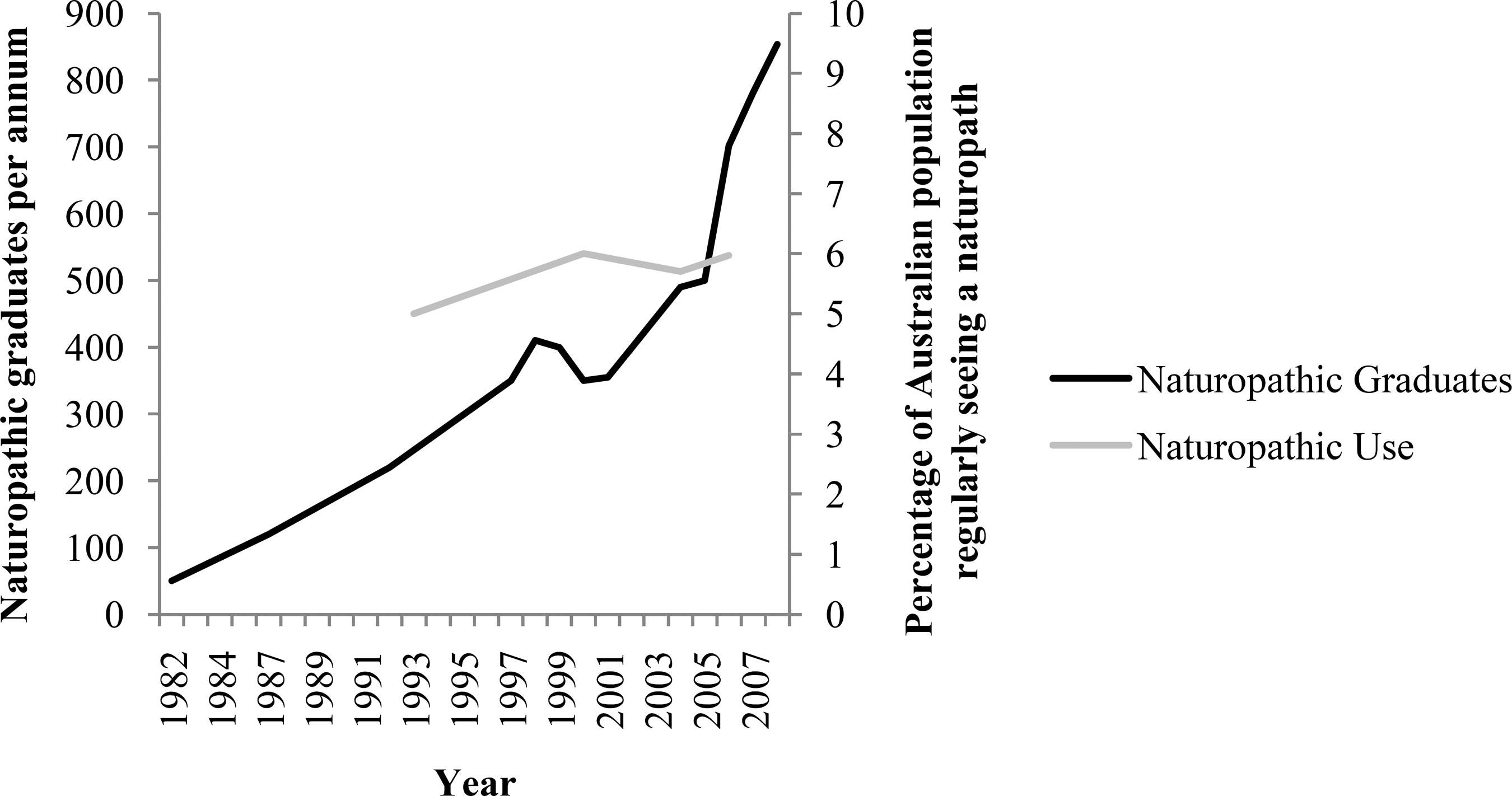
Comparison between increase in naturopathic graduates and public use of naturopaths in Australia. Source: 1982–2004 data taken from Lin report, 1 2005–2008 data based on Australian Department of Education Employment and Workforce Relations estimates. Naturopathic use taken from national complementary and alternative medicine surveys. 28 –30
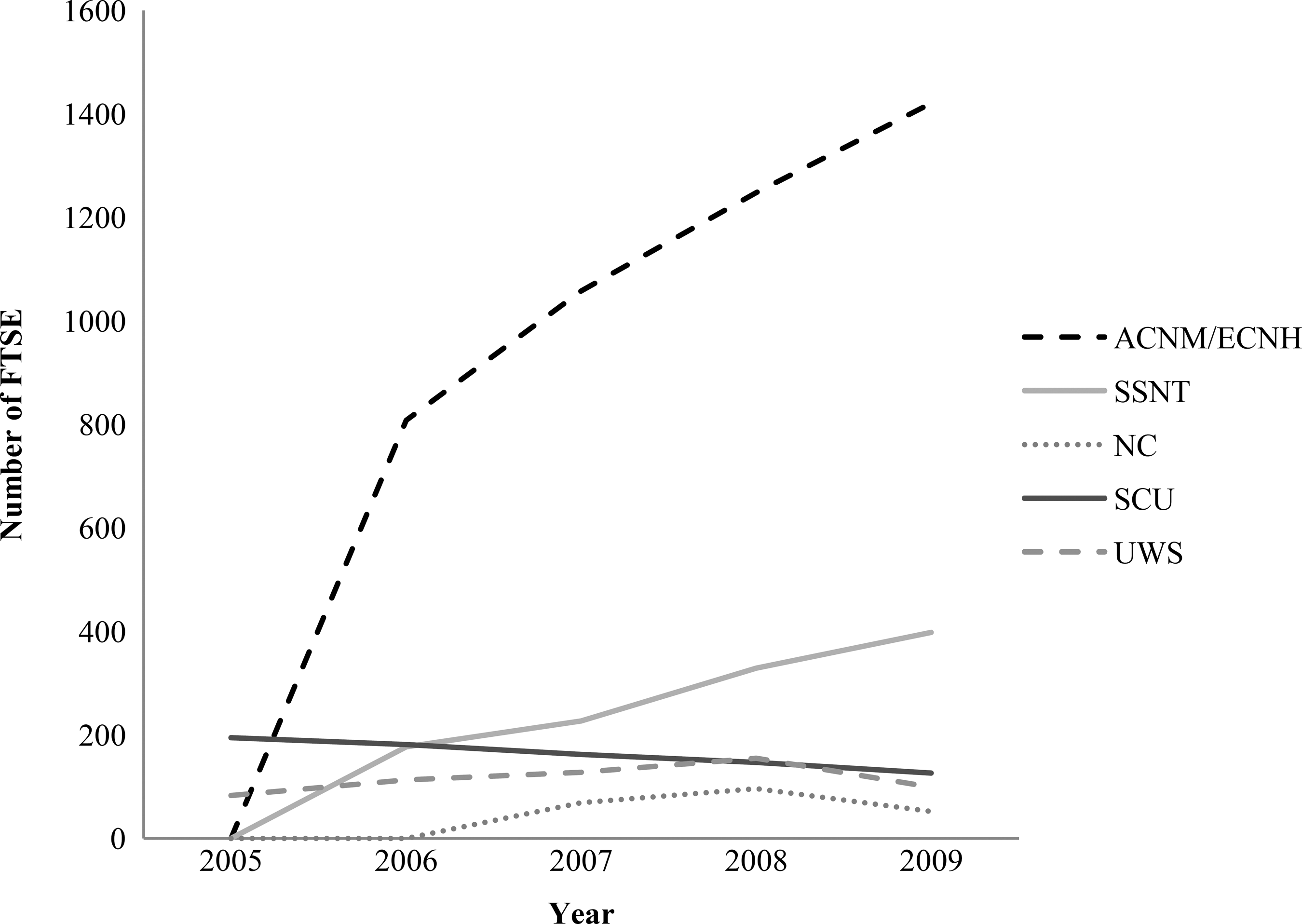
Total number of full-time student equivalents (FTSE) in FEE-HELP or HECS-HELP funded positions at Australian naturopathic colleges 2005–2009. Source: Australian Department of Education Employment and Workforce Relations. Please note Nature Care has since suspended its program in favor of a vocational education and training qualification and both the University of Western Sydney (UWS) and Southern Cross University (SCU) have suspended enrollments in their naturopathic programs as of the time of publication. HECS, Higher Education Contribution Scheme; ACNM/ECNH, Endeavour College of Natural Health; SSNT, Southern School of Natural Therapies; NC, Nature Care College.
The Effects of Increased Government Funding for Naturopathic Education
In 2003, the Higher Education Support Act 2003 allowed private providers of higher education access to government funding for student loans, known as FEE-HELP. Although students are required to repay FEE-HELP loans, this payment can be deferred in a manner similar to those for subsidized public university Higher Education Contribution Scheme (HECS-HELP) arrangements. Eligibility for these loans is dependent on institutional accreditation, rather than course outcomes or measures. Repayments are stratified based upon taxable income and incur no real interest rate above inflation. As such, the new “immediate affordability” of private education meant that providers in this area experienced a large increase in enrollments with the advent of FEE-HELP in 2006 (Fig. 1).
At current rates, long-term increases in graduate numbers are in fact far steeper than the trends in increased demand for actual naturopathic services, which calls into question whether such rampant growth is ultimately sustainable. Much of this increase is directly fueled by government support. In 2008, approximately AUD$22.5 million (USD$24.2 million; £15.1 million) was loaned to degree students studying at private naturopathic colleges through the FEE-HELP scheme (Fig. 1 and Table 1).
Source: College websites (fees) and Australian Department of Education, Employment and Workforce Relations (HECS-HELP and FEE-HELP loan data and enrollments).
2009 was the latest year for which complete data for both public and private education providers were available.
In contrast to private providers who are free to determine individual fee schedules, SCU and UWS are public universities and set nationally standardized course fees with 75% government contributions under the HECS–HELP Scheme.
HECS, Higher Education Contribution Scheme.
Data also suggest a shift to online delivery, with Nature Care providing 60.4% and the Endeavour College of Natural Health now providing 40.5% of their FEE-HELP-funded positions through some of form of distance option in 2009. This is despite distance models being viewed as inappropriate for naturopathic training by Australian government reports, 1 and international accrediting bodies. 22 The move to online delivery seems largely limited to the private for-profit sector, with no public university or nonprofit naturopathic courses offering significant distance options.
In addition to loan schemes, the Australian government offers full-time students nonreturnable support for living and education expenses through various welfare payments (see Fig. 2). Based on 2009 enrollments, conservative estimates would suggest this contribution to be approximately AUD$18.8 million per annum (USD$20.2 million; £12.6 million) for both full-degree and conversion courses. However, this is likely to be a significant underestimation considering that the vocational sector is also eligible for these payments, and has far more naturopathic students than the higher-education sector. 1
This situation may have been exacerbated more recently with the extension of FEE-HELP-type loans to vocational sector naturopathic programs via VET FEE-HELP. Eligibility of VET-level naturopathic courses for FEE-HELP-type payments may result in undermining one of the few incentives for students undertaking and colleges offering more substantial and comprehensive degree programs in naturopathy. This may result in education providers shifting focus back to vocational courses in naturopathy, for which accreditation costs are far less expensive, obligations less onerous, and the resources required for delivery fewer than they are for degree-level education, rather than focusing on improving course content at degree level.
The Effects on Professional Development in Naturopathy
Current trends in naturopathic education may have significant ramifications for the profession. There seem to be few short-term incentives for private for-profit providers to engage in activities that promote professional development, and this is reflected in research and professional development output among naturopathic colleges. As of the beginning of 2010, only one naturopathic faculty (within a public university) has been successful in securing National Health and Medical Research Council funds.
This may be reflective of the low priority the naturopathic education sector in Australia places on building or encouraging capacity in research or academia. In a 2004 survey of 821 naturopathic and Western herbalist education provider lecturers, only 8 (less than 1%) had written for peer-reviewed research, all of whom were employed in the public university sector. 1
A review of MEDLINE® citations from 2000 to 2010 using staff lists supplied by Australia's largest naturopathic education providers (including “conversion courses” and the VET sector's Australian College of Natural Therapies) explored the academic research output of these institutions (Fig. 3). Given the broad scope of naturopathic practice, and the fact that this exercise was undertaken to reflect institutional commitment to scholarly culture, rather than proficiencies in specific areas of research, all citations by naturopathic faculty were included, as opposed to only including those citing naturopathic medicine directly.
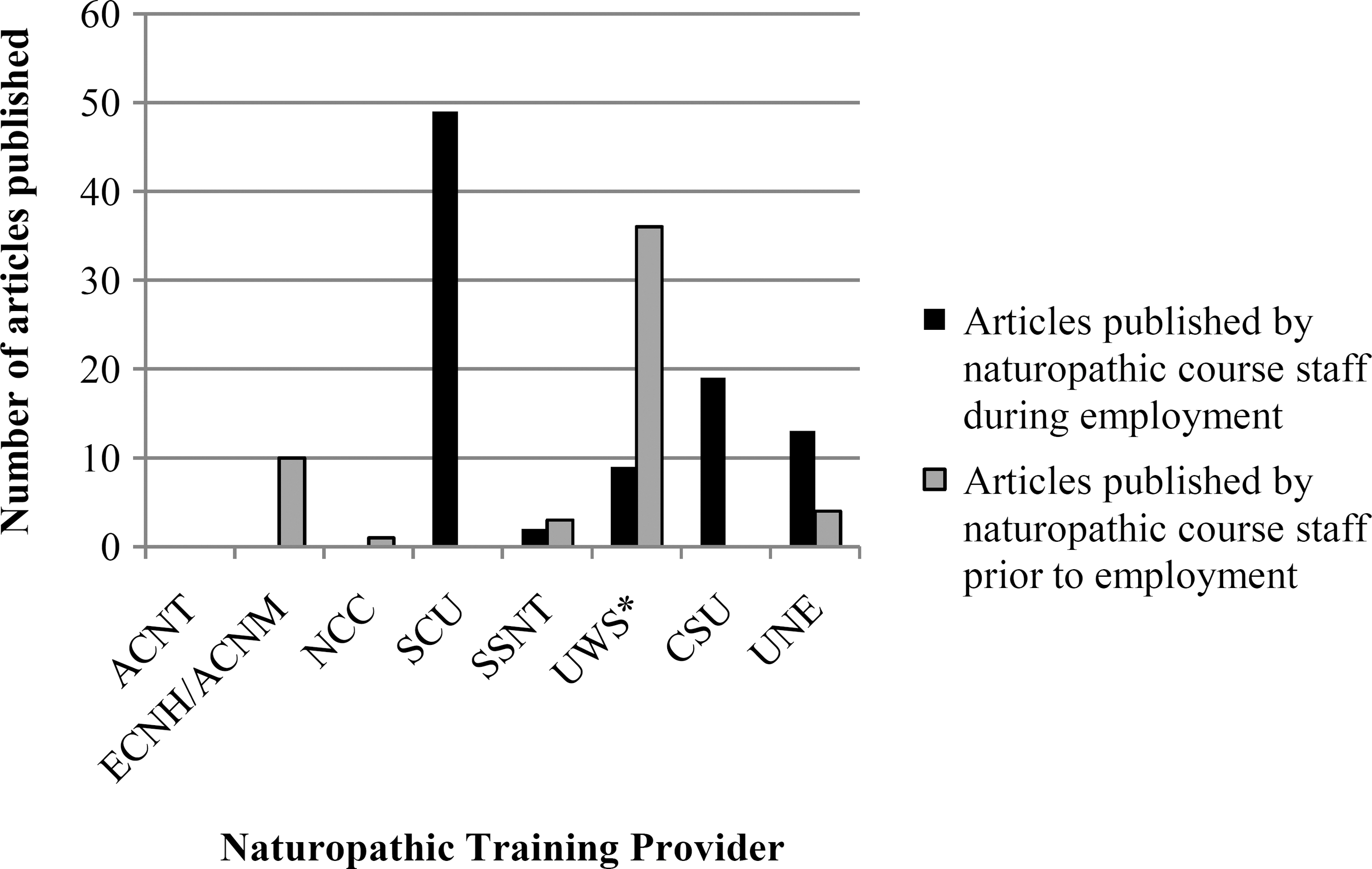
Number of MEDLINE®-listed articles published by naturopathic college staff both during employment and prior to employment at naturopathic colleges. *Note: The University of Western Sydney (UWS) has separate integrated complementary and alternative medicine research programs with over 100 MEDLINE citations since 2000 that build research capacity and provide research opportunities for graduates. ACNT, Australian College of Natural Therapies; ECNH/ACNM, Endeavour College of Natural Health; NCC, Nature Care College; SCU, Southern Cross University; SSNT, Southern School of Natural Therapies; UNE, University of New England.
Figure 3 suggests the dominance of naturopathic courses in the public university sector in encouraging naturopathic research and building capacity among naturopathic graduates, and the lack of commitment of private colleges to build capacity in these areas. Though some private colleges seem to be making laudable efforts to recruit staff with a track record in research, these staff appear to no longer continue to be active in research during their tenure at private naturopathic institutions. This may indicate institutional cultures that do not provide staff members with sufficient resources and support to broaden their expertise and interests in nonteaching or administrative academic endeavors. 10 This may ultimately make it difficult to attract the best staff to these positions, as it immediately hinders career development opportunities more readily found at other institutions or in other academic fields.
The naturopathic profession has disseminated information and encouraged professional growth through its own publications, and therefore conventional research output cannot always be taken to be indicative of the professional development activities promoted by the education sector. For this reason, all articles published in the same period in the four major Australian non-MEDLINE-listed peer-reviewed professional journals related to naturopathy 23 –26 were manually searched to look for contributions from authors from naturopathic education providers (Fig. 4). These results mirrored findings found in the review of MEDLINE-listed journals, with private colleges making little contribution to the naturopathic professional literature. Interestingly, even public universities that only ran “conversion” courses contributed more to both research and professional journals than private colleges running full naturopathic training programs.
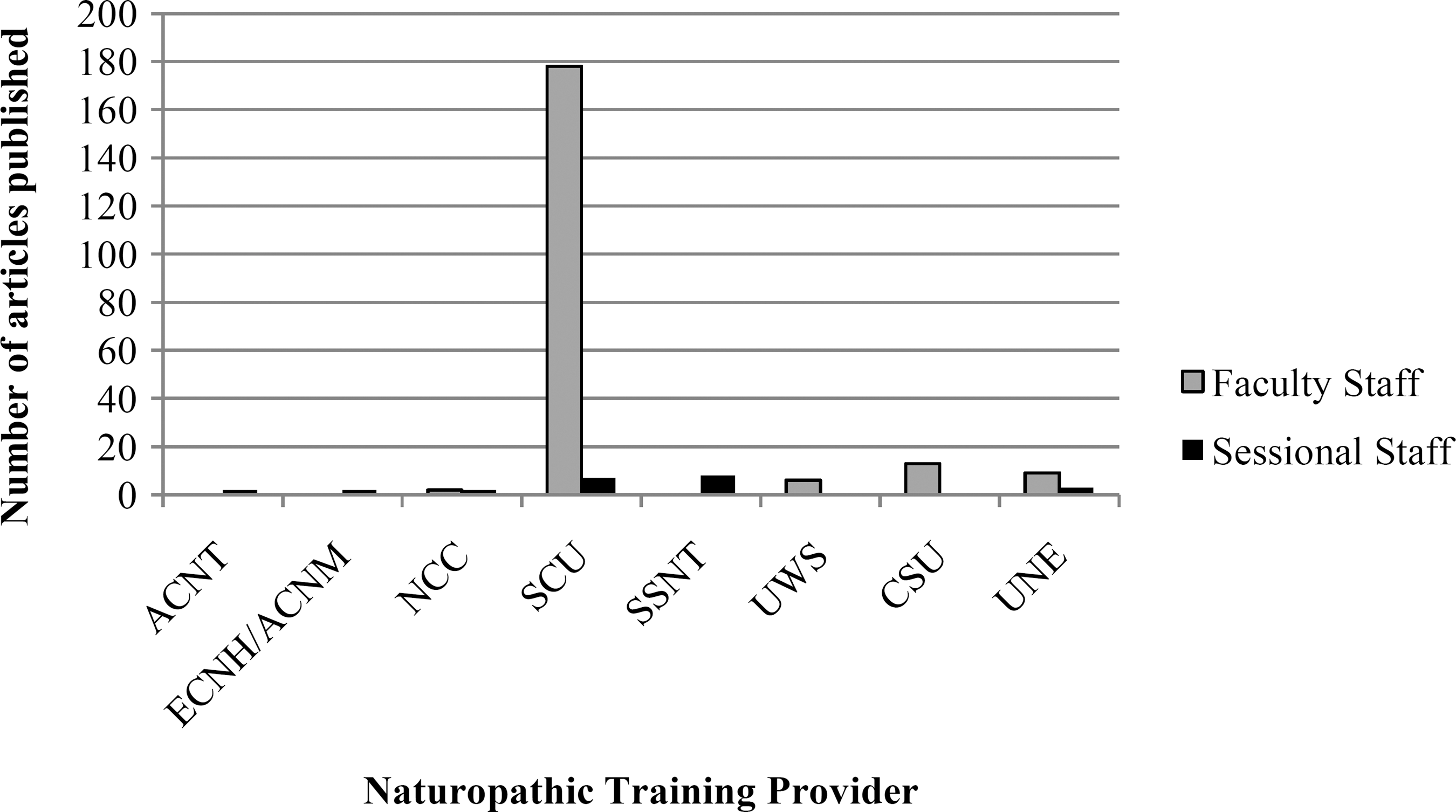
Number of articles published in professional naturopathic literature by faculty staff and sessional staff at Australian naturopathic colleges. ACNT, Australian College of Natural Therapies; ECNH/ACNM, Endeavour College of Natural Health; NCC, Nature Care College; SCU, Southern Cross University; SSNT, Southern School of Natural Therapies; UWS, University of Western Sydney; CSU, Charles Sturt University; UNE, University of New England.
Additionally, the contribution of private colleges is primarily driven by casual adjunct or sessional staff, although in universities it is driven by faculty (Fig. 5). Casual and sessional staff seem to have a dominant role in the private-sector college activities, and this has been a specific criticism of some naturopathic providers. 27 Although in many cases the additional experience of casual teaching staff is an asset to the college and the student body—particularly from those engaged in important clinical and industry roles outside the education sector—sessional or adjunct staff in any field generally receive fewer resources or support for their contribution to these activities from their parent institutions compared with their full time counterparts. Therefore, in many cases, research activity by casual teaching staff may be due more to the impetus and action of individual lecturers rather than college input in these endeavors.
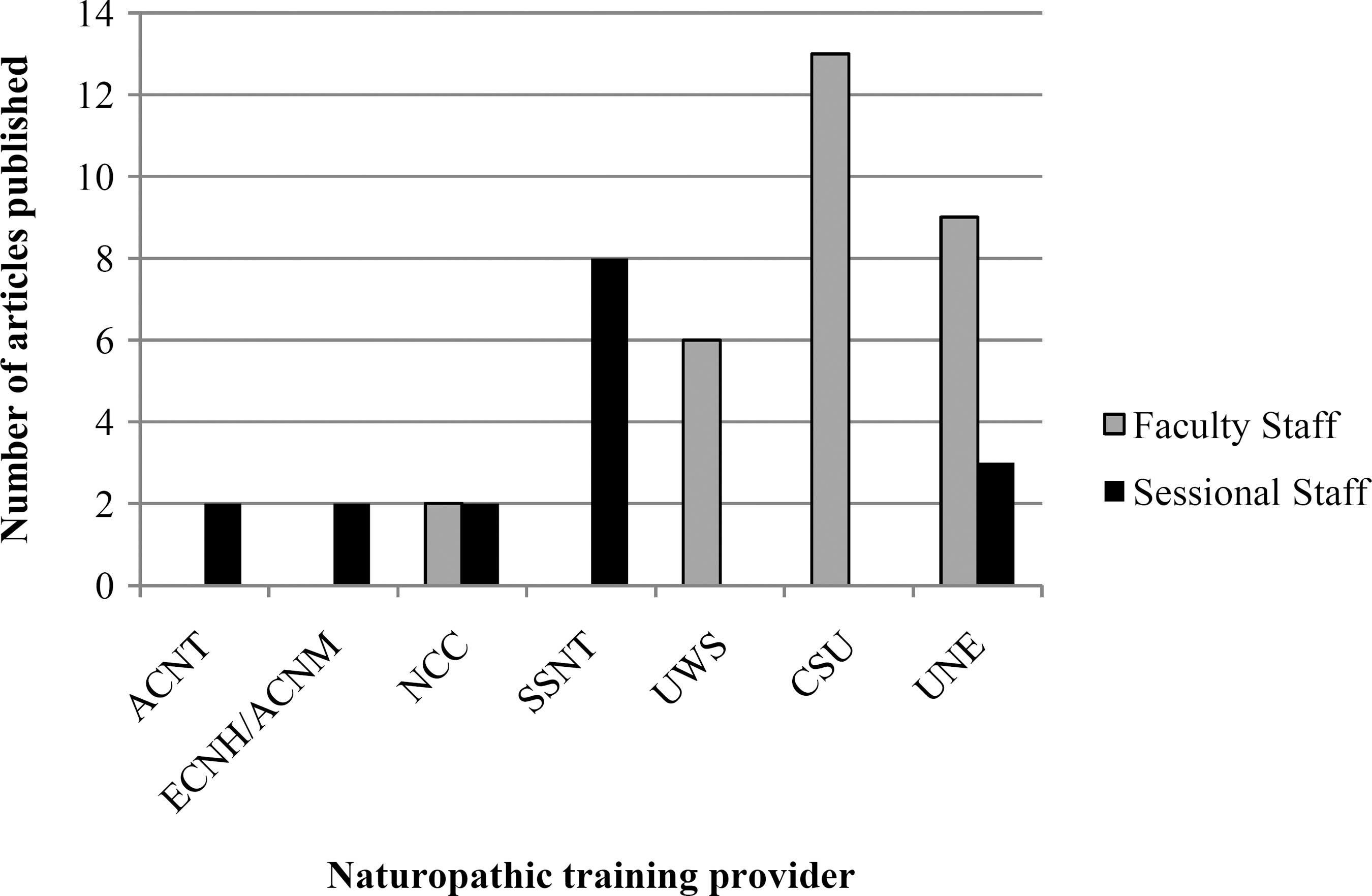
Number of articles published in professional naturopathic literature by faculty staff and sessional staff at Australian naturopathic colleges, with outlier Southern Cross University removed. ACNT, Australian College of Natural Therapies; ECNH/ACNM, Endeavour College of Natural Health; NCC, Nature Care College; SSNT, Southern School of Natural Therapies; UWS, University of Western Sydney; CSU, Charles Sturt University; UNE, University of New England.
Discussion
It is noteworthy that in all measures, including actual course content (examination found that average course content had also declined over the past 5 years) 1 , the output of naturopathic courses bears little relationship to the student numbers in those courses, or the government funds they attract. The current situation appears to perversely direct the bulk of government funding and support for naturopathic education to providers who offer the poorest training. In effect, the quality of naturopathic education in Australia is being killed by government kindness, with government funding and support linked only to student numbers rather than outcome or accountability measures. This encourages a commoditised approach to naturopathic education, with training institutions offered few incentives to improve standards of training, or even to maintain minimum standards.
By ignoring the development of the profession of naturopathy and not actively participating in the growth of the profession (which ensures institutional viability), the naturopathic education sector risks becoming unsustainable and may, at the current rate, be unable to continue. Students risk being exploited financially, left with large government debt and poor occupational outcomes due to the lack of support by many education providers in development of the naturopathic profession. This is of particular concern as private colleges place no limits on enrollments either through providing caps or minimum entry requirements of their courses. This exacerbates the risks of poor occupational outcomes for graduates as large numbers of practitioners enter the profession. In this context, commentators have expressed concern that this competitive marketplace may encourage opportunistic practices that threaten public safety as practitioners compete for market advantage. 1
Other commentators suggest that market forces ensure that unqualified therapists will struggle to be successful in practice. 26 However, this does not reflect the current state of practice because various Australian government reports have indicated that unqualified, untrained, or otherwise unfit practitioners have had little trouble developing financially successful practices. 27 In fact, market forces may work against protecting naturopathic education standards. Fragmentation of the profession through multiple (over 90) professional associations has meant that no one association has raised their training standards due to the potential loss of new members to competing associations. 1,18
Conclusions
Insufficient enforcement of standards in naturopathic education and a market dominated by private enterprise have resulted in inconsistent outcomes for graduates both educationally and professionally. This situation is exacerbated by uncontrolled government funding, and fragmentation of associations within the naturopathic profession. With this in mind, and for the safety of the Australian public and the profession itself, national statutory regulation of educational requirements of naturopaths is needed. The international complementary medicine community should learn from the Australian naturopathic experience. As can be observed from this article, a successful practitioner education sector needs to be measured on outcomes that reflect the graduate qualities and academic standards, rather than the size of the sector. Often the CAM community focuses solely on winning government support for their professions. However, if government support is not linked to these measures, this can lead to deleterious effects for the safety of not only the public but of the profession as a whole.
Footnotes
Disclosure Statement
No financial conflicts exist.