




Abstract
Objectives:
The objective of this study was to experimentally determine whether an unimprinted intention host device (IHD), electrically activated in the near presence of the Maitreya Buddhist relics for about 72 hours (3 nights), could be imprinted by its loving kindness essence into the IHD. This will be referred to as a “first-degree relic IHD.”
Design:
This first-degree relic IHD was placed in an unused, unconditioned room in a Scottsdale, AZ home in the presence of a water vessel (pH ∼5.6) being continuously monitored via a pH-sensor system that was computer recorded. This particular IHD was electrically switched on. Initially, no intention instructions were given to the system. After about 2200 hours, an intention statement was written to respectfully ask the first-degree relic IHD that the excess thermodynamic free energy aspect of this loving kindness essence be made manifest in this space so that its thermodynamic magnitude could be experimentally measured via the pH-sensor reading.
Results:
It was shown that during the first 3 months, only a small increase in water pH was recorded. However, during the postintention period, the pH increased by about +2.5 pH units or ∼60 meV increase in the thermodynamic free energy of the physical space, a very significant change. The excess thermodynamic free energy suggests that a fundamental change of the gauge symmetry state of the unconditioned room had occurred to a higher state.
Conclusions:
The following were concluded in this study: (1) Imprinting meaningful information onto a simple unimprinted IHD via passive exposure to the Buddha relics is possible. (2) Activating this IHD information to, in turn, imprint itself onto the space of a particular room so that a quantitative thermodynamic measure of its energetic essence can be physically realized is also possible. (3) Crucially, a verbal request from a deep meditative state by four humans appeared to be a necessary condition for this “imbedded loving kindness essence” to manifest itself in this way.
Introduction
About 3 months later, the first two authors, WAT and JET, visited the Manek home and subjectively felt a residual “space conditioning” within the room in which the relics had been displayed for public presentation and personal experiencing. One of us (WAT) speculated that perhaps these relics on pilgrimage had been created by the passing Buddhist Masters via a specific intention, somewhat like the first four authors (with the unseen) had co-imprinted intention host devices (IHDs) for the four target experiments, the results of which have been published elsewhere. 2 –10 During many of the discussions regarding the energies of the relics, one hypothesis that was considered was that the physical space of a tour venue, such as the Manek home, undergoes a fundamental shift or conditioning when the relics are present and that this could potentially be tested either at a future relic tour or via using the imprinted electronic device (hereafter, termed “the first-degree relic IHD”). WAT and colleagues have developed subtle energy detectors, and any change in physical space characteristics can be quantified in a predictable and reproducible way.
Materials and Methods
Six (6) months after the Manek home relic tour, WAT asked NM if he could use one of her 11 “first-degree relic IHD” devices to conduct a serious experiment to test the above hypothesis in the confines of the Tiller Scottsdale house's empty, unused, unconditioned room. She agreed and so WAT, WED, and J. Gregory Fandal set up the following procedures: (1) the “first-degree relic IHD" was placed on top of two UEDs in the empty room, (2) three different types of detector systems: a pure water pH-measurement system, a temperature, TAIR, measurement system, and a magnetometer-measurement system. A few weeks later, everything was switched on, running, and recording. It was hoped that the two unimprinted IHDs would be converted to “second-degree” relics via NM's “first-degree” relic. WAT's general target experimental work has shown that there is a connectivity or entanglement of information between measurement systems, and similarly, one should expect that a connectivity of an IHD and the two UEDs would occur. Initially, no intention instructions were given to the experimental system.
Results
Figure 1 presents cumulative pH data (Tiller WA, Dibble WE, Ludwig T, Bishof M, unpublished observations) measured in the room between February 21 and August 18, 2011. The pH-electrode was recalibrated and the old water replaced by fresh water on a 1-week cycle for about the first half of the 5½-month period and then switched to a 2-week recalibration cycle. During this first period, only a very slow growth in pH(t) occurred. This slow result was unexpected and was all the more striking in that, subjectively, the physical space changes appeared to occur rapidly over only a few hours at the Manek home relic tour. During this intervening period, discussions also occurred between WAT and NM concerning the probable EM gauge symmetry state of the “first-degree relic IHD.” One potential issue with the experimental setup was that it was designed to detect the SU(2) * gauge level conditioning by human intention. On the other hand, the Buddha relic IHD was clearly more robust, by subjective (feeling) measures. It was possible, therefore, that the space conditioning by the relics is of a much higher gauge symmetry state than SU(2), but by how much is not certain. So the authors began to wonder if it was at so high a gauge level that its gauge state energies were too high to perhaps register on our measurement space and be, in turn, accessible by our pH-detector system.
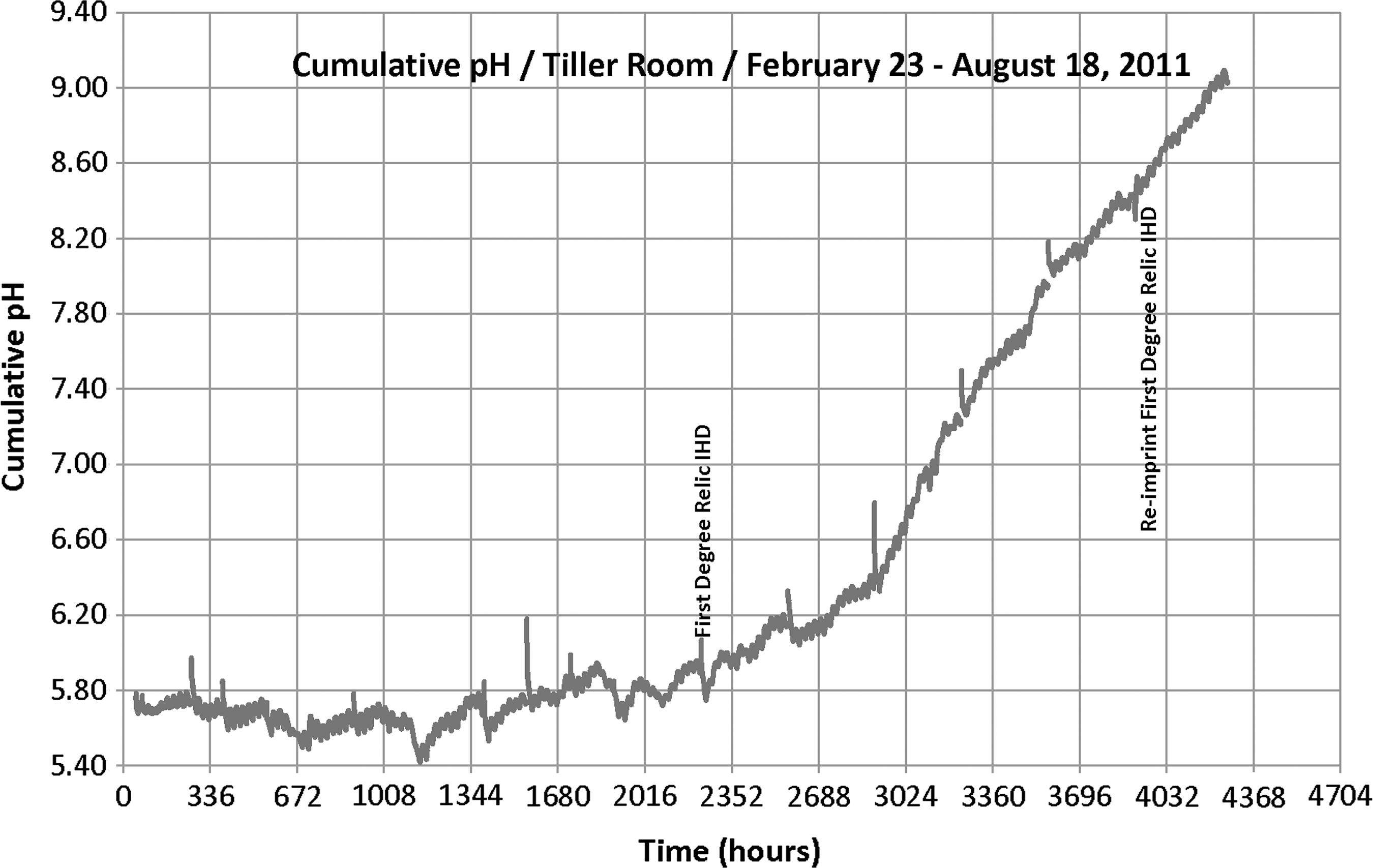
Plot of Tiller room cumulative pH change from the Nisha Manek “first-degree” (secondary) relic. IHD, intention host device.
JET came to the rescue, suggesting that WAT should perhaps write an intention statement to fully clarify what we are asking “the first-degree Buddha Relic IHD" to specifically do. The relevant part of that, ∼2200 hours, intention statement is the following: “This IHD has been exposed for 3 days some time ago to the Maitreya Buddha relics and thus has, to some degree, been information-entangled with that loving kindness essence. This loving kindness essence is thought to still reside with this particular IHD at some very high-gauge symmetry level of nature and thus still retains a significant excess thermodynamic free energy per unit volume state relative to our normal U(1) gauge state. It is respectfully requested that this excess thermodynamic free-energy aspect of this loving kindness essence be made manifest in this space so that (1) its thermodynamic magnitude can be experimentally measured via the active pH, temperature, and magnetic field sensors present in this space; and that (2) this loving kindness essence can also be transferred, at a very significant strength, to the two immediately underlying, originally unimprinted IHDs in this space.” We (WAT, JET, WED, and JGF), used this intention statement in a subsequent meditation and activation of the unconditioned space. The remarkable change in Figure 1 after ∼2300 hours was very encouraging.
In the following ∼2 months, ΔpH increased by about +2.5 pH units or about 60 millielectron volts. In thermal energy terms, this number is very large. It would take an effective temperature increase of about ΔTeff≈+700°C to produce such a thermodynamic energetic effect. Since the temperature in the room space did not change by more than ±10°C, this measured thermodynamic free- energy change was probably due to a large decrease of thermodynamic entropy via an increased coherence in the strongly “conditioned” space.
Discussion
The lessons to be taken from this short study are as follows: 1. Imprinting meaningful information onto a simple electrical device (IHD) via passive exposure to the Buddha Relics is possible; 2. Activating this IHD information to, in turn, imprint itself onto the space of a particular room (the unconditioned room in the Tiller home) so that a quantitative thermodynamic measure of its energetic essence can be physically realized (Fig. 1) is also possible; 3. Crucially, a verbal request from a deep meditative state by 4 humans appeared to be a necessary condition for this “imbedded loving kindness essence” to manifest itself in this way; and 4. The “physical space-conditioning” by the “relic-imprinted IHD” appears to be much stronger than that generated during the original IHD experiments.
2
–9,11
Conclusions
In closing, it is worth repeating the key protocols utilized in the four initial ground-breaking target experiments
2,11
with IHDs: 1. Carefully design the target experiment, set it up in a room, and set it running automatically to gather background data. 2. Take an unimprinted IHD, set it on a tabletop around which a group of well-qualified meditators sit. Plug the device into an electrical wall outlet and switch it on. The meditators go into a deep meditative state while consciously connecting at a feeling level with each other in the earth plane and with imagined unseen colleagues in higher dimensional planes. When the presence of these unseen colleagues is felt by the meditators, the previously designed imprint statement describing the purpose for this particular IHD is read (usually by WAT).
The several parts to this intention statement for the IHD are: 1. To activate the indwelling consciousness of the experimental space, 2. To cleanse that space to remove all prior unfavorable or negative entanglements so as to convert it to a sacred space suitable for the intended use, 3. To lift this cleansed and sacred space to a strongly coupled state of physical reality (at least the SU(2) electromagnetic gauge symmetry state), and 4. Verbally, state what the special tuning characteristic for this IHD is (see the specific intention statement used above).
This imprinted IHD is then sealed and stored in an electrically grounded Faraday cage (FC) until everything is ready for use. When sufficient background data have been gathered, the IHD is taken out of its FC, placed within ∼1 foot of the running experiment, plugged into an electrical wall-socket, and switched on. 12
Footnotes
Disclosure Statement
The authors declare that we have no competing financial interest.
*
This group theory notation applies to a member of the special unitary or unmodular group SU(n). The elements of SU(n) have n2-1 independent parameters. The neutron↔proton exchange reaction, which requires neutrino involvement, is also a member of the SU(2) group.