




Abstract
Objective:
To investigate the effect of a short-term yoga-based lifestyle intervention on risk factors for cardiovascular disease (CVD) and markers of inflammation and endothelial function in overweight and obese men.
Design:
Nonrandomized prospective lifestyle intervention study with pre–post design.
Setting and location:
Integral Health Clinic, an outpatient facility providing yoga-based lifestyle intervention programs for prevention and management of chronic diseases.
Subjects:
Overweight and obese men (n=51) were enrolled in the study. Subjects who were physically unable to participate and those participating in other interventions were excluded from the study.
Intervention:
A pretested intervention program including asanas (physical postures), pranayama (breathing exercises), group discussions, lectures, and individualized advice.
Outcome measures:
The primary outcome measure was weight loss, and the secondary outcome measures were clinical and laboratory correlates of CVD risk, levels of interleukin-6 (IL-6), adiponectin, and endothelin-1 (ET-1).
Results:
Men (n=51, body mass index [BMI] 26.26±2.42 kg/m2) were enrolled and underwent a yoga-based lifestyle intervention for 10 days. Of 51 subjects, 30 completed the study. There was a significant reduction in weight from Baseline to Day 10 (74.60±7.98, 72.69±8.37 kg, p<0.001, respectively), BMI (26.26±2.42, 25.69±2.47 kg/m2, p<0.001, respectively), and systolic BP (121.73±11.58, 116.73±9.00, p=0.042, respectively). There was a significant reduction in plasma IL-6 from Baseline to Day 10 (median 2.24 vs. 1.26 pg/mL, respectively, p=0.012). There was a significant increase in the plasma adiponectin from Baseline to Day 10 (median 4.95 vs. 6.26 μg/mL, respectively, p=0.014). Plasma ET-1 level remained unchanged.
Conclusion:
These findings suggest that even a short-term yoga-based lifestyle intervention may be an important modality to reduce the risk for CVD as indicated by weight loss, reduction in systolic blood pressure, an increase in adiponectin, and decrease in IL-6 in overweight and obese men.
Introduction
Materials and Methods
Participants
Male subjects (n=51) aged 18 to 55 years who were overweight or obese per World Health Organization/Indian Council of Medical Research criteria 27 for body mass index (BMI) were enrolled in the study during April 2010 to September 2011. The key inclusion criteria were BMI≥23 to <35 kg/m2 and consent and ability to attend this short-term lifestyle intervention program at Integral Health Clinic, Department of Physiology, All India Institute of Medical Sciences, New Delhi, India. The key exclusion criteria were physical inability to perform the physical exercises, participation in other extensive dietary and/or exercise intervention programs or regimens, substantial weight-loss (losing at least 10 % of initial body weight) in the preceding 12 months, and current use of nonsteroidal anti-inflammatory medications.
Study design
The study was a prospective outpatient clinic-based study and included a short-term yoga-based lifestyle intervention program aimed at orienting the participants toward a healthy lifestyle. The total duration of subject participation was 10 days, spread over 2 weeks. The laboratory assessment of adipocytokines and endothelial function was done at Baseline (Day 0) and at the end of intervention (Day 10). The post-intervention sampling at Day 10 was done at the end of the concluding session to balance the immediate effects of yoga. The concluding session lasted for approximately 1 hour and included feedback from each participant and study closeout activities. The adipocytokines assessed were plasma IL-6 and adiponectin, and the marker of endothelial function was plasma ET-1. Also, serum lipid profile and clinical correlates of cardiovascular risk factors were assessed.
The study was conducted in accordance with the Declaration of Helsinki and was approved by the local ethics committee and Institutional Review Board. All subjects provided their informed consent. The study was registered at Clinical Trial Registry India (CTRI/2012/02/002396).
Lifestyle intervention
This intervention program included outpatients, and lasted for 2 hours each day for 10 days. It consisted of an integrated and pretested intervention as published previously, 23,28 and included theory and practice sessions. The batches of participants were kept small including only six to eight participants at a time so as to ensure that participants got enough time with the experts (medical doctors, dieticians, and yoga experts). A typical day in the program started with a set of physical postures and breathing exercises for approximately 1 hour. Medical doctors provided individualized advice to the participants and included counseling for any general illness or chronic diseases, stress management, nutrition, and substance abuse. A nutrition awareness program was also included; however, providing meals was not a part of the program and making dietary changes was left to the individuals. The diet recommended was predominantly vegetarian, consisting of a combination of cereals and pulses, preferably unrefined, as the staple foods; moderate amounts of judiciously chosen fat; about 500 g of vegetables and fruits daily, with vegetables being predominantly leafy greens and at least some eaten raw; moderate amounts of milk and milk products (yogurt was suggested); and spices in moderation. Questions and unstructured discussions were encouraged among the participants. The study assessments were done at Baseline and at the end of the intervention (i.e., Day 10). All the assessments were done while subjects were relaxed, and between 8:00 AM to 9:30 AM to avoid any biases.
Study assessments
Weight and height was measured, and BMI was calculated for all participants. Systolic and diastolic blood pressure and pulse rate were also recorded for all the subjects. A fasting blood sample was collected from each participant, and serum and plasma were separated and stored at −80°C until analysis. Serum lipid profile was done using enzymatic method, which included estimation of total cholesterol, HDL-c, low-density lipoprotein, triglyceride, and very low density lipoprotein. Plasma IL-6 (Gen-Probe, Besancon Cedex, France), adiponectin (Biovendor, Brno, Czech Republic), and ET-1 (Biomedica Medizinprodukte, Vienna, Austria) were measured using commercially available ELISA kits. Samples were estimated in triplicate, and average values were used for calculations. Quality control assays were taken, and all the methods were standardized prior to estimations.
Statistical analysis
Descriptive statistics are provided for the demographic data and baseline profile. The markers of inflammation and endothelial dysfunction before and after intervention at Baseline and Day 10 were compared by using paired t-test in parametric data and Wilcoxon Sign Rank test in nonparametric data. The correlations between different variables were obtained by Pearson's correlation test for parametric data and Spearman's rho correlation test for nonparametric data. P-value<0.05 was taken as significant. Statistical software SPSS Version 11.5 and 16.0 were used for statistical analyses. Data is expressed as either mean±SD or median (interquartile range [IQR]), as appropriate.
Results
The study included 51 overweight and obese men with a mean age of 39±12.2 years. Of these, 30 subjects completed the study, 11 subjects were lost to follow-up (did not attend one or more sessions), and 7 subjects did not report at Baseline (did not attend any session). The phone calls to the participants revealed that these subjects missed one or more visits or dropped out due to other urgent engagements. Blood samples from three subjects did not qualify for biochemical estimations. The mean Baseline BMI of the participants was 26.26±2.42 kg/m2. The systolic and diastolic blood pressure at Baseline was 121.73±11.58 mm Hg and 79.13±7.46 mm Hg, respectively. There was a significant weight-loss (p<0.001), that was reflected in a significant reduction (p<0.001) in BMI from Baseline to Day 10 following intervention (Table 1). Simultaneously, there was significant reduction in pulse rate (p=0.02) and systolic blood pressure (p=0.042) (Table 1). There was a nonsignificant but clinically meaningful improvement in serum lipid profile (Fig. 1).
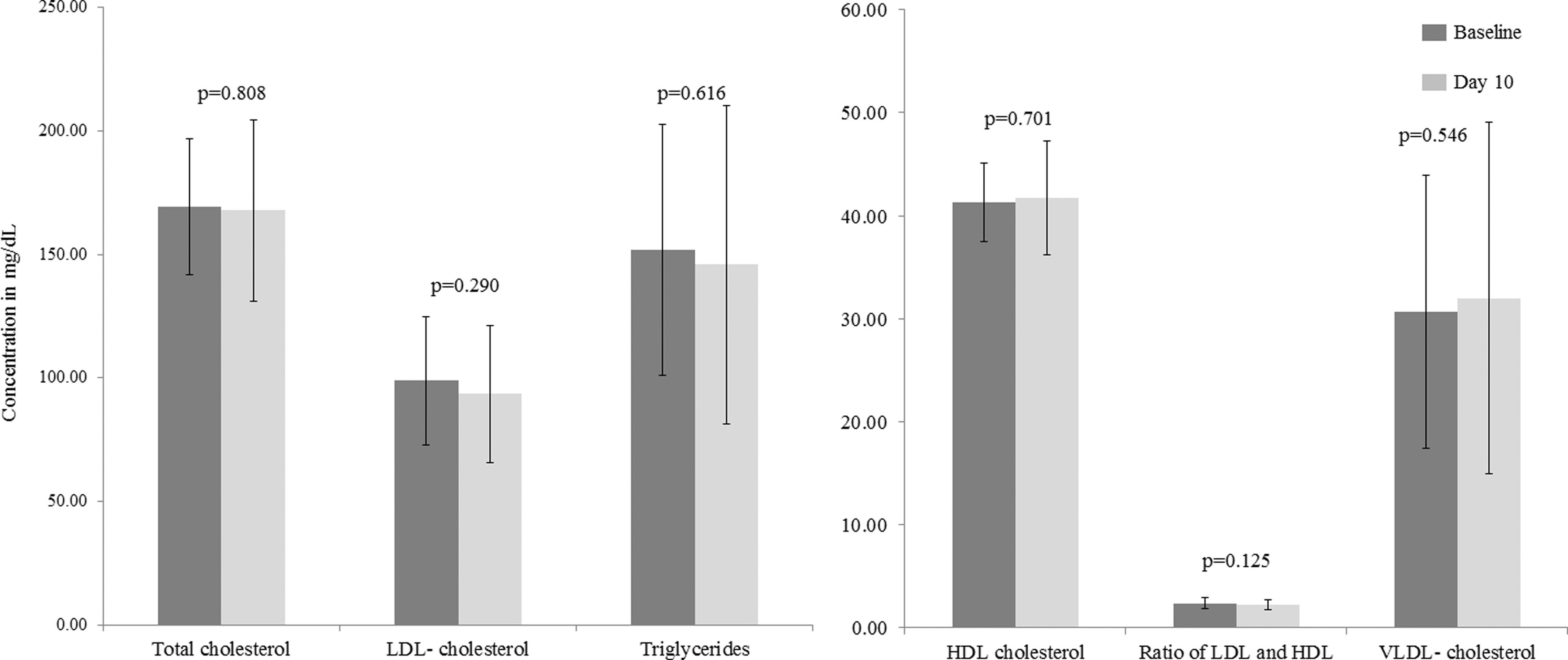
Lipid profile pre- and postintervention. All values are expressed as mean±SD. LDL, low-density lipoprotein; HDL, high-density lipoprotein; VLDL, very low-density lipoprotein.
All values reported as mean±SD.
There was a significant increase in levels of plasma adiponectin at Day 10 versus Baseline (median [IQR]; 4.95 [4.28–6.67] vs. 6.26 [4.23–8.82] μg/mL, respectively, p=0.014). The plasma levels of IL-6 showed a significant decrease following intervention at Day 10 as compared with Baseline (median [IQR]; 1.26 [1.00–2.60] vs. 2.24 [1.07–2.99] pg/mL, respectively; p=0.012). However, there were no significant changes in the levels of plasma ET-1 (Table 2).
All values reported as median (interquartile range).
The postintervention correlation statistics showed a significant correlation between reduction in weight and increase in adiponectin (r s=0.479, p=0.013) as well as reduction in BMI and increase in adiponectin (Spearman's correlation coefficient, r s=0.455, p=0.019). The decrease in systolic BP was significantly correlated with decrease in IL-6 (r s=0.397, p=0.030). Also there was a statistically significant correlation between reduction in BMI and increase in HDL (Pearson's correlation coefficient, ρ=0.578, p=0.001). The significant correlations are presented in Figure 2.
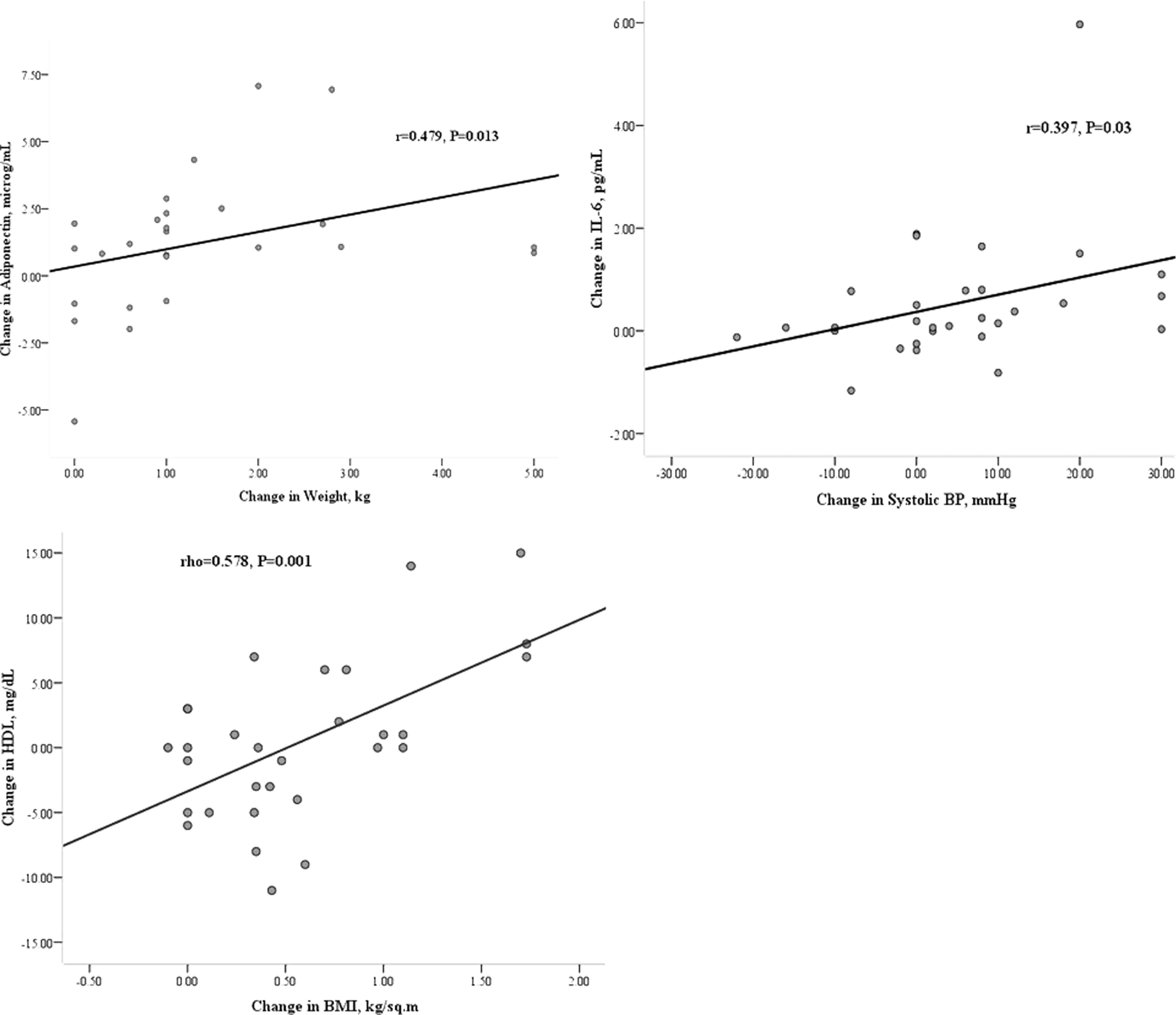
Correlation between outcome measures. *p<0.05, statistically significant. IL-6, interleukin-6; BP, blood pressure; BMI, body mass index; r s, Spearman's correlation coefficient; rho, Pearson's correlation coefficient.
Discussion
Overall, there was a significant reduction in body weight that was reflected in a significant reduction in BMI, which was achieved in a short duration of 10 days. There was significant reduction in blood pressure and a clinically meaningful improvement in the serum lipid profile. There was a significant increase in plasma levels of adiponectin, reduction in inflammation, and an anti-atherogenic effect. The decrease in inflammation was also evident from decreased levels of plasma IL-6, which could possibly contribute towards cardiovascular risk reduction. However, in this study, no significant changes in ET-1 levels were observed. The reduction in weight and BMI was significantly associated with improvement in markers of cardiovascular risk such as adiponectin and IL-6. The results suggest that a short-term yoga-based lifestyle intervention might be efficacious in reducing obesity-related inflammation and may delay or halt the progression of various components of cardiovascular risk factors such as hypertension and atherogenesis.
It has been shown that overweight and obese subjects often exhibit low-grade ongoing inflammation, 29 which may later culminate in a chronic disorder if it goes untreated and unaddressed. Of various inflammatory mediators, IL-6 is of key importance because it is predicted to be a central link between obesity, inflammation, and coronary heart diseases. 30 Since IL-6 is a major risk factor and predictor of CVD 9,31 it acts as a surrogate marker of cardiovascular health. The present study showed a significant reduction in plasma IL-6 levels following a short-term yoga-based intervention. These findings are in line with recent studies in which there was a trend towards reduction in IL-6 following a lifestyle intervention 32,33 ; however, other studies failed to show any change in levels of IL-6 following physical activity. 34,35 This might be due to behavioral lifestyle factors, such as psychological stressors, anxiety, and depression, also being able to substantially influence inflammation, and yoga being a well-known practice that reduces stress, anxiety, and depression through a positive psychoneuroimmune effects. In this study, a significant reduction in IL-6 was associated with a significant reduction in systolic blood pressure, which may be protective against CVD. Moreover, reduction of IL-6 may be beneficial in reducing all-cause mortality since IL-6 is a known predictor of all-cause mortality. 36 The most plausible reason for reduction in levels of IL-6 in this study is weight loss following the intervention since 15%–30% of the circulating IL-6 levels are contributed from adipose tissue in the absence of acute inflammation. 11
Obesity is associated with dysfunctional adipocytes contributing to increased systemic blood pressure via the renin-angiotensin system. 12 Obesity is also associated with low levels of adiponectin, a potential endogenous anti-atherogenic 13,14 and anti-inflammatory plasma protein. 15 Epidemiological studies suggest that reduced plasma adiponectin levels are independent predictors of CVD 22,37 and lower levels are associated with impaired endothelial function. 38 In the current study, there was a significant increase in plasma adiponectin, which correlated with weight loss and reduction in BMI. These findings are similar to those published previously that showed weight loss was associated with an increase in plasma adiponectin levels. 39 Since it has been suggested that hypoadiponectinemia is a risk factor for the development of early atherosclerosis 40 and may play a role in pathogenesis of coronary atherosclerosis, especially in obese and insulin-resistant subjects, 41 increase in the levels of adiponectin may play a role in prevention of CVD. Possibly, this benefit is derived from two different mechanisms of action of adiponectin; specifically, decreasing inflammation 15 and favoring endothelium-dependent vasorelaxation. 16
ET-1 is a potent vasoconstrictor and has been implicated in the pathogenesis of hypertension, coronary vasospasm, and heart failure. It has been reported that ET-1 levels are higher in obese subjects. 18,19 Further, it has been suggested that ET-1 may enhance production of IL-6, which results in increased inflammation. Since the yoga-based intervention resulted in decreased levels of IL-6, there is a possibility that this decrease would be associated with reduction in ET-1 levels. No significant change in levels of ET-1 was observed, which might be due to either a small sample size or a short duration of study.
The results of this study suggest that a short-term yoga-based lifestyle intervention may effectively reduce the risk for CVD by decreasing inflammation as assessed by plasma levels of IL-6 and increased levels of adiponectin, which is an anti-atherogenic and anti-inflammatory adipokine. It has been shown that the pharmacotherapy for CVD also works on similar principles. Telmisartan, a blood pressure–lowering drug, was also shown to increase adiponectin and decrease IL-6 levels. 42 The results also suggest that the benefit was multifaceted and improved various components of general health that predict risk of CVD. Therefore, a yoga-based lifestyle intervention may have a significant role as a complementary therapy in patients with CVD in addition to delaying or halting the causation and progression of CVD when practiced long term. Since India has high prevalence of CVD and its risk factors in male subjects, 43 such a short-term lifestyle intervention seems an important intervention for preventing and delaying the progression of CVD in overweight and obese men.
One limitation in this study was poor participant compliance. Though intervention programs running at the Integral Health Clinic have shown good compliance in general, in this study there were compliance issues. A plausible reason is that this study included only men who might have missed the scheduled visits due to job or work priorities. Long-term data on the sustainability of beneficial effects of this yoga-based intervention, using a long-term maintenance program, may provide robust conclusions, which were not possible in the current study.
Conclusions
Overall, there was a cumulative anti-inflammatory and anti-atherogenic effect of this short-term yoga-based lifestyle intervention program as observed by significant weight-loss, decreased IL-6 levels, and increased adiponectin levels. Since the efficacy was evident with a short duration of 10 days, such a lifestyle intervention program may play a pivotal role in reducing the CVD risk in otherwise healthy but overweight or obese men. This calls for a long-term study in vulnerable populations to demonstrate the efficacy of a yoga-based lifestyle intervention program.
Footnotes
Acknowledgments
The authors are thankful to Integral Health Clinic staff, especially Amit, Rashmi, Renu, and Manish for their help and support during this study. The study was financially supported by Central Council for Research in Yoga and Naturopathy, Ministry of Health & Family Welfare, Government of India.
Disclosure Statement
All authors declare that there are no conflicts of interest.