




Abstract
Objectives:
To investigate the change of skin impedance of acupoints along the Lung meridian in response to transcutaneous electrical nervous stimulation over an acupoint (Acu-TENS) over BL13 (Feishu).
Design:
This was a double-blinded, randomized, controlled crossover study.
Settings/location:
The study was conducted in a laboratory.
Subjects:
Eighteen (18) healthy individuals comprised the study subjects.
Interventions:
The intervention was a session of 45-minute Acu-TENS (application of TENS on BL13, Feishu) or placebo-TENS (similar to Acu-TENS but without electrical output).
Outcome measures:
Skin impedance at 10 acupoints on the Lung meridian was recorded before and after the 45-minute intervention period. Heart rate variability during the intervention was analyzed from continuous heart rate monitoring.
Results:
Skin impedance at all acupoints along the lung meridian decreased significantly after Acu-TENS, when compared to placebo-TENS (p<0.05). A significant reduction in sympathetic activity was also observed after Acu-TENS (p=0.012).
Conclusions:
Acu-TENS appears to modify skin impedance of acupoints along a related meridian and possibly modulates sympathovagal balance.
Introduction
Existence of acupoints and meridians has been evidenced by changes in skin impedance, 4 skin temperature, 5 brain activity signals, 6,7 and biofluid dynamics. 8 Acupoints reportedly have a higher conductivity (i.e., lower skin impedance) when compared with normal skin or nonacupoints. 9 Compared to individuals with normal health, lower skin impedance was observed in subjects with asthma, at a function-specific acupoint, Dingchuan, 10 and along the Lung meridian, an organ-related meridian. 11 Mean skin conductance measured along the 12 meridians was lower in patients with renal colic compared to control subjects. 12 These studies suggest that alteration of skin impedance may have a role in detection and monitoring of disease.
Hsu and colleagues 13 demonstrated that needle stimulation at the acupoint BL 15 (Xin Shu), a function-adjustable acupoint and supposedly associated with heart function, induced changes in skin conductance and modulation of autonomic nervous system output. The effect of stimulation of acupoints and the consequential effects on the Lung meridian have not been reported.
Stimulation of acupoints classically involves puncture of the skin with a needle. Though effective, acupuncture is invasive and may be associated with complications such as pneumothorax and infection. 14 On the other hand, transcutaneous electrical nervous stimulation over an acupoint (Acu-TENS) is a noninvasive intervention. Acu-TENS has been reported to induce similar clinical effects to acupuncture in the cardiovascular 15,16 and pulmonary system. 17 –19
This study aims to investigate whether Acu-TENS, applied to BL 13, an acupoint that supposedly has a specific role in modulation of lung function, could induce changes in (1) skin impedance on acupoints along the meridian related to the lungs, the Lung meridian; and (2) whether such stimulation influence output of the autonomic nervous system, as reflected by changes in heart rate variability (HRV). This may in turn have implications for Acu-TENS application in a variety of clinical circumstances and elucidate its potential mechanism.
Materials and Methods
Ethics approval was granted by the Departmental Ethics Review Committee at the involved university prior to data collection. The study was conducted in accordance with the Declaration of Helsinki.
Subjects
Individuals aged 18 years or older with no known history of respiratory, cardiovascular, endocrine, or neurological disorders were recruited through advertisements posted on a university campus. Those who suffered any upper respiratory tract infection within 4 weeks prior to the visit were excluded. Subjects were invited to the laboratory twice and acted as their own control to receive either Acu-TENS or Placebo-TENS as the first of two interventions. The order of interventions was randomized and generated by a computer program (Random Allocation Software, version 1.0, Isfahan University of Medical Sciences, Iran) and was concealed until the first intervention. The two visits were structured to be conducted at the same time of the day, and separated by at least 1 week as a washout period. The location of acupoints along the Lung meridian and measurement of the skin impedance pre- and postintervention was conducted by an assessor who was blinded to the type of intervention received by the subjects. To enhance the accuracy and repeatability of location of acupoints in the two separate visits, the following procedure was adopted. The acupoints along the Lung meridian was first mapped and marked, then a transparent plastic sheet with gridlines (each square was 1 mm2) was used to place over the skin of the subject. The assessor then marked the location of the acupoints on the transparent cover. The same transparent cover would be used for confirmation of acupoint locations at the second visit. The intervention order and delivery of interventions was organized by another investigator who was not involved in skin impedance measurement. Study details and procedures were explained and informed consent was obtained from each subject prior to the data collection. The subjects were told that electrical properties along the Lung meridian were measured under two different stimulation frequencies.
Study Procedures
Upon arrival at the laboratory, subjects were asked to rest in a sitting position to attain a steady cardiopulmonary status. Baseline assessments and acupoint mapping were then undertaken. The study procedure is illustrated in Figure 1.

Flow diagram of study procedures. TENS, transcutaneous electrical nervous stimulation.
Lung Meridian and Mapping
The Lung meridian was mapped 20 (Fig. 2). A total of 11 acupoints were located. 1,3,20 To ensure the consistency of point location, all of the points located on the Lung meridian were mapped by the same physiotherapist (also a certified acupuncturist) using body-cun (B-cun) measurements and following World Health Organization guidelines. 20
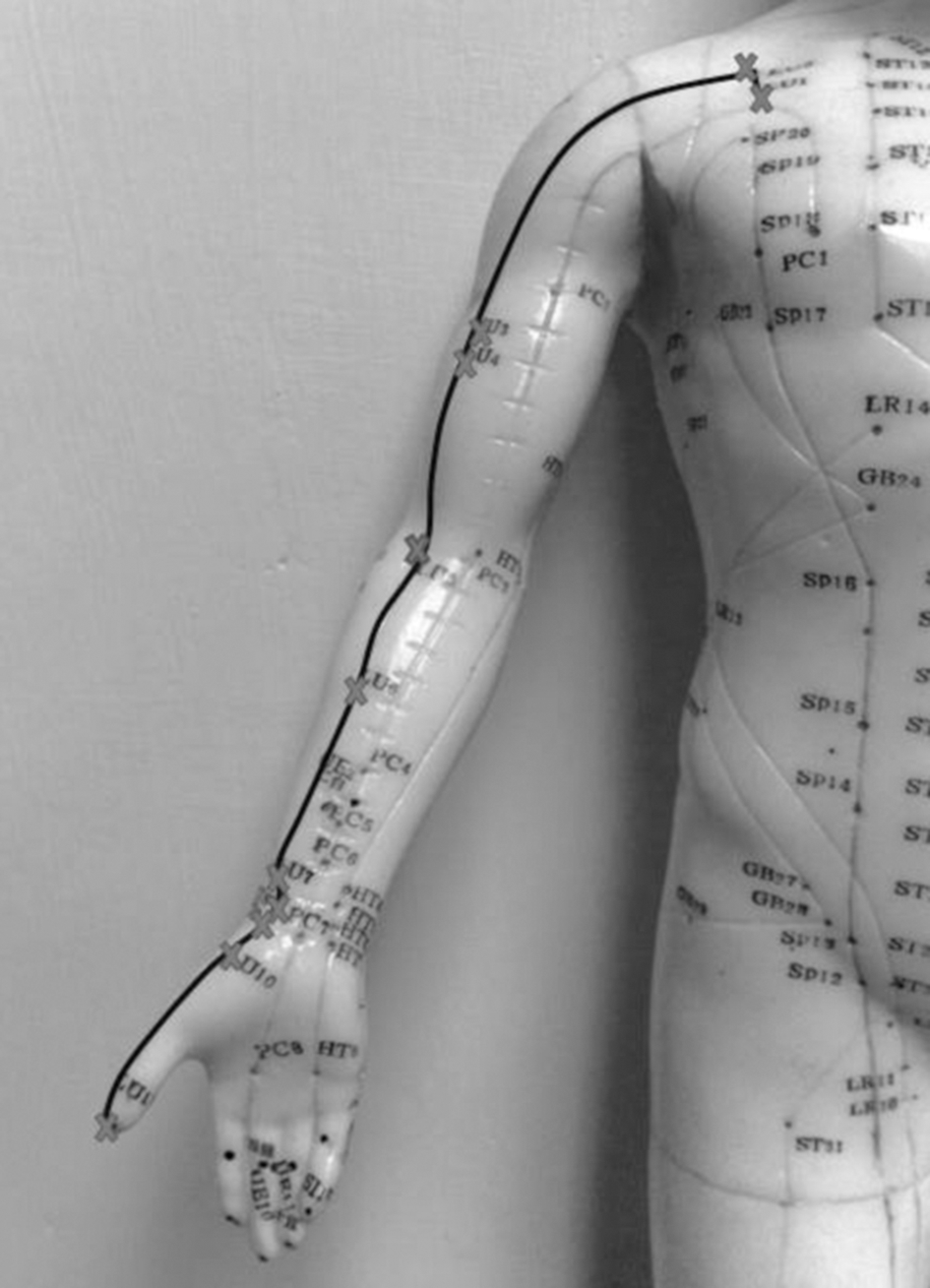
The Lung meridian is outlined and acupoints along the meridian are marked.
Outcome Measures
Lung function
All subjects underwent lung function spirometry before and after each intervention, using a spirometer (Pony FX, Cosmed, Italy) following the guidelines recommended by the American thoracic society. 21 Three measurements were taken to ensure data consistency; the best of the three measurements were recorded for analysis.
Heart rate variability
Heart rate was monitored continuously during the intervention by a Polar heart rate monitor (Polar RS800CX, Polar, Finland) and HRV was analyzed using frequency spectral analysis at 5-minute intervals 22 using Nevrokard computer software (Nevrokard Advanced Heart Rate Variability software 12.0). Spectral HRV was expressed as a low-frequency/high-frequency (LF/HF) ratio, which in turn reflects sympathovagal balance. LF mirrors sympathetic and vagal activities, while the majority of the contribution of HF involves vagal activites. 22
Skin impedance measurement
After locating and marking the 11 acupoints along the Lung meridian, the skin was cleaned with soap and water. To minimize the effect of debris or sweat on measurement of skin impedance, the skin was “stripped” by Red Dot™ Trace Prep (3M, Canada), then cleaned with a 70% isopropyl alcohol swab. A 10-mm×10-mm silver/silver chloride (Ag/AgCl) Red Dot™ electrode (3M, Canada) was then attached over each acupoint, after the skin had dried. Electrocardiogram (ECG) electrodes were specifically used to minimize the polarizability and pressure effects on series resistance. 23,24 After the electrodes were applied, a stabilization period of about 30 minutes was allowed before measurement of skin impedance commenced. 25
The skin impedance was measured using a two-electrode impedance meter (Multi-tester, Noraxon, USA Inc.) with LU 1 (Zhongfu) serving as the reference point for the 10 acupoints of interest along the Lung meridian. The machine delivered a small AC current at frequency of 100 Hz. Skin impedance at each point was recorded once the reading was steady. Skin impedance of all acupoints along the Lung meridian was measured twice, 15 minutes apart. All measurements were conducted in the university laboratory at a constant room temperature and humidity.
BL 13 Stimulation
BL 13 (Feishu) is one of the acupoints along the bladder meridian but is known to have an influence on respiratory disorders. 3 BL 13 is located 1.5 cun lateral to the lower border of the third thoracic vertebrae (T3). The skin area under T3 was prepared using the aforementioned method, followed by the attachment of an ECG electrode.
Depending on the randomization order, each subject received either Acu-TENS or Placebo-TENS at their first visit, and vice versa at the subsequent visit. During Acu-TENS intervention, the electrodes attached to bilateral BL 13 were attached to a TENS machine (ES 320, ITO Ltd., Japan). Stimulation frequency was set at 2 Hz and pulse duration of 200 μs. Stimulation duration was 45 minutes at the highest tolerable intensity but short of pain. During the placebo intervention, electrodes were attached to BL 13 but no electrical output was delivered to the acupoint despite an activated screen. Subjects were told that they may or may not feel any tingling sensations, depending on the stimulation frequencies. However, if they could feel the tingling sensation, they would be asked whether the intensity could be increased to highest tolerable sensation without feeling pain.
Statistical Analysis
Demographic data were presented as mean±standard error of mean. Skewed data were logarithm transformed. Baseline variables measured at the two visits were compared by paired t-test. Reliability of the skin impedance measurements was evaluated by an intraclass correlation coefficient (ICC) between the two readings recorded at each acupoint along the Lung meridian. An ICC > 0.75 indicates good-to-excellent association between the measurements. 26 Pre- and postintervention changes in lung-function parameters and skin impedance (at each acupoint along the Lung meridian) were compared by paired t-test. Heart rate data before and after each intervention were subjected to analysis of heart rate variability by Fast Fourier Transform. The LF/HF ratio before and after intervention was compared. All statistics were analyzed using a statistical package (PASW, 17.0, SPSS Ltd., Chicago, IL). A statistical significant level was set at p<0.05.
Results
Eighteen (18) subjects (7 male) with mean age of 27.17±0.97 years participated in this study. All subjects were nonsmokers. No significant difference was observed in any of the baseline variables between the two visits (Table 1).
Data were mean±standard error of the mean unless otherwise indicated.
TENS, transcutaneous electrical nervous stimulation; BMI, body–mass index; % Pred FEV1, percentage of predicted value of forced expiratory flow volume in 1 second; % Pred FVC, percentage of predicted value of forced vital capacity; LF/HF ratio, ratio of low frequency to high frequency.
Changes in skin impedance
The ICC of skin impedance measured at acupoints along the Lung meridian on the left and the right arm ranged from 0.962 to 0.998 in the Placebo-TENS group, and 0.941 to 0.998 in the Acu-TENS group. There was no significant difference between the left and right side at either visit nor between visits (p>0.05). The mean value of skin impedance on the left and right side was therefore used for analysis. After each 45-minute intervention, the skin impedance measured at all points decreased irrespective of the intervention. The drop in skin impedance after Acu-TENS was significantly more than after Placebo-TENS (p<0.02) (Fig. 3), except for LU 9.
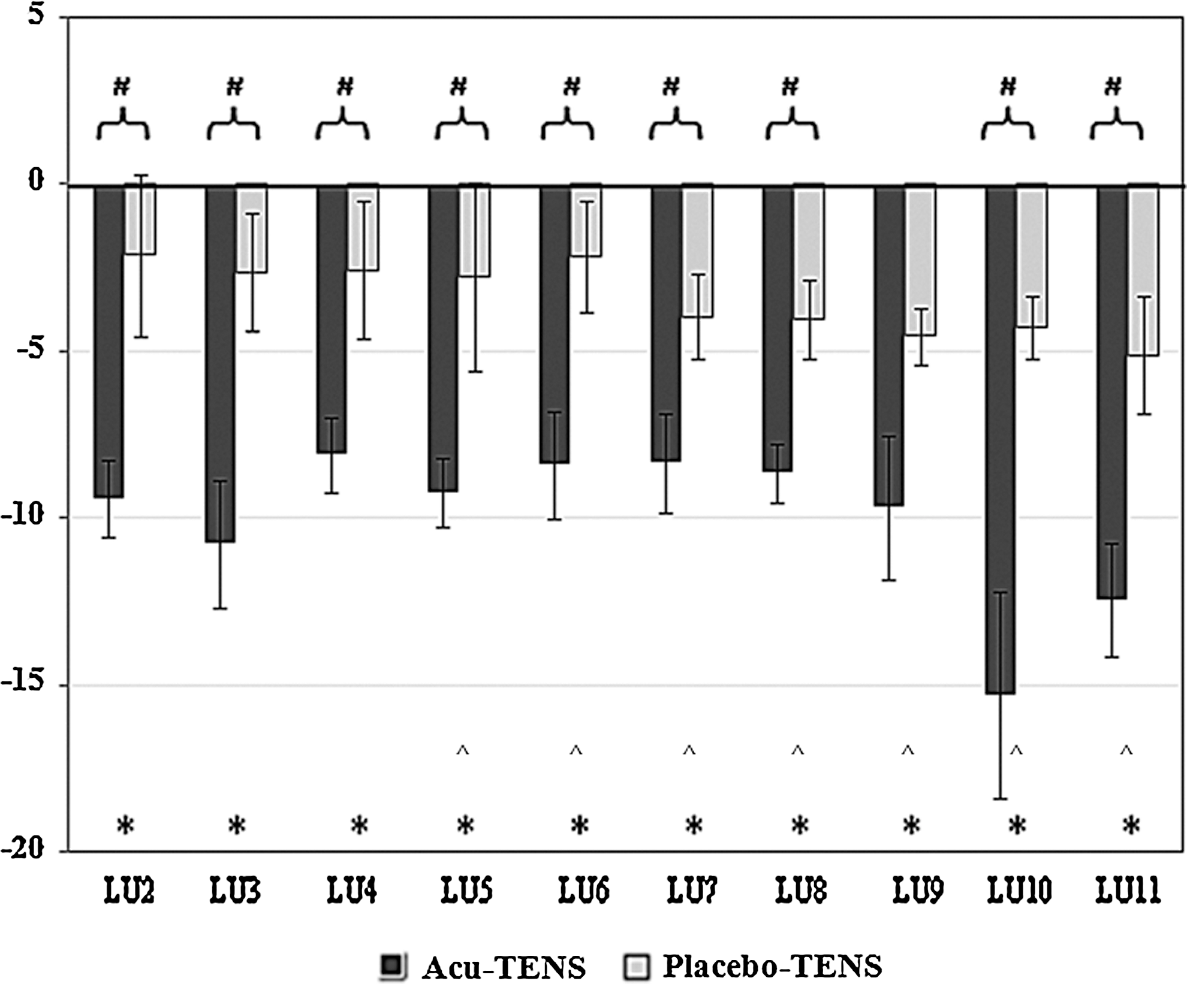
Percentage change of mean skin impedance before and after 45-minute intervention. *Denotes p<0.01 within Acu-transcutaneous electrical nervous stimulation (TENS) group; ^denotes p<0.05 within Placebo-TENS group; #denotes p<0.05 between Acu-TENS and Placebo-TENS group.
Heart rate variability
After Acu-TENS intervention, a decrease in sympathetic nervous activity was observed, reflected by a significant drop of the LF/HF ratio by 0.37±0.01 (p=0.012); the LF component deceased by 0.06±0.02 unit (p=0.027) and the HF component increased by 0.06±0.02 unit (p=0.027). No significant changes, however, were observed in any parameters after Placebo-TENS (Table 2). The between-group differences (p<0.02) are displayed in Table 2.
Data were mean±standard error of the mean unless otherwise indicated.
Within-group difference with p<0.05.
Between-group differences with p<0.05.
TENS, transcutaneous electrical nervous stimulation; FEV1, forced expiratory flow volume in 1 second; FVC, forced vital capacity; LF/HF ratio, ratio of low frequency to high frequency; HRV, heart rate variability.
Lung function
There were no significant differences in any lung function parameters measured before and after the 45-minute intervention at either visit (p>0.05) (Table 2).
Discussion
This study showed that 45 minutes of either Acu-TENS or Placebo-TENS over the acupoint BL 13 induced a reduction in skin impedance at acupoints along the Lung meridian. This suggests that transcutaneous electrical stimulation at BL-13, a specific acupoint associated with lung function, appeared to increase current conductivity along the Lung meridian, even though BL 13 is not itself on the Lung meridian.
Skin impedance is influenced by skin integrity, age, temperature, humidity, measurement time, and technical issues; 24 to minimize the influence of these factors, the study was conducted under controlled humidity and temperature. ECG electrodes were used during measurement, to minimize the plausible polarization and pressure effect during the measurement. 24 This study shows that a decline in skin impedance level was observed after 45 minutes of either Acu-TENS and Placebo-TENS, although the drop after Acu-TENS was much more significant. It is postulated that the drop in skin impedance after Placebo-TENS was probably a result of the change in hydration status of the stratum corneum, the outermost layer of the skin. Relationship between skin impedance and hydration status of the skin have been reported. 25,27 Attachment of ECG electrodes over the skin may have altered the hydration status to the stratum corneum and consequently altered the electrical impedance properties of the skin.
Acupuncture points are subdermal points. Stimulation of these points may have induced ionic or electrical changes of associated nerve endings. According to TCM concepts, an enhancement of electrical conductivity reflects an enhancement of energy flow. The change in electrical properties, reflected by a change in the skin impedance level observed in this study, implies that 45 minutes of TENS over BL 13 increases “energy flow” along the Lung meridian. Ultrasonic imaging supports an association between acupoints, muscular connective tissue, 2 and collagenous bands,28 and the theory of energy flow within the meridian system has been explained in Western medicine by the semiconducting properties of the skeletal and connective tissue systems. 29
The findings in our study parallel that of acupuncture at Xinshu (BL 15), an acupoint used for management of heart disease, which demonstrated a reduction in skin impedance of acupoints along the heart meridian. 13 The authors hypothesize that the alteration in electrical conductance along the heart meridian induced by acupuncture stimulation could influence autonomic cardiac control. 13 This aligns with the TCM concept whereby the stimulation of a function-specific point for an organ may have effects on the meridian linked to that organ through an enhancement of the flow of Qi. 3
The decrease in the LF/HF ratio after Acu-TENS indicates a shift in modulation of the autonomic nervous system from sympathetic to parasympathetic and/or a facilitation of vagal tone. Previous reports describe an association between needle acupuncture at PC 6 (Neiguan), 30 BL 15 (Xin Shu), 13 LI 10 (Quchi), and LI 4 (Hegu) 31 with autonomic nervous system activity modulation. BL 13 (Feishu) is located just lateral to the lower border of the third thoracic vertebrae where sympathetic efferents leave the spinal cord. 32 The authors hypothesize that Acu-TENS applied to BL 13 may have stimulated the efferent sympathetic branches at the third thoracic vertebral level.
Acupuncture modulation of body homeostasis is a “bidirectional” response when the body is under stress. 29 Acupuncture acts to strengthen or “tone” the body when it is in a “deficient” state and “sedate” the body when tone is “excessive.” 1 In healthy individuals, body tone is in equilibrium and stable, and therefore any effect of acupuncture stimulation may not be apparent. In the authors' previous studies, the homeostasis of the healthy subjects was deliberately disturbed by inclusion of a submaximal exercise protocol, inducing physiologic stress as evidenced by altered heart rate, blood pressure, and dyspnea intensity. 15,19 Positive effects of Acu-TENS on modulation of symptoms and physiologic responses were observed in those studies. 15,19 In contrast, the healthy subjects in this study were placed lying supine during the intervention and the body was not physiologically stressed. This may explain the findings that lung function at pre- and postintervention was similar in both groups.
Limitation of the Study
The major limitation of this study is the small sample size. Measurement of skin impedance over 10 acupoints takes almost 2 hours. Subject recruitment was limited by the perceived inconvenience. Measurement of skin impedance can be influenced by skin temperature, osmolarity of the skin surface, electrode medium and materials, pressure applied, and timing of measurement. 24,28 These confounding factors were controlled by thorough skin preparation using nonpolarizable ECG electrodes with negligible pressure influence 23 and by adopting a prolonged stabilization period 25 to ensure the temperature equilibrium of the skin and hydrogel electrode. Furthermore, this study only measured the changes of skin impedance along one particular organ-related meridian (i.e., Lung meridian), but not on other meridians or nonmeridians. Whether or not the changes observed in this study were merely associated with the specificity of meridian or a consequence of systemic changes in other meridians could not be determined. Further investigation taking into account other meridians is warranted.
Conclusions
This study showed that 45 minutes of Acu-TENS over BL 13, although not a point on the Lung meridian, but a function-adjustable point for management of lung disease, lowered skin impedance of acupoints along the Lung meridian. This may suggest a potential relationship among Acu-TENS, organ-specific points, and associated meridian. Further investigations of specific acupoint stimulation on meridian activity and symptom response in patients stressed by chronic lung conditions are warranted.
Footnotes
Acknowledgments
This study was supported by a CERG injection grant, The Hong Kong Polytechnic University. The authors are indebted to Mr. Barry Chan, Mr. Wilson Lam, and Mr. Hei Lai for their assistance in coordination of the project. We are also thankful to all our subjects who devoted their time to this study.
Disclosure Statement
No competing financial interests exist.