




Abstract
Dear Editor:
Many natural products have mechanisms of action consistent with known anxiolytics (e.g., benzodiazepines) and possess few reported side-effects and minimal abuse potential, making them an attractive alternative treatment for anxiety. 1 –3 Clinical and preclinical research has demonstrated the utility of natural products including Matricaria recutita (chamomile), Passiflora spp. (passion flower), Piper methysticum (kava kava), Lavendula spp., (lavender), Ginkgo biloba, Melissa officinalis (lemon balm), Centella asiatica (gotu kola) and Valeriana spp. (valerian) in treating anxiety symptoms. In the general population, 13% of young adults (19–30 years) use botanical supplements 4 ; however, in college samples, use of natural products has been reported to be as high as 70%. 5 Little is known about patterns or reasons for use of natural products among college students, although their use of these products appears to be greater than that of an age-matched general adult population.
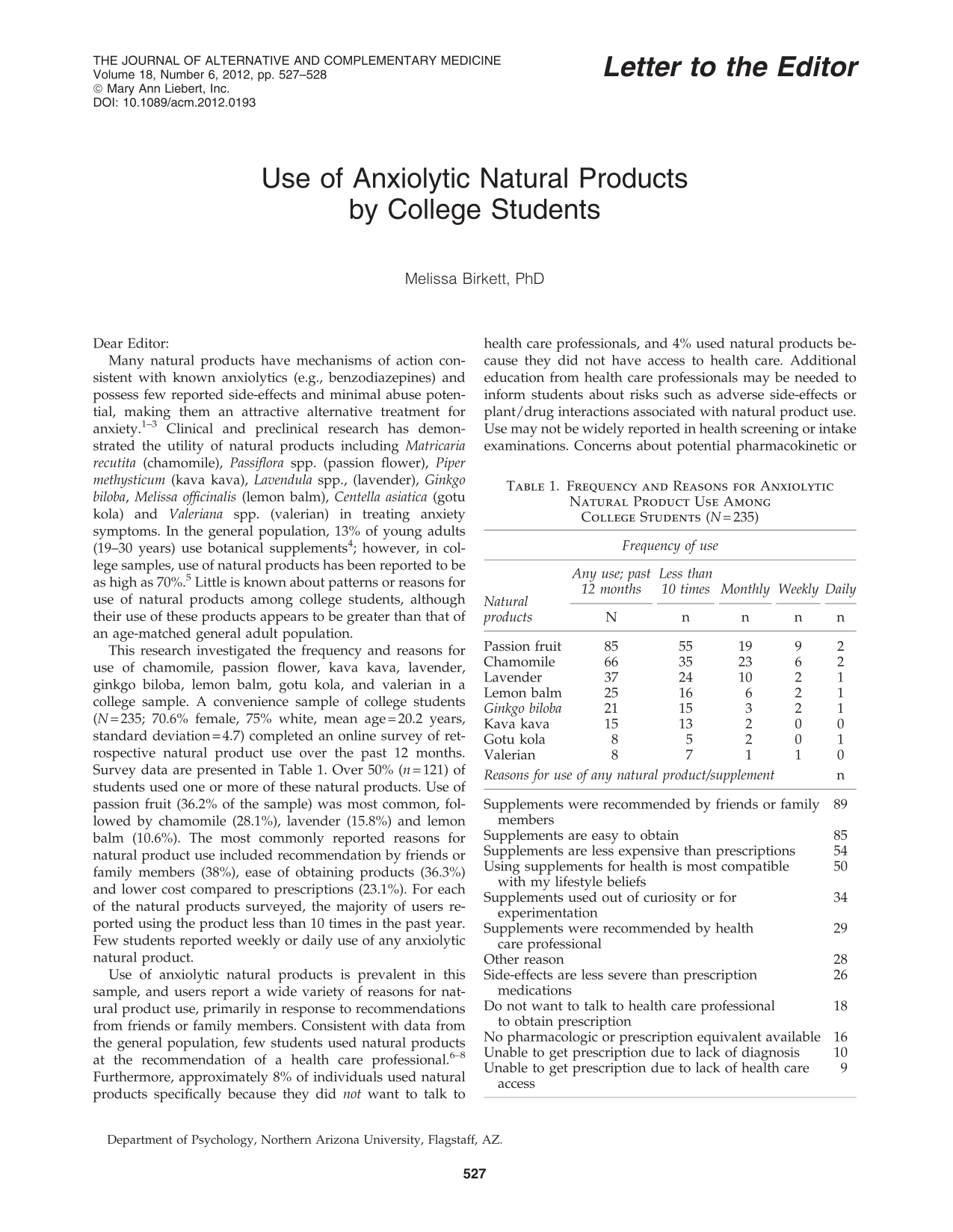
This research investigated the frequency and reasons for use of chamomile, passion flower, kava kava, lavender, ginkgo biloba, lemon balm, gotu kola, and valerian in a college sample. A convenience sample of college students (N=235; 70.6% female, 75% white, mean age=20.2 years, standard deviation=4.7) completed an online survey of retrospective natural product use over the past 12 months. Survey data are presented in Table 1. Over 50% (n=121) of students used one or more of these natural products. Use of passion fruit (36.2% of the sample) was most common, followed by chamomile (28.1%), lavender (15.8%) and lemon balm (10.6%). The most commonly reported reasons for natural product use included recommendation by friends or family members (38%), ease of obtaining products (36.3%) and lower cost compared to prescriptions (23.1%). For each of the natural products surveyed, the majority of users reported using the product less than 10 times in the past year. Few students reported weekly or daily use of any anxiolytic natural product.
Use of anxiolytic natural products is prevalent in this sample, and users report a wide variety of reasons for natural product use, primarily in response to recommendations from friends or family members. Consistent with data from the general population, few students used natural products at the recommendation of a health care professional. 6 –8 Furthermore, approximately 8% of individuals used natural products specifically because they did not want to talk to health care professionals, and 4% used natural products because they did not have access to health care. Additional education from health care professionals may be needed to inform students about risks such as adverse side-effects or plant/drug interactions associated with natural product use. Use may not be widely reported in health screening or intake examinations. Concerns about potential pharmacokinetic or pharmacodynamic drug/natural product interactions have been raised, and improved communication between natural product users and health care providers has been recommended. 6,7,9,10 Interactions between some natural products and oral contraceptives may be of specific concern in this population. 11
Altogether, this research presents novel data about use of anxiolytic natural products by college students. This research is consistent with report of increased use of natural products by college students and extends reported use to data collected from responses to items about specific products that may possess mechanisms of action consistent with pharmacologic anxiolytics.
Footnotes
Acknowledgments
This research was conducted at Northern Arizona University with support from the Department of Psychology.
Disclosure Statement
No competing financial interests exist.