




Abstract
Background:
Acupuncture is used worldwide in medical treatment. However, needle insertion damages the skin and patients sometimes feel pain. To avoid such drawbacks, an acupoint stimulation device using focused ultrasound has been developed. Ultrasound stimulation does not damage the skin like acupuncture does because ultrasound can deliver vibration energy to soft tissues noninvasively.
Objectives:
The aim of this study was to clarify the effect of acupoint stimulation using focused ultrasound.
Subjects:
Fifty (50) healthy volunteers (40 males and 10 females) were included in this experiment.
Design:
Subjects were randomly assigned to two groups. LR-3 was stimulated bilaterally for 36 seconds by focused ultrasound and conventional acupuncture. Brachial artery blood flow volume was monitored by an ultrasound with an echo-tracking system. The hemodynamic parameters were measured before, during, and 30, 60, 180 seconds after stimulation.
Results:
During stimulation, the blood flow volume of the acupuncture stimulation group decreased significantly (p<0.05) compared with resting value, but that of the focused ultrasound stimulation group did not decrease. Blood flow volume of both groups increased gradually and showed significant increase at 180 seconds after stimulation (p<0.05).
Conclusions:
Blood flow volume was increased significantly by both focused ultrasound stimulation and conventional acupuncture. Although a significant decrease of blood flow volume during acupuncture stimulation was observed, no such decrease was observed during ultrasound stimulation. Findings of the present study show that noninvasive stimulation of acupoints by focused ultrasound is as effective as conventional acupuncture in blood flow volume of the brachial artery.
Introduction
Insertion of needles in acupuncture damages the skin, 9,10 but ultrasound stimulation does not. Thus, ultrasound stimulation has a smaller risk of infection and users do not feel any pain during stimulation. Focused ultrasound stimulation uses almost the same intensity as ultrasound physical therapy (1–3 W/cm2). 7 Temperature increase at the focal point can be suppressed by changing the supply voltage and waveform. For this reason, ultrasound stimulation can be considered safer than acupuncture.
The size of the ultrasound transducer is about 6 mm in diameter, small enough to be easily placed the skin during daily life. Users can switch the device on whenever they want to stimulate acupoints.
The aim of this study was to clarify the effect of acupoint stimulation using focused ultrasound.
Materials and Methods
Methods
Fifty (50) healthy volunteers (40 males and 10 females) were included in this experiment. The study protocol was approved by the Ethics Committee of Tohoku University Graduate School of Medicine, and written informed consent for participation was given by all of the subjects. Subjects were randomly assigned to group A (focused ultrasound stimulation) or group B (conventional acupuncture). The clinical profile of each group is shown in Table 1, and the protocol of this study is shown in Figure 1. The protocol was made referring to reports by Takayama et al. 11,12
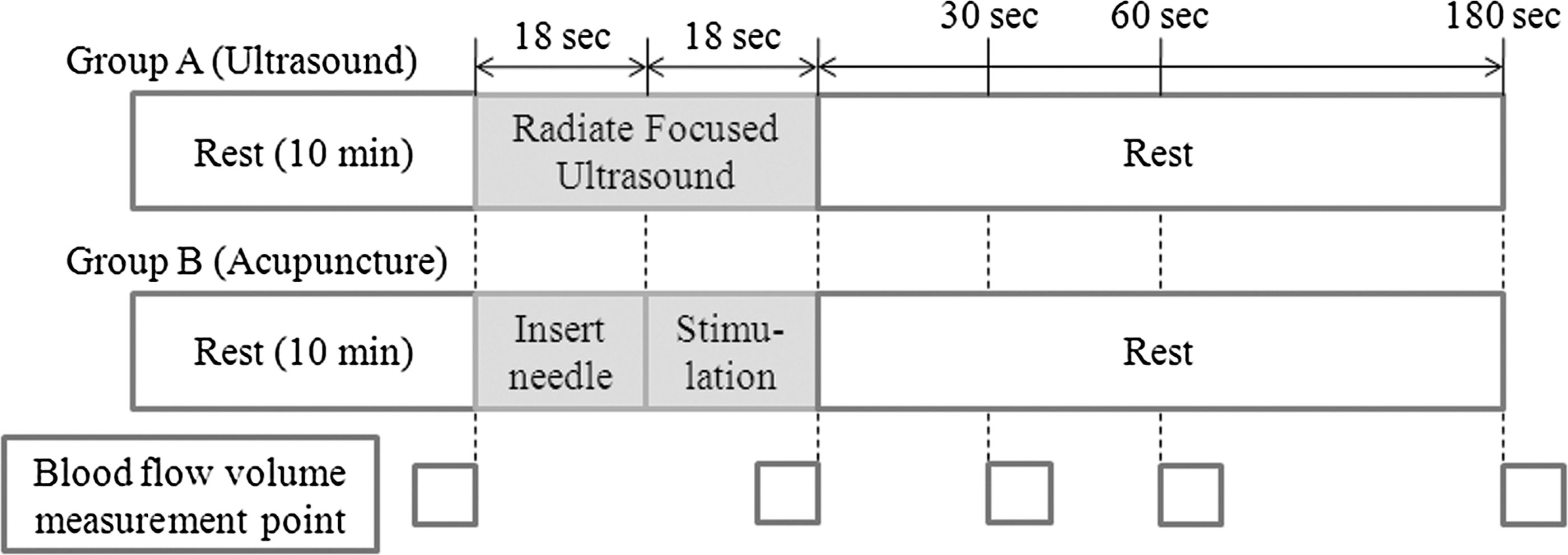
Protocol of the experiment. Measurement of blood flow volume was performed before, during, and 30, 60, and 180 seconds after acupoint stimulation. Group A subjects were stimulated by focused ultrasound, and Group B subjects were stimulated by acupuncture.
Values are presented as the mean±standard deviation.
Each subject rested for 10 minutes in a supine position. At the end of the 10-minute rest period, measurement of brachial blood flow volume was started. LR-3 was stimulated bilaterally for 36 seconds. Group A subjects were stimulated by focused ultrasound using the focused ultrasound device that was fabricated, and group B subjects were stimulated by conventional acupuncture.
In order to compare the effect of focused ultrasound stimulation with that of acupuncture as shown by numerical value, blood flow volume of the brachial artery was measured. The LR-3 acupoint is the primary acupoint on the Liver meridian and has the functions of “smoothing the Liver” and “regulating the Blood” in Traditional Chinese Medicine. The effect on the radial artery by stimulation of LR-3 with acupuncture has been reported. 11,12 Thus, LR-3 was stimulated to confirm the effect of focused ultrasound stimulation on blood flow volume of the brachial artery.
Blood flow volume was measured by an ultrasound system (Prosound α10®, Aloka Co., Ltd., Japan) at 30, 60, and 180 seconds after the stimulation. In order to reduce the influence of respiration on blood flow volume, the subjects were asked to breathe every 6 seconds during the experiment, and blood flow volume was averaged for 6 seconds at the measuring point.
Focused ultrasound stimulation
To produce focused ultrasound, the device shown in Figure 2 was fabricated. Focused ultrasound was produced by a concave-shaped PZT (lead zirconate titanate, Pb(Zrx,Ti1-x)O3) transducer. 8 The diameter of the device is 5.5 mm and its focal point is 9 mm from the device. In this method, the focal point is set at a depth of 5 mm from the skin surface. This is almost the same depth as insertion of an acupuncture needle. The ultrasound intensity at the focal point was set at about 2.38 W/cm2 by applying a 20 Vp-p sine wave of resonance frequency (1.83 MHz) to the device. Before the experiment, the temperature increase at the focal point was measured in an agar phantom by a thermocouple. The rise of temperature under the condition of this experiment (2.38 W/cm2, 36 seconds) was less than 1°C.
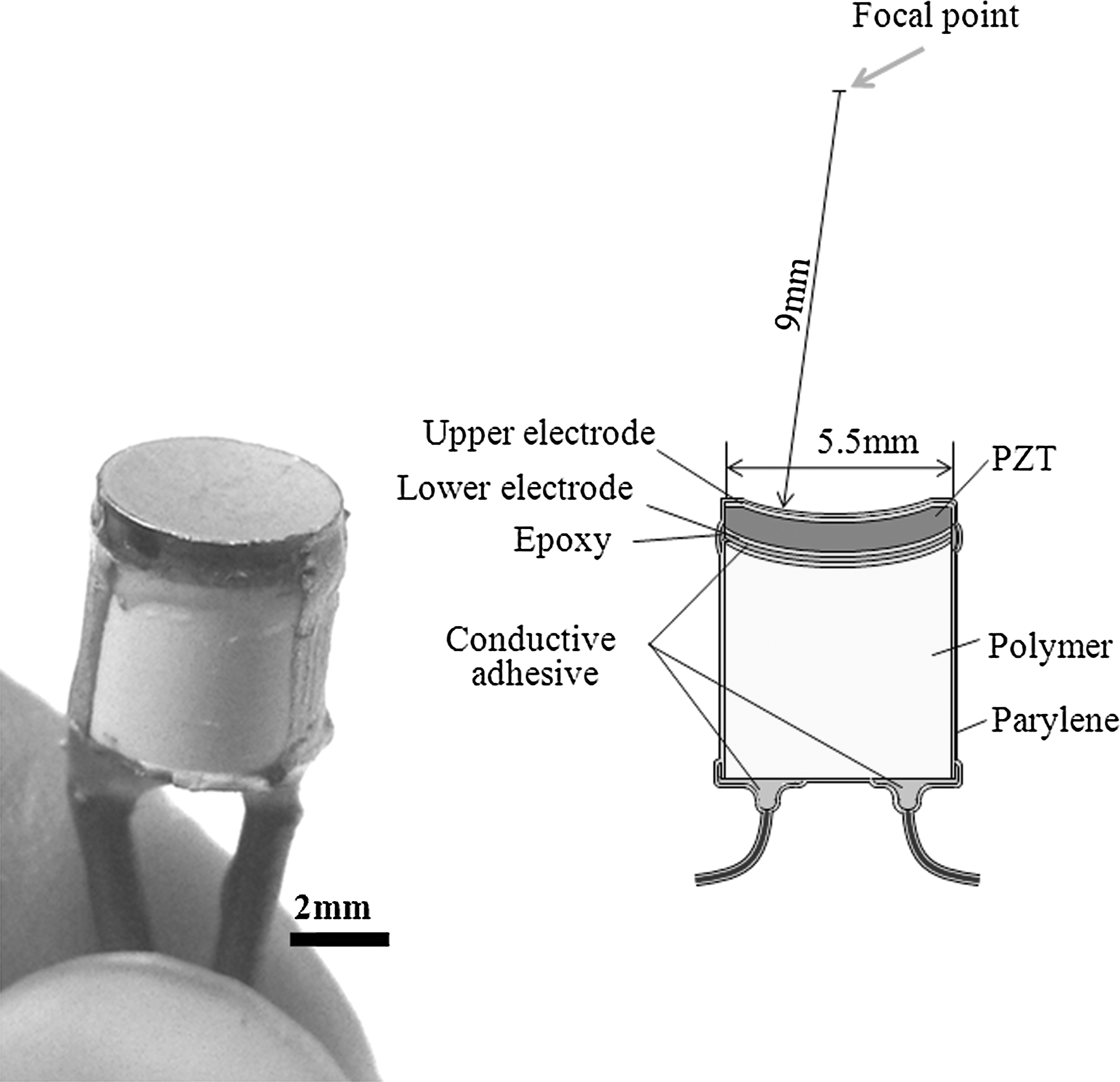
Photograph and cross-sectional view of focused ultrasound device. PZT, lead zirconate titanate.
Acupuncture stimulation
Acupuncture was performed by a licensed acupuncturist. A disposable fine stainless steel needle (diameter: 0.16 mm; length: 40 mm; Seirin Co., Ltd., Japan) was inserted at LR-3 bilaterally and maintained at a depth of 5–10 mm during the experiment. After the needle was inserted, stimulation (rotating the needles manually within an angle of 90°) was performed for 18 seconds.
Statistics
Statistical analysis was performed with SPSS software. Repeated-measures ANOVA, followed by Dunnett's post hoc test were used for statistical comparison between the measurement points. Two-way ANOVA was used for statistical comparison between groups A and B. Results are presented as the mean±standard deviation and p<0.05 was used to indicate significance for all statistical analysis.
Results
Table 1 shows the characteristics of the subjects in groups A and B. There were no significant differences in age, sex, weight, height, body surface, or blood flow volume of the brachial artery before stimulation.
The blood flow volume was determined as milliliters per second per square meter and calculated in relation to resting value as percent change. The change of blood flow volume is shown in Figure 3. The blood flow volume of group B decreased significantly during acupuncture (p<0.05) compared with resting value, but that of group A did not decrease, during ultrasound stimulation. After stimulation, blood flow volume of groups A and B changed similarly. They increased gradually and showed a significant increase at 180 seconds after stimulation (p<0.05). There was a significant difference in the change of blood flow volume between groups A and B (p=0.012).

Percent change of blood flow volume of brachial artery. Values are presented as the mean±standard deviation, and *p<0.05 versus before stimulation.
Burn injury, bleeding, skin denaturation, and infection by ultrasound stimulation did not occur in group A subjects. Similarly, neither infection nor bleeding by acupuncture stimulation was a problem in group B subjects.
Discussion
During stimulation, the blood flow volume of every group B subject temporarily decreased. Although almost none of the subjects felt pain, nociceptive stimulation by needle insertion might cause transient contraction of the peripheral artery. There was no significant decrease of blood flow volume with focused ultrasound stimulation (group A) during stimulation. This might suggest that focused ultrasound stimulation did not result in nociceptive stimulation. Several stimulations are used to generate a signal input from the skin, and the information is transmitted to the spinal area and the central nervous system. The mechanisms of acupuncture reaction have explained by spinal level and supraspinal mechanisms. The physiological mechanisms of decreased and increased blood flow volume in the upper limb by the stimulations applied from the skin are related to a peripheral vascular resistance due to an instantaneous increase and decrease in sympathetic tone. Generally, needle acupuncture is interpreted as nociceptive stimulation. On the other hand, ultrasound stimulation might be interpreted as thermal and vibratory stimulation. Because captured peripheral nerves by the stimulations are different between acupuncture and ultrasound stimulation, the physiological reaction might be different.
At 180 seconds after stimulation, a significant increase of blood flow volume occurred in group B. This change of blood flow volume suggests that stimulation by acupuncture caused peripheral artery vasodilation. Takayama et al. have reported the effect of acupuncture on blood flow volume of the brachial artery. 12 They suggested that acupuncture at LR-3 can affect the sympathetic tone of the upper limbs. In group A, a significant increase of blood flow volume was also shown at 180 seconds after stimulation. This proves that like conventional acupuncture, stimulation by focused ultrasound at an acupoint is effective. Two factors are thought to be involved in the stimulation of an acupoint using focused ultrasound. One is a physical factor and the other is a thermal factor. 7,13 Body tissue at the focal point might be vibrated by acoustic pressure of focused ultrasound. This causes physical stimulation like that caused by acupuncture. If the ultrasound energy is changed to thermal energy in body tissue at the focal point, the temperature of the focal point rises, which causes thermal stimulation like moxibustion. The temperature rise of our device was measured in an agar phantom before the experiment. Under the present experimental conditions (supply voltages, waveform, stimulation time), there was no temperature rise at the focal point. Thus, it is suggested that focused ultrasound caused only physical stimulation at the acupoints in this experiment.
When inserting an acupuncture needle, the needle damages the skin and patients sometimes feel pain. 9,10 During acupoint stimulation with ultrasound, however, patients do not feel pain, including nociceptive pain. Ultrasound stimulation does not damage the skin, and entails no risk of bleeding.
In a healthy person, the effect of focused ultrasound stimulation on blood flow is similar to acupuncture. Focused ultrasound stimulation has potential for use as noninvasive acupoint stimulation in clinical application. Further study will be needed to investigate the effects in clinical conditions.
Limitations
The results should be treated with caution, given that this is a pilot study with no placebo control intervention and a short examination time. There is a possibility that the obtained result might be due to some sort of anticipatory effects caused by the protocols used. Therefore, the authors intend to compare the effects of ultrasound stimulation with placebo control in clinical conditions in a future study.
In this method, the measurement time of blood flow volume was 180 seconds, which seems insufficient to evaluate the effects of ultrasound acupuncture. However, a significant increase of blood flow volume was shown. Additional research should be done to establish whether the blood flow volume at 30 minutes after ultrasound stimulation changes in the same way or differently as compared with acupuncture stimulation.
Conclusions
The LR-3 acupoints were stimulated by focused ultrasound using a focused ultrasound device, and blood flow volume of the brachial artery was measured with an ultrasound system to evaluate the effect. Blood flow volume was increased significantly by both focused ultrasound stimulation and conventional acupuncture. Although a significant decrease of blood flow volume during acupuncture stimulation was observed, no such decrease was observed during ultrasound stimulation.
Footnotes
Disclosure Statement
No competing financial interests exist.