




Abstract
Objectives
Design:
Randomized controlled trial.
Settings:
College settings located in metropolitan areas of Korea.
Participants:
A total of 49 female college students who were overweight or obese (body–mass index [BMI] ≥25.0 kg/m2) were recruited and randomly assigned to the experimental group (n=25) or the control group (n=24).
Interventions:
The experimental group applied three S. alba seeds to each of five auricular points (Shenmen, mouth, stomach, endocrine, and small intestine points). These participants were asked to stimulate those points 10 times at a rate of two times per second 30 minutes before mealtime, three times daily, for 1 month. They performed the procedure for each earlobe for alternating weeks (a total of 2 weeks' treatment for each ear).
Outcome Measures:
The obesity index included weight (kg), BMI (kg/m2), percentage body fat, and waist-to-hip ratio. Self-efficacy was measured by using a self-efficacy scale.
Results:
Female students in the experimental group showed significant decreases in weight (t=10.76; p<0.001) and BMI (t=9.60; p<0.001) and significant improvement in self-efficacy (t=1.85; p<0.05) compared with those in the control group. However, percentage body fat (t=1.27; p>0.05) and waist-to-hip ratio (t=0.60; p>0.05) changes did not significantly differ between the two groups.
Conclusions:
These findings suggest that auricular acupressure using S. alba seeds may be an effective intervention for decreasing weight and BMI and increasing self-efficacy of overweight and obese individuals.
Introduction
O
Reasons for obesity vary and may include an unbalanced diet, genetic predisposition, social and economic factors, lack of exercise, endocrine disorders, and a variety of mental and emotional disorders. 4 Moreover, obesity is the main cause of various chronic diseases, such as diabetes, hypertension, arteriosclerosis, hypercholesterolemia, cardiac disease, and cerebrovascular disease. In addition, obesity has been causally linked with breast cancer, uterine cancer, and ovarian cancer among women. 5
In general, primary methods for resolving obesity are drugs, exercise, diet, and behavior modification therapy. 6 More recently, the potential value of Oriental medicine approaches, such as herbal medicine, acupuncture, massage, high-frequency therapy, qi gong, and cupping treatment, has become apparent. 7 Of these methods, auricular acupuncture therapy has been explored as a novel obesity treatment. 8 Previously, studies on the effect of auricular acupuncture on obesity focused only on adults. 9,10 The results of these studies have indicated that auricular acupuncture delays digestion with reduction of stomach activity; weakens gastrointestinal function by inhibiting the pneumogastric nerves; stimulates the metabolism of accumulated fat; and reduces weight by exacerbating fullness, reducing hunger, and suppressing appetite.
In nursing, the effects of acupressure therapy on obesity reduction have been studied according to the meridian system of Oriental medicine. 11 In one study, obesity significantly decreased after auricular acupressure among obese children. 12 Another study linked auricular acupressure therapy and dietary treatment with subsequent reductions in weight, body–mass index (BMI), and body fat rates of young adults. 4 However, the effectiveness of self-administered auricular acupressure in reducing obesity among women in their 20s has not been studied.
Thus, this study was undertaken to identify the effect of reducing obesity only with auricular acupressure, targeting young women with a BMI ≥25 kg/m2 by attaching Sinapsis alba seeds, which are warm and nontoxic, to Shenmen, mouth, stomach, endocrine, and small intestine points of both ears to inflict continuous acupressure.
Self-efficacy is a psychological term that refers to our belief in our own ability to succeed in specific situations. Self-efficacy has a direct effect on the self-regulatory actions of obese people and plays an essential role in the choice of health behavior against obesity. 13 A negative association has been reported between the degree of obesity and self-efficacy, demonstrating that obesity and self-efficacy are related. 14 Few studies have been conducted to determine the effects of acupressure on self-efficacy. However, a previous study examined the effects of auricular acupressure with and without the use of an Internet-assisted program on smoking cessation and self-efficacy among adolescents. 11 Auricular acupressure alone improved self-efficacy of those attempting to quit smoking. Bandura suggested that this enhanced self-efficacy reflected one's mastery experiences (i.e., experiencing success) in applying auricular acupressure oneself. 15 Thus, the current study included self-efficacy as an outcome variable and sought to examine whether self-efficacy of obese women increased as a result of auricular acupressure therapy.
The purpose of this study was to examine the effects of auricular acupressure, whether auricular acupressure therapy is effective in reducing the obesity index (body weight, BMI, percentage body fat, and waist-to-hip ratio) and increasing self-efficacy of obese female college students in Korea.
Materials and Methods
Study design
This study used a randomized controlled trial design with pre- and post-tests.
Participants
The study recruited 200 women from D college who volunteered to participate in the study. Of these, 58 were selected on the basis of inclusion criteria and were randomly assigned to the experimental (n=29) or control (n=29) groups. We first prepared a black box that contained small sheets numbered 1–58. We then let 58 participants pick up one number blindly. Participants who chose an odd number were assigned to the experimental group, and those who chose an even number were assigned to the control group. Three participants in the experimental group who had failed to do acupressure regularly, one participant in the post-test, and five participants in the control group who had not participated in the post-test were left out. Three of five dropouts in the control group could not be contacted because of a change in their contact address, and the other two were rejected post-test.
Data from 49 participants were used in the analysis because of the nine participants who withdrew during the study (Fig. 1). Suh's study, which had a large effect size (d=0.7), evaluated the effect of auricular acupressure therapy on BMI reduction in South Korea by using t-tests with two independent samples. 4 The statistical power analysis was performed for the independent t-test, and 26 participants in each group were needed to have a similar large effect size (d=0.7) and produce 80% power (a=0.05). 16
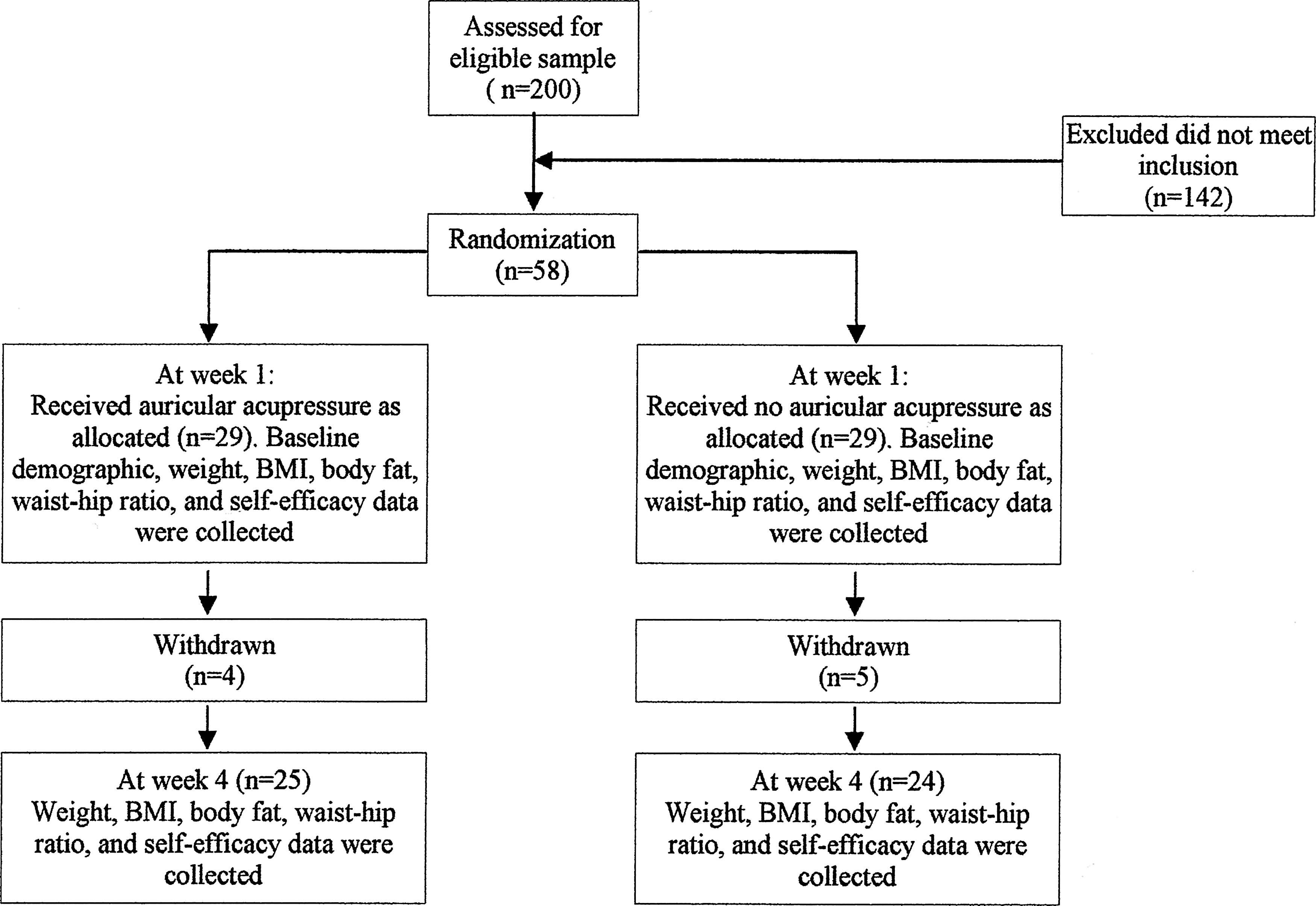
Flow of the study participants. BMI, body–mass index.
Pretest data collection was conducted in May and June 2010. Inclusion criteria were as follows: (1) BMI ≥25.0 kg/m2; (2) no ear injury, such as inflammation or lesions, and no medical history of ear surgery within the last 6 months; (3) no specified physical disease; (4) no history of western or Oriental medical treatment for obesity; and (5) agreement to refrain from obesity treatments, including exercise and dietary therapy during the study. This last criterion was a recommended precaution to prevent the influence of exogenous variables that could affect reduction of obesity.
The study was approved by the Clinical Research Ethics Committee of the D University of South Korea. All participants were required to give written informed consent before the trial started. Participants were informed about the purpose of the study and were assured of their confidentiality; it was clearly indicated that study participation was voluntary and that participants could withdraw at any time.
Outcome measures
In this study, a model IOI 757 body composition analyzer (Seoul Medixline, Seoul, Korea) that uses a biological electric instrument was used to measure the obesity index. Weight (kg), percentage body fat, and waist-to-hip ratio were measured twice. To calculate BMI, height (m) was measured with a model HF-200 apparatus (Fanics, Co, Korea).
Participant characteristics were collected by a questionnaire at the pretest. Self-efficacy was measured by a self-reported method using a self-efficacy scale consisting of 24 questions: 7 on confidence, 12 on self-regulatory efficacy, and 5 on task difficulty preference. 17 Each question was measured with a 5-point Likert scale ranging from 1 (not at all) to 5 (strongly agree), and total scores ranged from 24 to 120 for 24 questions, with higher scores indicating better self-efficacy. The Cronbach ( was 0.81 in the previous study 17 and 0.85 in the current study.
Intervention and procedures
A preliminary study was conducted with four obese female students to test the feasibility of the auricular acupressure therapy. Difficulties in finding the exact auricular points and attaching S. alba seeds were resolved by marking auricular points with a ballpoint pen and taking photos using a cell phone to find the exact auricular points. Then, participants in the experimental group learned how to attach the seeds to five auricular points (Shenmen, mouth, stomach, endocrine, and small intestine points) and were asked to attach three seeds to each auricular point to produce sufficient acupressure effect. Second, they were asked to press the inside of the ear with one finger while supporting the outside of the ear with their thumb to stimulate an auricular point for 5 seconds, 10 times per auricular point, three times per day for a total of 4 weeks, with each procedure being done 30 minutes before mealtime. Each participant was asked to attach a new S. alba seed in the opposite ear on a weekly basis to continue stimulation during the study. On the basis of previous studies, auricular acupressure points were drawn up under the supervision of Oriental medical doctor. 12,18
S. alba seeds used for auricular acupressure are mature mustard seeds from the Brassicaceae family and chiefly work for lung, spleen, and stomach. They have warm properties; thus, they induce perspiration and stimulate the smooth flow of qi blood according to Dongeuibogam. 19 After performing acupressure, participants were asked to fill out the auricular acupressure performance table to confirm continuous administration of auricular acupressure. The research assistants sent each participant daily telephone and text messages to ensure that no auricular acupressure session was missed and to prevent dropout; a researcher met each participant personally in the second week of the study and confirmed the performance table. Pretest data collection was conducted before initiation of auricular acupressure therapy for both groups. Post-testing was conducted after 4 weeks of the start of auricular acupressure therapy in the experimental group and 4 weeks after the pretest in the control group. The control group received the auricular acupressure treatment after the study was completed.
Data analyses
Data were analyzed using SPSS software, version 17.0 for Windows (SPSS, Chicago, Illinois). Chi-square tests, Fisher exact tests, and t-tests were used to test the homogeneity of the two groups. The effects of auricular acupressure therapy were evaluated with independent t-tests and paired t-tests. The level of statistical significance was set at p<0.05. Missing values in test scores were considered missing at random.
Results
Table 1 presents general characteristics of the 49 participants. Mean (standard deviation) ages were 20.6±0.82 and 20.7±1.40 years for the experimental and control groups, respectively. The groups did not differ significantly in terms of age, obesity of family members, regularity of meals, eating a snack before sleeping, drinking, smoking, regular exercise, experience of diet, health status, percentage body weight, BMI, body fat, waist-to-hip ratio, and self-efficacy (p>0.05) (Tables 1 and 2).
Unless otherwise noted, values are the number (percentage) of participants.
Fisher exact test.
SD, standard deviation.
Values are expressed as mean±standard deviation.
Effects of auricular acupressure on obesity index
After the intervention, weight decreased by 3.1±0.73 kg in the experimental group and by 0.2±1.05 kg in the control group. There was a statistically significant difference between the two groups in body weight change (t=10.76; p<0.001). In addition, BMI decreased by 1.23±0.34 kg/m2 in the experimental group and by 0.15±0.45 kg/m2 in the control group. BMI change differed significantly between the two groups (t=9.60; p<0.001). Percentage body fat decreased by 1.14%±2.85% and 0.36%±0.93% in the experimental and control groups, respectively; however, the difference was not significant (t=1.27; p=0.105). Similarly, change in waist-to-hip ratio did not significantly differ between the two groups (t=0.60; p=0.277) (Table 3).
Values are expressed as the mean±standard deviation.
Effects of auricular acupressure on self-efficacy
The average score for total self-efficacy increased by 3.28±5.22 in the experimental group but decreased by 0.33±7.75 in the control group after the intervention. There was a statistically significant difference between the two groups in total self-efficacy scores (t=1.92; p=0.032). In addition, subcategory of self-regulatory efficacy in the experimental group increased by 1.48±3.68 after the study, while it decreased by 0.79±4.85 in the control group. A statistically significant difference was evident between the two groups (t=1.85; p=0.035). However, changes in subcategories of self-confidence (t=0.41; p=0.341) and task difficulty preference (t=1.47; p=0.074) were not significantly different before and after the intervention between the two groups (Table 4).
Values are expressed as the mean±standard deviation.
Discussion
This study attempted to identify the effects of auricular acupressure with S. alba seeds on obesity and self-efficacy in female obese individuals and found that applying auricular acupressure in five auricular points (Shenmen, mouth, stomach, endocrine, and small intestine points) was effective in decreasing weight and BMI and increasing self-efficacy of obese young women.
Often the most common acupuncture points for treating obesity are Shenmen, mouth, stomach, endocrine, and small intestine points. Stimulating the Shenmen point can lead participants to become calm and can induce a sedative sensation. The auricular mouth point can reduce strong angry feeling and can be used to treat oral ulcers. The stomach and endocrine points on the ear can control appetite and suppress hunger while promoting satiety and fullness; the overall effect is to promote weight loss. 20,21
The effects noted in the current study are similar to those in previous studies that have examined the effect of auricular acupressure on weight loss and BMI. 4,12,22 One study used S. alba seeds in auricular acupressure therapy in five auricular points targeting obese children and yielded obesity reduction in 2, 4, and 6 weeks; another study found a significant decrease in weight, BMI, and body fat rate with combined auricular acupressure and meridian acupressure therapy at five auricular points and 14 meridian points for 13 weeks. 12 Another study comparing the effects of two different auricular acupressure therapies that used Japanese magnetic pearls and Vaccaria seeds found that reduction of BMI was greater in the group that used Vaccaria seeds. 22 These prior results support the current use of S. alba seeds in decreasing obesity. The seeds have warm properties and nontoxic materials and help reduce obesity by stimulating qi and blood flow of the ear and body.
Auricular acupressure is transformation therapy, derived from auricular acupuncture of Oriental medicine, in which the ear is considered as a miniature of life activity in internal body organs. Accordingly, symptoms and treatment effects in the whole body are alleviated by smoothing the flow of qi and blood through meridian points when pressure is applied to the appropriate acupuncture points of the ear. 23
Before auricular acupressure therapy, studies identified effects of auricular acupuncture in weight loss and appetite control. 24 –26 Auricular acupuncture of the Shenmen, mouth, stomach, endocrine, and small intestine points affects the gastrointestinal hormones of triiodothyronine, pancreozymin, insulin, gastrin, and secretin, leading to weight loss. 24 These studies used acupuncture therapy with different times of application. However, the consistent results in weight loss provided compelling evidence that stimulation of the Shenmen, mouth, stomach, endocrine, and small intestine points are effective in reducing obesity.
In the current study, self-efficacy of the experimental group increased significantly compared with the control group. Furthermore, among the subcategories, self-regulatory efficacy was significantly increased in the experimental group. In addition, a negative association was apparent between self-efficacy and BMI (p<0.05), as found previously. 14 It is assumed that those in the experimental group may have increased their self-efficacy as a result of participating in the self-administered auricular acupressure therapy. It could be explained as a “mastery experience,” in which the successful completion of applying acupressure therapy within a designated time period may have increased self-efficacy of individuals in the experimental group compared with those in the control group. 15 Increased self-efficacy will be valuable to obese individuals and could help to promote further efforts to control weight; previous researchers contended that self-efficacy plays an essential role in choosing and maintaining health actions against obesity. 13
Few studies have investigated the effects of auricular acupressure on self-efficacy. However, one study showed that auricular acupressure with and without an Internet-assisted program provided a positive effect on increasing self-efficacy of adolescent smokers in a smoking cessation program; this finding may imply that auricular acupressure alone may increase self-efficacy of obese individuals. 11 It has been reported that those who are confident in their physical characteristics tend to maintain smooth relationships with others and manage their life actively, while those who are not confident are inclined to have a low self-concept, which harms their self-esteem. 27 In particular, young women with low self-concept are prone to excessive dieting because of their obsession with being slim. This obsession can be harmful to their health, resulting in conditions such as serious anemia and eating disorders. 28 Therefore, efforts to increase self-efficacy may promote weight reduction in as well as the psychological health of young women.
This study presented empirical data on the effect of auricular acupressure with S. alba seeds on the reduction of obesity. These data could be used to develop an effective intervention method for decreasing obesity. If programs that use this intervention are continually developed, management of obesity will be directed more positively and realistic goals for weight loss will be achieved.
Acupressure was self-administered by attaching seeds to five meridian points of the ear for 4 weeks. Thus, it was difficult to confirm whether the process was done accurately and in accordance with the protocol, although each participant was encouraged by means of telephone calls and daily text messages to perform auricular acupressure. In addition, the sample size was small because of the attrition of nine participants in the middle of the study; this may have produced insignificant results in some of the study variables because of the lack of power.
Conclusions
The current study used a randomized controlled trial design targeting 49 female college students who were overweight or obese. Auricular acupressure in the five auricular points (Shenmen, mouth, stomach, endocrine, and small intestine points) with S. alba seeds reduced weight and BMI and increased self-efficacy. However, the relatively short study period (4 weeks) may have been insufficient to detect significant results in the reduction of percentage body fat and waist-to-hip ratio. It is expected that auricular acupressure therapy could be used as an effective intervention for decreasing obesity among young adults because it is safe, noninvasive, inexpensive, and easy to self-administer, with few adverse effects. Future studies are needed to investigate auricular acupressure therapy over longer periods and to compare the effects of S. alba seeds with those of other materials.
Footnotes
Acknowledgments
The authors thank Diana Jere for her editorial assistance.
Author Disclosure Statement
No competing financial interests exist.