




Abstract
Background:
Xilei-san is a traditional Chinese herbal medicine that has proven to be of possible use in the treatment of ulcerative proctitis (UP) in a pilot study.
Objectives:
This study was intended to compare Xilei-san with dexamethasone enemas in subjects with mild-to-moderate active UP.
Methods:
A double-blind randomized study was performed in 35 subjects. During the initial 8 weeks, the subjects received an enema of Xilei-san or dexamethasone at bedtime, then discontinued the treatment and were followed for 12 weeks. All of the subjects received 3 g/day oral mesalazine during the entire study. The disease activity was assessed at inclusion and at weeks 4, 8, and 20.
Results:
Both treatments showed significant improvement in clinical, endoscopic, and histological grades in comparison with the baseline.
Conclusions:
Xilei-san enemas are comparable to dexamethasone enemas in this study. This medicine is safe, well accepted, and may be an alternative drug in the treatment of mild-to-moderate active UP.
Introduction
Oral corticosteroids have been a well-accepted treatment for active distal UC for over 50 years. 1 However, their long-term use may be limited by potential adverse effects. The administration of a corticosteroid enema was first suggested to be efficacious in distal UC in 1956. 2 The proven efficacy and few systemic adverse effects have since led to the widespread acceptance of rectal corticosteroid therapy. 3
Xilei-san, a traditional Chinese herbal medicine, is composed of watermelon frost, calcite, cow gallstone, peal powder, borax, borneol, indigo, and ammonium chloride. This medicine has a long history in China and has been useful for erosions and ulcerations of the tongue, pharynx, and oral cavity. Recently, a pilot clinical trial from Japan showed that Xilei-san was effective in 6 cases with active refractory ulcerative proctitis (UP). 4 The therapeutic mechanism of Xilei-san has been unclear. A domestic report suggested that Xilei-san may upregulate the expression of occludin and downregulate the expressions of Toll-like receptor 4 and nuclear factor-κB, hence inhibiting tumor necrosis factor-α expression and improving the barrier function of the mucosa, which might be part of the mechanisms in treating oxazolone-induced colitis in mice. 5
Xilei-san is an inexpensive and easily available drug in China. This present trial was designed to compare the effects of a Xilei-san enema with those of a conventional steroid enema (a dexamethasone enema) in subjects with mild-to-moderate active UP.
Materials and Methods
Subjects
The study protocol was approved by the ethics committee of the First Affiliated Hospital of Zhengzhou University. Each subject gave written informed consent before entering the trial. All consecutive subjects with the diagnosis of UP at the Gastroenterology Clinic of the First Affiliated Hospital of Zhengzhou University between August 2010 and August 2011 were recruited. UP was diagnosed according to the criteria of the European Crohn's and Colitis Organisation. 6
The inclusion criteria were as follows: (1) Subjects between the ages of 18 and 80 years were eligible to participate if they had established mild-to-moderate UP that persisted at least 1 year; or (2) they had previously established UP with mild-to-moderate exacerbation at least 7 days.
The exclusion criteria were as follows: (1) subjects with infectious colitis; (2) subjects receiving oral 5-aminosalicylic acid within 30 days prior to study enrollment, any immunosuppressive agents during the 90 days prior to enrollment, or any oral or rectal steroid preparation 7 days prior to enrollment; (3) subjects having any episode of drug allergy; and (4) pregnant or lactating women.
Study design
This study was a double-blind, randomized, parallel group, 20-week clinical study conducted in the First Affiliated Hospital of Zhengzhou University.
Xilei-san (Beijing Tong Ren Tang Ltd., Co., Beijing, China) was formulated as a 1000 mg/60 mL suspension and dexamethasone as a 5 mg/60 mL suspension, and both were distributed by a clinical pharmacist. Both treatments were packed in similar packages and labeled as RCTex. Each subject received a package based on the assigned number at the time of randomization. The subjects were instructed to take the formulation as an enema once a night for 4 weeks, and the use of drug and the compliance of subjects was monitored weekly by the pharmacists making contact with them. Only those subjects who exhibited a clinical response were recruited for the second stage of the treatment.
Considering the adverse effects of dexamethasone, this drug was formulated as 2 mg/60 mL in the second stage of the treatment. The subjects who received a rectal Xilei-san preparation in first 4 weeks continued to receive the same dosage of a rectal Xilei-san preparation once a night for 2 weeks, once every 2 nights for 1 week, and once every 3 nights for 1 week, and then discontinued the treatment for 12 weeks. The subjects in another group continued to receive a rectal dexamethasone preparation once a night for 2 weeks, followed once every 2 nights for 1 week, and once every 3 nights for 1 week, then discontinued the treatment for 12 weeks.
All of the subjects were assigned to be administered 1000 mg oral mesalazine (Etiasa, Ferring, Ipsen, Germany) 3 times a day as the foundation treatment and were not allowed to use other medicines during the trial.
The subjects were enrolled consecutively following a medical evaluation of the initial clinical and endoscopic severity of the condition using a full colonoscopy. The clinical severity of the condition was evaluated at inclusion and at weeks 4, 8, and 20. The colonoscopy was performed by the same gastroenterologist at inclusion and at week 8, and four biopsy specimens were obtained from the most severe area of lesion in each subject. All of the biopsy specimens were studied by the same experienced pathologist.
Therapeutic efficacy and disease activity
The clinical severity of the disease was determined according to the refined criteria of Marteau, considering that the major clinical manifestations of mild-to-moderate UP were rectal bleeding with no obvious systemic symptoms (Table 1). 7 Remission was defined as receiving a score of 0 in conjunction with three consecutive negative scores on a fecal occult blood test within the past week. Improvement was defined as a decrease in the score by ≥2 points from baseline and a sum score ≤2 points. Partial improvement was defined as a decrease in the score by ≥2 points from baseline and a sum score >2 points. Nonimprovement was defined as a decrease in the score by <2 points from baseline or an increase in the score. Clinical relapse was evaluated in subjects attaining clinical response and remission at week 8 and was defined as the occurrence of bloody stools and positive fecal occult blood test >2 times in the past 12 weeks.
The criteria of Marteau were refined, considering that the major clinical manifestations of mild-to-moderate ulcerative proctitis were rectal bleeding with no obvious systemic symptoms.
Using the most severe bleeding episode within the last 3 days of a period.
The endoscopic severity of the disease was determined by the mucosa appearance according to a modified Mayo endoscopic score, 8 as follows: 0=normal; 1=erythema, reduced capillary network, mild friability, and minimal granularity; 2=friability, marked erythema, no vascularization, erosions, and pus; and 3=ulceration, spontaneous bleeding, and pus. The three categories for endoscopic response were remission, or score=0; response, a decrease in the score by ≥1 point from the baseline; and no response, a similar or aggravated endoscopic finding compared with baseline.
The histological severity of the disease was determined according to the criteria of Truelove and Richards 9 : 0=no significant inflammation; 1=mild inflammation; 2=moderate inflammation; and 3=severe inflammation.
End points
The primary endpoint was the clinical remission rate at week 4. The secondary endpoints included the clinical and endoscopic remission rates at week 8 and the clinical relapse rates at week 20. Adverse events were assessed at weeks 4, 8, and 20.
Ethical considerations
The study protocol was approved by the ethics committee of the First Affiliated Hospital of Zhengzhou University. All of the subjects gave written informed consent. The study was also registered on International Standard Randomised Controlled Trial Number Register (ISRCTN) with a trial number of SRCTN 56157078.
Statistical analyses
The statistical analysis was performed using SPSS 16.0 software (SPSS Inc., Chicago, IL). Student's t-test and the Wilcoxon test were used to compare the quantitative variables. The Fisher's exact test was used to compare the qualitative variables. A p-value<0.05 was considered to be significant.
Results
A total of 17 (94.44%) and 16 (94.12%) subjects in the Xilei-san enema and conventional steroid enema groups, respectively, completed 4 weeks of treatment; 16 (88.89%) and 15 (88.24%) subjects completed 8 weeks of treatment; and 15 (83.33%) and 15 (88.24%) subjects completed 20 weeks of treatment. The reasons for study termination are indicated in Figure 1. The baseline characteristics of the subjects were similar between the two groups with regard to age, sex, duration of disease, and the clinical, endoscopic, and histological severity of disease prior to the treatment (Table 2).
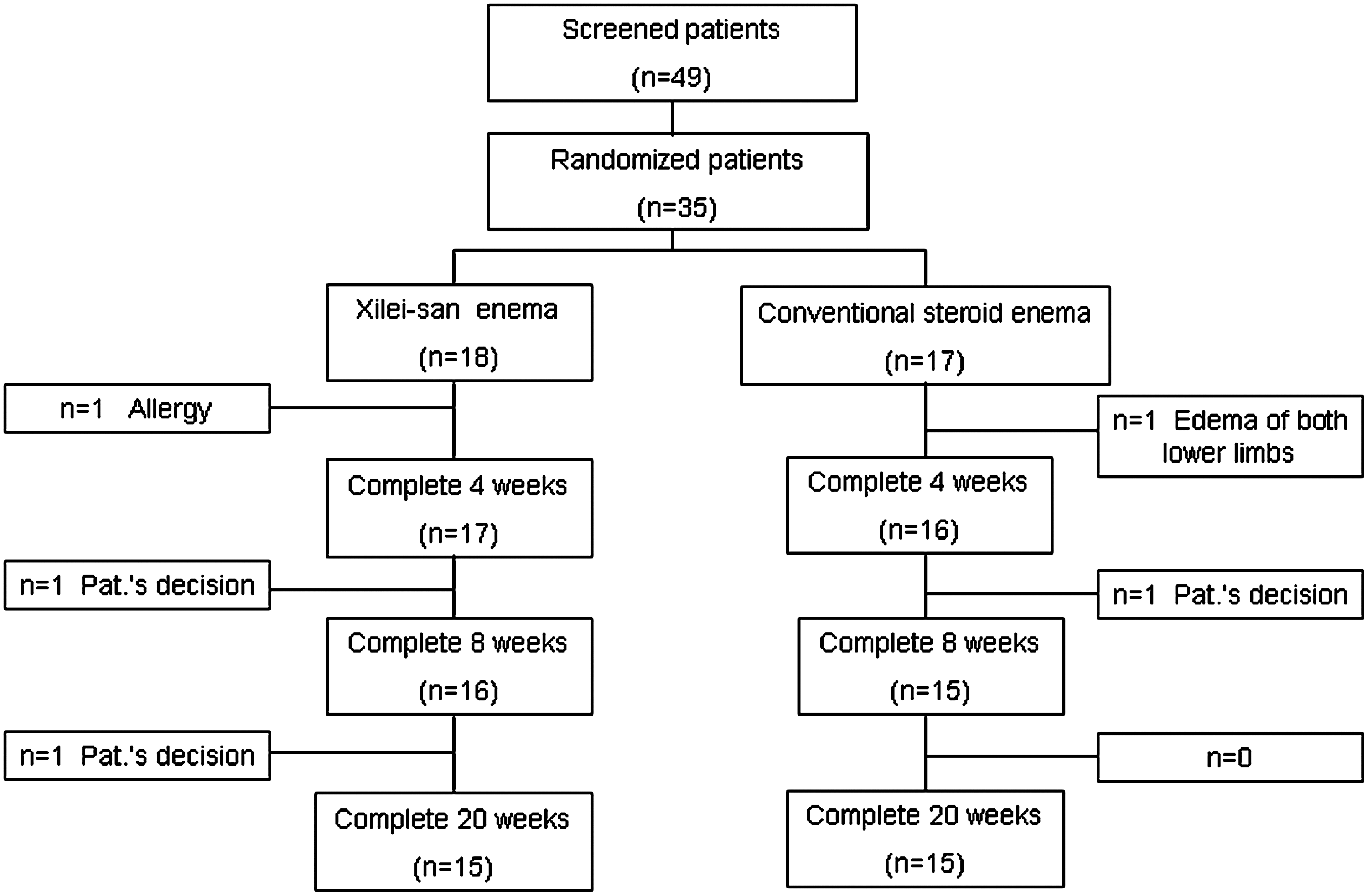
A flowchart describing the progress of patients during the course of the study. A total of 35 subjects with mild-to-moderate ulcerative proctitis were randomly assigned to receive Xilei-san or steroid enemas during the first 8 weeks of treatment. Pat.'s decision, patient's decision.
Plus–minus values are means±standard deviation.
Therapeutic efficacy
At week 4, 15 of the 17 subjects (12 remission, 2 improvement, and 1 partial improvement) in the group receiving the Xilei-san enema exhibited a clinical response, compared with 14 of the 16 subjects (11 remission, 1 improvement and 2 partial improvement) in the group receiving the conventional steroid enema (p=1.000 for both comparisons). Additionally, the rates of clinical remission at weeks 4 and 8 were similar between the Xilei-san enema and the conventional steroid enema group (p=1.000 for both comparisons).
The rates of endoscopic remission at week 8 were similar between the groups (12 of 16 versus 11 of 15, p=1.000). However, there were significant improvements in the endoscopic and histological scores, from 2.43±0.52 (mean±standard deviation) and 2.12±0.61 before treatment to 0.51±0.24 and 0.61±0.23 after treatment, in the Xilei-san enema group (p=0.001 and 0.007, respectively) (Figs. 2 and 3). In the conventional steroid enema group, the initial endoscopic and histological scores were 2.42±0.91 (mean±standard deviation) and 2.03±0.81, and these values changed significantly after treatment, to 0.62±0.31 and 0.84±0.57 (p=0.003 and 0.005, respectively) (Figs. 2 and 3).
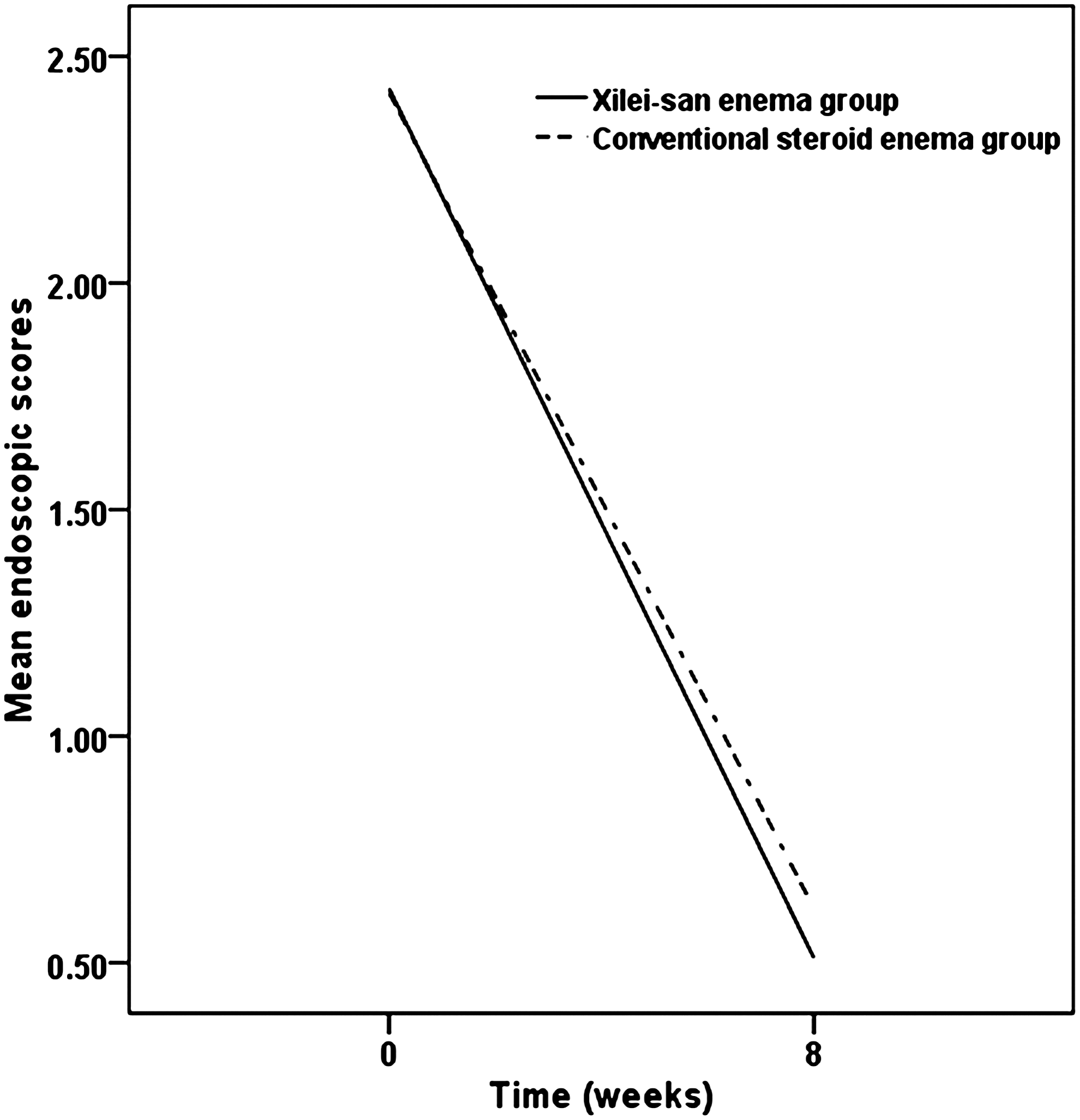
A change of mean endoscopic scores between 0 and 8 weeks. The endoscopic scores changed significantly after treatment in the Xilei-san enema group (2.43±0.52 versus 0.51±0.24, p=0.001) and the conventional steroid enema group (2.42±0.91 versus 0.62±0.31, p=0.003).
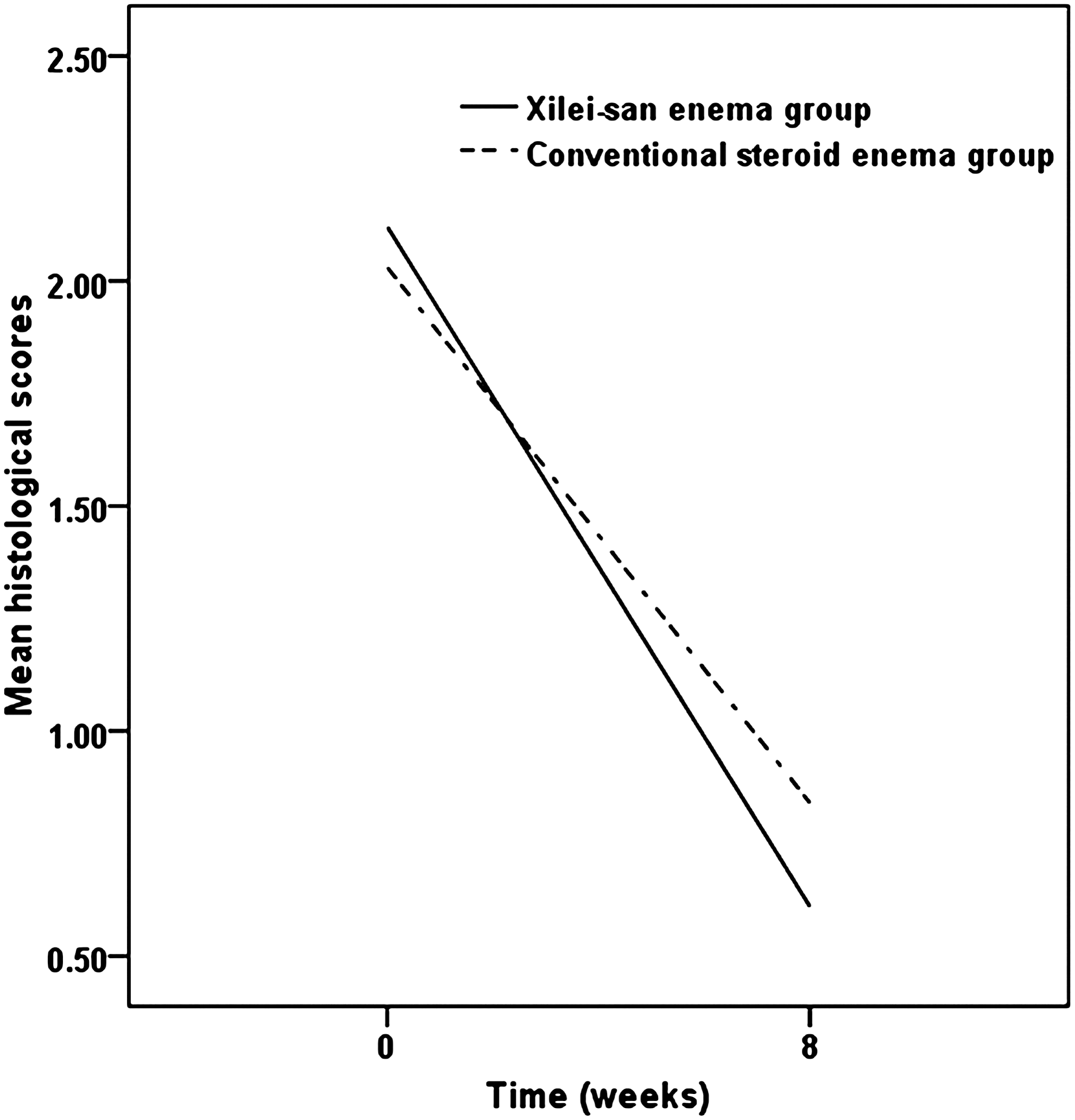
A change of mean histological scores between 0 and 8 weeks. The histological scores changed significantly after treatment in the Xilei-san enema group (2.12±0.61 versus 0.61±0.23, p=0.007) and the conventional steroid enema group (2.03±0.81 versus 0.84±0.57, p=0.005).
At week 20, both groups showed similar rates of clinical relapse (1 of 16 versus 2 of 15, p=0.600).
Adverse events
The majority of adverse events were of mild or moderate intensity. In the Xilei-san enema group, 1 subject exhibited serious anal or rectal pain that was relieved by mixing procaine into the enema, and 1 subject exhibited an allergic reaction that was relieved by discontinuing the enema treatment. In the conventional steroid enema group, 1 subject exhibited edema of both lower limbs and was relieved by discontinuing the enema treatment and undergoing diuretic treatment; 4 subjects exhibited acne; 2 subjects exhibited anal or rectal pain; 1 subject exhibited headaches, and 1 subject exhibited asthenia. The proportions of subjects exhibiting adverse events in the Xilei-san enema group were lower than that in the conventional steroid enema group (2 of 18 versus 9 of 17; p=0.012).
Discussion
This study is the first clinical trial to compare the effects of a Xilei-san enema with those of a conventional steroid enema (dexamethasone enema) in subjects with mild-to-moderate active UP.
Xilei-san has a long history in China and has been used in the treatment of erosions and ulcerations of the tongue, pharynx, and oral cavity. Recently, a pilot clinical trial from Japan showed that Xilei-san was effective in 6 cases with active refractory UP. 4 In the present trial, an 88.24% clinical response was found, with 70.59% remission at week 4 and 75.00% remission at week 8, in subjects receiving a Xilei-san enema treatment. Moreover, there were significant improvements in the endoscopic and histological scores at week 8. However, a 6.25% (1/16) clinical relapse was observed at week 20.
Rectal corticosteroid therapy has achieved widespread acceptance because of the proven efficacy and reduced adverse systemic effects relative to oral corticosteroids. 3 Overall, 65%–83% of subjects obtained symptomatic and endoscopic improvement with topical corticosteroid treatment. 10 Similar to the reports, it was found in the present study that the proportion of clinical responders reached 87.50% at week 4, and the proportions of clinical remission reached 68.75% at week 4 and 73.33% at week 8. Additionally, 2 of 15 (13.33%) subjects exhibited clinical relapse at week 20.
In this present trial, it was found that there were no differences in efficacy or in the rates of clinical relapse between the Xilei-san enema and the conventional steroid enema group. However, the subjects receiving the Xilei-san enema treatment suffered significantly fewer adverse events than those receiving the conventional steroid enema treatment.
Conclusions
In general, the results of this study showed that treatment with a Xilei-san enema resulted in significant improvements in the clinical, endoscopic, and histological severity of disease in subjects with mild-to-moderate active UP. It was also found that this improvement is comparable to the improvement resulting from a conventional steroid enema. However, it should be noted that this study has a small sample size. Thus, further studies in large cohorts of subjects are warranted to evaluate the therapeutic effects and mechanism of Xilei-san, and a randomized, double-blind, placebo-controlled study has been commenced based on the results obtained from this clinical trial.
Footnotes
Acknowledgments
We thank pharmacists for their commitment to this program. This study was sponsored by research funding for the doctoral program of higher education of China and the Youth Innovation Fund of the First Affiliated Hospital of Zhengzhou University.
Disclosure Statement
No competing financial interests exist.