




Abstract
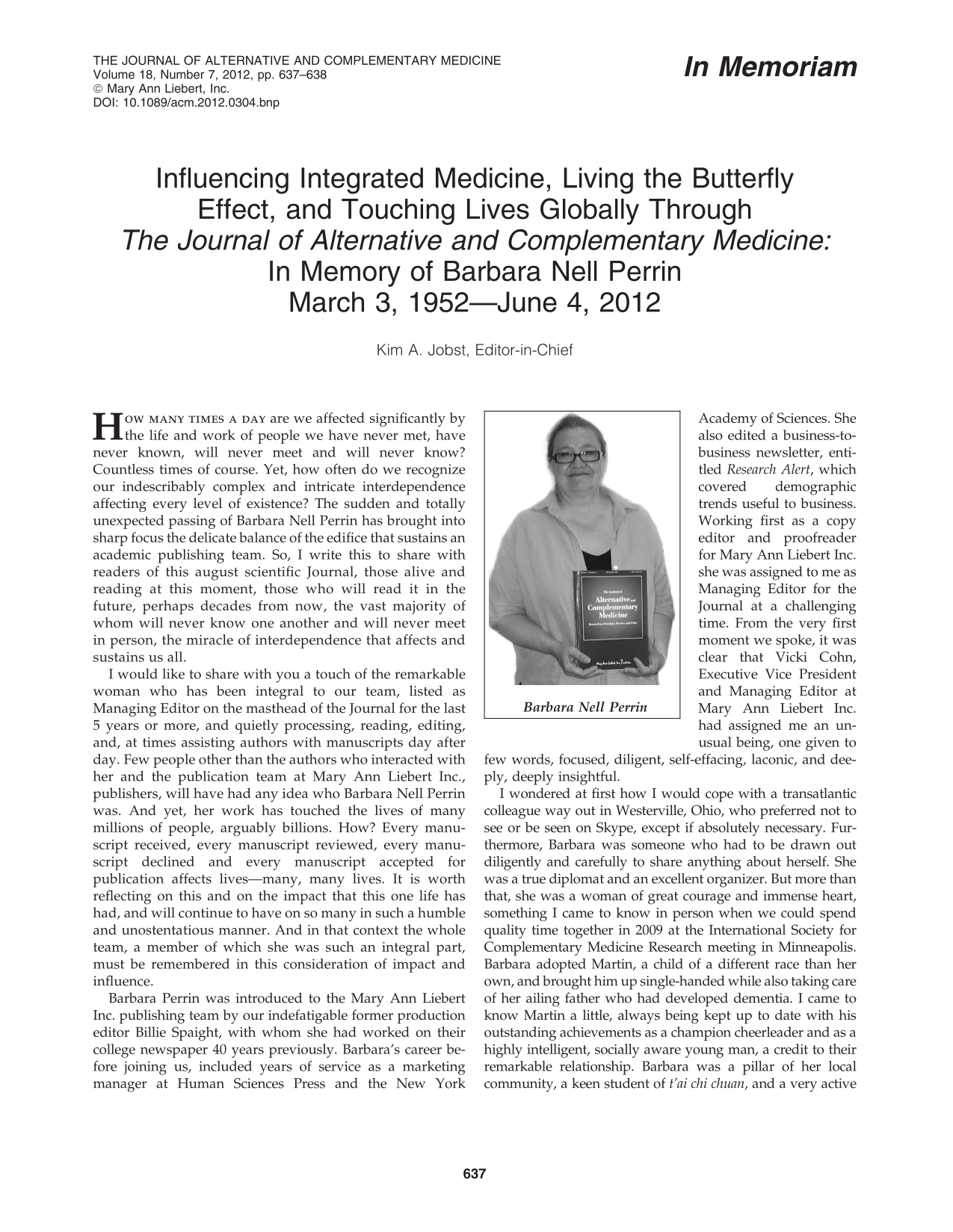
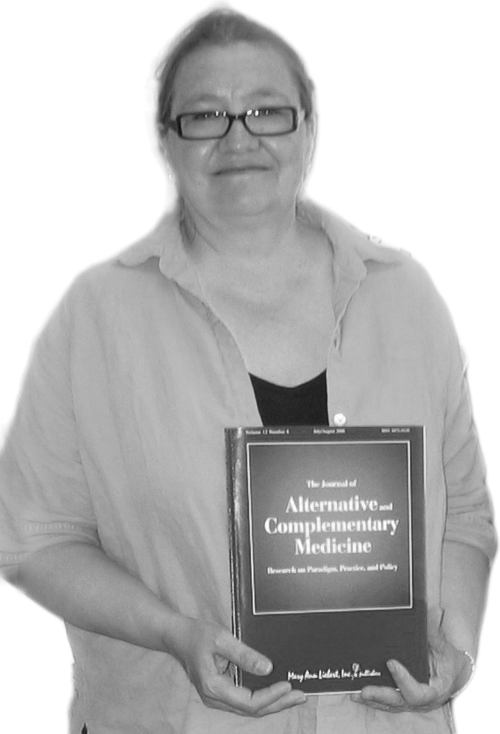
I would like to share with you a touch of the remarkable woman who has been integral to our team, listed as Managing Editor on the masthead of the Journal for the last 5 years or more, and quietly processing, reading, editing, and, at times assisting authors with manuscripts day after day. Few people other than the authors who interacted with her and the publication team at Mary Ann Liebert Inc., publishers, will have had any idea who Barbara Nell Perrin was. And yet, her work has touched the lives of many millions of people, arguably billions. How? Every manuscript received, every manuscript reviewed, every manuscript declined and every manuscript accepted for publication affects lives—many, many lives. It is worth reflecting on this and on the impact that this one life has had, and will continue to have on so many in such a humble and unostentatious manner. And in that context the whole team, a member of which she was such an integral part, must be remembered in this consideration of impact and influence.
Barbara Perrin was introduced to the Mary Ann Liebert Inc. publishing team by our indefatigable former production editor Billie Spaight, with whom she had worked on their college newspaper 40 years previously. Barbara's career before joining us, included years of service as a marketing manager at Human Sciences Press and the New York Academy of Sciences. She also edited a business-to-business newsletter, entitled Research Alert, which covered demographic trends useful to business. Working first as a copy editor and proofreader for Mary Ann Liebert Inc. she was assigned to me as Managing Editor for the Journal at a challenging time. From the very first moment we spoke, it was clear that Vicki Cohn, Executive Vice President and Managing Editor at Mary Ann Liebert Inc. had assigned me an unusual being, one given to few words, focused, diligent, self-effacing, laconic, and deeply, deeply insightful.
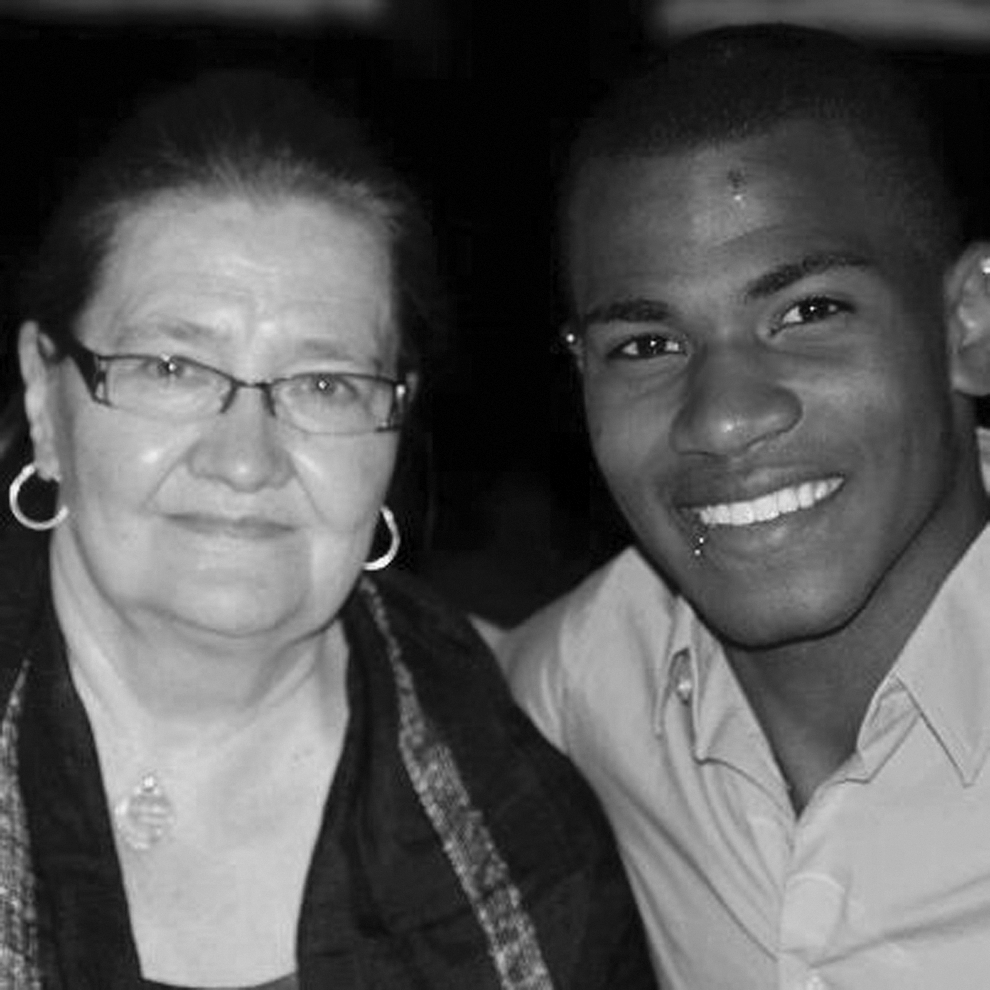
I wondered at first how I would cope with a transatlantic colleague way out in Westerville, Ohio, who preferred not to see or be seen on Skype, except if absolutely necessary. Furthermore, Barbara was someone who had to be drawn out diligently and carefully to share anything about herself. She was a true diplomat and an excellent organizer. But more than that, she was a woman of great courage and immense heart, something I came to know in person when we could spend quality time together in 2009 at the International Society for Complementary Medicine Research meeting in Minneapolis. Barbara adopted Martin, a child of a different race than her own, and brought him up single-handed while also taking care of her ailing father who had developed dementia. I came to know Martin a little, always being kept up to date with his outstanding achievements as a champion cheerleader and as a highly intelligent, socially aware young man, a credit to their remarkable relationship. Barbara was a pillar of her local community, a keen student of t'ai chi chuan, and a very active political voice, being passionate about voting reform and a dedicated assistant at elections.
Her gifts as a writer saw her regularly published in factual articles, creative fiction and poetry while she was busy assisting authors with suggestions that would enhance their submissions. It is here, in her work as Managing Editor of this Journal and later also of Medical Acupuncture on which she tirelessly assisted Richard C. Niemtzow, MD, PhD, PhD, that journal's Editor-in-Chief, that her influence spread to the four corners of the world, in ways that neither she nor anyone else could predict or even know. In all these roles we can see expressed what E.N. Lorenz referred to initially as the essence of chaotic behavior in dynamical systems: “sensitive dependence on initial conditions,” about which he first spoke in these terms in 1972 at the American Association for the Advancement of Science. 1 This is the way that even the smallest change in initial conditions, caused, for example, by the flapping of a butterfly's wings, or, in our case, the work of the Managing Editor, may lead to dramatic changes in the behavior of the system (i.e., patient care, health care policy, research and development, and, ultimately, the quality and nature of human experience. Barbara's life and work exemplified this, as does the work of all those who strive to maintain the quality and rigor of our Journal and all of those who submit their work in to our hands and whom we try our utmost to serve. I am grateful to have had the privilege of working with Barbara Nell Perrin and give thanks for her life and work on behalf of all associated with the field who have knowingly or unknowingly been affected by the flapping of her wings.