




Abstract
Objective:
To assess the effectiveness of abdominal acupuncture at the endocrine and metabolic level in patients with obesity-type polycystic ovary syndrome (PCOS).
Methods:
Eighty-six women from the First Affiliated Hospital of Guangzhou Medical College with a diagnosis of PCOS (body–mass index [BMI] ≥25 kg/m2) were randomly assigned to receive 6 months of abdominal acupuncture (once a day) or oral metformin (250 mg three times daily in the first week, followed by 500 mg three times daily thereafter). BMI, waist-to-hip ratio (WHR), ovarian volume, menstrual frequency, homeostasis model assessment for insulin resistance (HOMA-IR), and Ferriman–Gallwey score were measured at the beginning of the study and after 6 months of treatment. Luteotrophic hormone (LH), testosterone, follicle-stimulating hormone (FSH), fasting blood glucose, 2-hour Postprandial blood glucose, fasting insulin, 2-hour postprandial blood insulin, total cholesterol, triglycerides, low-density lipoprotein cholesterol (LDL-C), and high-density lipoprotein cholesterol (HDL-C) were also assessed.
Results:
According to the results at baseline and 6 months, BMI, WHR, Ferriman–Gallwey score, ovarian volume, luteotrophic hormone, ratio of luteotrophic hormone to follicle-stimulating hormone, testosterone, LDL-C, triglycerides, total cholesterol, fasting blood glucose, 2-hour postprandial blood glucose, fasting insulin, 2-hour postprandial blood insulin, and HOMA-IR were reduced significantly in the two groups (p<0.05). Menstrual frequency and HDL-C (p<0.05) increased significantly in both groups; follicle-stimulating hormone also increased in both groups, but the change was not significant (p>0.05). The acupuncture group showed considerable advantages over the metformin group in terms of reduced BMI and WHR and increases in menstrual frequency (p<0.05).
Conclusion:
Abdominal acupuncture and metformin improved the endocrine and metabolic function of patients with obesity-type PCOS. Abdominal acupuncture may be more effective in improving menstrual frequency, BMI, and WHR, with few adverse effects.
Introduction
However, a controlled diet and aerobic exercise over a long time span may be hard to maintain. Thus, patients with PCOS are commonly treated with metformin, an oral insulin-sensitizing agent. 4 This drug reduces blood glucose concentrations and improves insulin sensitivity in the liver and the peripheral tissues, thereby inhibiting hepatic glucose production and increasing glucose uptake and use in muscle. 5 Metformin normalizes several measures in women with PCOS. 6 Reduction of androgen levels, with an approximately 25%–50% decrease in testosterone, has been well documented, and a recent study showed that metformin administered for up to 6 months reduced hirsutism in PCOS. 7 In addition, other studies have revealed that metformin may increase the number of menstrual cycles in women with PCOS. 8 Thus, in women without evidence of renal or hepatic disease, metformin appears effective in reducing the negative effects of PCOS on reproductive and metabolic health.
Traditional Chinese Medicine (TCM) is a label that covers a broad range of traditional medicine practices throughout Asia. Acupuncture is an important component of TCM. There are more than 300 acupoints along the meridians that are described as a system for transporting energy and as a fundamental circulatory system for all tissues in the body. The meridians are not nerves and are not visible in anatomy; however, manual or electrical acupuncture activates the afferent nerve fibers. 9
Acupuncture is considered a relatively safe treatment. The incidence of adverse effects is substantially lower than that of many drugs or other accepted procedures for the same conditions. Compared with many conventional medical treatments, the rate of serious adverse effects of acupuncture has been reported as 3 per 1 million treatments. 10 Because adverse effects and serious adverse reactions are obstacles to current therapies for ovulation induction in women with PCOS, alternatives are required. Acupuncture has been reported to be a suitable alternative or complement to pharmacologic induction of ovulation in women with PCOS; this treatment provides the additional advantages of relieving other symptoms and adverse effects. 11
Abdominal acupuncture offers the advantages of comfort and safety, as well as effectiveness and efficiency. A systematic study based on 30 years of clinical investigation assessed the mechanism of indications of abdominal points and their relation with the whole body; in addition, the first study of abdominal acupuncture assessed the Shenque (CV 8)-channel-collateral system. 12 Considered to play a key role in abdominal acupuncture therapy, umbilical point CV 8 (on the umbilicus) is the central nucleus of the meridian and collateral regulatory system and is closely related to the qi and blood circulation throughout the body. In TCM, the stomach channel of foot-yangming regulates energy metabolism, and the conception vessel nourishes the whole genital system.
In this study, CV4, CV6, CV12, and CV13 and bilateral ST21, ST25, and ST28, which are located near the abdomen and close to fat depositions, were selected as acupoints. Abdominal acupuncture may directly affect adipose tissue and improve endocrine and metabolic functions. The needle was placed in the abdomen and hind limb, thus exhibiting the same somatic innervation as the ovaries and uterus. 13,14 Therefore, acupuncture on the abdomen, where somatic innervation corresponds to the ovaries, may restore normal endocrine, neuroendocrine, metabolic, and autonomic function.
This study aimed to assess the effectiveness of abdominal acupuncture as a treatment for obesity-type PCOS. The effect of abdominal acupuncture therapy on obese women with PCOS, as well as a parallel comparison with metformin, was also studied.
Materials and Methods
Study design and ethics
This single-center randomized clinical trial examined the effect of abdominal acupuncture on obese women with PCOS. To ensure equal proportions of age and body–mass index (BMI) in each study group, female patients who met the inclusion criteria were randomly allocated in a 1:1 ratio to an abdominal acupuncture or a metformin group. Stratification by age and BMI ensured equal proportions of those variables across groups. Computer-generated randomization within each stratum was conducted by using permuted blocks of two; randomization was concealed until interventions were assigned. The study was conducted in accordance with the principles of the Declaration of Helsinki and was approved by the ethics committee of the First Affiliated Hospital of Guangzhou Medical College, Guangzhou, China. The trial is registered at the Chinese Clinical Trial Registry with identifier no. ChiCTR-TRC-12002003.
Participants
Participants were recruited from an outpatient gynecology department, and the study took place at the First Affiliated Hospital of Guangzhou Medical College from January 2006 to May 2009. PCOS was defined according to modified Rotterdam criteria: ultrasonography-verified PCOS (≥12 follicles 2–9 mm and/or ovarian volume ≥10 mL in one or both ovaries) with oligomenorrhea/amenorrhea or clinical signs of hyperandrogenism (hirsutism or acne). 15 A BMI ≥25 kg/m2 was used to define obesity. 16 Hirsutism was defined as a Ferriman–Gallwey score of ≥8. 17 The presence of acne was defined by a positive response to the question “Do you have acne?” Oligomenorrhea was defined as an intermenstrual interval >35 days and fewer than eight menstrual bleeds in the previous year. Amenorrhea was defined as absent menstrual bleeding or no menstrual bleeding in the previous 90 days. Women with PCOS were excluded if they were younger than 18 or older than 38 years of age or had cardiovascular disease, diabetes mellitus, or endocrine or neoplastic causes of hyperandrogenemia. Women older than age 38 years were excluded because many women in that age group wish to become pregnant; as a result, they may prefer assisted reproductive technology over the long-term treatment for PCOS. All participants gave informed oral and written consent.
Interventions
Abdominal acupuncture
Patients in the acupuncture group received acupuncture twice a week for 6 months by a registered acupuncturist educated in theoretical and practical acupuncture at Guangzhou Medical College. The acupuncture protocol was based on the authors' clinical experience in treating women with PCOS. Disposable, single-use, sterilized needles made of stainless steel (made in China, produced by Suzhou Tianyi Acupuncture Apparatus; length, 40 mm; diameter, 0.25 mm) were inserted to a depth of 15–30 mm in segmental acupuncture points located in abdominal muscles with innervations corresponding to the ovaries; conception vessel CV4, CV6, CV10, and CV12; and stomach meridian ST21, ST25, and ST28 bilaterally. All needles were retained manually (de qi) once inserted and remained in place for 30 minutes at each treatment.
Metformin
Patients in the metformin group received metformin hydrochloride tablets (Bristol-Myers Squibb, Shanghai, China; medicine accurate character, H20023370) for 6 months. Metformin is taken with food. In the first week of the study, patients received 250 mg three times daily; thereafter, the metformin dose was 500 mg three times daily.
Outcome measurements
All measurements were performed in the morning after an overnight fast. Because most women with PCOS had oligomenorrhea or amenorrhea, the examination day was chosen independently of cycle day. Outcome measurements were repeated after 6 months of intervention (within 1 week after the last treatment).
Anthropometry
Height, weight, waist and hip circumferences, sagittal diameter (the abdominal height as measured in the supine position), BMI, and waist-to-hip ratio (WHR) were measured or calculated by standard protocols.
Insulin sensitivity
The homeostasis model assessment of insulin resistance (HOMA-IR) was used to quantify insulin resistance and β-cell function, according to the following formula: glucose (mmol/l)×insulin (μU/ml)/22.5. 18 Fasting blood samples for metabolism analyses were drawn between 7:30 am and 8:30 am and were immediately aliquoted on ice and stored at −80°C until assay. Blood samples were taken independently of the follicular phase of the menstrual cycle because most participants had oligomenorrhea or amenorrhea. A standard oral glucose tolerance test (75 g) was used to test for insulin resistance. Blood samples were drawn from the antecubital vein at 0 and 120 minutes for measurement of plasma glucose and insulin concentrations. Fasting blood glucose and 2-hour postprandial blood glucose were determined by using the glucose oxidase method. Fasting insulin and 2-hour postprandial insulin levels were assessed with chemiluminescence at the Department of Clinical Chemistry, First Affiliated Hospital of Guangzhou Medical College.
Ovarian morphology
Transvaginal ultrasonography was performed to measure ovarian volume. The women with amenorrhea received an injection of intramuscular progestin, 20 mg/d for 3 days. The progestin injection induced withdrawal bleeding. Transvaginal ultrasonography was performed on the third day of the patient's menstrual cycle or progestin-induced bleeding. The ovarian volume was taken as the mean of the volumes of the two ovaries.
Menstrual frequency
Menstrual frequency was calculated by the assessment of menstrual history, which involved recording menses in the 3 months before the study as a baseline. Baseline was calculated by dividing the number of menstrual bleeds by 3. Monthly menstrual frequency from baseline to 6 months was calculated by dividing by 6.
Biochemical assessments
Plasma concentrations of total cholesterol, high-density lipoprotein cholesterol (HDL-C), low-density lipoprotein cholesterol (LDL-C), and triglycerides were determined by using the enzymatic colorimetric method. Luteotrophic hormone (LH), follicle-stimulating hormone (FSH), and free testosterone were analyzed by radioimmunoassay at an accredited laboratory at the Department of Clinical Chemistry in the First Affiliated Hospital of Guangzhou Medical College.
Statistical analysis
Statistical analysis was performed by using SPSS software, version 13.0 (SPSS, Inc., Chicago, Illinois). A paired two-tailed t test was used to analyze the change within each group before and after the treatments. The paired two-tailed t test was performed after the Kolmogorov–Smirnov test for normalization of the distribution; a Student t test was used where appropriate. The results are expressed as the mean±standard error, and p<0.05 was considered to represent a statistically significant difference.
Results
Demographics and measurements at baseline
Among the 146 women screened at the outpatient clinic, 86 were enrolled and randomly assigned to the abdominal acupuncture group or the metformin group. No one withdrew from the study, and all 86 patients completed the study (Fig. 1). As shown in Table 1, the demographic and clinical profiles did not significantly differ between the two groups before the study.
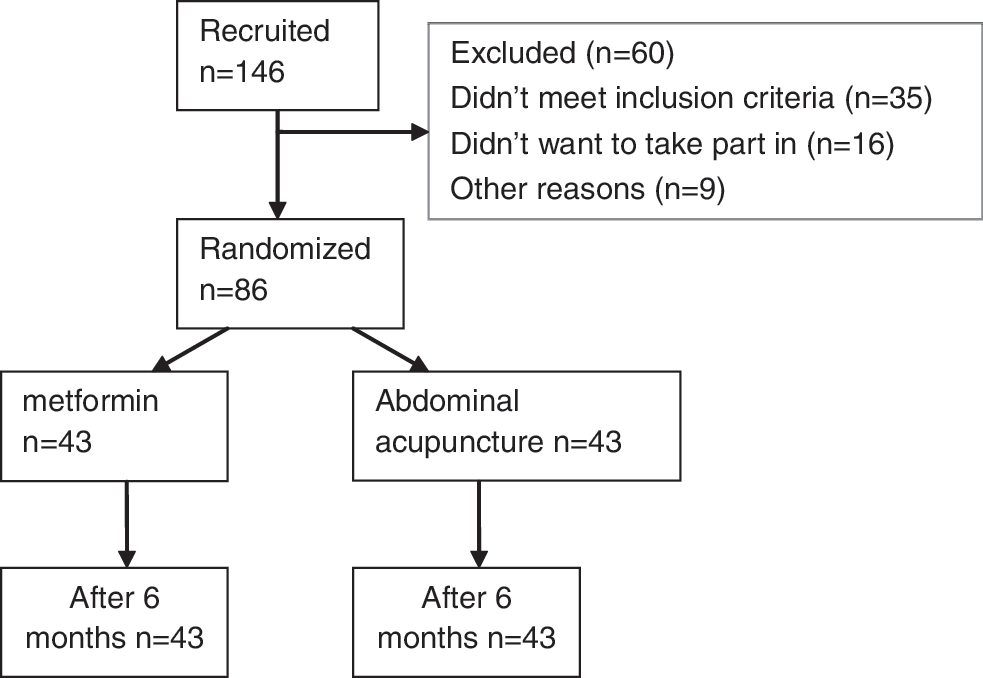
Flowchart of the study.
Values are expressed as the mean±SEM error.
P-values are not significant.
FGS, Ferriman–Gallwey score; FSH, follicle-stimulating hormone; HDL-C, high-density lipoprotein cholesterol; HOMA-IR, homeostasis model assessment for insulin resistance; LDL-C, low-density lipoprotein cholesterol; LH, luteotrophic hormone; WHR, waist-to-hip ratio.
Outcomes at 6 months
Table 2 showed the post-treatment demographic and clinical profiles of the two groups. BMI, WHR, Ferriman–Gallwey score, ovarian volume, LH, ratio of LH to FSH, testosterone, LDL-C, triglycerides, total cholesterol, fasting blood glucose, 2-hour blood glucose, fasting insulin, 2-hour postprandial insulin, and HOMA-IR were reduced significantly in both the metformin and the abdominal acupuncture groups (p<0.05). Menstrual frequency and HDL-C levels increased significantly (p<0.05) in both groups; FSH also increased in the two groups, but the changes were not significant (p>0.05). The abdominal acupuncture group exhibited considerable advantages over the metformin group in terms of reduced BMI and WHR and increased menstrual frequency (p<0.05).
p<0.05 (versus pretreatment value in each group).
p<0.05 (for comparison of the changes between the abdominal acupuncture and metformin groups at baseline and at 6 months of treatment).
Adverse effects
Gastrointestinal symptoms (diarrhea, abdominal discomfort, and anorexia) are the most common adverse effects of metformin. The effects are usually dose dependent and can be minimized by gradually increasing the metformin dose. In this study, the starting dose of metformin was 250 mg three times daily in the first week. It was increased over a period of 1 week, reaching a dose of 1500 mg/d. Twenty-one patients in the metformin group had mild adverse effects that occurred in the first stages of metformin use (nausea or vomiting in 7, mild diarrhea in 10, and slight dizziness or weakness in 4). No one in the metformin group withdrew from the study.
No uncomfortable symptoms occurred in the abdominal acupuncture group. Neither metformin nor abdominal acupuncture injured the liver or kidney: Serum creatinine and urea nitrogen levels were still normal after the interventions.
Discussion
PCOS is associated with high sympathetic nerve activity, and increased sympathetic nerve activity may be associated with hyperandrogenism. 19 Obesity may worsen all clinical features of PCOS; it is considered the most important determinant of excessive sympathetic activation. Adiposity still remains the leading concern in the pathogenesis of PCOS. 20 Recently, serum insulin, triglycerides, waist circumference, and WHR were shown to be correlated positively with BMI in women with PCOS. As an acceptable proxy for thinness and overweight or obesity, when BMI was >23 kg/m2, the prevalence of metabolic syndrome was particularly increased. 21 As shown in Table 1, at baseline, the patients exhibited metabolic dysfunction, such as high levels of triglycerides and HOMA-IR. Approximately 50% of women with PCOS are overweight or obese, and most have the abdominal phenotype. 22 WHR is used as a measurement of obesity and indicator of central obesity, which, in turn, is a possible indicator of other, more serious health conditions. WHRs >0.9 in men and >0.8 in women were associated with a significant increase in many risk factors. 23 At baseline in the current study, the mean WHR in the two groups was >0.8.
Metformin has been widely accepted as the therapeutic option for women with PCOS; it is prescribed to correct the characteristic metabolic and endocrine abnormalities (including reducing luteinizing hormone and sex hormone–binding globulin levels) and to ameliorate hyperinsulinemia and hyperandrogenemia. 5,24 Currently, metformin is one of the main pharmacotherapeutic options in the treatment of PCOS. As was seen in the current study, metformin exhibits an apparent beneficial effect on weight reduction and improvement in ovarian function, as assessed by menstrual frequency and testosterone production. 8,25
Acupuncture is a nonpharmacologic treatment widely used in complementary and alternative medicine to reduce weight. It is also commonly used in reproductive endocrinology and fertility clinics. 26,27 A meta-analysis of randomized controlled trials that evaluated the effect of various types of acupuncture therapies suggested that acupuncture is an effective alternative for treating obesity. 28 In addition, acupuncture significantly reduced BMI and abdominal adipose tissue by reducing abdominal visceral adipose tissue. 29 Weight loss may improve insulin sensitivity and ovarian functions 30,31 and enhance ovulation rates. 32,33
The physiologic effects of acupuncture are reported to result from neuromodulation that occurs after direct nerve stimulation. 34 Needling the acupoints may activate the peripheral afferent nerve fibers and receptors, resulting in responses from the peripheral, autonomic, and central nervous system; 35 –37 in turn, this produces anti-inflammatory, neuroendocrine, and neuroimmune signals. 38
PCOS is associated with peripheral and central factors that influence sympathetic nerve activity. 11 The sympathetic nerves appear to be involved in controlling ovarian secretory activity and are important regulators of ovarian function. Some researchers found the greater density of catecholaminergic nerve fibers in polycystic ovaries. 38,39 Acupuncture may regulate the ovarian responsiveness to sympathetic inputs and overcome sympathetic-related anovulation in women with PCOS. 19 Some studies reported that acupuncture increased ovulation (38%); significantly decreased BMI, WHR, and fasting insulin levels; 40 and improved high plasma β-endorphin levels and low hand temperature by reducing sympathetic activity. 41
The abdominal nerve plexus, a large plexus of sympathetic nerves in the abdomen, is a part of the sympathetic nervous system. Needling the acupoints located around the abdomen may activate the peripheral nervous system and stimulate the sympathetic nervous system via the abdominal nerve plexus. When needles are inserted into the skin and muscle, exciting ergoreceptors and causing afferent activity in Ad-, and C-fibers, they stimulate the same somatic innervation area as the ovaries; this decreases sympathetic nerve activity, thereby leading to decreased secretion of ovarian androgens. 42 As shown in Table 2, abdominal acupuncture and metformin can improve the menstrual cycle and hormonal and metabolic profiles. However, abdominal acupuncture was more effective than metformin in improving menstrual frequency, BMI, and WHR. This finding suggests that abdominal acupuncture may be more effective than metformin in restoring normal ovarian function and reducing the central fat that tends to accumulate in women with PCOS. 43
The primary limitations of this study were the lack of sham methods (such as placebo needles or superficial needling) and follow-up data. In addition, the study was not a randomized, double-blind, controlled study because it is difficult to blind both the participant and the practitioner to acupuncture treatment. However, the authors are preparing to conduct a well-designed randomized, double-blind, controlled study.
Conclusion
This study showed abdominal acupuncture to be effective in restoring the normal endocrine and metabolic function of patients with obesity-type PCOS. Compared with metformin, abdominal acupuncture improved menstrual frequency, BMI, and WHR.
Footnotes
Acknowledgments
This work was supported by Natural Science Foundation of China (30701119) and Natural Science Foundation of Guangdong Province (9151008901000050).
Disclosure Statement
No competing financial interests exist.