




Abstract
Objectives:
This paper examines the meanings of classical texts in contemporary East Asian medicine.
Methods:
This study conducted anthropological fieldwork of the Hyungsang Medical Society, the major practitioner association in South Korea, which follows the teachings of Donguibogam (Bogam), one of the most influential texts in contemporary Korean medicine. Field data were collected by long-term observation of clinical practices at member clinics, in-depth interviews with practitioners, and participation in activities of the medical society.
Results:
The Hyungsang Medical Society follows Bogam's emphases—such as the fundamental constituents of human beings and the constitutional differences among persons—and actualizes the teachings in Hyungsang medical theory. Hyungsang medicine proposes several person types, based on bodily appearances, that inform a person's inner status. These types illustrate emerging diagnostic methods derived from Bogam. The Jung (essence), Ki (energy), Shin (spirit), and Hyeol (blood) types are developed with a premise that disproportionate composition of the fundamental constituents leads to different face shapes among the four types of persons. A case developed in this study demonstrates that once a patient is identified as one of the types, the practitioner gains an advantageous position to approach the patient's health issues.
Conclusions:
The emerging person-types of Hyungsang medicine illustrate how a new medical practice is taking place in East Asian medicine today through contemporary actors' interpretation and actualization of classical texts, suggesting that classical texts play, and have the potential to play, a continuing role in East Asian medicine.
Introduction
S
Against this backdrop, the present study examines the current meanings of classical texts as a method of viewing East Asian medicine today. In so doing, this study attempts to contribute to discussions of not only the status quo of modern-day East Asian medicine but also its direction in the future.
This study used anthropological perspectives and methods to investigate what classical texts mean to contemporary East Asian medicine. In examining the situatedness of traditional medicine in modernity, anthropological studies of traditional medicine have shown its effectiveness. 2 –5,7 –14 The emblematic anthropological method, fieldwork, entailing long-term observation of practice and in-depth interviews with the actors involved, captures vivid pictures of contemporary traditional medicine and provides a window for viewing conflicts, negotiations, and the consequential transformation of contemporary traditional medicine in modernity. The anthropological view of medicine is characterized by an emphasis on the interconnectedness of medicine and other social constituencies, including the state, economic issues, social organizations, legal regulations, and patients' culture, to view and seek (or not to seek) traditional medicine. To scrutinize this complex sociomedical web, anthropologists situate themselves in actual venues within the web and experience practices of traditional medicine contingent on social matters. This positioning enables anthropologists to illuminate the entanglement of the medical and the social and delineate the current situatedness and unfolding of traditional medicine in given local and global contexts. With a socially tinged, multifaceted picture of traditional medicine, anthropological studies provide traditional-medicine communities and the broader audience with a forum for discussing traditional medicine today.
Drawing on the anthropological fieldwork of Korean medicine in South Korea, this paper illustrates the lasting role of classical texts in modern-day East Asian medicine. Specifically, the present study delves into the emerging theory and practice of diagnostic methods derived from an East Asian medical text, Donguibogam (Bogam hereafter), written in the 17th century during the Joseon Dynasty. In so doing, this study demonstrates that classical texts continue to play an irreducible role and contain great potential to nourish modern-day East Asian medicine. The field data gleaned at actual venues of Korean medicine will also help us understand how East Asian medicine is practiced in South Korean contexts.
Methods
The findings rely on anthropological fieldwork of the Hyungsang Medical Society, the major practitioner association in South Korea, which consists of 1,129 Korean medicine doctors who follow the teachings of Bogam. 15 Using anthropological methods at medical settings established by medical anthropologists, 8,9,11 this study collected field data through long-term observation of clinical practices at three member clinics and participation in activities of the medical society, including lecture series for practitioners or Korean medicine college students, academic conferences, and newly graduated practitioners' apprenticeships under senior society members. In-depth interviews with society members were conducted for theories and underlying logics of clinical practices. The data collection activities lasted for 2 and a half years, from April 2008 to October 2010. This study's methods also included developing a case study to demonstrate how the Hyungsang medical theory is realized in actual clinical settings.
Results
Hyungsang Medical Society in the context of contemporary Korean medicine
Before discussing the continuing role of classical texts demonstrated in Hyungsang medical theory, this section provides a brief survey of Korean medicine in South Korea and the Hyungsang Medical Society in the context of Korean medicine today. Korean medicine in South Korea exhibits interesting characteristics, as its historical trajectory and modern reconfiguration have taken a distinctive path. The contemporary Korean version of East Asian medicine has been established with the same institutional structure as biomedicine in South Korea, 16 consisting of 6-year Korean medicine colleges, university-affiliated and nonaffiliated hospitals, and private clinics. The parallel institutional structure with biomedicine and the impressive popularity of Korean medicine colleges, to which the top 1% of college applicants are usually admitted, provide considerable social authority to Korean medicine. 17 In contrast to Traditional Chinese Medicine in China, 3,5,8 Korean medicine in South Korea has not undergone standardization. Diverse clinical practices derived from various currents of medical tradition—such as schools of Donguibogam, Sasang medicine, Huangdi neijing, Shanghanlun, Sa-am acupuncture, and constitutional acupuncture—mark the salience of Korean medicine today. 18
This diversity in Korean medicine is attributed to a fact of Korean medicine today: Knowledge transmission is not dominated by Korean medicine colleges and their affiliated hospitals but flourishes in diverse organizations and activities, including lecture series and workshops organized by practitioners' associations or individual practitioners. The Hyungsang Medical Society, a well-known practitioners' association in South Korea, exemplifies the noncentralized knowledge transmission and its consequential diverse currents, theories, and practices in Korean medicine. The society has developed Hyungsang medical theory derived from Bogam, one of the most influential texts in contemporary Korean medicine. The Hyungsang Medical Society follows the teachings of Master Park In-kyu (1927–2000), who scrutinized the teachings of Bogam and founded a major association of Korean medicine. Society members, in interviews, said that Master Park focused on what Bogam tries to emphasize and had actualized those emphases in Hyungsang medical theory. This earnest way of reading Bogam takes shape in the theory of Hyungsang medicine.
Theory and practice of Hyungsang medicine
Even though Bogam's structure is similar to that of an encyclopedia, citing around 200 East Asian classical texts and covering a variety of illnesses and formulas, researchers of Korean medicine agree that its organizing principles permeate the entire volume and differentiate Bogam from other medical texts.
19
–21
Scholars often select two compilation principles: first, the emphasis on the fundamental constituents of human beings, Jung ( jing, essence), Ki (
 qi, energy), and shin (
 shen, spirit); and second, the constitutional differences among persons. Bogam reveals the first tenet by positioning in-depth discussions of Jung, Ki, and Shin in the introductory sections and permeating their fundamentality into the following chapters. The second tenet is articulated in the very first sentences of the main sections. Citing Zhu Zhenheng
  , the renowned physician of the Yuan Dynasty, Bogam asserts, “If [patients' outer] shapes and colors are different, [their inner] organs are also different [depending on individual constitutions]. Therefore, even when outer symptom is the same, treatments should be differentiated
  .”
22
This viewpoint, pointing out different treatments for different constitutions, saturates the entire volume and acts as a fundamental tenet.
.”
22
This viewpoint, pointing out different treatments for different constitutions, saturates the entire volume and acts as a fundamental tenet.
These principles have reached contemporary followers of Bogam. Hyungsang medicine illustrates well how the Bogam's emphases are actualized in contemporary Korean medicine. For example, the medical society's stress on the looking diagnosis among the four diagnostic modalities ( looking, hearing, asking, and touching diagnoses) of East Asian medicine is particularly associated with the interconnectedness between outer appearances (shapes and colors) and the inner body (organs). The very name of the medical society, Hyungsang, embodies the significance of the second principle. Hyung-Sang is a yin-yang coinage with a yin constituent, Hyung (
 Xing, shape or form), and a yang constituent, Sang (
 Xiang, image). One of the most significant epistemologies retained in this yin-yang coinage is consistency among constituents in given settings. Even though yin and yang have contrasting aspects, they share something consistently penetrating. Relying on this consistency, Hyungsang medicine practitioners can read inner status (image) from outer appearance (form). That is, the looking diagnosis, grasping inner organs' status by looking at the form and color of a patient's face, is enabled by this consistency.
Master Park, according to Hyungsang society members, researched the meaning of consistency between organs and form/color, manifested in the very first part of Bogam and detailed in the main chapters. He gleaned statements associated with inner and outer consistency dispersed in Bogam and systemized them in the Hyungsang medical theory. Drawing on his intensive reading of Bogam and 30-year clinical experience, Master Park has advocated a number of person types based on their bodily appearances that inform their inner status, such as Jung, Ki, Shin, and Hyeol types; six channel types; and five organ types. These constitutional types are brand-new categories, at variance with the Sasang constitutional types in Korean medicine proposed by the 19th-century scholar-physician Lee Je-ma—a testament of diverse, and continuously diversifying, Korean medicine in South Korea.
To demonstrate how Hyungsang medicine's person types work, this paper describes the Jung, Ki, Shin, and Hyeol categories, the groupings frequently used among Hyungsang Medical Society members. Of the four types, the first three are the fundamental constituents of human beings emphasized in Bogam. Hyeol ( Xue)—usually translated as blood—is another important constituent in East Asian tradition. Combining these four fundamental bases of human existence, Master Park formulated the four person-type categories.
As shown in Figure 1, Jung, Ki, Shin, and Hyeol persons have characteristic faces, particularly face shapes; round, rectangular, inverted triangle, and oval, respectively. According to the Hyungsang medical theory, Jung, Ki, Shin, and Hyeol are not evenly constituted in each person. Rather, each person has one factor that is greater than the other three. This disproportionate composition leads to different appearances and characteristics among the four types of persons. If a person has more of the Jung component, he or she tends to have a round face. If a person has a rectangular face, he or she has more of the Ki component.
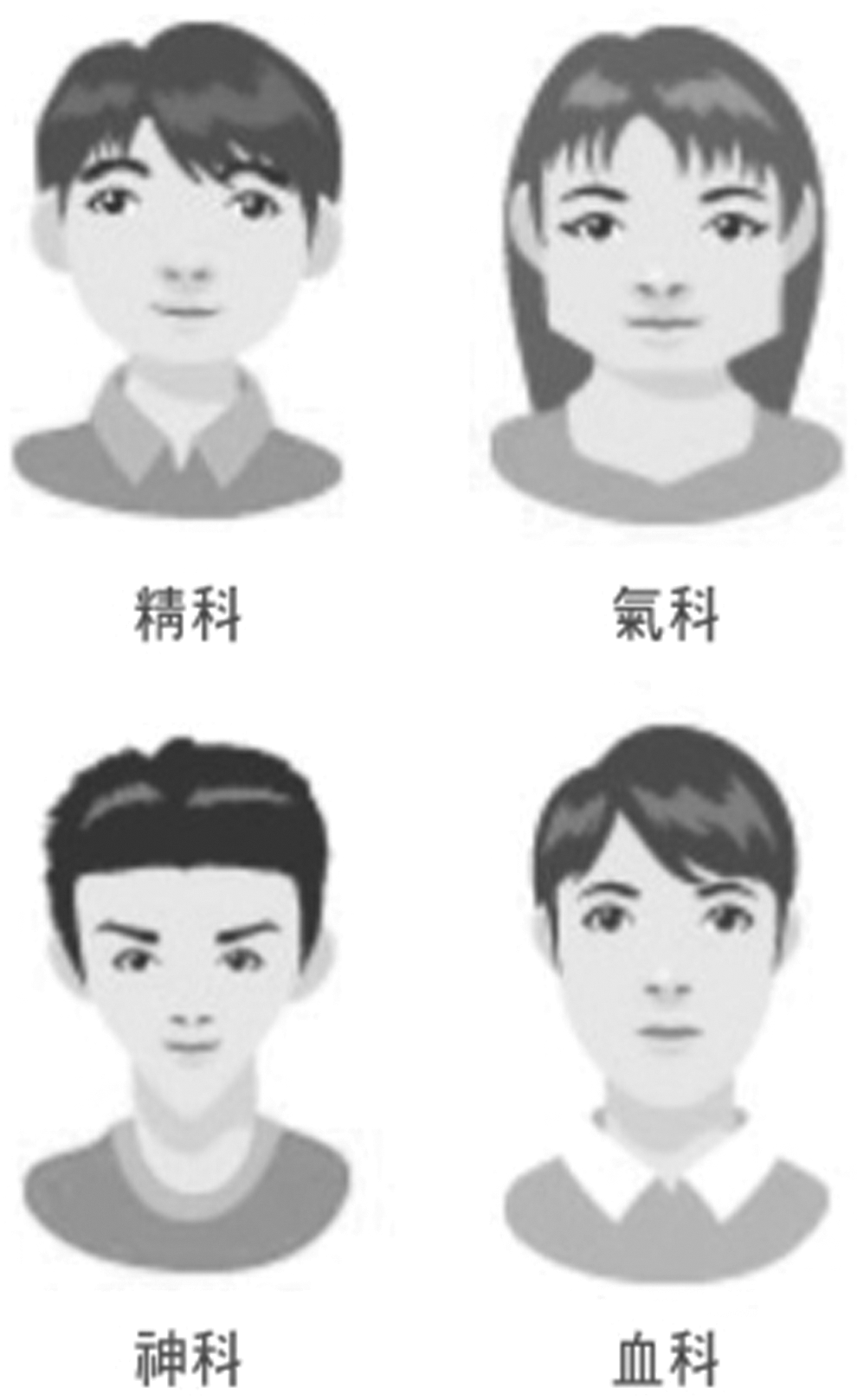
Portrayals of a Hyungsang grouping: the Jung category (upper left), the Ki category (upper right), the Shin category (lower left), and the Hyeol category (lower right). The cartoon figures are used to suggest characteristics of Jung, Ki, Shin, and Hyeol persons. The cartoons not only show the shape of the face but also depict a characteristic of each person. For example, the sharpness of the eyes and eyebrows in the Shin type suggest the person's keen character. Hyungsang society members said that it took more than 6 months for the medical society to complete these cartoon figures. The medical society approached a design company to create the cartoons, explaining how Jung, Ki, Shin, and Hyeol persons look. When the company responded with a draft, senior members of the society met and discussed revisions. The exchanges between the company and the society lasted more than 6 months before they came up with the images seen here. The cartoon figures are used in lecture series for new members and members' clinics to explain Hyungsang medical theory to patients. Even though distinctive features of the four person types are depicted in these cartoon figures, discerning one type from the others is difficult during an actual clinical encounter. To gain the ability of the visual diagnosis, novices are trained by numerous encounters with patients, including apprenticeships under senior society members.
The meaning of Hyung-Sang expounds the link between face shape and the fundamental components. In Hyungsang medical theory, the face is an important outer appearance (Hyung) that provides significant information about the invisible inner state (Sang). In the Jung, Ki, Shin, and Hyeol categories, face shape is consistent with a person's inner distribution of the four components. As Kuriyama—presenting the consistency of facial color and bodily state—asserts “the flowering visage is the bloom of the body's essences,” 23 Jung, Ki, Shin, or Hyeol is reflected in a person's face shape. Face shape is the outer appearance of the most prevalent component. In other words, the aura and unfolding energy of Jung, Ki, Shin, and Hyeol are delineated in a certain shape of the face.
Once a patient is identified as one of the types, the practitioner gains an advantageous position to approach the patient's health issues. Because the Jung, Ki, Shin, and Hyeol types have an emphasized component, each type tends to have illnesses related to the more stressed component. The Jung type often gets sick by the loss of Jung, or the essence. For example, if a Jung person reports dizziness and pain in the lower back, the patient is prone to loss of Jung in the kidney. When the loss of Jung is confirmed by other indications, such as in facial color and pulse, the practitioner uses a treatment to nourish the essence.
Although the society's name indicates its emphasis on Hyung (shape or form), the diagnosis not only depends on looking at Hyung. Rather, Master Park stressed that a practitioner should consider four points of diagnosis: Hyung (form), Saek ( Se, color), Maek (
 Mai, pulse), and Juing (
 Zheng, symptom, determined by asking patients questions). How these four aspects are combined is illustrated by the following. The case study also clarifies how the medical society's theory is substantiated in clinical encounters. Observation of the case took place in a Korean medicine clinic run by Dr. Park, a member of the Hyungsang Medical Society. The author often observed the Jung, Ki, Shin, and Hyeol categories being applied during long-term fieldwork in Dr. Park's clinic. The following case was selected as representative of numerous clinical encounters observed during 2 and a half years of anthropological fieldwork.
A Case of Ul ( Yu, stagnation)
Ms. Yoon (a pseudonym), a patient in her fifties, visited Dr. Park's clinic for the first time, reporting pain in her knee. Short exchanges between the two actors in the doctor's office about the cause of the main symptom (a missed step) and the precise location of pain (left knee) were immediately followed by a session of looking and touching diagnoses. Dr. Park combines the two methods among the four East Asian diagnostic modalities: taking the pulse and looking at the patient's face. This combined diagnosis session lasted around 1 minute. During this silent moment, Dr. Park tried to glean information about the patient's illness state by using diagnostic methods taught in Hyungsang medical theory. Long-term observations in Dr. Park's clinic revealed that he usually gains considerable information about a patient's illness with the looking and pulse-taking diagnoses.
In the asking-diagnosis session that followed, he merely ascertained what the looking and pulse-taking methods revealed. Ms. Yoon was a Ki-type person according to the Jung, Ki, Shin, and Hyeol categories. Hyungsang medical theory argues that male and female Ki types are treated differently, following the teachings of Bogam. The text states that “since male is yang, when he gains qi (ki is the Korean pronunciation of qi), it tends to be dispersed. And since female is yin, when she gains qi, it tends to be stagnated” (p. 79). 22
That Ms. Yoon is female and a Ki-type person drew Dr. Park's attention to her vulnerability to qi stagnation. Combining the looking diagnosis with pulse-taking, the possible stagnation turned into valuable information. Ms. Yoon had a sunken pulse, which indicated stagnation. Because Dr. Park felt a sunken pulse at a specific pulse-taking point that gives information about the upper body, he gained more detailed information about the patient's illness: The stagnation mainly causes health issues in the upper part of the patient's body.
Breaking the silent moments of the looking-touching diagnosis session, Dr. Park continued with the asking-diagnosis session with three questions: First, “Do you have pain in your shoulder?”; second, “Have you tended to be melancholic recently?”; third, “You feel heaviness in your chest, don't you?” These were all “yes or no” questions. This specific question pattern reflected the purpose of the asking diagnosis in Hyungsang medicine—to confirm the information gained with the looking and touching diagnoses. Ms. Yoon—who responded to all the questions with “yes”—showed visible surprise regarding how the doctor knew her problems. Dr. Park asked the first and third questions because those symptoms are common among patients with stagnant qi in the upper body. He asked the second question because stagnant-qi patients often experience melancholy. Hearing “yes” from the patient, Dr. Park confirmed what he had diagnosed in the combined looking and touching session.
The question-and-answer session was followed by Dr. Park's explanation of Ul and its causes and symptoms. The Korean medicine doctor added that Ul often causes distraction and that her knee injury was connected to the distraction. Satisfied with Dr. Park's explanation of the fundamental cause of her knee injury, Ms. Yoon elaborated her stress—the major cause of qi stagnation—at work and her recent distraction as a growing problem in her everyday life. Ms. Yoon received both treatments of acupuncture and herbal medicine. Along with acupuncture therapy for her knee injury, for her Ul problem Dr. Park prescribed a formula called Ijintang  with Kyogamdan
  , referring to Bogam.
22
, referring to Bogam.
22
Discussion
Hyungsang medicine's development of a new diagnostic method is nothing extraordinary. Rather, it is just a reminder of the way in which East Asian medicine has been developed and transformed. Despite the connotation that tradition is static and noninnovative, “traditional” medicine has never been disinclined to change. Throughout East Asian medical history, the emergence of new schools and innovative practices has been ubiquitously observed. 24 –26 Brand-new medicines in the recent past, such as the Wenbing (warm pathogen disorder) school in the late Qing Dynasty (1644–1911) and the Sasang medicine school in the late Joseon Dynasty (1592–1910), articulate that traditional medicine has continued to change with innovative theories. 27,28 The new looking diagnosis in the Hyungsang Medical Society demonstrates that this practice of reconstructing and renewing tradition continues in East Asian medicine today. Rather than transmission of ancient archetype to the present, the “tradition” of East Asian medicine has been a trajectory in the making, involved with endeavors in the past and present. Retaining foundational medical epistemology and theories, the fundamentality, classical texts have been at the center of this practice of constructing tradition. The emerging person-types of Hyungsang medicine exemplify how remaking of tradition takes place through communications of present and past actors with the medium of medical texts. With their unfading applicability for new theories and practices, the classical texts play, and have the potential to play, a continuing role in contemporary traditional medicine.
Footnotes
Author Disclosure Statement
No competing financial interests exist.