




Abstract
Objectives:
To evaluate the effect of two inhaled essential oils (black pepper or angelica) on the nicotine habits of students, staff, and faculty on a U.S. college campus.
Design:
Comparative study with pre-/post-test measures.
Setting:
Community college in rural East Texas.
Participants:
Convenience sample of 20 volunteers from the college community (students, faculty, and staff) who were regular (daily) users of nicotine (cigarettes, snuff, or chewing tobacco).
Interventions:
Inhalation of one drop of essential oil on a tissue for 2 minutes when participant was craving nicotine.
Outcome Measures:
(1) Pre-inhalation journal recording of self-assessed level of craving for nicotine on a 0–10 scale, (2) post-inhalation journal recording of self-assessed level of craving for nicotine on a 0–10 scale, and (3) minutes that participant waited from start of inhalation until next use of tobacco.
Results:
Both black pepper and angelica reduced the level of nicotine craving and allowed a longer delay before next use of tobacco. However, black pepper reduced the level of craving more than did angelica, and angelica allowed for a longer delay than did black pepper.
Conclusions:
Aromatherapy may be useful in nicotine withdrawal. Further studies are warranted.
Introduction
Several methods are available to help people stop using nicotine. These approaches range from behavioral techniques to pharmaceuticals. But although many studies have been done on behavioral and pharmaceutical treatments, only a few studies have addressed complementary therapies. These include acupuncture 3 and yoga. 4 Twenty meta-analyses of more than 300 studies concluded that behavioral and pharmacologic treatments were effective for smoking cessation. 5 Most of these reviews demonstrated that brief advice, behavior therapy, and nicotine replacement were the treatments of choice. None of these studies looked at complementary therapies. Manske and others 6 searched the literature and “identified 420 unique peer-reviewed published studies concerned with group-based cessation.” Best practices include one-on-one intervention, cessation groups, telephone counseling, and self-help methods. Again, none of these studies examined complementary therapies.
Most smoking cessation therapies are run by voluntary organizations and are not part of conventional medical treatment; many smokers try to quit on their own. 7 Smoking was not considered an addiction until recently, and most health insurance companies do not reimburse for treatment. Smoking has not decreased among poor, disadvantaged, or undereducated Americans, 8 and the future of smoking cessation will likely remain in the hands of volunteers and smokers themselves.
The methods that have been tested and deemed effective include cognitive-behavioral therapy; oral drugs, such as bupropion; nicotine patches, gum, or mouthspray; and support groups. 9,10 Although many of these common therapies have been studied, there is little information on former smokers who quit on their own.
Aromatherapy is widely used by health professionals, such as nurses, 11 doctors, 12 massage therapists, 13 and occupational therapists, 14 as well as lay people, for symptoms such as insomnia, nausea, and depression and to enhance well-being. Therefore, exploring whether aromatherapy could help people quit smoking is a reasonable endeavor. This study compares the effect of two essential oils: angelica (Angelica archangelica) and black pepper (Piper nigrum) on nicotine craving and time to next use of nicotine. Participants were faculty, staff, and students at a community college who smoked cigarettes or who dipped or chewed nicotine products, such as snuff or chewing tobacco. The choice of angelica and black pepper was based on a literature search, plus information from RJ Buckle Associates.
Between 1999 and 2011, students at RJ Buckle carried out 11 separate small pilot studies on smoking cessation for their clinical aromatherapy certification. Five studies used angelica, six studies used black pepper, and one used multiple essential oils. The first study, by DaCosta et al. in 1999, was cited by Buckle in the book Clinical Aromatherapy: Essential Oils in Practice. 15 In 2005, Zhao et al. found that angelica inhibited nicotine-induced behavior in rats. 16 Rose and Behm (1994) found that inhaling black pepper reduced nicotine craving in humans. 17 Sayette and Parott (1999) found that olfactory stimuli reduced the urge to smoke. 18
Materials and Methods
Study design
The study used a pre-test/post-test quasi-experimental design. One group received angelica and one group received black pepper. Both groups inhaled the essential oil for 2 minutes when they felt the urge to smoke or use tobacco (nicotine products). Measurements were (1) the pre- and posttreatment level of craving for nicotine on a scale of 0–10 and (2) how many minutes a participant waited from smelling the essential oil until using tobacco. The study was conducted during a 2-month period.
Materials
Black pepper and angelica essential oils were supplied by Elizabeth van Buren (
Participants
Study participants were volunteer students, faculty, and staff at a community college who used nicotine regularly by smoking, dipping, or chewing. Regular use was defined as use of tobacco at least four times per 24-hour period. Table 1 displays participants' self-reported nicotine use. Upon entering the study, participants were asked about craving and wait time. All 20 participants stated that once they noticed a craving rated as 3 or greater (according to the scale described below), the wait time was less than 3 minutes to use of nicotine unless they were somewhere where smoking was prohibited.
F, female; M, male.
Assignment and human participants
Twenty participants were randomly assigned to one of two groups using a random table of numbers; even numbers were assigned to group A (angelica) and odd numbers were assigned to group B (black pepper). All participants provided written consent. The college's institutional review board reviewed and approved the study format.
Method
An email was sent to all faculty and staff asking them to announce the study to classes and give out contact information to anyone who used nicotine in any form (cigarettes, chewing tobacco, or snuff) daily. A convenience sample of 20 people volunteered for the study. Participants were randomly assigned to group A (angelica) or group B (black pepper). Participants were given a printed journal sheet and were asked to do the following for 3 days at least 3 times a day, or more frequently if they had craving for nicotine: (1) Rate score of nicotine craving on a scale of 0–10 (0=no craving at all, 10=unbearable craving that needed immediate satisfaction) and record it in journal; (2) note the time using a watch or clock with a second hand and place a drop of the essential oil on a tissue and inhale deeply for 2 minutes; (3) again rate the nicotine craving on the 0–10 nicotine scale and record it in the journal; (4) note the number of minutes waited (from the time recorded in step 2) until nicotine use and record it in the journal; and (5) return the journal to the principal investigator.
Participants were not asked to abstain from using tobacco. They were asked to record their level of craving for tobacco, then to smell the essential oil for 2 minutes, then record their level of craving for tobacco again. They also recorded how many minutes elapsed between starting to inhale the oil and the next use of nicotine.
Measurement
Standardized journal sheets were given to each participant to record (1) the date and time, (2) the craving for nicotine, and (3) the time elapsed between use of the essential oil and the next use of nicotine. Each journal was tabulated by the amount the cravings increased or decreased after use of the oil and the time elapsed before use of nicotine. The rating scores and wait time to tobacco use for each oil were transcribed onto spreadsheets (Figs. 1 and 2) to compare results between the two essential oils.
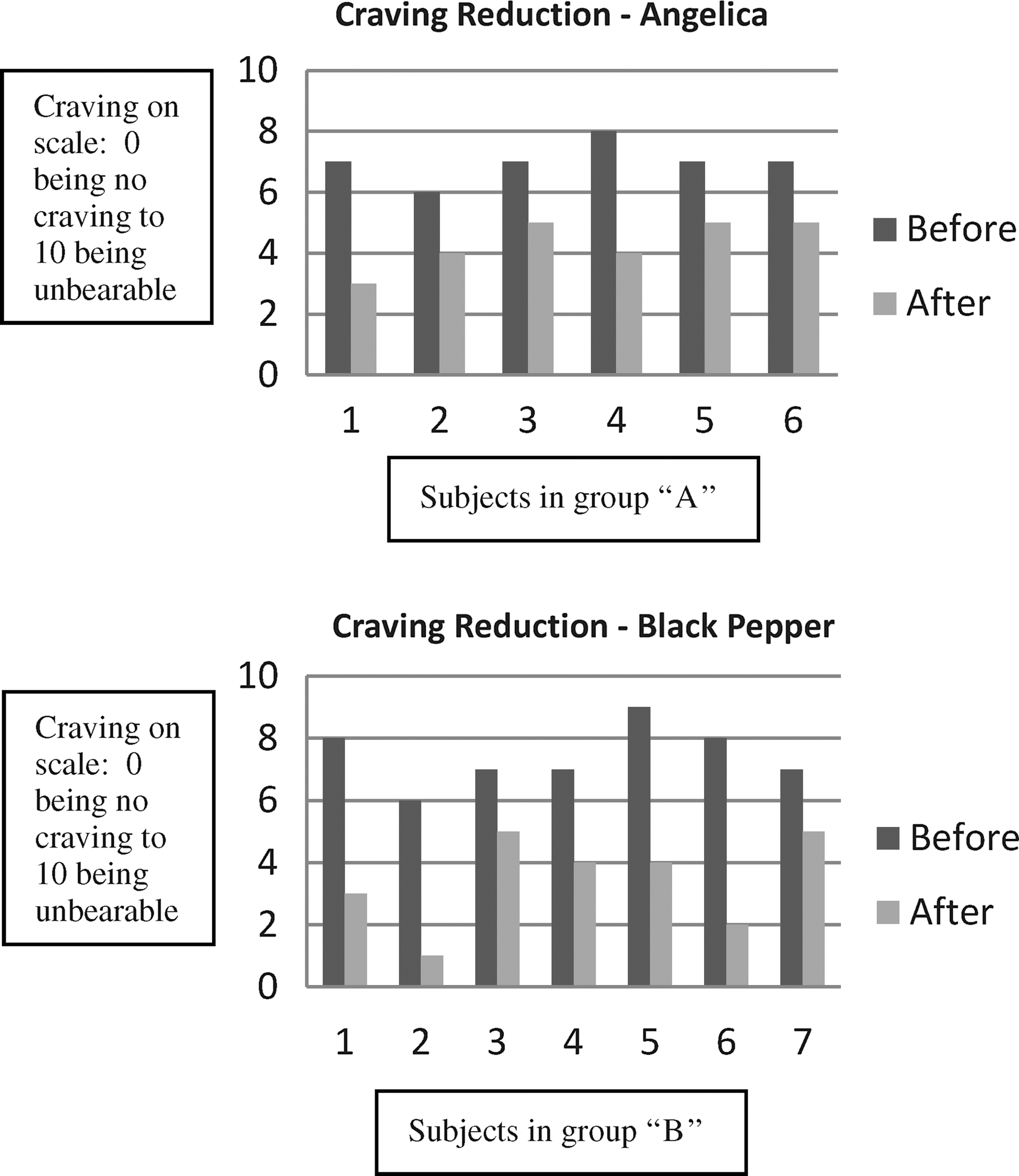
Comparison of craving reduction between participants using angelica and those using black pepper.
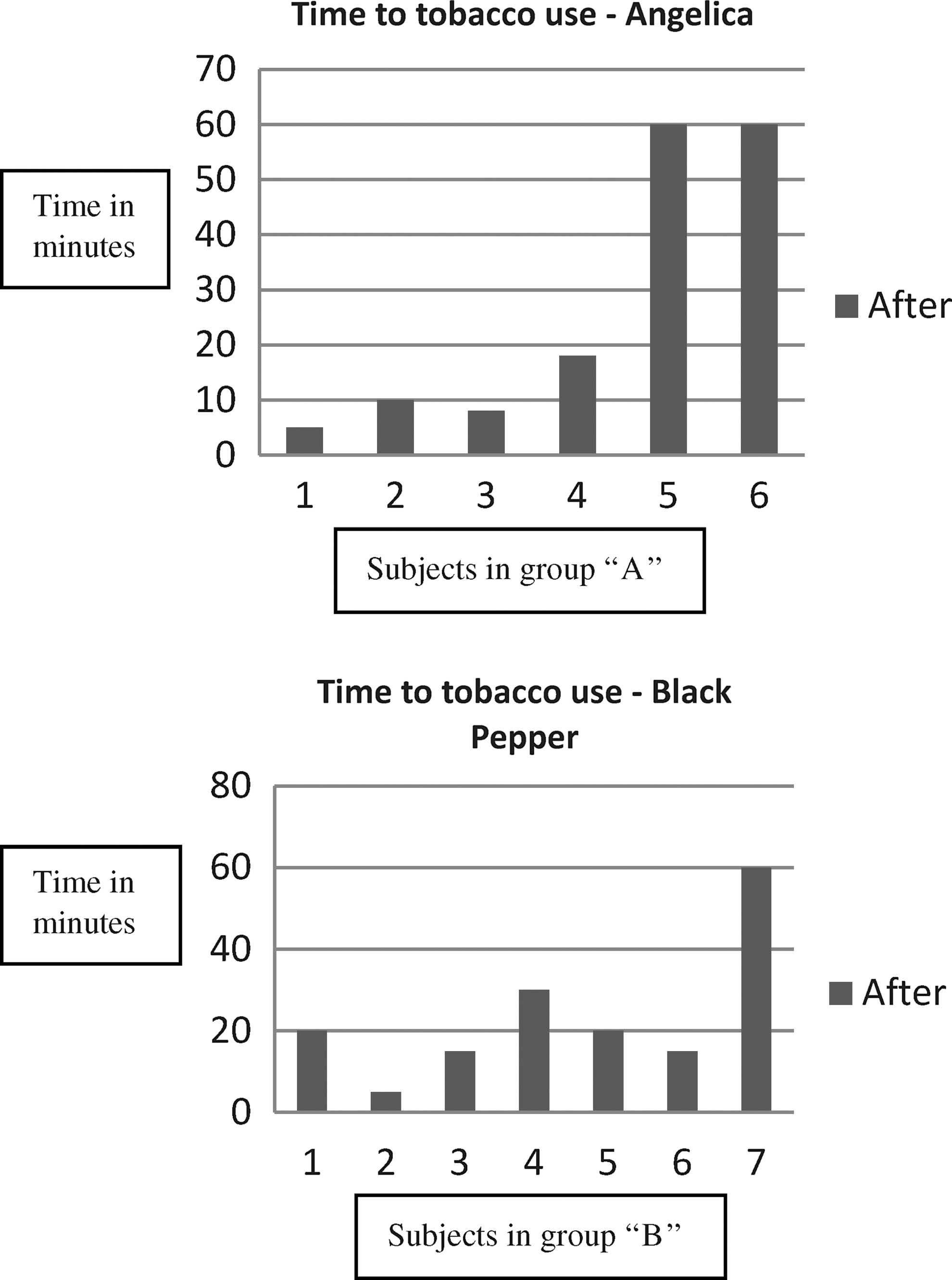
Comparison of time to tobacco use between participants using angelica and those using black pepper.
Each of the 20 participants received a journal sheet and a vial of oil. Ten were randomly assigned to the angelica group and 10 were assigned to the black pepper group (Table 1). Thirteen participants completed the journals and returned them to the principal investigator (return rate, 65%). The small sample size precluded use of a statistical analysis, but a comparison of the groups demonstrated positive results.
Results
Angelica and black pepper were both effective in reducing nicotine craving and increasing the time before the next nicotine use. In addition, group B (black pepper) had a greater reduction in cravings (see Fig. 1), but group A (angelica) managed to wait longer on average before using nicotine (see Fig. 2). The results are promising even with such a small sample.
One unanticipated result was that three participants (two in group A and one in group B) actually quit nicotine use completely during the study; at a 10-week follow-up, they had not relapsed. Participants were not asked to attempt cessation, but the three participants who quit made comments such as “The cravings were so low, I just didn't want to smoke any more” and “I just lost my desire to dip [snuff] when I smelled the oil, so I quit.” This was an unexpected but added benefit and should be studied further.
Participant withdrawal
Seven participants withdrew because they could not be contacted (n=5) or, when contacted, did not return their journals (n=2). It is unknown whether the participants who withdrew varied in some way from those who stayed in the study.
Variables
Group A had six participants (four men and two women); group B had seven participants (five men and two women). In group A, three participants used chewing tobacco, one used snuff and two smoked cigarettes. In group B, two participants used snuff, two used chewing tobacco and three smoked cigarettes. Participant ages ranged from 18 to 41 years (mean, 25 years) in group A and from 18 to 39 years (mean, 24 years) in group B (Table 1).
Discussion
Because the design was a pre/post measurement of craving, both essential oils seem to have had a positive effect in reducing craving for nicotine as well as a prolongation of time from use of oil to next use of nicotine. However, the sample size is small, and this study bears replication using a larger sample. Future studies should collect baseline information on desire to quit and awareness of cravings, as well as more detailed demographic data.
Some of the anecdotal feedback was unexpected. For example, several of the men liked the smell of black pepper, but several of the women preferred angelica. Preference could play a role in whether and how much the oil helped reduce cravings. The type of nicotine use and aroma preferences may have a direct bearing on the effects and use of essential oils. 20
The positive results with both black pepper and angelica, and especially the unintended benefit that three participants ceased using tobacco altogether, would suggest the need for additional study of nicotine addiction. Furthermore, essential oil use could be compared with other modalities, such as guided imagery, deep breathing, and massage.
The journals kept by the participants show an interesting (but not surprising) finding that cravings for nicotine use were highest around mealtimes, especially immediately after a meal. Use of alcohol beverages was also strongly associated with nicotine craving. The direct link among aroma, taste, and nicotine addiction could be explored further. Data could be examined to assess whether oils are more effective at certain times of the day.
Social factors are other important considerations for research. Two of the quitters in the study were a married couple—the husband dipped snuff and the wife smoked cigarettes. Other participants in the study were members of a baseball team and were trying to help one another quit. Support is an important factor in any behavior change, and studies conducted in the future should consider the motivation and social support of the participants.
Obvious limitations of the study include the small sample size and the fact that it was a convenience sample. Most participants were male, so the low number of women is an important limitation as well. It is possible that the simple act of becoming aware of cravings for nicotine can help reduce those cravings. The same is true for the increasing times observed before next use of nicotine. Simply becoming aware of time might itself increase the length of time before using nicotine. Furthermore, factors such as age and desire to quit before the study were not assessed or controlled. This study included all types of nicotine use, including smoking cigarettes, dipping snuff, and chewing tobacco. Dividing nicotine users into groups would produce a stronger study design.
Conclusions
This small pilot study indicates that angelica and black pepper reduced cravings for nicotine and increased the time before next nicotine use. Without exception, participants experienced a reduced craving for nicotine and were able to delay the next use of nicotine. Black pepper was more successful in reducing cravings, and angelica produced greater effects in time delay to next use. Three participants (23%) quit nicotine use completely during the study and at a 10-week follow-up had not relapsed. Additional studies are warranted. Inhaling angelica and black pepper is safe, with few adverse effects, and is a relatively inexpensive method (compared with medication) to help in nicotine cessation. This area of research could contribute to the health and welfare of tobacco users globally.
Footnotes
Acknowledgments
The authors would like to acknowledge the support of Panola College in allowing this research to be conducted on the campus.
Disclosure Statement
No competing financial interests exist.