




Abstract
Blood-letting therapy is one of the most important treatments in traditional Mongolian medicine (TMM). To observe the practice of Mongolian traditional-style blood-letting therapy (MTSBLT), two TMM clinics in Mongolia were visited in 2012 and two practitioners and a patient were interviewed. The interviews provided information on several characteristic features of MTSBLT, including its three stages: preparation, blood-letting, and recuperation. In the preparation stage, an herbal decoction, such as Braivu sumtan, is given for 3–5 days, during which time massage, cupping, and moxibustion can be applied. In the blood-letting stage, specific points, which differ from acupuncture points, are selected according to the patient's symptoms, and the targeted vein is incised just once. At this time, about 10 mL of blood is drained. In the recuperation stage, the patient needs to be cautious about diet and refrain from excessive physical exercise to prevent adverse effects. The patient interviewed had a favorable attitude toward blood-letting, believing that MTSLBT was an effective treatment for his symptoms.
Introduction
B
The Hospital of Traditional Medical Science, Technology and Production Corporation of Mongolia and Tumurbaatar Otoch hospital, both situated in the urban area of Ulaanbaatar, Mongolia, were visited in 2012. Two Mongolian physicians and one patient who underwent blood-letting therapy were interviewed. The author of this report is a doctor of Korean medicine and has practiced as a physician in Mongolia for 3 years. The purpose of this photoessay is to briefly describe current clinical practice in Mongolian traditional style blood-letting therapy (MTSBLT), and it may help improve understanding of TMM.
Clinics and Physicians
The Hospital of Traditional Medical Science, Technology and Production Corporation of Mongolia is a teaching hospital of Health Sciences University of Mongolia, School of Traditional Medicine (the national university for traditional medicine, six grades). Because this is a national hospital, patients are treated for free and are covered by the national insurance system. Dr. Monkh-bat (age 25 years; Figs. 1a and 2) graduated from the school and has worked in this hospital since 2011. The other clinic is a private ambulatory hospital named Tumurbaatar Otoch. Dr. Tumurbaatar (age 42 years; Fig. 1b) graduated from Otoch Manramba Traditional Medical School (private college for TMM, five grades) and has the unusual distinction of having served as a physician to the ninth archbishop of Buddhism in Mongolia, Bogd Javzandamba khutagt. He founded the clinic and has been its director since 2009.
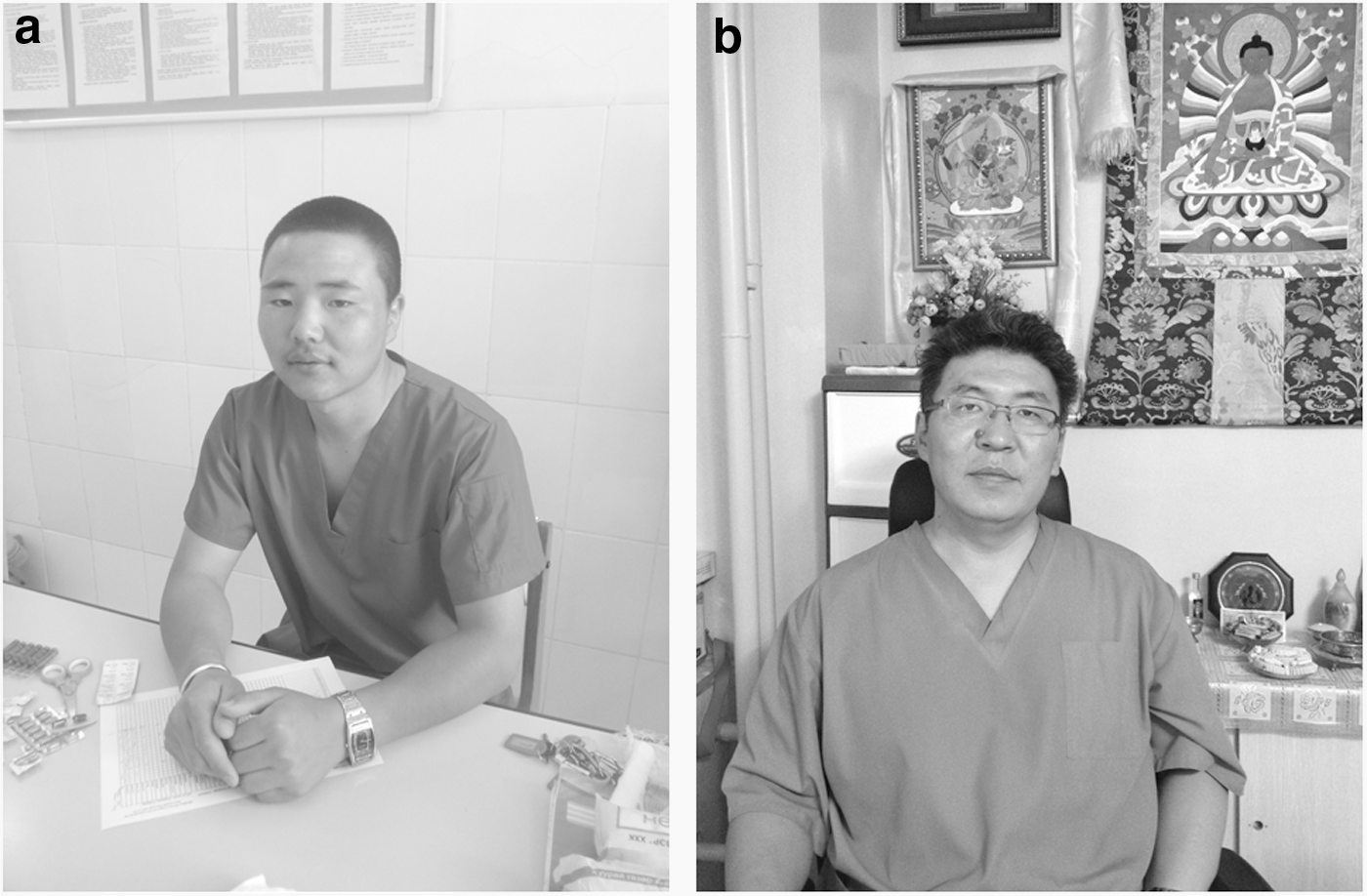
Two practitioners of traditional Mongolian medicine.

The procedure of Mongolian traditional blood-letting therapy.
Indications for and Contraindications to Blood-Letting Therapy
Indications for blood-letting were thought to be fire or heat syndromes, which are generally accepted as blood or liver diseases in TMM. The patient treated by Dr. Monkh-bat was diagnosed with porphyrinemia, which caused liver damage. Dr. Tumurbaatar's patient had transient hypertension and severe headaches. The doctors recognized these diseases as symptoms of excess heat or abnormal activity of the blood. Children, pregnant women, the elderly, and people who are extremely thin or fair-complexioned cannot undergo blood-letting therapy.
MTSBLT Procedure
Both doctors agreed on the general blood-letting procedure: Patients need to go through three stages of treatment. (1) The preparation stage consists of administration of an herbal decoction called Braivu sumtan, which contains three herbs (the fruits of Gardenia jasminoides Ellis, Terminalia chebula Retz, and Melia toosendan Sieb. et Zucc) for 3–5 days, along with other treatments, including massage, cupping, or moxibustion. The purpose of this stage is said to separate good from bad blood. Experimental studies suggested that individual herbs of Braivu sumtan may have supportive effects on bleeding procedure through antithrombotic activities. 2 (2) The next step is the blood-letting, which is performed just once. The time for blood-letting is decided through pulse diagnosis. Delgersen sudas, a “surging” but relaxed pulse, indicates that the process of separating healthy and bad blood has been completed. (3) The final step is the recuperation stage. During this period, patients should not consume alcohol or oily, sour, or spicy food and should avoid excessive physical activity.
The two doctors demonstrated MTSBLT, using similar procedures. First, the spot for blood-letting was wiped with antiseptics and a tourniquet was tied to reveal the targeted vein. Second, the vein was incised with a disposable surgical blade. Third, blood continued to be drained until its color turned from black to bright red (Fig. 2). Traditionally, several types of blade were used for blood-letting, but in current practice only disposable blades are permitted, to prevent infection.
Of the many points for blood-letting, two are generally selected: Rutun for diseases or symptoms of the upper half of the body and Lonza for those of the lower half. The vein called Rutun, which is to be found four fingerbreadths above the olecranon of the right ulna, was selected for both patients because liver disease and headaches belong to the upper half of the body (Fig. 2).
Cautions Related to Blood-Letting Therapy
Generally, blood-letting is conducted only twice a year, in the spring and in the autumn. It is essential to drain the appropriate volume of blood: Excessive blood loss induces the so-called Khi syndrome of complaints, such as tinnitus, headache, or emotional problems; if too little blood is drained, the treatment will not be effective. To judge the appropriate amount of blood drained, the crucial point is to observe when the blood changes color (Fig. 2d). Only a few drops, or about 10 mL, of blood were drained from the two patients on this occasion.
Education and References on Blood-Letting Therapy
Both doctors said that they learned blood-letting from their college professor in the last 2 years of medical school. The teachers taught the theory and demonstrated blood-letting practice to the students. The Four Medical Tantras, which is the representative medical textbook of TMM, was used as an importance reference on the subject of blood-letting.
A Patient's Perceptions of Blood-Letting Therapy
Sandag-dorj (age 53 years), who was treated by Dr. Tumurbaatar, was interviewed about his experience with blood-letting treatment. His chief complaints were transient hypertension and severe headaches, and he attended this treatment session on the doctor's recommendation. He was favorably disposed toward blood-letting because Mongolians traditionally have faith in this treatment. Expenditure on blood-letting therapy was perceived as reasonable and necessary, given his previous personal experiences of being admitted three times to other national or private clinics. During the preparation stage, he took the decoction for 5 days and received cupping and massage four times. By the time he was ready for blood-letting, his troublesome symptoms had already abated by about 70%. He said that the blood-letting itself was not painful or frightening. It was his last visit to the clinic, his treatment having now finished.
Discussion: Possible Mechanism and Current Evidence of MTSBLT
It can be assumed that several components contribute to the effects of MTSBLT. The herbal decoction itself may be effective in treating inflammation and relieving pain. 3 –5 During the blood-letting procedure, nociceptive stimulation of skin and blood vessels may be related to analgesic effects (as occurs with acupuncture), and letting out a small amount of blood can improve micro-circulation (as seen with use of leeches). 1 However, there has not been enough evidence to clearly explain the exact mechanism of MTSBLT's therapeutic effects until now.
MTSBLT is one of the most important and frequently used interventions in MTT. Several clinical studies show the effectiveness of MTSBLT for treating neck pain, hypertension, headaches, stroke, and conjunctivitis. 1 However, these studies suggest only limited evidence because most of them were case studies or case series and were methodologically weak. In addition, clinical studies and textbooks of MTSBLT only offer safety precautions against malpractice of MTSBLT; they have not adequately reported on adverse events related to the treatment. Thus, safety issues have not been evaluated clearly until now.
Conclusion
MTT developed treatment methods that varied among regions, cultures, and history. MTSBLT, which is a unique treatment modality in MTT, has always been actively used in clinical practice in Mongolia. Compared with different types of blood-letting techniques in the traditional medicines of many other countries, MTSBLT is distinguished by its preparation method and selection of the point for blood-letting, as well as its own particular theoretical basis. Exploring MTSBLT offers the chance for traditional medical physicians and patients to understand MTT and gain a new perspective on blood-letting therapy. This is the objective of this short photo-essay.
Footnotes
Acknowledgments
The authors are grateful to Dr. Tumurbaatar and Dr. Monkh-bat for allowing them to undertake this research visit and conduct interviews. We especially thank Dr. Togtokhbayar and Professor Khishigjargal for their kind help and support for this research.
Disclosure Statement
The authors state that no competing financial interests exist.