




Abstract
Objectives:
The study objective was to discern whether the coherence between brain activities of the “patient” and practitioner differ between Reiki experts and novices.
Rationale:
If the physical process associated with Reiki involves “convergence” between the practitioner and subject, then this congruence should be evident in time-dependent shared power within specific and meaningful frequency electroencephalographic bands.
Design:
Simultaneous quantitative electroencephalogram measures (19 channels) were recorded from 9 pairs of subjects when 1 of the pairs was an experienced Reiki practitioner or had just been shown the procedure. Pairs recorded their experiences and images.
Setting/Location:
The “practitioner” and “patient” pairs were measured within a quiet, comfortable acoustic chamber.
Outcome Measures:
Real-time correlations and coherence between pairs of brains for power (μV2·Hz−1) within the various frequency bands over the 10-min sessions were recorded and analyzed for each pair. Descriptors of experiences were analyzed for word meanings.
Results:
Only the coherence within the theta range increased over time between the brains of the Reiki pairs relative to the Sham pairs, particularly over the left hemisphere. The pleasantness–unpleasantness rating for the words employed to describe experiences written after the experiment were more congruent for the Reiki pairs compared to the reference pairs.
Conclusions:
The increased synchronization of the cerebral activity of the participant and the practitioner during proximal therapies involving touch such as Reiki may be an important component of any subsequent beneficial effects.
Introduction
T
Reiki is a method presumably rediscovered by Japanese researchers from ancient Tibetan practices of touch therapy and healing. The proximal form involves the practitioner placing his or her hands over discrete portions of the patient's body while concentrating upon specific geometric patterns. The presumption is that under optimal conditions once the practitioner has learned to access some “universal” energy, it enters through the practitioner's head and is mediated through the hands to optimize the patient's own ability to stabilize and to heal. Increases in hemoglobin and hematocrit, 3 reduction in anxiety and pain, 4,5 increases in immunoglobulin A, diminished blood pressure, 6 increased vagal activity, 7 and reductions in blood urea nitrogen with normalization of glucose 8 have been reported. The effect size (i.e., the amount of variance explained by the treatments) accommodates about one quarter to one half of the variance in the measures taken.
That some individuals' proximities can affect biochemical and biological systems has been shown under relatively rigorous experimental conditions but effectively ignored. Grad's 9 repeated experiments showed that the proximity of the hands of a local “healer” to ordinary water affected the growth of plants treated with this water. Preliminary data indicated that the spectrum emission from that water was increased in the infrared range. Justa-Smith 10 showed that another healer affected the activity of the enzyme trypsin under controlled conditions. The latter effect was equivalent to the effects of a static magnetic field of 100 G.
There are likely physical bases for these effects that display a normal distribution of potency within the human population. The whole body capacitance is between 20 and 50 pF and the average skin resistance is between 50 and 1000 kΩ. The product of resistance and capacitance is the time constant that results in frequencies between 75 kHz and 3 MHz, which is also the range where optimal effects for Kirlian glows occur. 11 The latter are discerned by interactions between energies emitted by living tissue and electrostatic fields. Such interactions suggest there are perhaps recondite patterns of frequencies of electromagnetic fields intrinsic to living systems that can be amplified when other fields (e.g., from a proximal person) are superimposed. One of the consequences of this superimposition could be the emergent phenomena of “beats” (subtractions between frequencies) and interference patterns.
We reasoned that if Reiki was sufficiently potent to influence multiple biological measures and it operated through subtle physical mechanisms, there should be obvious effects upon brain activity. These effects should be primarily reflected as increased coherence of electroencephalographic power between the brains of the practitioner and the recipient. Because traditional Reiki procedures involve no overt verbal behavior but require only subjective (covert) thinking and imaging by the practitioner and proximity to the subject or patient, this procedure would produce minimal confounding variables during a QEEG study.
Materials and Methods
Participants
There were 5 pairs of Reiki and 4 pairs of Sham treatment subjects (n=18). The seasoned Reiki senders' history of experiences ranged from 4 to 10 years. The Sham senders were randomly selected form volunteers and had no experience. All senders were women between the ages of 23 to 24 years of age in the Sham group and 26 and 30 in the Reiki group. The receivers were between 18 and 27 years of age and were male and female.
Procedure
Reiki and sham techniques
For any experiment, the sender and receiver (who were not familiar with each other) met in the experimenter room and were introduced. Each person sat within an acoustic chamber that was also a Faraday cage. The receiver sat on a comfortable chair with the back toward the sender, who was seated as well. Both members of the pair were fixed with 19-channel electroencephalogram caps whose outputs were sent externally to 2 laptop computers outside of the chamber. They were briefly told to relax and respond to instructions and to remember any images or feelings so they could be recorded after the session was completed. The door was partially closed. Communication with the experiments occurred through the small space in the door. During the experiment there was no talking or overt verbal communication between the practitioner and subject.
After the instruction: “start the treatment,” each practitioner (sender) “imagined” the first Reiki symbol, a spiral with a straight line with its associated word (Choku Rei) that was repeated 3 times. The second symbol, a face-like pattern, and its word (Sei He Ki) were repeated 3 times while the practitioner continually “imagined” the force moving into the receiver. The third imagined symbol looks like a Japanese Christmas tree. During the imagination process, the word (Hon Sha Ze Sho Nen) was repeated 3 times. This cycle was about 1 min and repeated throughout the measurement period. The practitioners also imaged specific colors associated with symbols. In addition, the senders placed both of their hands over the backs of the receivers and occasionally touched them. They had been told they may or may not be touched lightly intermittently.
The Sham senders were shown the 3 symbols and the words just before the procedure started. They were instructed to remember the symbols and the associated words and that when they heard the word “Start” they would imagine and “send” the words and the symbols to the receiver. They were informed to repeat this procedure until they were told to stop. There was no overt talking during the experiment. Postexperiment verification indicated they engaged in this activity throughout the 10-min period. They were instructed to place their hands over the back of the receivers. At the end of the session, each person of the pair described the images and feeling experienced during the 10 min of “treatment.”
EEG data collection
A total of 300, 2-s samples were extracted for each person's QEEG for each pair of subjects. The segments were imported into MATLAB for computation of spectral power within the delta (1.4–4 Hz), theta (4–7.5 Hz), low-alpha (7.5–10 Hz), high-alpha (10–13 Hz), low-beta (13–20 Hz), high-beta (20–30 Hz), and gamma (30–40 Hz) frequency bands. The values for each of the 300-s samples for each person were then loaded into SPSS for statistical analyses.
Global power measures for each frequency band were completed by taking the sum of the power within each of the 19 channels. Spearman rank order correlations were completed between any given sensor for the “sender” in each pair of subjects with the equivalent sensor for the “receiver” of each pair for each of the frequency bands. Correlations were completed for 3 blocks of time (that constituted the first 3.3 min of “treatment,” after 3.3–6.6 min of treatment and between 6.6 and 10 min of treatment) between the global power for the sender and receiver in any given frequency band. Consequently, there were 400 values (100×4 pairs) for the Sham group and 400 values for the Reiki group.
A total of 150, 4-s time-locked samples were extracted from the raw record and imported into MATLAB. Within MATLAB, coherence was calculated using specialized script freely available within the EEGlab package. Coherence was computed between each sensor from the sender and the same sensor for the receiver for each of the classical frequency bands. For example, the coherence was computed between the Fp1 in the sender and the Fp1 in the receiver. The coherence values were then averaged according to the 3 time blocks representing the beginning, middle, and end of the Reiki or Sham treatment.
Emotional word meanings
After the experiment was completed and QEEG measurements were completed, the pairs were told to write down descriptions of what each had experienced during the experimental period. Every word employed by each of the 9 pairs (4 Sham, 5 Reiki) to describe their experiences during the 10 min of the treatments was transcribed and scored automatically for emotional meaning by the Whissell Dictionary. 12 The Whissell Dictionary contains numerical ratings of thousands of common words along the 2 major domains of evaluation and activity. It has been revealing for similarities and differences in various traditions of literature and political discourse. The mean value per narrative along the pleasantness–unpleasantness, inactive–active, and concrete–abstract scales (1–7) was obtained. For each pair, the mean value for the receiver was subtracted from the mean value of the sender for each of the 3 categories.
The working hypothesis was that the affective or emotional loadings of the words employed by the sender–receiver pairs in the Reiki treatment to describe their experiences should be more congruent, as defined by a very low subtracted value, than for the Sham pairs. In particular, we expected the ratings along the unpleasant–pleasantness domain but not the activity domain to be more congruent for the actual Reiki treatments in light of the history of positive sensations reported by both practitioners and patients. Considering Reiki's success, we reasoned that the magnitude of the effect should be sufficiently large to influence affective domains of cognition as well as the more subtle QEEG patterns.
Statistical analyses
For the QEEG data, seven 4-way analyses of variance within 1 between-subject factor (treatment) and 3 within-subject factors (time, lobe, hemisphere) were completed for the coherence values for each of the frequency bands. Similar analyses were employed for the other data. SPSS-16 software was utilized.
Results
As shown in Figure 1, a statistically significant interaction [F(2,14)=9.26, p<0.01] between the block (time) of the treatment and the treatment was clearly evident for theta activity that accommodated 57% of the variance in this measure. Although there was no significant difference in the interbrain coherence for the practitioner and subject for the Sham and Reiki treatments during the first 3 min, during the subsequent 2 blocks (7 min), the theta coherence increased more for those receiving Reiki compared to Sham treatments.
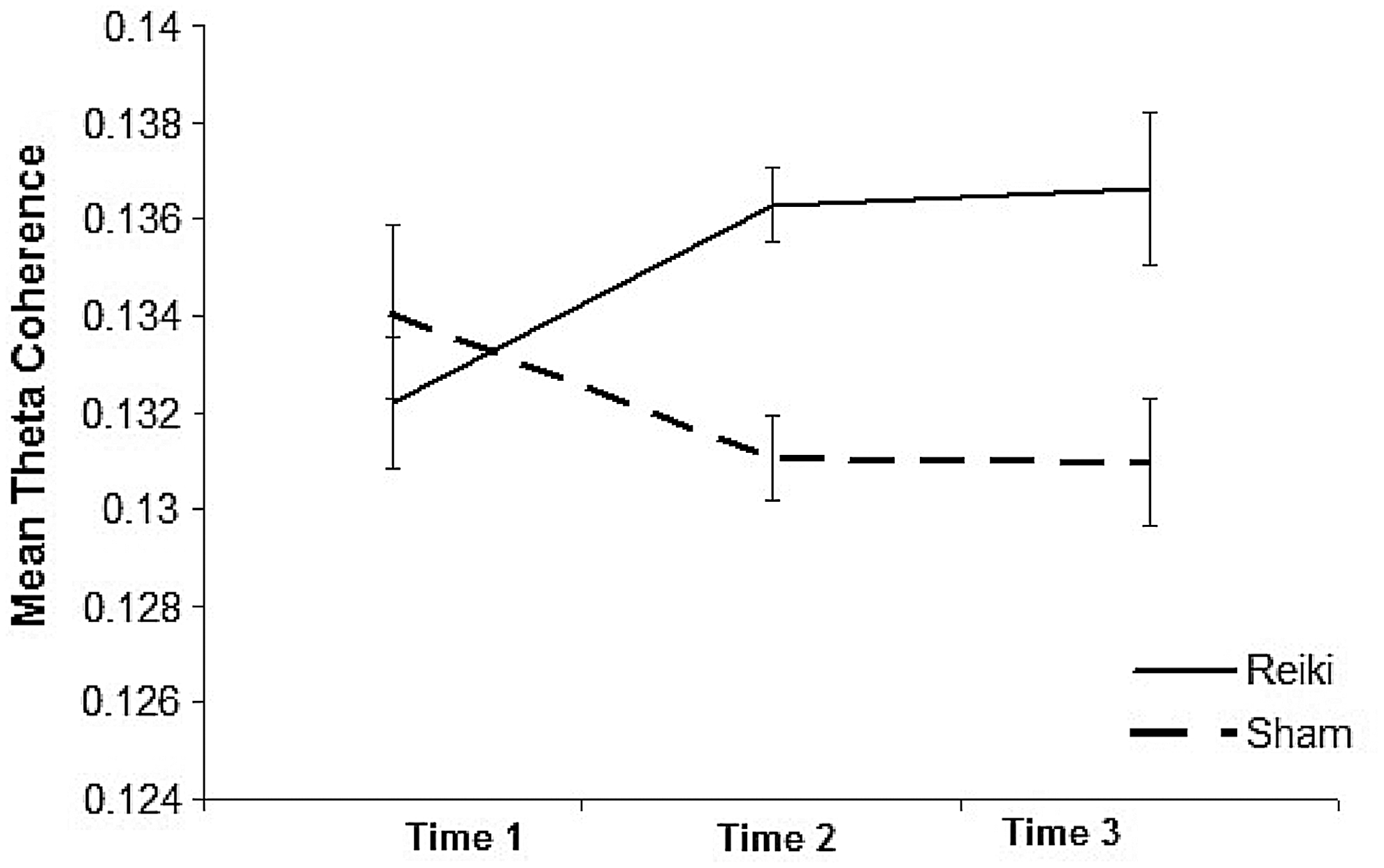
Mean interbrain coherence within the theta (4–7 Hz) range over successive 3.3-min intervals (total=10 min) for the Reiki and Sham pairs of subjects. Vertical bars indicate standard error of the mean.
Figure 2 shows the mean coherence values in power between the pairs of brains within the theta band of the right and left hemispheres for the Reiki and Sham pairs. Post hoc analyses of the statistically significant (F[2,14]=3.77, p<0.05, η2=0.35) interaction between treatment, time, and hemisphere indicated that the major source of the interaction was due to the greater coherence of theta activity over the left hemisphere for the Reiki-subject pairs compared to the Sham-subject pairs for the second and third time blocks compared to the reversed pattern for the first time block, while this group-by-time interaction was not evident within the right hemisphere.

Mean coherence between brains of pairs of Reiki and Sham subjects for the left and right hemispheres over successive intervals of the procedure and measurements (total 10 min). Vertical bars indicate standard error of mean.
On the other hand, for the alpha band, the significant interaction between treatment by cerebral region by hemisphere (F[7,49]=2.84, p<0.05; η2=0.29) was a right hemispheric effect. As can be seen in Figure 3, the Reiki pairs displayed significantly more interbrain coherence over the right frontal regions but less interbrain coherence relative to the reference group over the caudal right hemisphere. These discrepancies were not apparent over the left hemisphere.
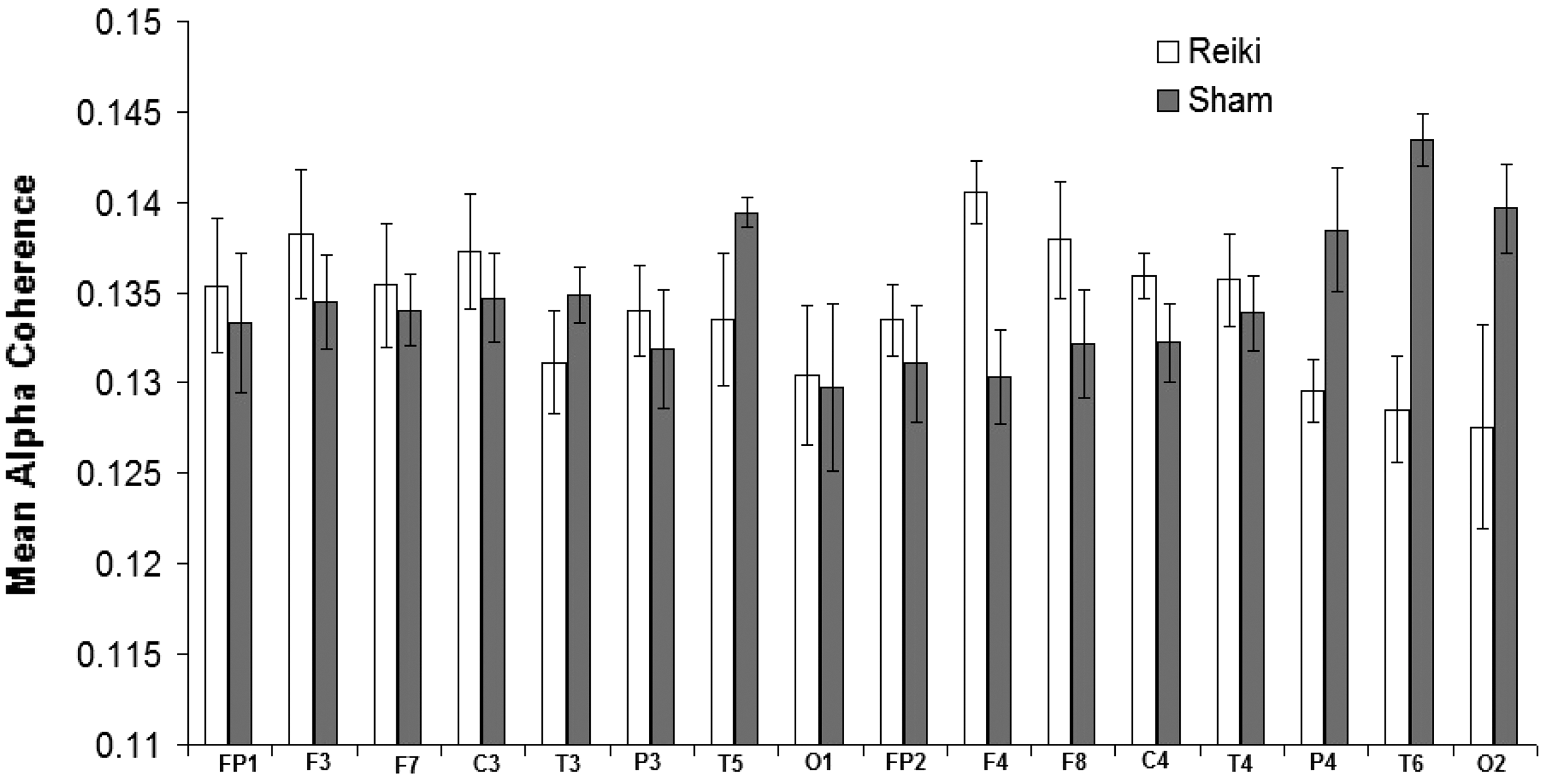
Coherence between brains within the alpha (8–13 Hz) range for Reiki and Sham conditions over the right frontal regions (F4/F8). Vertical bars indicate standard error of the mean.
Concordance of emotional word ratings
As predicted, there was significantly (F[1,9]=4.04, p<0.05; 1-tailed) greater congruence (calculated by the difference between the raw Whissell Dictionary scores for all words employed to describe the experiences of the sender–receiver pairs) in the emotional ratings of words along the unpleasant–pleasant dimension employed by the 5 Reiki pairs (M=0.02, SD=0.14) compared to the 4 Sham pairs (M=−0.13, SD=0.10). However, this treatment difference was not evident for the congruence for the activity–passivity (F=1.94) or for concrete–abstract imagery (F=<1.00).
Discussion
The results of this time-coupled quantitative measurement of coherence between 2 brains of individuals within close spatial proximity demonstrated that pairs engaged in Reiki procedures showed progressively greater coherence within the theta band of activity over the duration of the treatment compared to the Sham pairs, even though the latter “practitioners” employed the same symbols and procedures. The fact that the coherence within the theta band increased over time only for the Reiki pairs but not for the Sham pairs indicates that the former was not due to simple shared proximity.
The occurrence of the enhanced coherence indicated that more of the 4-s increments of sampling were similar in magnitude between the 2 brains involved with the Reiki procedure with respect to brain patterns compared to Sham-subject pairs. Because both the Reiki-subject pairs and the Sham-subject pairs engaged in the same procedures and maintained the same distance between practitioner and subject (“patient”), the most parsimonious explanation is that there is some process associated with the Reiki practitioners that resulted in the convergence of similarity between discrete frequency bands of their brain activity and that of their respective subjects. We 13 have measured this effect previously with Sean Harribance, whose capacity to infer the cognitive states of others is well documented. We found that his proximity to the subject was associated with increased similarity of his or her brain activity to the cerebral patterns generated by him during his interpretations of their cognitive history.
Subsequent analyses indicated that the theta activity within the left hemispheres of the senders and receivers displayed increased coherence for the Reiki procedure compared to the Sham procedures. The specificity of the left hemisphere is consistent with the greater similarity (congruence) of the unpleasant–pleasant dimension but not the activity–passivity or concrete–abstract dimensions of the words employed to describe images and feelings during the procedure by the sender–receiver pairs involved with the Reiki versus Sham procedures. Activation of the left hemisphere in general is associated with more pleasant affect as well as the sense of self.
The left hemisphere is also more strongly associated with linguistic images and immunofacilitation. 14 It may be relevant that the types of physiological changes noted in other studies would be consistent with left hemispheric activation. Guided imagery, 15 which would also emphasize left hemispheric activity, is also known to be health-enhancing in some individuals who have been diagnosed with life-threatening diseases such as cancer. Although there is ample evidence that close whole-body proximity of another person is associated with exposure of approximately 100 W from the person's body metabolism as well as intrinsic primate reactions, the possibility that electromagnetic intercoherence between the 2 brains of proximal people suggests an alternative explanation for some of the claims of Reiki.
The theta range, regardless of hemisphere, is important for isolation of potential mechanisms. The theta range is the primary resonance frequency of human cerebrums, as suggested by the ratio of the bulk velocity for integrated waves of cerebral activity (about 4.5 m/s) and the typical circumference of the skull (about 0.6 m), which results in an intrinsic resonance of between 7 and 8 Hz. The relatively narrow band of cerebral circumferences and bulk velocities, moving along the rostral–caudal axis with a repetition rate once every 20–25 ms, could encourage cerebral-field to cerebral-field interactions. Considering that the loss or gain of a bit of information within a system maintaining a temperature of 37°C is on the order of 10−21 J (ln2·kT, where k=the Boltzmann constant and T is the temperature in °K) and given the measurement of photon emissions 2 from the cerebrum at distances on the order of a meter to be about 10−11 W·m2, the potential for information exchange is at least theoretically feasible.
The direct measurement of the importance of the theta band in this study is also relevant for claims of remote Reiki effects. The remarkable similarity between the “resonance” frequency of the human cerebrum and the Schumann resonance (7–8 Hz) generated diffusely between the earth and its ionosphere may not be a coincidence. As thoroughly reviewed in the prescient article by Cherry, 16 Schumann resonances are a plausible biophysical mechanism by which many aspects of human health might be mediated and modulated by solar and geomagnetic activity. The ubiquitous nature of Schumann resonance fields, whose magnetic field (picoTesla range) and electric field (millivolt) intensities are within the same range as those generated by the human brain during cognitive processes, could satisfy a primary condition required for distant effects according to traditional concepts of physical interactions.
In the present study, we cannot discern whether the theta coherence enhancement of the Reiki pairs was due to the self-selection of the individuals who were the practitioners. The Sham senders were randomly selected students who had volunteered for the experiment. It is possible that the Reiki senders displayed unusual capacities that encouraged their interest in the practice, and this pre-experiment property facilitated interbrain coherence quite independent of the subjective procedures. In other words, individuals who are prone to theta predominance, which in itself facilitates coherence in proximal individuals, could be associated with the predilection for interest in the practice because of the congruence between the procedures and theta-related personality features. Although the relative power of theta does increase with aging, in our experience this shift is usually reserved for individuals in their later decades rather than the young population of Reiki practitioners employed in our study.
The Reiki procedure, which involves repeatedly imagining 3 symbols (“in one's thoughts” but not vocally), their specific Japanese words, and the act of associating a color, might be considered an optimal means of increasing the interhemispheric coherence of the senders. Whereas symbols and colors are traditionally associated with right temporo-occipital activity, repetitions of words are more involved with left temporoparietal activity. Both ideations of geometric patterns and repetition are more likely to increase theta-band reveries and imageries.
Conclusions
Short periods of Reiki by experienced practitioners were associated with marked increases in electroencephalographic coherence between themselves and their “patients.” The changes occurred primarily within the theta band over the left hemispheres of the Reiki–patient pairs and were associated with greater congruence of the unpleasantness–pleasantness scores for the words employed to describe their experiences. Sham Reiki–patient pairs did not show this effect.
Footnotes
Acknowledgments
Thanks to Kevin Saroka, Mark Collins, Mandy Scott, and Kiki for their technical assistance and support.
Author Disclosure Statement
No competing financial interests exist.