




Abstract
Objective:
To examine the effects of a Chinese medical herb complex formula, Kuan-Sin-Yin (KSY) decoction, on hepatitis B virus (HBV) carriers.
Methods:
Of 86 HBV carriers, 57 who met the inclusion criteria completed this study from February 2011 to December 2011 in Taipei City Hospital, Taiwan. The participants were randomly assigned to one of two groups: the KSY group (n=29) and a control group (n=28) that received KSY diluted 16 times. The participants took one packet of decoction per day after dinner for 6 weeks. The major outcome measurements were the percentage reduction in alanine aminotransferase (ALT), aspartate aminotransferase (AST), and the log of the HBV DNA level. The other measurements included seroconversion of hepatitis B e antigen and responses to the World Health Organization Quality of Life–Brief Version (WHOQOL-BREF) and Short-Form-12. The measurements were collected before the first treatment and 6 weeks later.
Results:
In the KSY group, AST and ALT levels decreased significantly and the score on the physical component of WHOQOL-BREF increased significantly. However, in the control group, there was no significant change after 6 weeks of treatment. Only the KSY group had a significant percentage reduction in ALT (change, −25.2% versus −0.74% in the control group) after 6 weeks of treatment. No major adverse effects occurred after 6 weeks of treatment.
Conclusions:
KSY significantly improved ALT levels. The study suggests that a longer-term study testing the efficacy of KSY in a larger sample is warranted.
Introduction
H
No existing medicines can completely eradicate the virus. Several antiviral drugs have been approved for hepatitis B, but they induce significant dose-dependent adverse effects and drug resistance. 5,6 Many hepatitis B carriers will accept complementary and alternative medicine to improve their liver function and control the progression of chronic hepatitis B. 7,8 Traditional Chinese Medicine (TCM) is a well-established segment of the health care system in Taiwan and in the spoken-Chinese areas of China, Hong Kong, and Singapore. TCM has been proven to be an efficacious and safe treatment option for chronic hepatitis B in some clinical trials and meta-analyses. 9 –12
In TCM theory, abnormal liver function of chronic hepatitis B carriers might be caused by impairment of qi flow in the human body. The authors designed a TCM, Kuan-Sin-Yin (KSY), that improved and regulated the qi flow of HBV carriers with abnormal liver function. Previous studies showed chronic hepatitis B carriers had poor quality of life (QOL). 13 QOL also plays an important role in these carriers. 14
In view of the above, this randomized, controlled clinical trial sought to evaluate whether KSY given as a decoction can improve liver function and QOL in chronic hepatitis B carriers with abnormal liver function.
Methods
Study design and participants
This randomized, controlled trial was conducted from February 2011 to December 2011 in Taipei City Hospital, Taiwan. Of 86 registered HBV carriers screened at the outpatient clinic, 60 patients were enrolled. The inclusion criteria were as follows: (1) hepatitis B surface antigen (HBsAg) positivity, (2) age 20–60 years, (3) alanine aminotransferase (ALT) level>40 IU/L and<200 IU/L, (4) no therapy with antiviral agents for the last 3 months, and (5) understanding of the purpose and process of this study and signed informed consent. The exclusion criteria were the following: (1) infection from other liver diseases, (2) serum creatinine level ≥2.0 mg/dL, (3) total bilirubin level ≥2.0 mg/dL, (4) pregnancy or breast-feeding, and (5) any other conditions deemed unsuitable for trial as evaluated by the physician in charge.
Chronic hepatitis B carriers with abnormal liver function were randomly allocated to receive KSY or KSY diluted 16 times as a control for 6 weeks (Fig. 1). All groups received their respective treatment for 6 weeks. During the study period, all participants were asked to maintain their regular diet and lifestyle. Informed consent was obtained from all enrolled participants. The protocol was approved by the Human Ethics Committee of Taipei City Hospital. Participants were free to withdraw at any time during the study.

Trial profile and design. KSY, Kuan-Sin-Yin.
Sample preparation and treatment
The KSY decoction contained seven Chinese herbs (Table 1), which were evaluated by contamination screening for heavy metals and pesticides and by a microbial limit test. The herbs were authenticated by thin-layer chromatography by Sun-Ten Pharmaceutical Co. Ltd., Taiwan, and standard contents were analyzed by high-performance liquid chromatography by Industrial Technology Research Institute, Taiwan. All the herbs were purchased and prepared from the Pharmacy Department of Branch of Linsen and Chinese Medicine, Taipei City Hospital, Taipei, Taiwan. In the KSY group, all herbs were soaked in water at a ratio of 1:3 (g:mL) and subsequently boiled at 1.5 atm, 120°C, for 4 hours by an automatic Chinese herb boiling machine; each pack was then separated into 100-mL portions by an automatic Chinese herb packing machine. For the control group, KSY was diluted 16 times, resulting in a noncurative decoction. The decoction was stored at 4°C until the experiment. Participants were asked to take one pack of the decoction 30 minutes after dinner each day for 6 weeks.
Net weight 36 g of herbal medicine was extracted with 100 mL water in each pack.
Measurements
The major outcome measurements were the percentage reduction of ALT, aspartate aminotransferase (AST), and the log of the HBV DNA level. Other measurements included seroconversion of hepatitis B e antigen (HBeAg); other basic laboratory data (total bilirubin, total cholesterol, creatinine, triglyceride, low-density lipoprotein, high-density lipoprotein, and fasting blood glucose); and responses on a self-administered questionnaire to evaluate subjective symptoms, adherence, and health-related QOL. All measurements were checked at the beginning and the end of the study.
All measurements were made by using the standardized method at 0800–0900 hours following overnight fasting. The whole blood sample was drawn and centrifuged at 4°C, with 1 mL of the sample rapidly frozen at −80° for the subsequent HBV DNA level analysis. This analysis was performed with COBAS® TaqMan® HBV real-time polymerase chain reaction (Roche Diagnostics Ltd., Taipei, Taiwan).
QOL questionnaire
To collect information on QOL, the self-administered World Health Organization Quality of Life–Brief Version (WHOQOL-BREF), Taiwan version, was administered. This instrument is well validated, with consistency coefficients ranging from 0.70 to 0.77. 15 The WHOQOL-BREF questionnaire evaluates QOL in the physical, psychological, social, and environmental domains, with scores ranging from 0 to 100.
The Medical Outcomes Study Short Form-12 (SF-12) was also used to evaluate QOL. This questionnaire consists of 12 items measuring eight concepts: physical functioning, role limitations due to physical health problems, bodily pain, general health, vitality, social functioning, role limitations due to emotional health, and mental health. Responses to these questions can be transformed to two scores for physical and medical conditions (PCS-12 and MCS-12, respectively). The mean score (±standard deviation) in the general population is 50±10. 16 Higher scores represent better health.
Statistical analysis
The data were analyzed by using SPSS software, version 17.0 (SPSS, Inc., Chicago, Illinois). A Student t-test was used to examine the mean differences between the KSY group and the control group. A paired t-test was used to examine the mean within-group differences at 0 and 6 weeks. All p values were two tailed, and findings were considered statistically significant at an α level of 0.05.
Results
Demographics and measurements at baseline
Among the 86 HBV carriers screened at the outpatient clinic, 60 met the inclusion criteria and wanted to participate in this study. They were randomly and equally allocated to the KSY and control groups. One participant from the KSY group and two from the control group discontinued because of personal reasons. In the end, 57 participants completed the study (Fig. 1). The means±standard deviations of age, height, body weight, and body–mass index were 49.1±12.8 years, 165.8±8.2 cm, 72.6±17.9 kg, and 26.3±5.8 kg/m2, respectively. As shown in Table 2, demographic characteristics, clinical profiles, and responses to the QOL questionnaires did not significantly differ between the two groups at baseline.
p<0.05.
**p<0.01.
ALT, alanine aminotransferase; AST, aspartate aminotransferase; KSY, Kuan-Sin-Yin; WHOQOL-BREF, World Health Organization Quality of Life–Brief Version.
Comparison among groups at 6 weeks
Table 2 displays the measurements after 6 weeks of intervention. As can be seen, there was no significant difference between the two groups. The average ALT and the log of the HBV DNA level decreased by 21.2 IU/L and 0.3 log10 IU/mL in the KSY group, respectively, and by 1.5 IU/L and 0.3 log10 IU/mL) in the control group after 6 weeks of intervention. Table 3 shows the percentage reduction in anthropometric measures, fasting serum levels, and QOL scores. As shown, there were no statistically significant difference in percentage reduction between the two groups except for ALT.
Comparison within groups at 0–6 weeks
Table 2 lists comparisons of measurements within groups before and after 6 weeks. ALT and AST in the KSY group decreased significantly after the intervention, but the control group did not show significant changes. As for QOL score, the KSY group showed significantly increased scores for the physical domain after treatment. The HBV DNA level in the KSY group showed a decreasing trend after 6 weeks of treatment, but not to a significant level (Fig. 2).
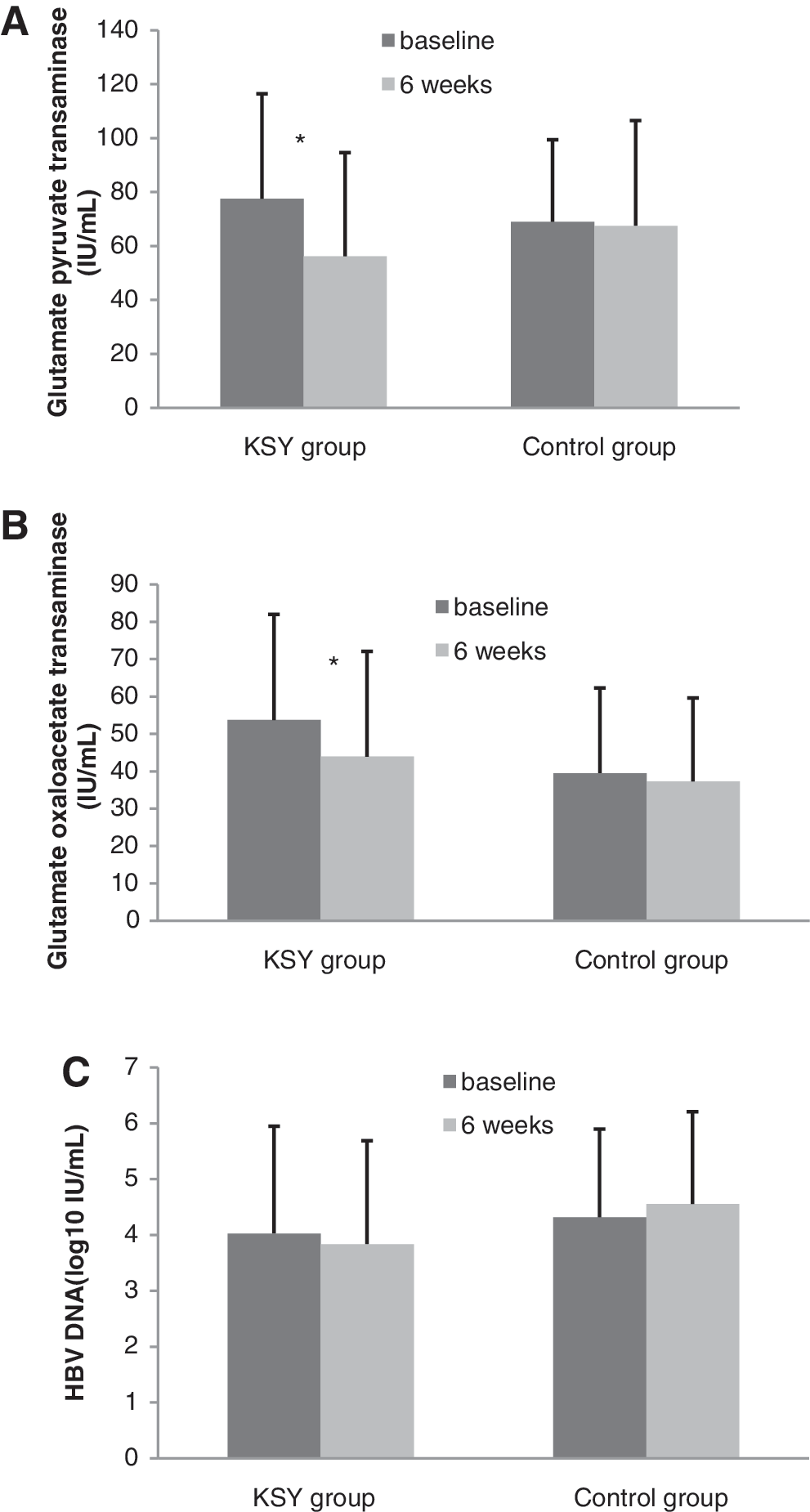
The effects of Kuan-Sin-Yin and control on the liver function at baseline and after 6 weeks.
Percentage reductions in outcome measures
Table 3 shows the percentage reductions of all measurements. The reduction was calculated by the following formula: [(after−baseline)/baseline]×100%. As shown, the percentage reductions in ALT were significantly different between the two groups after intervention. In addition, there was no significant difference in percentage reduction of the other outcome measures or QOL scores between the two groups.
Adherence
About 55% of the participants took all of their medication; 19.3% had 1 pack of medication remaining after treatment, 12.3% had 2 packs remaining, and 14.2% had more than 2 packs remaining. Table 2 shows no significant difference in the remainder of medication in the two groups (p=0.37).
Adverse effects
No participants withdrew from the study because of discomfort or adverse effects. One participant had abdominal discomfort and one participant in the KSY group developed mild constipation. One participant in the control group had mild dizziness. All symptoms were noted in the second week after the treatment. No major adverse effects were seen during the study.
Discussion
The initial finding of the study showed that the percentage reduction in ALT reached statistical significance between the two groups after 6 weeks of treatment. KSY improved ALT levels in chronic HPV carriers with abnormal liver function. KSY was composed of seven TCM herbs (Table 1). Previous in vitro and in vivo studies have shown that Codonopsis pilosula, Atractylodes macrocephala, Poria cocos, Glycyrrhiza, Radix astragali, Agastachis herba, and Fructus ligustri have the potential to modulate the immune system, with anti-inflammatory and antioxidant properties. 17 –23 Thus, KSY might have the potential to improve liver function through immune modulation, with anti-inflammation and antioxidant properties. The details of the mechanism must be further explored in the future.
Although some anti-HBV drugs have been developed and approved for HBV carriers, these drugs have adverse effects and drug resistance. Interferon-α induced an influenza-like syndrome and decreased leukocyte and platelet counts. 5 Lamivudine is a nucleotide analogue, and prolonged use can result in drug resistance. 6 Thus, a safe and effective anti-HBV drug was required. The current study demonstrated that KSY not only improves the abnormal liver function of chronic HBV carriers but also has fewer adverse effects.
Cui et al. reviewed TCM herbs that improve liver function. 24 Most of the studies selected pure active compounds extracted from traditional Chinese herbs to treat chronic liver disease. 25 However, TCM physicians always treat patients using an herb complex formula, not a single herb. We designed the KSY decoction, which was a complex formula with seven herbal medicines. According to the theory of TCM, it can enhance and regulate the qi flow of the human body. We used the diluted decoction as a control with which to evaluate the therapeutic effect of this TCM decoction used by Chinese-speaking people in Asia area for a thousand years.
The proportion of negative seroconversion of HBeAg showed no change in either group. The HBV DNA level did not decrease significantly, although the HBV DNA level decreased after treatment in the KSY group. To further understand KSY efficacy, a within-group comparison showed that KSY significantly decreased ALT and AST after 6 weeks of treatment. In 2010 Tang et al. reported that the proportion of negative seroconversion of HBeAg was significantly higher and the HBV DNA level was significantly lower in the Astragali group than in the control group, indicating that Astragali inhibited replication of HBV. 26 Liu et al. found in 2005 that ALT and AST significantly improved after 24 weeks of treatment with fuzheng huayu capsules. 27 That study was a randomized, controlled, double-blind trial conducted in China that enrolled 216 patients with chronic hepatitis B and fibrosis. Although the same results for ALT improvement were achieved, AST did not improve.
Health-related QOL is an important issue. The current results also showed that KSY improved the score on the physical domain of the WHOQOL-BREF in the within-group comparison. Marcellin et al. used SF-36 QOL scales to assess the effect of pegylated interferon-α2a treatment in patients with chronic hepatitis B. 28 They found that the physical and mental component scores decreased after 48 weeks of treatment, but only the physical component score was significantly decreased compared with the chronic hepatitis B and chronic hepatitis C studies. This study provided new evidence regarding improved QOL with the herbal decoction to improve liver function.
Despite the encouraging results, this work still had limitations, such as a short treatment time and small sample size. The control KSY was diluted 16 times but still might have had some clinical effects. Future research should be performed with a longer treatment time and other well-designed protocols in the future.
In conclusion, the present study showed that KSY significantly improved the ALT level and the QOL score. The details of the effects require confirmation by further studies. The KSY group had no adverse effects after 6 weeks of treatments. Use of one pack of KSY per week in chronic hepatitis B carriers with abnormal liver function (ABL) was deemed safe. This study suggests that a longer-term and larger-scale KSY clinical trial is warranted.
Footnotes
Acknowledgments
The authors sincerely thank all patients who participated in this study and colleagues at Lin-Sen (TCM) branch, Taipei City Hospital, Taiwan, for their assistance in this study. Clinical Trial.gov Identifier: NCT 01338714
Disclosure Statement
No competing financial interests exist.