




Abstract
Introduction:
Quantum theoretical discourse has previously illustrated (1) the therapeutic process as three-way macro-entanglement (between patient, practitioner, and remedy, called PPR entanglement), and (2) depicted the Vital Force (Vf) as a quantized spinning gyroscope. Combining the two via semiotic geometry leads to a topological description of the patient's journey to cure. In this present article, two new metaphors for the homeopathic therapeutic encounter are described, based on (1) a quantum mechanical model of adaptive mutation (QMAM), and (2) the illuminated geometric patterns generated by a light source attached to a spinning gyroscope.
Methods:
(1) QMAM demonstrates how quantum superposition between DNA and mutant adaptations could arise and how environmental pressure “collapses” the DNA wave function to a particular state. In QMAM for the therapeutic process, isolation helps induce coherence between patient, practitioner, and remedy, generating a quantum-like superposition of patient “unwell” and “well” states. (2) The light beam from a precessing gyroscope sweeps out an ellipse, which becomes circular, the faster the gyroscope spins on its axis and the less it precesses. Ellipses have two foci that, as a metaphor for the state of a patient's Vf, are seen to represent the patient's “unwell” and “well” states.
Results:
Superposition of the patient's “unwell” and “well” states generated by the QMAM metaphor can “collapse” to the cured state, following decoherence at the end of therapeutic process. Similarly, the curative therapeutic process may be thought to “spin up” the patient's Vf, so the precessing ellipse's foci (i.e., the patient's “unwell” and “well” states) merge into a “circular” curative state.
Conclusions:
The two new metaphors may be seen as equivalent and semiotic simplifications of the previous more complex topological description of the patient's “journey to cure.”
Introduction
A
Zeilinger challenges this view, considering a quantum state's mathematical formulation to be only a representation of what can be known about it. 3 This implies that an equally valid way to interpret quantum theory is in terms of information 4 and that this can have a more fundamental meaning than any notion of “objective reality.”
D'Espagnet goes further, suggesting what we consider as reality is only “weakly objective,” not strongly objective as assumed by most scientists. 5 This has profound implications for our conception of the universe, because what constitutes meaningful information is to some extent in the mind of the beholder (a beholder being required for it to be considered meaningful in the first place).
Over 2500 years ago, this was pre-empted by the pre-Socratic Greek philosopher Protagoras, who said, “Man is the measure of all things.” 6 Philosophers have tended to ignore Protagoras since then, however, choosing instead to “banish” meaning outside and independent of human thought, not (as modern interpreters of Protagoras have argued) fundamentally and dynamically grounded in human nature. For example, Professor Mark Turner suggests, “meaning is conceived of…as essentially anchored in states of affairs in an objective reality, with the consequence that the meaning of an utterance must be the reality to which it refers….a semantic express train shoots straight from the linguistic symbols to an objective reality without passing through the human brain, let alone stopping in the human brain, let alone taking its entire journey there.” 7 Turner then goes on to argue for an updated, more cognitively aware attitude toward Protagoras, proposing the need for a new theory of meaning that could inform the physical and biosciences.
It is in this context that Zeilinger's interpretation of quantum theory 3 might prove useful. If a wave function contains within it all that can be known about a system by observation (not its presumed reality outside of and separate from an observer), 8 then as Henry Stapp has suggested, the act of observation in part creates that which is observed 9 (or, as 18th-century Bishop George Berkeley put it, “To exist is to be perceived”). 10 Realization of this effectively nonlocal coherence between observer and observed is how the therapeutic process in any healing modality, including homeopathy, might usefully be described using the discourse of quantum theory. 11
For example, consider “entanglement” between such qualitatively and apparently ontologically different “macroscopic” entities as a remedy (something derived from a material substance), and a symptom totality (an abstract idea generalized from one individual's observations about another). 12 From a realist standpoint, such “entanglement” is meaningless, and indeed has been contemptuously dismissed. 2 However, from Zeilinger's perspective, remedy and symptom totality might be seen before anything else, as sources of information. 13 Thus, having similar ontologies, they should be quite capable of becoming “entangled” (via the practitioner) during the therapeutic process. 14
Though orthodox quantum theory is one of the most successful theories ever devised, adopting an information-based interpretation of quantum theory allows generalization of its discourse beyond exclusive concentration on the physics of matter, to the therapeutic contexts described here. Indeed, via Weak Quantum Theory, it has already been shown to be relevant to the description and understanding of such nonphysical phenomena as the dynamics of interpersonal relations. 15
In addition, two recent trials (one suggesting that homeopathy's clinical benefits in rheumatoid arthritis arise solely from the consultation and not any remedies, 16 and the other showing that placebos have meaningful clinical benefits in irritable bowel syndrome even when the patient knows they are receiving placebo 17 ) may be understood in terms of a previously described 18 complementary relationship between remedy and consultation, 19 similar to that found between momentum and position, or energy and time, in orthodox quantum theory. The discourse of quantum theory, therefore, could lead to conclusions about the therapeutic process akin to those of current holistic world views, and more ancient vitalist traditions. 20,21
So for more than a decade, topological metaphors based on the mathematical discourse of quantum theory have been developed that have attempted to illustrate how the therapeutic process (in homeopathy and other complementary and alternative medical [CAM] procedures) leads to the patient's journey to cure.
1,11
Most notably, such illustrations involve a form of three-way quantum-like entanglement—PPR entanglement (see Box for nomenclature)—between patient (
These combined representations generate several possible therapeutic outcomes, each depending on the mix and nature of the various patient, practitioner, and remedy-state functions. For simplicity, these have been reduced to two for each (indicated by “up” and “down” arrows; see Box). Thus: • The patient state function, • The practitioner state function, • The remedy-state function,
Thus, previous articles have shown it is possible to use these combined representations to visualize the homeopathic therapeutic encounter in terms of a semiotic topology in which the various stages of the therapeutic process can be represented metaphorically as a complex pattern of changing geometric shapes. These shapes are themselves derived from semiotic representation of the dynamically unfolding relationship between patient, practitioner, and remedy-state functions, understood as becoming “entangled” during the therapeutic encounter. 1,11,22
What the present article addresses is the possibility of developing simpler metaphors for visualizing the homeopathic therapeutic encounter, and to see whether they are compatible with those already considered. Two such alternative strategies present themselves: (1) one by considering quantum mechanical model of adaptive mutation (QMAM), 24 and (2) by observing the geometric patterns generated (i.e., conic sections) 25 by attaching a light source to a spinning gyroscope.
Quantum Mechanical Model of Adaptive Mutation
Neo-Darwinian theory is based on the principle that mutations occur randomly with respect to the direction of evolutionary change, which is provided by selection for advantageous mutations. This idea has been challenged recently by the phenomenon of adaptive mutation, 26 which proposes that genetic mutations can arise as an immediate and direct response to selective environmental pressures. As Cairns et al. suggested in their 1988 Nature paper, “When populations of single cells are subject to certain forms of strong selection pressure, variants emerge bearing changes in DNA sequence that bring about an appropriate change in phenotype.” 26
Though hotly debated, adaptive mutations are thought to differ from standard mutations in that (1) they occur only in cells that are not dividing or divide only rarely, (2) they are time dependent not replication dependent, and (3) they appear only after the cell is exposed to some selective environmental pressure. The question then is what kind of mechanism lies behind adaptive mutation.
One of the most likely mechanisms considered is for spontaneous mutations to be initiated by so-called quantum “jump” events, involving tautomeric shifts by single protons of DNA bases. 27 –29 As a result, some authors have proposed that living cells might act as quantum measurement devices, able to monitor the state of their own DNA. 30 –36 Interestingly, this has led to suggestions (in a biomolecular version of the famous Schrodinger's cat paradox) that DNA could exist in a superposition of mutational states. 37 Adaptive mutations might then be generated by environment-induced “collapse” of DNA's superpositional quantum wave function. 38,39
McFadden and Al-Khalili 24 reasoned that for such a mechanism to be feasible, the evolving DNA wave function must remain coherent for long enough for it to interact with the cell's environment. They investigated this possibility by modeling a specific mutational process involving quantum tunneling, and estimated the rate of decoherence for the coding protons initiating mutational events within DNA. These authors claimed to demonstrate that, based on their simple model, DNA coding information remained coherent for biologically feasible periods of time. They also demonstrated that the strength of coupling between the DNA wave function and its environment has the potential to accelerate the rate of decoherence, thereby enhancing mutation rates to cause adaptive mutations.
Use of QMAM as a Metaphor for the Therapeutic Process
For our purposes here, the most salient features of QMAM are that
• DNA can be represented by a wave function,
• It can exist in a superposition of mutational states for biologically feasible amounts of time, prior to decoherence into an adaptively mutated state by interaction with the environment. 24
In order to illustrate the therapeutic process, for “DNA” read the “unwell” patient to be “stuck” in a dis-eased state, represented by the wave function
On entering into a therapeutic relationship with a practitioner (see [a] in Fig. 1), we consider that the various states of the patient, practitioner, and therapeutic modality (also represented by wave functions) become effectively isolated from the external environment during the consultation, allowing their coherence, to form the PPR entangled state
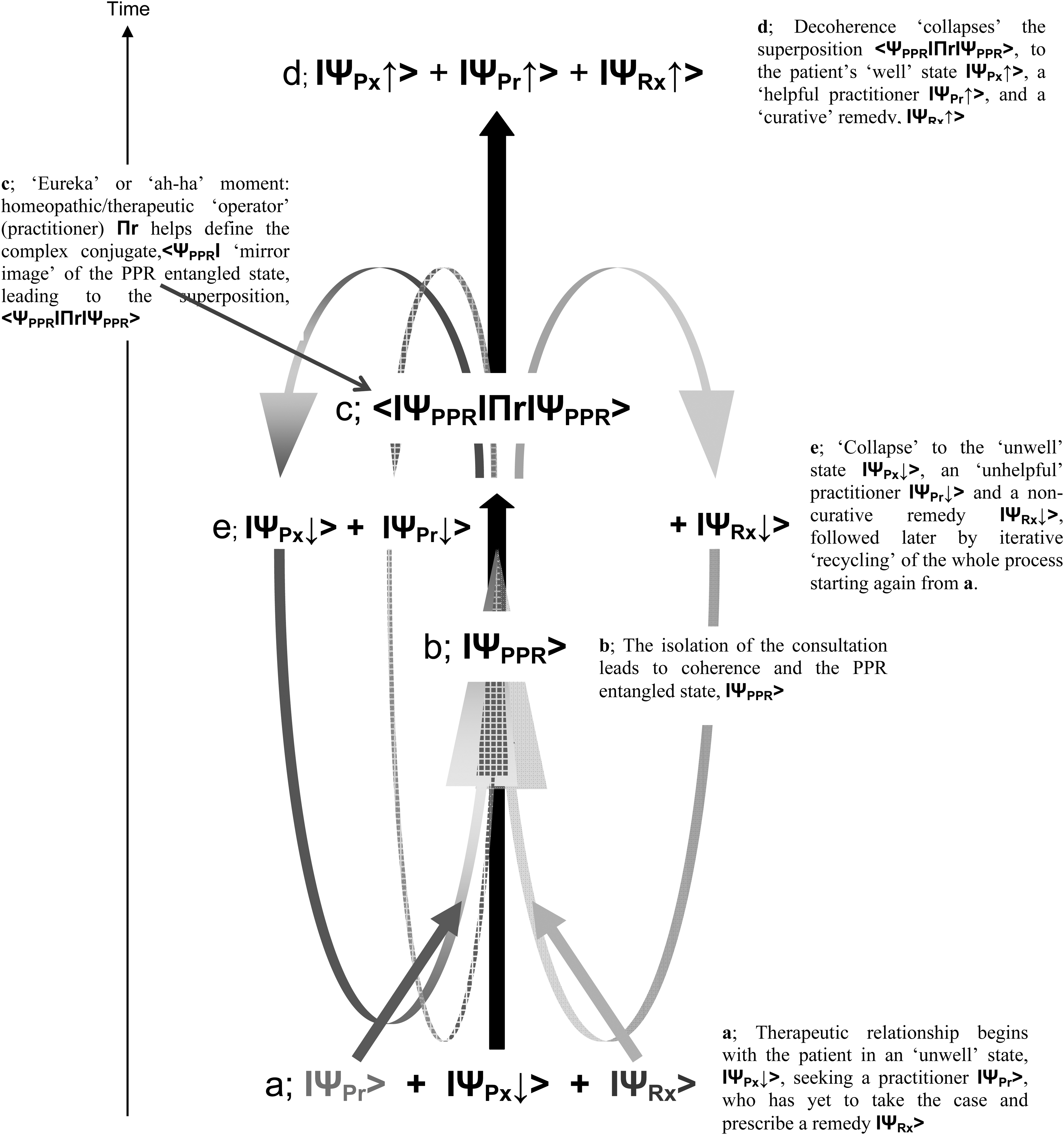
An instantaneous “snapshot” of iterative coherent patient-practitioner-remedy (PPR) entanglement.
What this means is that the isolation-induced coherence generates a situation where both the “unwell” and “well” states of the patient—
In terms of what the patient and the practitioner may experience, the patient is “shown” both their “unwell” state
When this patient awareness is combined with decoherent interaction with the external environment after the consultation, this could have the effect of providing a “strong selection pressure” (to borrow a phrase from QMAM) that “collapses” the “Eureka insightful” state superposition
However, in order to avoid a possible therapeutic version of the quantum Zeno effect,* 41 it is advisable that patients do not revisit their practitioners too often, otherwise they might find themselves “trapped” in their unwell state (though this most probably would not apply in a high-dependency, intensive-care, constant monitoring situation, where the active participation of the patient's attentive consciousness is highly unlikely).
By the Light of a Spinning Gyroscope….
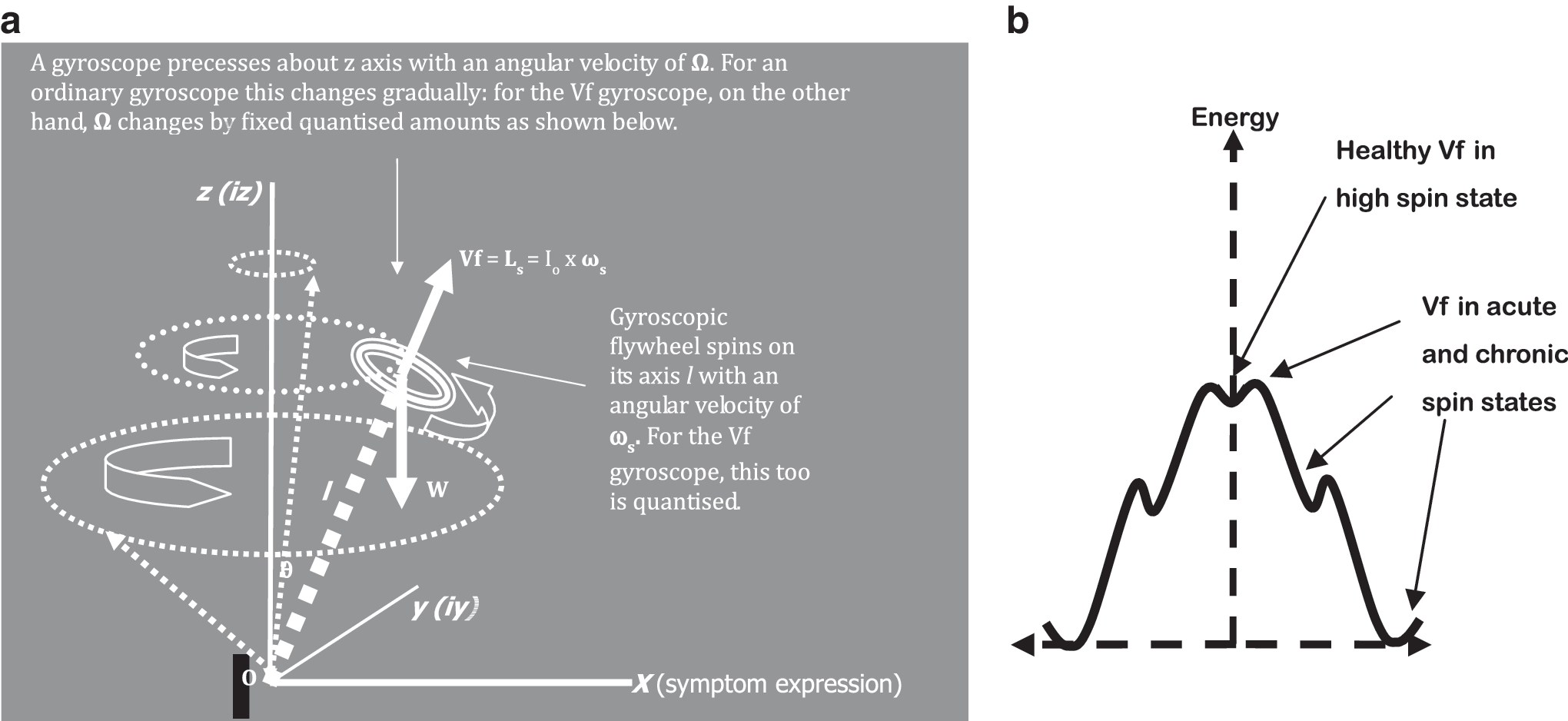
Previous articles have used the metaphor of a quantized spinning gyroscope to represent the action of the Vf in health and dis-ease. 34 The rotational characteristics of spinning objects like gyroscopes are well known. Thus, when a gyroscope is spinning rapidly, its rotational axis stands vertically in opposition to the downward pull of gravity. As the rate of spin slows, the gyroscope's ability to resist the downward pull of gravity weakens, so that the gyroscope leans over and precesses about its original vertical rotational axis.
Thus, a healthy Vf is imagined as “spinning” rapidly, standing straight, and resisting being “pushed over” by dis-ease. An unhealthy Vf, on the other hand, “spins” more slowly, is more easily “pushed over” by disease, and so “precesses” (i.e., expresses symptoms).
A light source attached to the rotational axis of a gyroscope and angled toward the ground is found to sweep out a circle of light when the gyroscope is spinning rapidly and standing erect. However, as the gyroscopic spinning slows, and the rotational axis begins to precess, so the light source sweeps out an ellipse whose eccentricity increases as the gyroscopic spinning slows and the precession of its rotational axis increases. The light source then sweeps out various conic sections (ranging from a circle to ellipses of increasing eccentricity; Figs. 2 and 3), 25 depending on the gyroscope's slowing rate of rotation and increasing rate of precession about its vertical axis.† 42
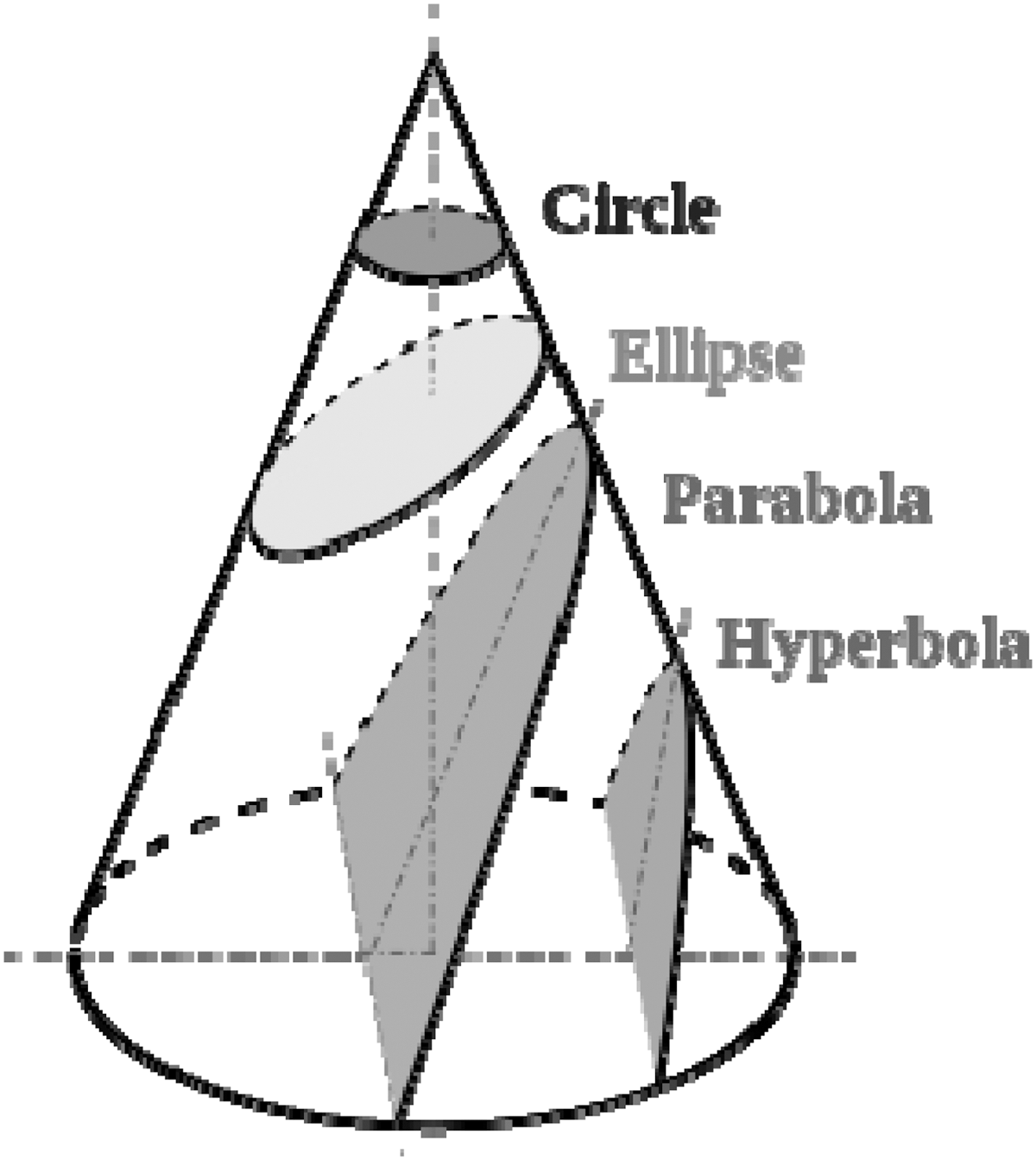
Conic sections are curves obtained by the intersection of a cone (more precisely, a right circular conical surface) with a plane. When the plane is parallel to the base of the cone, a circle conic section is generated: when the plane is at an angle to the base of the cone (but does not go through the base), an ellipse is generated whose eccentricity increases with the angle the plane makes to the cone's base.
Ellipses and Circles as Geometric Metaphors for States of Health
The relevance of these light-source-generated conic sections swept out by the gyroscope to the patient's health is that when the Vf “gyroscope” is “precessing” and therefore expressing symptoms, this corresponds to the patient being in a dis-eased “unwell” state,
As an ellipse has two foci, one can surmise that in its dis-eased “unwell” state, the precessing Vf gyroscope might also be thought of as being governed by two “foci”: one tending toward health, while the other tending toward dis-ease. One can then imagine that the reason for the Vf gyroscope's precession—and hence, expression of symptoms—is the opposition between these two opposing “forces,” in much the same way that a real gyroscope's precession is the opposition between its upward-pointing angular momentum vector and the gravity vector pulling it down (Fig. 2). It should be mentioned that at this stage (i.e., prior to the consultation and the formation of a therapeutic relationship with a practitioner), all the patient is aware of is that they are unwell.
Discussion
Comparing the two new metaphors with each other…
During the consultation, the patient is shown their dis-eased “unwell” state,
… and with a previous topological description
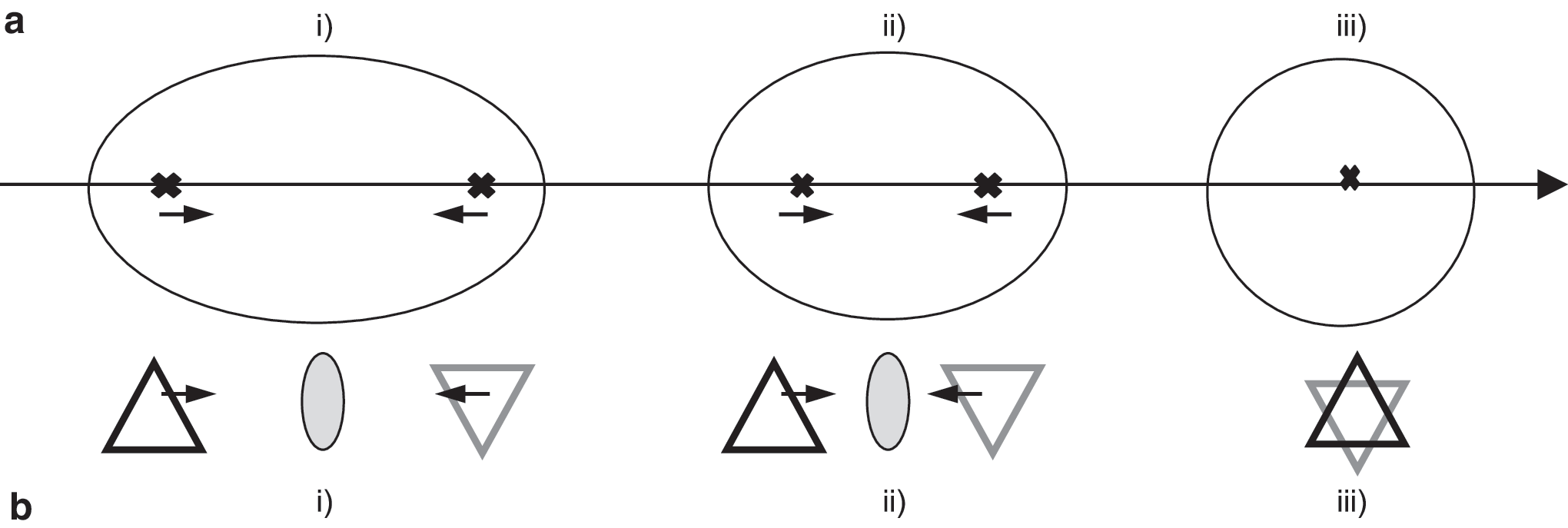
There is a direct correspondence here between the semiotic description of the patient's “journey to cure” in terms of an ellipse being transformed into a circle, and the previous topological description.
1
In the latter, the practitioner provides the conditions necessary for PPR entanglement by being an “active mirror” (represented as
Recognizing this possibility marks the beginning of the patient's “journey to cure,” which metaphorically may be represented as a movement “through the looking glass” of the practitioner's “active mirror.” This in effect combines the two tetrahedra of the reflected dis-eased and inverted cured states into a stellated octahedron: the totality representing the curative PPR entangled state,
A simplified 2-D representation of this previous topological description
1
is shown in Figure 4bi–iii, directly under the ellipses/circle of Figure 4ai–iii, in order to show the correspondence between the two metaphors. We see that the movement of the ellipse's two foci toward each other, and their eventual merging into one when the ellipse converts into a circle, corresponds to the previous metaphor's two tetrahedra (representing the PPR entangled state
Furthermore, the QMAM metaphor for the therapeutic process generates the superposition of “unwell”
Conclusion
Materialistic reductionism in the physical sciences has been a powerful tool for describing the world since the beginning of the Enlightenment. The hegemony of scientific materialism, however, has been challenged by Post-Modernist thinkers, 42 but principally by quantum physicists (e.g., d'Espagnet, 5 Stapp, 9 Goswami, 43 Hameroff and Penrose, 44 etc.), precisely because it fails to take into account the phenomenon of consciousness. As the philosopher Thomas Nagel put it, “Consciousness is the most conspicuous obstacle to a comprehensive naturalism that relies only on the resources of physical science. The existence of consciousness seems to imply that the physical description of the universe, in spite of its richness and explanatory power, is only part of the truth, and that the natural order is far less austere than it would be if physics and chemistry accounted for everything.” 45
Far from impressed by Nagel's views (which it considers unnecessarily teleological), 46 the scientific community believes consciousness will eventually be explained as some materialistic epiphenomenon. But it is precisely in the uncertain, highly subjective, and all-too-human arena of the therapeutic encounter between patient and practitioner that Nagel's skepticism concerning the limitations of materialistic reductionism could well have its greatest impact.
In this respect, Nagel's skepticism (echoed by Stapp's ideas on the quantum theory of placebos) 47 was pre-dated in medicine by the French philosopher, physician, and historian of science, George Canguilhem (1904–1995). Long before Evidence-Based Medicine was formulated in the early 1990s, Canguilhem was emphasizing the importance of both empiricism and rationalism for properly understanding the science of medical practice. 48,49 He foresaw how “much of modern science is actually scientism‡ and that many scientists believe that all realms of experience are amenable to mathematical interpretation.” 50
Canguilhem's work illuminated the yawning gulf between our expectations of increasing biological knowledge and the difficulty of applying it in clinical practice. “Medicine,” as Canguilhem pointed out, “is the science of the limits of the powers that the other sciences claim to confer upon it.” 49 Given the current “compassion” crisis within the UK's National Health Service, 51 “Cum Scientia Caratas”—“Scientific knowledge applied with compassion”, the motto of The Royal College of General Practitioners in the United Kingdom—seems much more of an ideal than a reality.
Regarding normality, disease, and health as different functional aspects of the whole organism, Canguilhem was more interested in developing holistic concepts of disease than with today's exclusive pursuit of scientific data-gathering at the expense of clinical judgment. 52 –54 It is here that Canguilhem resonates with the current controversy in the United Kingdom surrounding homeopathy as a viable therapeutic modality. What Canguilhem reminds us of is that although a disease can be diagnosed via its generalized symptom picture, it happens to an individual who also responds in his/her own way. Homeopathy and other so-called “complex” therapies aim to treat the individual. So testing them via generalized procedures like the randomized-controlled trial (RCT) is inappropriate (which is why such therapies are called “complex”).
Given the by-now standardized procedures and protocols for gathering, preparing, and presenting medical statistics, Canguilhem's insights raise two concerns: • Can the statistical scientific data on diseases and cures always be considered secure if they have been prior exposed to the filter of pre-determined “norms” (as in the RCT [e.g., by choice of statistically significant p-values])? • Is a generalized quantitative scientific approach to disease always superior to an individual clinician's qualitative judgment about a patient?
To the latter, Canguilhem might have answered an emphatic “Non!” Based on his own medical experience during World War II, and his later philosophical and historical insights, Canguilhem advocated a more humane view of medicine. Commenting on Canguilhem, Richard Horton, editor of the Lancet writes, “Canguilhem asks us to examine the content of a patient's experience rather than to begin with a biological translation of that experience. If physicians begin by suspending their prevailing scientific ideologies about disease, they are more likely to discover the qualitative intentions of their patients' symptoms. To allow our conceptions about a ‘disease’ to be governed only by the amount of objective data that can account for that condition is to undermine the project of medicine…We seek biological meaning, but that end point may not be what our patients seek: indeed, it may be what they fear.” 50
The views of Canguilhem, Nagel, and Stapp, etc., however, run entirely counter to the current trend in medicine that attempts to embed it ever more deeply within a materialistic reductionist paradigm. Therefore, developing metaphors for the therapeutic process based on the discourse of quantum theory (with all that implies in terms of its acknowledgement of the role of consciousness in our understanding of the universe) may be seen as a way to counter this trend. For as Stapp concludes, “The likelihood of achieving a useful scientific theory of the mind-brain connection is far greater for a quantum physics-based psycho-physical approach that incorporates quantum dynamical effects of the conscious mind upon the physical brain, than for a ‘promissory classical-physics-based physicalism’ that excludes from the outset the possibility of any effect of the patient's mind upon his body.” 47
Thus, the PPR entanglement metaphor (developed in previous articles)
1,11,22
considers the patient (
In this present article, two new metaphors have been introduced: one based on QMAM, 24 and the other derived from observation of the illuminated geometric patterns generated by a gyroscope with a built-in light source. Consideration of both metaphors indicates their relationship with each other and the original PPR entanglement metaphor (Fig. 4). Metaphorically, it is now possible for the patient's “journey to cure” to be seen as
a. “Collapse” of the “unwell”
b. Merging of a semiotic ellipse's two foci into one (Fig. 4ai–iii);
c. Merging of the two semiotic tetrahedra into a stellated octahedron
In this respect, metaphors a and b may be thought of as semiotic simplifications of the more geometrically complex previously developed metaphor c.
Footnotes
Acknowledgments
The author gratefully acknowledges the gift of an incredibly noisy but fundamentally illuminating Chinese toy gyroscope from Dr. Stan Switala, PhD, ND, DipAc, Dip CHM, MRN, MICrA, MBAcC, MATCM, naturopathic physician and practitioner of functional medicine.
I am also grateful to a referee for pointing out that a Bose-Einstein Condensate (BEC: a state of matter in which separate atoms or subatomic particles, cooled to near absolute zero, coalesce into a single quantum mechanical entity – that is, one that can be described by a single wave function – on a near-macroscopic scale) 55 might also be fruitfully considered as a metaphor for the therapeutic process.
From a BEC perspective, dis-ease might be thought of as a ‘condensate’ to the stressor mode of toxins, bacteria, virus, or genes. Therapy might be achieved when the remedy produces a condensation back into the healthy state. In addition, if the hydrophilic solvent containing the remedy is thought of as being ‘imprinted’ with n different frequencies prior to succussion, then preparation of the remedy by succussion might have the effect of ‘imprinting’ one particular frequency m times. This frequency could then take over the whole ‘imprint’, effectively erasing all other frequency imprints. Clearly, a ‘BEC’ model could be a promising further metaphor for the therapeutic process.
Disclosure Statement
No competing financial interests exist.