




Abstract
Objectives:
This investigation aims to provide a database of Dozo traditional knowledge of medicinal plants used for the treatment of common diseases.
Design:
The study was conducted through individual interviews using a survey form. Data were recorded in a database allowing statistical analysis. Each plant was recorded and documented with a herbarium specimen.
Settings/Location & Subjects:
The term Dozo refers to great hunters from Burkina Faso, highly renowned for their knowledge of medicinal plants. Niamberla village was founded by Dozo hunters and is currently the residence of many traditional healers. Unfortunately, their indigenous knowledge is not well recorded and may be lost between two generations.
Results:
A total of 16 traditional healers were interviewed, giving 89 recipes for the treatment of 37 diseases. The most common diseases are malaria (13%), psychological/spiritual issues (12%), gastric disorders (11%), sexually transmitted diseases (10%), and wounds (8%). A total of 56 medicinal plants have been identified, consisting mostly of trees (44%), shrubs (34%), and herbs (16%).
Conclusions:
The results of this research provide a basis for pharmacological and toxicological investigations and are necessary to preserve the indigenous knowledge of traditional medicine among Dozo hunters.
Introduction
A
Since 1978, the WHO has recommended that each developing country make a complete inventory of their medicinal plants, with an evaluation of known safety and efficacy, along with methods for the standardization of the active components. 5 This process necessarily passes through ethnobotanical investigations, involving collaboration between researchers, doctors, and traditional healers. 6
In Burkina Faso, surveys have been conducted for scattered programs and institutions, but very few results have been published. 1,7 –9 This project aims to help document traditional medicine through an ethnobotanical survey involving 5 researchers, 16 traditional healers, and 1 biomedical doctor from Burkina Faso. The targeted area is Niamberla village, which is the birth village of one of the researchers, and was founded by Dozo hunters of the Sénufo community. The Dozo are initiated and trained hunters, and their lives involve many secret ceremonies and sacrifices. 10 These people are well known in West Africa for their traditional knowledge regarding the use of medicinal plants in the treatment of common diseases, including malaria, diarrhea, hemorrhoids, and gastric disorders. While there are other similar villages founded by Dozo hunters throughout West Africa, this village was chosen not only because one member of the research team comes from this village, but also because his father was included as one of these venerable healers. The main objective of this research is to record the indigenous knowledge of one Sénufo community of Dozo hunters about medicinal plants in order to preserve this knowledge and to provide a usable database for future analysis and investigations.
Materials and Methods
Study area and the people
Niamberla village, founded and inhabited by Dozo hunters of the Sénufo community, is situated in the western quadrant of Burkina Faso in the province of Kénédougou (Fig. 1). The last census in 2006 reported the population to be 2687, of which 51% were female and 49% were male. The most frequently encountered soils are hydromorphic mineral to stagnosol (pseudogley) soils. The major plant communities are shrub savannas, tree savannas, and woodland savannas, along with woodland and gallery forests. The most common woody species included Acacia sieberiana DC., Anogeissus leiocarpa (DC.) Guill.&Perr., Burkea africana Hook., Daniellia oliveri (Rolfe) Hutch. and Dalziel, Diospyros mespiliformis Hochst. Ex A.DC., Isoberlinia doka Craib and Stapf, and Guibourtia copallifera. The main herbaceous species were Andropogon gayanus Kunth, Diheteropogon amplectens (Nees) Clayton, Loudetia simplex (Nees) C.E. Hubb., and Vetiveria nigritana Stapf. Islam is the dominant religion in the area although many people also practice African traditional religions that are deeply rooted in their ancestral customs. The community is organized by strict discipline and respect for the customary hierarchy.
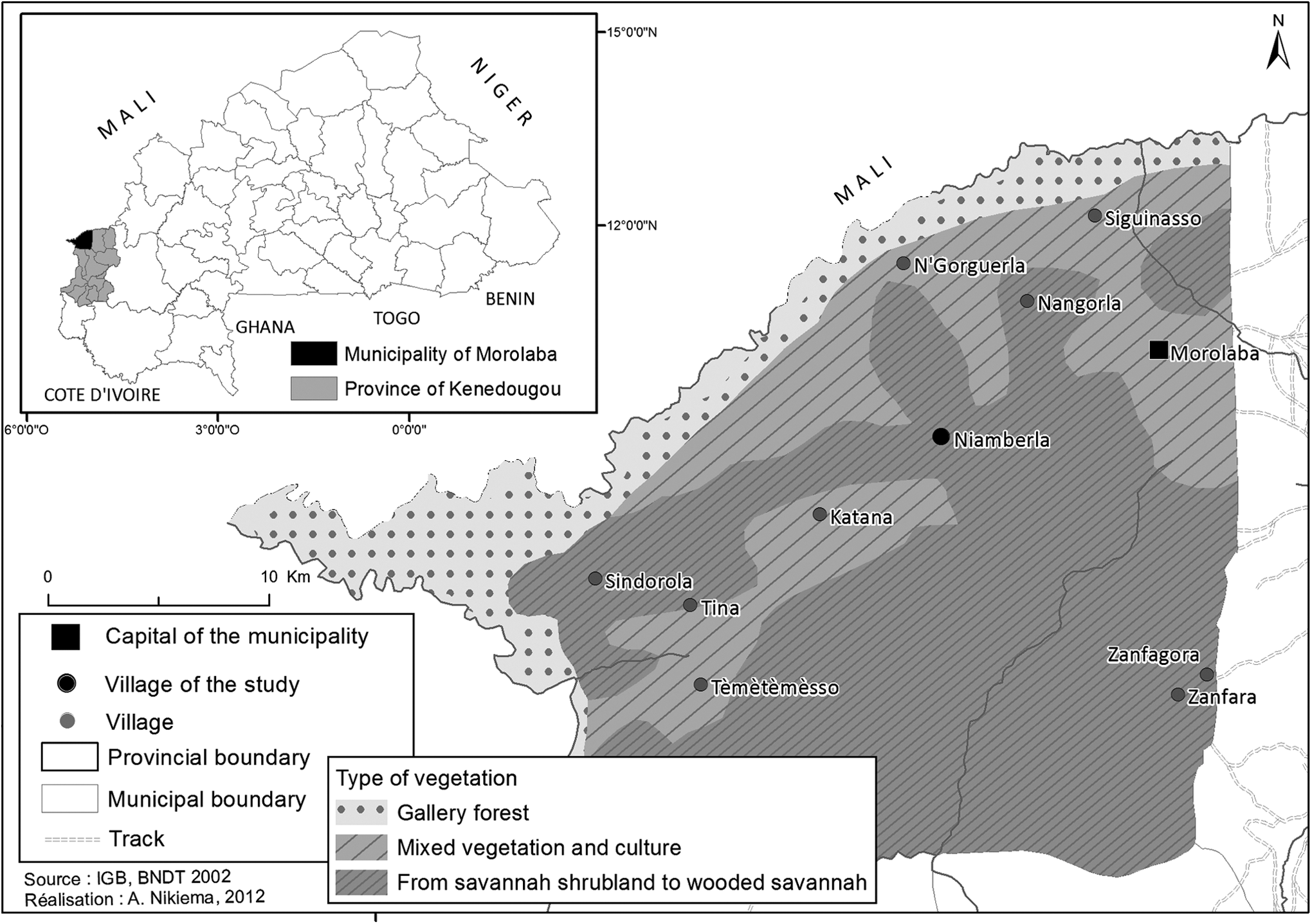
Location of Niamberla village in the municipality of Morolaba, province of Kénédougou. Source: Geographic Institute of Burkina Faso, 2002.
Methods
Two researchers and one biomedical doctor conducted the survey through individual semistructured interviews with 16 traditional healers, who were chosen following a meeting with the village chief and the president of the local chapter of the Association of Traditional Healers, based on their reputations as healers and medicinal plant experts in the community. The Sénufo language was used for the discussion. One member of the research team served as the translator and medical reference. Data were collected using a special survey form and were recorded into a database for statistical analysis. The collected data included the diseases treated, the local plant name and parts used, and the types of extraction and methods of administration. A specimen of each plant was collected in the presence of the traditional healer and was later identified by Prof. Hamdaé Ouedraogo, a renowned botanist from the University of Ouagadougou (Burkina Faso). Consent to have the results published in an international journal was given by the village chief after consultation with the participating healers.
Results and Discussion
Practice of traditional medicine among the Dozo hunters
Interviews were conducted with 16 traditional healers, with ages ranging from 39 to 100 years. Although the importance of gathering information from females in the community has been shown, 11 all of the healers in this study were male. Similar to what is seen with modern biomedicine, each traditional healer in this community is specialized in the treatment of one or more diseases. This knowledge is transmitted in the same family from generation to generation.
This research encountered four main obstacles: • Description of the diseases by healers is often imprecise by biomedical standards. That observation is in concordance with the results provided by another study on traditional medicine and kidney diseases in Burkina Faso.
12
• Emerging diseases such as high blood pressure, cancer, and diabetes are not understood, as well as diseases that have been more prevalent in the past. • The concept of dose is relative. For example, some dosages are measured by the little finger or by the palm of the hand. In these conditions, the amount of the medicine depends on the person who makes the measurements. That kind of dosage has also been described by Megersa et al. in an ethnobotanical study of medicinal plants in Ethiopia.
2
• Biomedical evidence of the traditional remedies is not well-established due to the lack of collaboration between biomedical doctors and traditional healers.
Some African countries have established centers for traditional medicine to train both actors of modern and folk medicine, 6,13 and this dynamic may also help to improve the practice of traditional medicine in Burkina Faso.
Plants and remedies recorded
There were 83 medicinal plants recorded during the study, representing 58 common names. Of these, 56 were identified to species level (Table 1). The most common plant types were trees (44%), shrubs (34%), and herbs (16%). Because of the sterile condition of the plants when herbarium specimens were collected, the 27 plants that were not identified have been excluded from the present publication.
The table summarizes the main results of the survey by presenting the plants, treated diseases, plant parts used, preparation, and mode of administration. The plants are listed in alphabetical order first by the plant family and Latin binomial, and then by the common name.
Most recipes contain a single plant, which is a characteristic of traditional medicine among Dozo hunters, which differs from most African communities, in which recipes of traditional medicine consist of a mixture of two or more plants. 14,15 The most commonly used plant parts are the leaves (37%), roots (33%), and stem bark (14%). These data are consistent with the extensive use of trees (41.8%) in the preparation of recipes. Unlike other communities, which preferentially use the roots and stem bark of plants, 6 our results showed that the Dozo healers mostly use plant leaves, aiding in the conservation of species and environmental protection. Preparation methods varied, including decoction, maceration, infusion, calcination, carbonization, powder, and ointments for external application. Nevertheless, the most commonly used were found to be decoction (55%), maceration (25%), and powder (11%). The different modes of administration follow the same dynamics with predominantly oral (46%), followed by body bath (34%), and enema and poultices (7% each).
According to entries in Napralert®, PubMed, and the Web of Science, the most widely researched plants listed in this research included Arachis hypogaea L., Ipomoea batatas (L.) Lam., Manihot esculenta Crantz, Moringa oleifera Lam./Moringa ovalifolia Dinter & Berger, Sorghum bicolor (L.), and Tamarindus indica L.Moench. Each of these plants has more than 1000 research entries. In this study, a plant was only recorded the first time it was mentioned by a healer, so an area for future research could look at the frequency of citation for each plant to see which are used more than others.
Diseases encountered
During our investigation, there were 89 preparations recorded for the treatment of 37 diseases and related health problems (Table 1). The main diseases were malaria (13%) followed by psychological and spiritual issues (12%), gastric disorders (11%), sexually transmitted diseases (10%), and various types of wounds (8%), various forms of headaches (6%), and chest pain (4%). The frequency of pathologies gives an idea about the health situation of Niamberla village. This community does not differ from others in Burkina Faso, where malaria is one of the leading causes of medical consultations and deaths each year. 16 As the majority of rural populations use traditional medicine, the healers offer more recipes for the most common diseases compared with those not often encountered.
Aside from easily classifiable diseases, other preparations are available to treat difficult-to-define diseases, including those involved with spiritual or psychological problems. The most common of these cited was anxiety/anguish (50%), followed by others that included hallucinatory psychoses, nightmares, bad luck or curses, schizophrenia or “craziness,” and being struck by lightning. These kinds of treatments are generally accompanied with incantation words that cannot be scientifically verified at this time. In this report, we explicitly removed the incantations related to the recipes.
Future research
While comparing the uses of these plants to those that have been previously recorded, it was noted that very little or no previous ethnomedical and/or biochemical research could be found about Ampelocissus leonensis (Hook. f.) Planch, Anaphrenium insigne (Delile) Fiori, Maximilianea tinctoria (A. Rich.) Kuntze, Pusaetha africana (Guill. & Perr.) Kuntze, Vangueria agrestis (Schweinf. ex Hiern) Lantz, and Vicoa leptoclada (Webb) Dandy. These six plants, therefore, signal exciting opportunities for future biochemical discoveries.
There are also biochemical studies that support the healers' claims about some of the plants. Additional information may be sought for these plants, as they hold an especially appealing possibility of new treatments for diseases that affect people throughout the region. For example, Annona senegalensis (Mourimé) was reported as a treatment for general malaise and anxiety. Okoye et al. isolated a diterpenoid with potent anticonvulsant effects from this same plant, which was collected in Nigeria in 2007. 17
Publications about antimalarial properties were found for a number of plants cited for treatment of symptoms of malaria in this study. For example, Benoit-Vical et al. found that when Cochlospermum planchonii was given to patients with uncomplicated malaria caused by Plasmodium falciparum at a hospital in Banfora, Burkina Faso, it appeared to be as safe and effective as chloroquine. 18 Other plants cited as treatments for malaria included Combretum fragrans (Nafôho-ngué) and Waltheria indica (Ganha-tou-yé), both of which have exhibited in vitro antiplasmodial activity. 19,20 A dichloromethane extract of one plant used to treat both malaria and anxiety has shown antiplasmodial and GABAA–benzodiazepine receptor binding activity. 21 Another plant that was cited for treatment of symptoms of sickle cell disease, Moringa oleifera (Toubabou-nèré), showed potential for antisickling properties in a study from Nigeria. 22
These results provide a useful platform for future studies about medicinal plants used by Dozo hunters. As mentioned before, a similar study in the same village and surrounding villages could focus on the frequency of use of the plants noted in this study. It is also of vital importance that identification is provided for plants that were not identified previously. Because these specimens were collected without fruits and flowers, finding the taxonomic identification was not possible at the time, proving to be a key limitation to this study. However, in the future, herbarium specimens may be collected when these plants are fertile. When flowering and/or fruiting specimens are collected, additional expertise may also be sought from taxonomists at other herbaria. When the identity of these plants is ascertained, it will be published in a separate scientific article.
In addition, it would be interesting to ask the healers about perceived efficacy, side effects, and toxicity associated with these plants. Any similar studies in the future will begin with a memorandum of agreement between the researchers and the healers to clearly demonstrate that the research is a collaboration between the two groups and that both groups agree on the research methods and how to convey the results in the most beneficial manner.
Conclusions
This research helps to document the indigenous knowledge of Dozo hunters on medicinal plants and traditional medicine. It opens a perspective for a botanical survey of Niamberla village to identify unknown plants that are useful for the treatment of many diseases. In addition, these results provide a base for future biological and ethnomedical investigations.
Footnotes
Acknowledgments
We acknowledge the entire community of Niamberla village for its kind cooperation and its availability throughout the investigation. We are especially grateful to the village chief and the president of the association of traditional healers for having facilitated the entry into the village and the mobilization of the entire community. We also acknowledge Aude Nikièma of the National Institute of Social Sciences (INSS-CNRST), who kindly provided us with the map of Niamberla. This study was self-funded by the authors.
Author Disclosure Statement
The authors declare that there are no conflicts of interest related to the publication of this article. No competing financial interests exist.