




Abstract
Objectives:
To clarify the effect of olfactory stimulation with perilla essential oil on human prefrontal cortex activity using near-infrared time-resolved spectroscopy.
Design:
Single-center prospective study.
Methods:
Nineteen female university students (mean age, 21.6±1.5 years) participated in the study. Perilla essential oil was used as an olfactory stimulant and air as a control. Oxyhemoglobin concentrations in the prefrontal cortex were measured by using near-infrared time-resolved spectroscopy when the participants were presented with the stimulant or control. Emotional effects were subjectively evaluated by using a modified semantic differential method.
Results:
Olfactory stimulation with the perilla essential oil significantly reduced the oxyhemoglobin concentration in the prefrontal cortex. No significant differences in the feelings of comfort or relaxation, which strongly reflect human mental status, were observed between the perilla essential oil and control periods.
Conclusions:
Olfactory stimulation with perilla essential oil reduced prefrontal cortex activity, thereby inducing physiologic relaxation.
Introduction
P
Traditional medicine is of increasing interest as an alternative medicine worldwide, and the World Health Organization has announced that it will add a chapter on traditional medicines, including the Japanese Kampo, to the 11th edition of the International Classification of Diseases in 2015. Accordingly, several scientific investigations on the effects of Kampo have been initiated. Nonetheless, the importance of perilla remains to be clarified. Perillaldehyde, the primary component of perilla, is reported to have an antidepressant-like effect via the olfactory nervous system in vivo in a murine model. 7 However, to date, the physiologic effects of olfactory stimulation with perilla in humans have not yet been identified. 8 Given the tendency toward an increase in the number of individuals with stress-related diseases worldwide, 9,10 determining the physiologic effects of perilla and its ability to induce relaxation is important.
The authors have previously determined the physiologic effects of nature on human physiology and quality of life 11 –16 and found that near-infrared time-resolved spectroscopy is a useful technique for performing such studies. 17 –19 Measurement of the prefrontal cortex activity is possible at 1 Hz because the change in oxyhemoglobin (oxy-Hb) concentration can be measured by using this method.
Accordingly, the aim of the present study was to determine the effects of olfactory stimulation with perilla on the human prefrontal cortex activity.
Materials and Methods
Participants
In this experiment, 19 female university students (mean age, 21.6±1.5 years) participated. All were informed about the aim and procedures involved in the experiment, and they provided their written informed consent to participate. This study was performed in accordance with the regulations of the Ethics Committee of the Center for Environment, Health, and Field Sciences, Chiba University, Japan.
Study protocol
Physiologic measurements were performed in a chamber with an artificial climate maintained at 25°C with 50% relative humidity and 230 lux illumination. Perilla essential oil (Tree of Life Co., Ltd.) extracted from the leaves and subjected to steam distillation was used as an olfactory stimulant and air as a control. Perilla essential oil (0.5 μL) was injected in a 24-L odor bag; odors were presented to each participant by means of a device fixed on the chest and situated approximately 10 cm under the nose (Fig. 1). The flow rate of the essential oil was set at 3.0 L/min. Preliminary investigations determined the subjective intensity to odor, for example, as weak or easily sensed. The odor was administered for 90 seconds while the participants sat with their eyes closed. The order of presentation of the odor and control was counterbalanced for each participant.

Olfactory stimulation and the device used to administer the odors.
Near-infrared time-resolved spectroscopy
During odor administration, oxy-Hb concentrations in the prefrontal cortex were measured using the near-infrared time-resolved spectroscopy via the TRS-20 system (Hamamatsu Photonics K.K.). 17 –19 The oxy-Hb concentrations in the left and right prefrontal cortex were measured at 1 Hz for 10 seconds before (premeasurement condition) odor administration as well as during the 90 seconds of odor administration (postmeasurement condition). The oxy-Hb concentration shown is the difference between the pre- and postmeasurement conditions. Data were transformed by linear interpolation because the 1-Hz sampling rate was only an approximate. The difference in oxy-Hb concentrations between the pre- and postmeasurement conditions was used for analysis.
Semantic differential method
In addition to the neurophysiologic measurements, the participants subjectively evaluated the emotional effect of the odors using a modified semantic differential method. 20 This method used three pairs of adjectives assessed on 13 scales, including “comfortable–uncomfortable,” “relaxed–awakening,” and “natural–artificial.” The semantic differential rating test was performed after odor administration.
Statistical analysis
The oxy-Hb concentration in the postmeasurement condition was compared with that in the premeasurement (average, 10 seconds) condition to determine any variation, and assessments were made every 30 seconds. All experiments were set at a 1-second interval from 0 to 1 second.
SPSS software, version 21.0 (IBM Corp., Armonk, NY, USA), was used for all statistical analyses. Neurophysiologic responses to the perilla essential oil and control were compared with a two-way analysis of variance (ANOVA) for repeated measures, followed by analysis of simple main effects. Wilcoxon signed-rank test was applied to analyze differences in psychological indices between the perilla essential oil and control periods.
Results
Physiological effects
Oxy-Hb concentrations were measured in the prefrontal cortex of women during olfactory stimulation with the perilla essential oil (Fig. 2). Two-way ANOVA with oxy-Hb concentrations as the dependent variable was used, and olfactory stimulation and elapsed time were the independent variables. The two-way ANOVA revealed no significant effect of the olfactory stimulus (perilla essential oil versus control) or the administration time on oxy-Hb concentrations, but a significant olfactory stimulus×time interaction effect in the left prefrontal cortex (F [2,28]=4.842; p<0.05) was seen. Similarly, there was no significant effect of the olfactory stimulus or time, but a significant stimulus×time interaction effect in the right prefrontal cortex (F [2,28]=9.993; p<0.01) occurred. Because the stimulus×time interaction effect significantly differed in both the left and right prefrontal cortex, the simple main effects were assessed using a post hoc test for every 30 seconds of elapsed time.
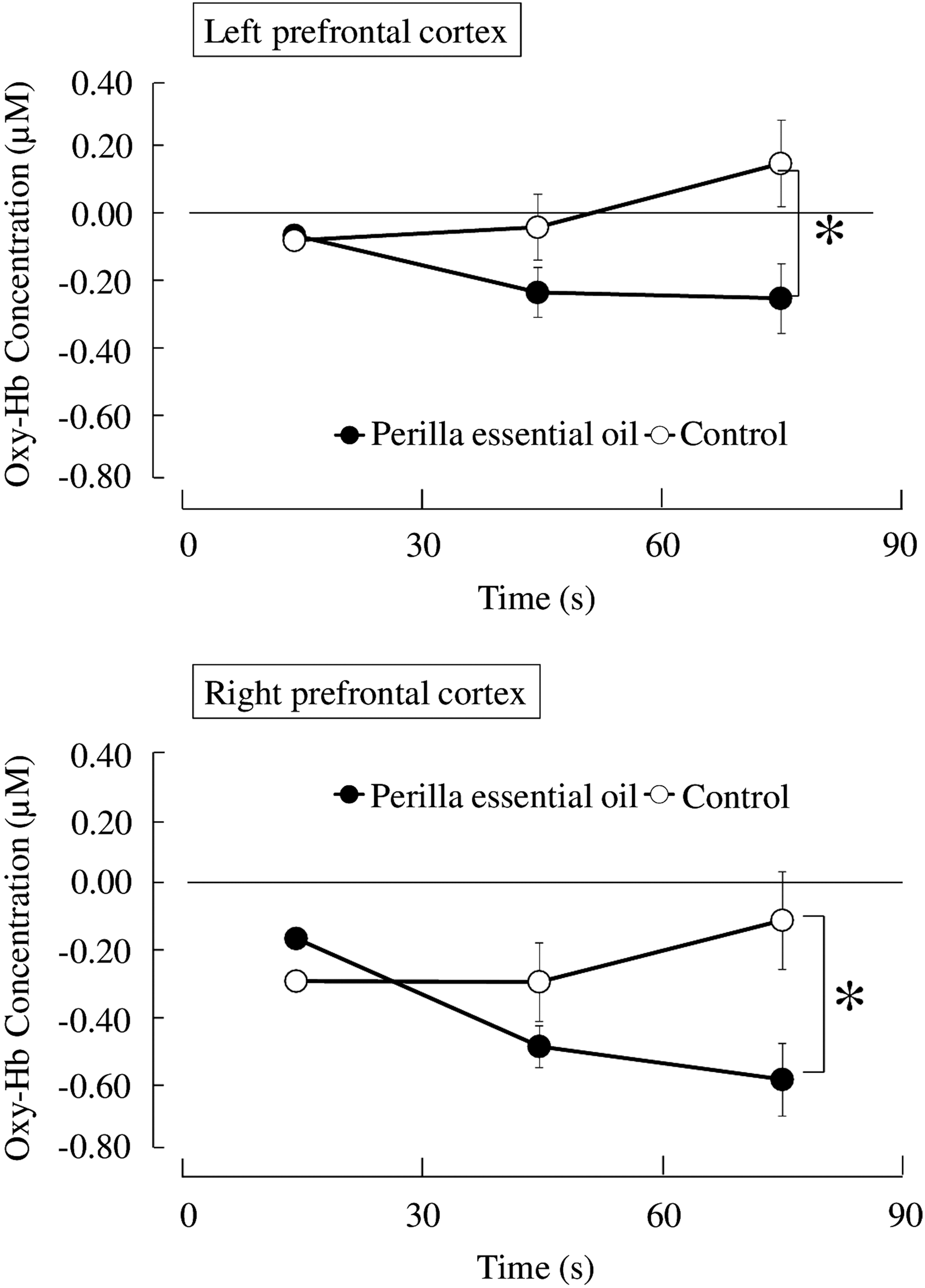
Time-dependent oxyhemoglobin (oxy-Hb) concentration changes in the prefrontal cortex during olfactory stimulation with the perilla essential oil or control (air). The oxy-Hb concentration shown is the difference between the pre- and postmeasurement conditions. Data are expressed as mean±standard error (n=15). *p<0.05 by two-way analysis of variance for repeated measures, simple main effects.
No significant simple main effect regarding the oxy-Hb concentration in the left prefrontal cortex was observed between 1 seconds and 30 seconds and between 31 seconds and 60 seconds. However, between 61 seconds and 90 seconds, the oxy-Hb concentration was −0.25 μM during the administration of the perilla essential oil and 0.14 μM during the administration of the control; analysis of the 0.39-μM difference indicated that the oxy-Hb concentration was significantly lower after exposure to the perilla essential oil compared with the control (F [1,14]=5.345; p<0.05) (Fig. 2). Similarly, there was no significant simple main effect regarding the oxy-Hb concentration in the right prefrontal cortex between 1 seconds and 30 seconds and between 31 seconds and 60 seconds. However, between 61 seconds and 90 seconds, the oxy-Hb concentration was −0.57 μM after exposure to the perilla essential oil and −0.11 μM after exposure to the control (0.46 μM was significantly different; (F [1,14]=5.193; p<0.05) (Fig. 2). These findings clearly indicate that olfactory stimulation with the perilla essential oil reduced activity in the prefrontal cortex.
Psychological effects
Subjective reports of feeling “comfortable,” “relaxed,” and “natural” were determined by using the modified semantic differential method (Fig. 3). There was no difference in the reports of feelings of comfort or relaxation between the perilla essential oil and control periods, all of which were reported to lie between “indifferent” and “slightly comfortable” or “slightly relaxed” on the measurement scale. However, reports of feeling “natural” ranged from “indifferent” to “slightly natural” with the perilla essential oil but from “indifferent” to “slightly artificial” with the control. The perilla essential oil was therefore perceived as being significantly more natural than the control.
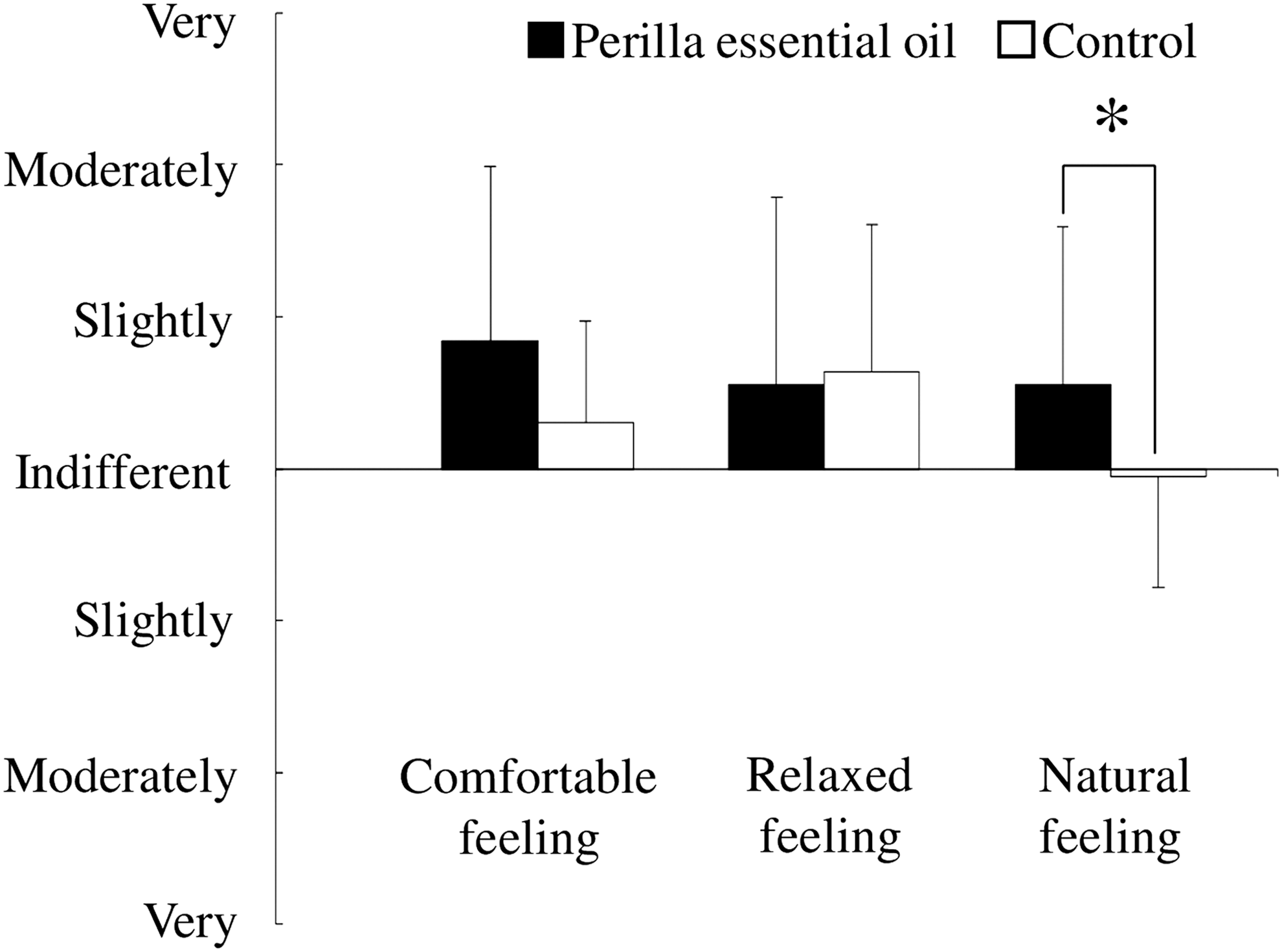
Subjective feelings measured by a modified semantic differential questionnaire after olfactory stimulation with perilla essential oil or the control. Data are expressed as mean±standard deviation (n=19). *p<0.05 by Wilcoxon signed-rank test.
Discussion
Most reports concerning perilla have been associated with both in vivo and in vitro studies. Perillaldehyde, which is the bioactive component of perilla, has an antidepressant-like effect via the olfactory nervous system in an in vivo mouse model. 7 Perillaldehyde is assumed to be an important component associated with the a priori stress relief experienced upon exposure to odors because it is a specific odorous substance that constitutes approximately 50% of the composition of the perilla essential oil. Thus, it has been suggested that perilla odor is bioactive in vivo. Studies targeting humans are required for its daily use.
This study sought to determine the effect of olfactory stimulation with perilla essential oil on the human prefrontal cortex activity. Olfactory stimulation with perilla essential oil reduced the oxy-Hb concentrations and decreased the right and left prefrontal cortex activity (oxy-Hb concentration was used as an index of activity). This suggests that perilla can make an important contribution toward improving the effects of stress in an increasingly artificial society and that it can be incorporated into everyday use.
With regard to the subjective evaluations, feelings of comfort and relaxation strongly reflect the human mental state. In this study, the participants reported feeling “indifferent” or “slightly comfortable” or “slightly relaxed” when exposed to both the perilla essential oil and control, whereas the physiologic indices showed a clear decrease in both the left and right prefrontal cortex activity. Thus, the physiologic evaluation was superior to the subjective evaluation.
The authors have previously studied the effects of nature on the human physiology and have confirmed that activity in the prefrontal cortex is decreased in forest therapy studies. 21,22 In addition, sympathetic nervous activity decreased, parasympathetic nervous activity increased, and blood pressure and heart rate decreased because of exposure to nature. 12,13 Furthermore, decreased concentrations of cortisol, a typical stress hormone, and improved immune functioning were found in individuals with a weakened immune system as a result of forest therapy. 23 –25 Thus, it is clear that natural forested environments have physiologic effects on humans, including induction of physiologic feelings of relaxation. The current study evaluated only prefrontal cortex activity; therefore, this cannot be considered a complete physiologic evaluation. Other experimental indices, such as brain activity, autonomic nervous activity, endocrine activity, and immune activity should now be assessed to determine the effects of olfactory stimulation with perilla on human physiology and feelings of relaxation.
Conclusion
Compared with the control, olfactory stimulation with perilla essential oil significantly reduced oxy-Hb concentrations and prefrontal cortex activity, but no significant differences in the feelings of comfort or relaxation were reported in the subjective evaluations. In conclusion, it is clear that olfactory stimulation with the perilla essential oil reduced the prefrontal cortex activity, thereby inducing physiologic relaxation.
Footnotes
Acknowledgment
This study was supported by a grant from the Policy Research Institute, Ministry of Agriculture, Forestry and Fisheries, Extramural Research Program for Agricultural, Forestry and Fishery Policy Research.
We are grateful to Ms. Misako Komatsu and Ms. Mariko Aga for their valuable contributions during the data collection phase of this study.
Author Disclosure Statement
No competing financial interests exist.