




Abstract
Background:
Although some research suggests that the formation of pressure ulcers is rare in patients with amyotrophic lateral sclerosis (ALS), several patients have nonetheless developed this problem. To date, however, no case reports in the literature have described patients with ALS who develop ischial pressure ulcers. Outside of the ALS literature, evidence suggests that ischial pressure ulcers frequently develop in wheelchair users and also in patients treated in various health care settings.
Case description:
A patient diagnosed with ALS reported the development of ischial pressure ulcers after consistent immobility for 1 year (32 months after her ALS diagnosis). This patient, who was sitting on the wounds, was treated with ointment and morphine; the latter was ineffective in controlling the pain. Moving the patient from sitting to supine, lateral, or semilateral positions, either on the bed or wheelchair, to separate the ulcers from the surface of the chair or bed was deemed impossible because of exaggeration of other symptoms, including shortness of breath and pain in other parts of the body. A new method of postural alignment was developed to alleviate the pain associated with the pressure ulcer. This method, Iyengar yoga therapy, which uses props to reposition a patient, alleviated pain and healing of two pressure ulcers of the patient after 3 weeks of starting this intervention.
Conclusion:
Although the ischial pressure ulcers were successfully treated in a patient with ALS, further study is necessary to investigate the effectiveness of this postural alignment intervention in ALS and other patient populations for the management of ischial pressure ulcers.
Introduction
A
Iyengar yoga is a specialized type of yoga developed by Sri B.K.S. Iyengar, a renowned exponent of yoga teachings. Iyengar has published numerous books describing the principles underlying his teachings, which include a therapeutic approach in treating ailments as well as the innovative use of yoga props (e.g., belts, blankets, bolsters, chairs). Iyengar also focused on the use of breathing exercises and relaxation for yoga therapy interventions for several ailments, including various neurologic and musculoskeletal conditions. 8 The following case supports the effectiveness of props used in Iyengar yoga for the management of pressure ulcers.
Case Study
In May 2007, a 62-year-old woman was diagnosed with ALS in a research medical center, 11 months after she first noticed muscle weakness in her left hand. The patient started attending yoga therapy 2 weeks after her diagnosis and continued the therapy until the last few days of her life.
Thirty-two months after the patient's diagnosis of ALS and during hospice care, she reported experiencing unbearable pain because of pressure ulcers in the buttocks region. At this time, she was regularly sitting on the wounds because of an inability to reposition herself and the aggravation of numerous symptoms. When the patient reported these ulcers, she had completely lost her speech, was using noninvasive ventilation 24 hours a day, and was completely dependent on the feeding tube (percutaneous endoscopic gastrostomy) for nutrition, hydration, and medications. In addition, the patient had been confined to an electrical wheelchair for almost a year, and she would spend the entire day sitting on the wheelchair from the time she got up in the morning until she went to bed in the evening. The patient started sleeping in a sitting position in the hospital bed, in her home, because of shortness of breath while in supine position. Her shortness of breath occurred despite use of noninvasive ventilation and support of an oronasal mask (covering the nose and mouth).
Other symptoms that affected the patient's immobility and inability to reposition herself were severe head drop, paralysis of her legs and left arm, muscle atrophy in the face, and pain in the shoulder joints and neck. When the patient reported pain due to pressure ulcers, moving the patient's trunk to a lateral, semilateral, and/or supine position and sustaining her in these positions were impossible for more than a few minutes (either on the bed or in the wheelchair).
Evaluation of Pressure Ulcers
The patient's pressure ulcers were evaluated on the basis of her self-reported pain, caused by continual sitting on her wounds, and distress (she consistently cried). Because of the patient's inability to write more than a few words (from fatigue and inability to hold the pen), information was obtained from the patient's caretaker, who was present throughout the assessment and yoga therapy visits. According to the caretaker, the patient had developed ulcers the size of a dollar coin under both sitting bones. The caretaker further indicated that although the patient initially declined medication for pain, she later agreed to receive morphine. The case manager of the hospice team graded the wound, which was being treated as a stage II or III pressure ulcer. 9 She also reported that a hospice team, who visited the patient three times a week, had provided a pressure-redistributing mattress and administered morphine to control the pain during the treatment of the ulcers. In addition, the patient's daughter and other caretakers applied the ointment as part of ulcer management. None of the interventions were effective for managing the pain or progression of the ulcers. This support was provided before the start of yoga therapy realignment.
Method of Intervention and Results
According to previous guidelines for the prevention and treatment of pressure ulcers (European Pressure Ulcer Advisory Panel /National Pressure Ulcer Advisory Panel), cushions and other support surfaces have not been shown to prevent or heal pressure ulcers; rather, continuing pressure through sitting or resting may delay healing and cause further deterioration. 10 Particular to wheelchair users, the current guidelines recommend limiting the amount of time sitting on the ischial pressure ulcers to three times a day for no more than an hour sitting. The current guidelines, however, do not specify how the patient is to be positioned for the remaining 21 hours rather they just recommend bed rest. 11 Because limited sitting would have further aggravated the patient's ulcers, a new way to reposition her was needed.
Yoga therapy offers a useful intervention—carefully positioned props, which create space between the surface and the ulcers of the patient with ALS. The Iyengar yoga therapy method during the beginning phases of treatment required repositioning the patient with placement of slightly firm pillows next to the wounds, which elevated the pelvis/wound for hours at a time. A bolster just above the back of the knees and below the sitting bones helped maintain the elevation of the pelvis/ulcers; otherwise the patient would have slid off the pillows. This technique is unique in that no literature has captured the effect of elevation (of the effected body part with ulcers) with this repositioning. Rather, the recommendation was only to sit on the wounds for a shorter period, coupled with a variety of cushions. Thus, the cushions or any seating surface did not make a difference in the outcome; it was the positioning of the patient's body on the wheelchair with the support of pillows and the bolster that made the difference in the treatment.
Most experts, who identify pressure ulcers in patients with ALS, fail to identify the treatment intervention they used. Malik and Stillman anecdotally identified taking and keeping pressure off an ulcer as one of the recommended interventions, once ulcers have developed. 2 Although these experts emphasized the need to keep pressure off the ulcers to maximize blood and the circulation of air (along with cleaning and dressing wounds), they did not identify the actual method to achieve this pressure relief, nor a way to do so in the case of ischial ulcers. Further, depending on the severity of symptoms for patients with ALS, this intervention can be difficult, particularly in the advanced stages of the illness. Accordingly, other strategies are needed.
In response to the patient's limitations to reposition herself and the associated pain from continuously sitting on her ulcers, a new yoga therapy intervention was created. Without compromising the patient's sitting position and the angle of the back seat of the wheelchair, two pillows were placed next to the wounded area. This positioning completely separated the ulcers from the surface of the cushions because the supported pillows elevated the pelvis.
The means that facilitated the repositioning of the pillows was achieved by lowering the back seat of the wheelchair and, once the pillows were in place, promptly returned the patient to her previous position. While the pillows were being placed, the patient was encouraged to focus on breathing in order to prevent shortness of breath. Subsequently, one thick bolster was placed under her bent knees and was pulled closer toward the pelvis next to the wounded area to support the lifted pelvis from sliding and to assist in maintaining stability while sitting (Figs. 1 and 2). When the patient's body was aligned in the wheelchair, with the support of various props, she reported decreased pain and greater comfort in sitting. This postural alignment with props was shown to the caretaker, who was encouraged to place the patient in the same position until the wounds healed. Because the patient reported feeling very comfortable in the position, numerous caretakers followed similar positioning of her.
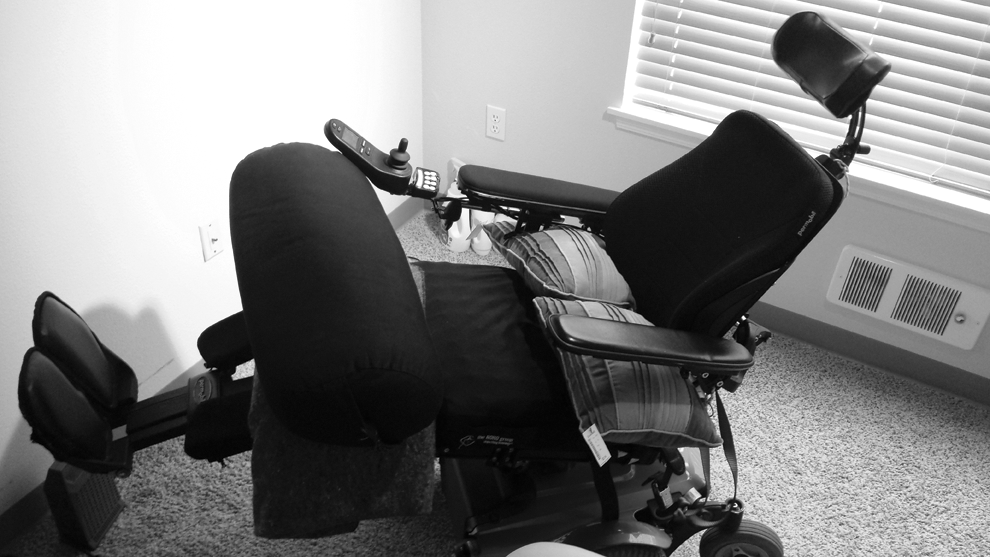
Electric wheelchair with bolster and cushions.
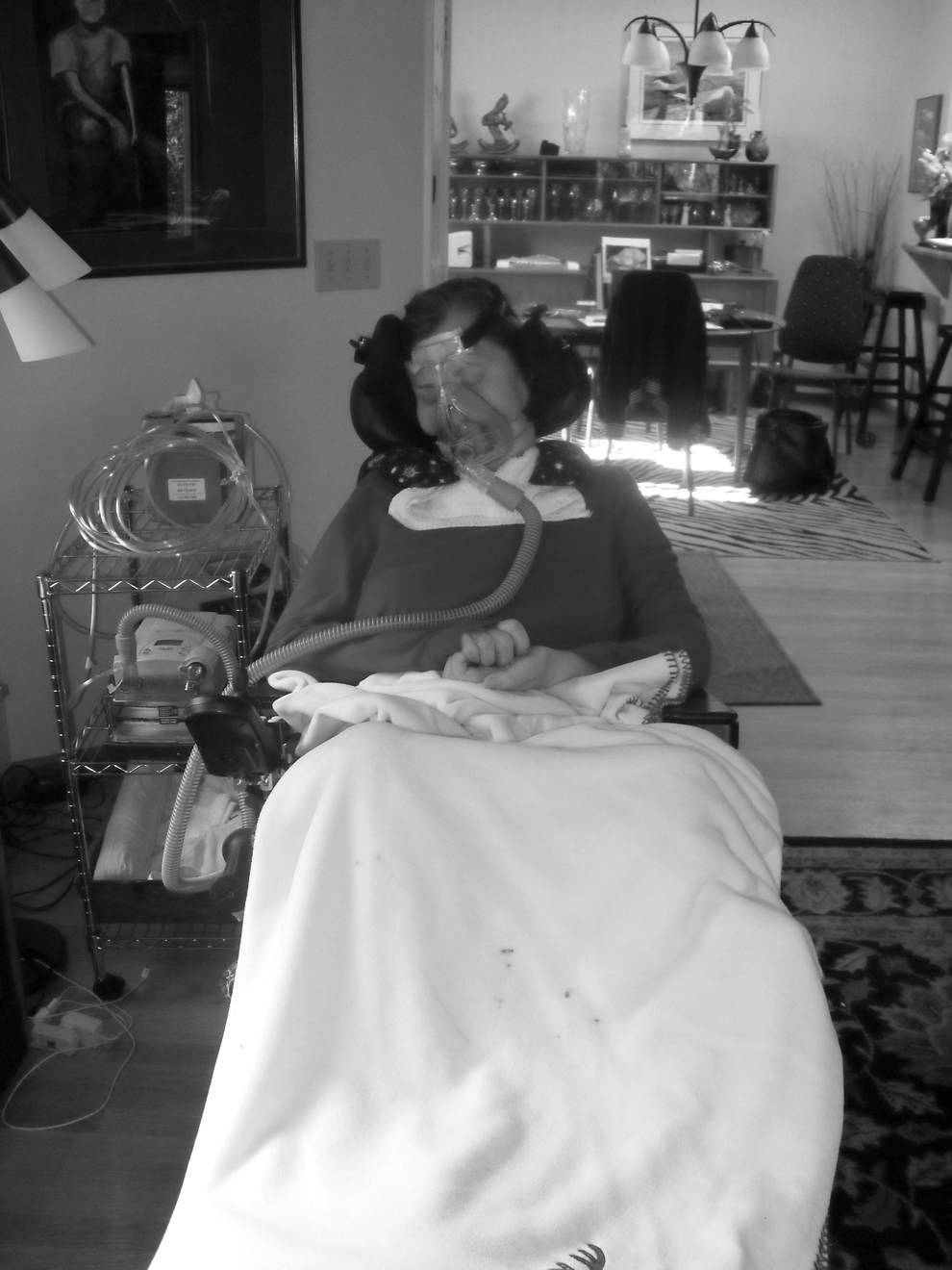
Patient in wheelchair with bolster and cushions.
One caretaker who worked 5 days a week, during the day shift, regularly followed the technique, and the patient's positioning was noted before starting each therapy session. The night caretaker, who worked 5 days a week, continued to place a bolster just above the back of the knees, leaving the patient to sleep in a sitting position throughout the night. Three weeks after starting the yoga therapy intervention, the patient reported complete alleviation of pain and cure of the ulcers. After the ulcers were treated, both pillows, which were still under patient's buttocks, were removed and she was positioned again on the wheelchair. The patient reported finding relief with the swelling of her feet and the stiffness of her knee joints by keeping her legs in an elevated position. Thus, the bolster underneath the knees was not removed from the legs, and the caretaker was encouraged to continue using it intermittently throughout the day. The patient did not report any further pain related to ischial pressure ulcers, and she continued to attend yoga therapy while sitting in her wheelchair/bed till the last week of her life.
Discussion
Because there are no identified case studies with ischial ulcers in patients with ALS, this case study is an important addition to the literature. The development and recurrence of ischial pressure ulcers are frequent in wheelchair users, particularly those with spinal cord injury. 12 –15 Ischial pressure ulcer development is also a common problem in numerous patients treated in various home and health care settings (e.g., long term, intensive, acute, and hospice care). 16 –21 Not only are pressure ulcers debilitating for patients who experience them, but they are also an extremely costly illness to patients, their families, and insurance providers as a whole. Reddy, Gill, and Rochen estimated that each year approximately 60,000 patients will die of hospital-acquired pressure ulcers and that the cost of treating these wounds is approximately $11 billion per year. 22,23 Schessel, Ger, and Oddsen reported a treatment cost of $43,814 in a single case study with a quadriplegic man diagnosed with stage IV ischial pressure ulcer. Insurance payment for the hospitalization was $242,350 (related to pressure ulcer treatment). 24 Given these costs, prevention and/or finding alternative treatment options seem to be an imperative, as is identifying this problem in patients with ALS.
Zeller and others reported that pressure ulcers can occur quickly (within 2–6 hours) in individuals who are limited in mobility when in a wheelchair or bed-bound. 9 Patients with ALS in the latter stages of the illness are often confined to wheelchairs and beds. 6,7, 25 –27 Furthermore, patients can experience pain in various parts of body, including shoulders and neck. 6,7,28 –31 Moreover, respiratory failure due to diaphragmatic paralysis can occur at any time for patients with ALS, all of whom are eventually unable to manage staying in a supine position on the bed. 32
As a result of prolonged sitting in a wheelchair or moving to an erect position from supine to compensate for the worsening of respiratory symptoms, patients are highly susceptible to develop ischial ulcers. Because the patient this author was working with experienced pain in her shoulder and neck regions and shortness of breath in various positions, turning her trunk became impossible; as a result she remained in a sitting position while awake and asleep. Furthermore, she lost the ability to communicate verbally and had difficulty in writing. According to the caretaker, she was the first to notice ulcers in patient's buttocks during dress changing, which she then reported to the hospice team. Thus, experts treating patients with ALS should not only regularly check the buttocks area in patients who spend extended periods in a sitting position, but they should also evaluate all symptoms of patients before repositioning a patient.
In this study, the author used a yoga therapy intervention that consisted of repositioning the patient with the support of props. This repositioning was created for the patient to take pressure off the ulcers, to mitigate further worsening, and for pain management. This new posture with the support of props not only was effective in alleviating pain but also assisted in healing.
Conclusion
A yoga therapy intervention that consisted of a postural alignment, developed for the management of ischial ulcers, is an effective intervention with a patient with ALS. Given the intervention's effectiveness with extremely severe and chronic symptoms, including shortness of breath and pain, which restricts the patient from repositioning, it is likely that other patient populations with differing illnesses could also benefit. The method used in this case report was very simple and cost-effective and required minimal, if any, turning of the patient, which is laborious, time-consuming and sometimes impossible for caretakers. This case study highlights the effectiveness with one patient with ALS, but further studies are necessary to investigate the effectiveness of the postural alignment for other patient populations.
Footnotes
Acknowledgments
The author gratefully acknowledges the patient, the patient's family, and caretakers, who were very supportive of the yoga therapy. The author thanks Dr. Michele Ribeiro and Erik Ackerson for their assistance in editing and working with the author to complete the article. The author would also like to acknowledge his guru, B. K. S. Iyengar, for his invention of various props and the methods for using them.
Author Disclosure Statement
No competing financial interests exist.